


Packaging Machinery Market Overview
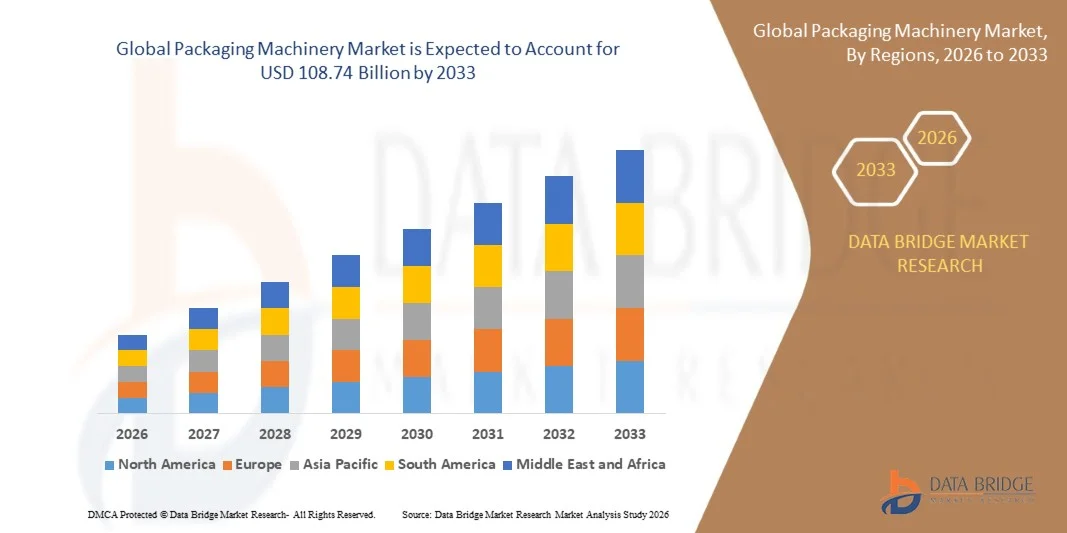
As per Data Bridge Market Research analysis, the packaging machinery market was valued at USD 61.89 billion in 2025 and is projected to reach USD 108.74 billion by 2033, growing at a CAGR of 7.30% from 2026 to 2033. The market is experiencing consistent growth driven by rising demand for packaged goods, advancements in automation technologies, increasing consumer preferences for convenience, and expanding applications across food, beverages, pharmaceuticals, chemicals, and personal care industries.
The increasing adoption of automated and flexible packaging solutions, combined with the rapid expansion of e-commerce and evolving product safety standards, is encouraging manufacturers to invest in advanced packaging machinery. Filling, labeling, form-fill-seal, cartoning, wrapping, and palletizing systems are increasingly being deployed to enhance production efficiency, reduce labor costs, minimize packaging waste, and support sustainable packaging initiatives across industries.
Market Size & Forecast
- Global Market Value (2025): USD 61.89 Billion
- Expected Market Value (2033): USD 108.74 Billion
- Forecast CAGR (2026–2033): 7.30%
- Leading Region in 2025: Asia Pacific
- Fastest Growing Region: North America
Key Market Trends & Insights
- Asia-Pacific dominated the packaging machinery market with the largest revenue share of 38.5% in 2025, supported by rapid industrialization, expanding food and beverage manufacturing, increasing pharmaceutical production, and growing adoption of automated packaging solutions across emerging economies
- The filling machines segment led the market with a 32.5% share in 2025, driven by widespread adoption across food and beverage, pharmaceutical, and personal care industries requiring accurate, high-speed, and hygienic product filling operations
- North America is expected to be the fastest-growing region during the forecast period, registering a CAGR of 6.0% from 2026 to 2033, fueled by rising automation adoption, increasing investments in advanced manufacturing technologies, growing demand for sustainable packaging solutions, and expansion of pharmaceutical, food, and e-commerce industries across the United States and Canada
- Palletizing machines are the fastest-growing machine type, projected to register a CAGR of 7.0%, reflecting the surge in adoption of automated material handling solutions, rising labor costs, and growing demand for efficient end-of-line packaging operations.
- The general packaging conventional segment dominated the technology platform category with a 58.7% revenue share in 2025, led by its extensive adoption across industries due to established infrastructure, cost-effectiveness, and operational simplicity
- Food and beverage accounted for 44.2% of the market, preferred by increasing global consumption of packaged foods, beverages, processed products, and convenience foods.
- The modified atmosphere packaging (MAP) segment is the fastest-growing technology platform category, with a CAGR of 7.1%, driven by increasing demand for extended shelf life, improved food safety, and preservation of product quality
Report Scope and Packaging Machinery Market Segmentation
|
Attributes |
Packaging Machinery Key Market Insights |
|
Segments Covered |
|
|
Countries Covered |
North America
Europe
Asia-Pacific
Middle East and Africa
South America
|
|
Key Market Players |
|
|
Market Opportunities |
|
|
Value Added Data Infosets |
In addition to the insights on market scenarios such as market value, growth rate, segmentation, geographical coverage, and major players, the market reports curated by the Data Bridge Market Research also include import export analysis, production capacity overview, production consumption analysis, price trend analysis, climate change scenario, supply chain analysis, value chain analysis, raw material/consumables overview, vendor selection criteria, PESTLE Analysis, Porter Analysis, and regulatory framework. |
Packaging Machinery Market Trends
Trend: Growth in Smart & Sustainable Packaging Automation
Packaging manufacturers are increasingly adopting smart packaging machinery integrated with robotics, artificial intelligence, Industrial Internet of Things (IIoT), and advanced automation technologies to improve production efficiency, reduce downtime, and enhance operational flexibility. The integration of sensors, real-time monitoring systems, and predictive maintenance solutions enables manufacturers to optimize packaging lines and achieve higher productivity. The growing shift toward sustainable packaging is also accelerating demand for machinery capable of processing recyclable, lightweight, and alternative packaging materials. For instance, in February 2024, Tetra Pak announced several strategic investments to increase recycling capacity for carton packages in the European Union (EU), supporting the transition toward a circular economy by keeping valuable raw materials in circulation and strengthening sustainable food packaging systems.
The increasing adoption of smart automation and sustainable packaging technologies is expected to remain a key trend, enabling manufacturers to improve efficiency while meeting evolving environmental and consumer requirements.
Packaging Machinery Market Dynamics
Key Market Driver: Rising Demand for Automated Packaging Solutions
The rapid expansion of packaged food, beverages, pharmaceuticals, and consumer goods industries has created substantial demand for automated packaging machinery that supports high-speed production, improved product safety, and operational efficiency. Manufacturers are increasingly deploying filling, labeling, form-fill-seal, cartoning, and palletizing systems to reduce labor dependency and enhance manufacturing output. For instance, in April 2024, Krones introduced an AI-based fill-level control system for the Dynafill filling technology, using machine learning models and sensor data to improve filling precision, process efficiency, and resource-friendly beverage production.
The increasing integration of automation, artificial intelligence, and digital technologies in packaging machinery is expected to drive market growth by improving production efficiency, enhancing quality control, reducing operational costs, and enabling more flexible packaging operations across industries.
Key Restraint/Challenge: High Initial Investment Cost of Advanced Packaging Machinery
A significant challenge in the packaging machinery market is the high upfront investment required for advanced automated systems. Modern packaging platforms incorporate robotics, digital controls, vision inspection systems, and intelligent software solutions, requiring substantial expenditure for equipment procurement, installation, maintenance, and workforce training. These cost factors can restrict adoption among small and medium-sized enterprises that face budget limitations. For instance, in September 2024 an article published in the Journal of Management Analytics identified lack of infrastructure, limited financial resources, high implementation complexity, and cybersecurity concerns as major barriers affecting Industry 4.0 adoption among small and medium-sized enterprises (SMEs), highlighting the challenges manufacturers face in investing in automation infrastructure, connectivity solutions, and digital capabilities
High investment requirements, infrastructure limitations, and skill gaps continue to restrict the adoption of advanced automated packaging machinery among smaller manufacturers, creating a key challenge for wider market penetration.
Key Market Opportunity: Expansion of Sustainable Packaging Machinery and Flexible Packaging Solutions
The increasing demand for recyclable, lightweight, and eco-friendly packaging formats is creating significant opportunities for packaging machinery manufacturers. Companies are developing advanced equipment capable of handling new sustainable materials while maintaining production efficiency and reducing packaging waste. The growth of flexible packaging, driven by lower material usage, transportation efficiency, and extended product shelf life, is further increasing demand for adaptable packaging systems. For instance, in October 2024, Amcor released its sustainability report, highlighting progress in sustainable packaging solutions. The company reported that more than 94% of its flexible packaging portfolio had recycle-ready solutions available and approximately 95% of its rigid packaging production by weight was recyclable in practice and at scale, demonstrating the growing industry shift toward circular economy-focused packaging solutions.
The increasing development of recyclable and sustainable packaging solutions is creating significant opportunities for packaging machinery manufacturers to develop advanced equipment capable of processing new eco-friendly materials and supporting circular packaging initiatives.
Packaging Machinery Market Scope
The packaging machinery market is segmented on the basis of machine type, technology platform, and end user.
- By Machine Type
On the basis of machine type, the packaging machinery market is segmented into filling machines, form fill and seal machines, cartoning machines, palletizing machines, labelling machines, wrapping machines, and cleaning and sterilizing machines. The filling machines segment dominated the packaging machinery market with 32.5% revenue share in 2025, driven by widespread adoption across food and beverage, pharmaceutical, and personal care industries requiring accurate, high-speed, and hygienic product filling operations. Filling machines are extensively used for liquid, powder, and solid product packaging due to their ability to improve production efficiency and maintain consistent product quality. Increasing consumption of packaged beverages, dairy products, and pharmaceutical formulations is supporting segment expansion. These systems enable manufacturers to reduce material wastage, enhance filling precision, and improve overall operational productivity. Continuous advancements in automated filling technologies, including servo-driven systems, smart sensors, and digital monitoring solutions, are further improving machine performance. The growing demand for flexible and high-volume production lines continues to strengthen the dominance of filling machines globally.
The palletizing machines segment is projected to register the fastest growth at a CAGR of 7.0% from 2026 to 2033, driven by increasing adoption of automated material handling solutions, rising labor costs, and growing demand for efficient end-of-line packaging operations. Palletizing systems enable faster and more accurate stacking, sorting, and transportation of packaged products across food and beverage, pharmaceuticals, chemicals, and consumer goods industries. The expansion of e-commerce and modern logistics networks is increasing the need for automated warehouse and distribution solutions. Integration of robotics, artificial intelligence, and smart factory technologies is further enhancing palletizing efficiency and reducing operational downtime. Manufacturers are increasingly replacing manual palletizing processes with automated systems to improve workplace safety and productivity.
- By Technology Platform
On the basis of technology platform, the packaging machinery market is segmented into general packaging conventional, modified atmosphere packaging (MAP), and other advanced packaging technologies. The general packaging conventional segment dominated the market with 58.7% revenue share in 2025, owing to its extensive adoption across industries due to established infrastructure, cost-effectiveness, and operational simplicity. Conventional packaging technologies remain widely preferred by small, medium, and large manufacturers for standard packaging applications. These systems support a broad range of packaging formats, including bottles, cartons, pouches, and containers used in food, beverage, pharmaceutical, and chemical industries. Their lower investment requirements compared with advanced technologies make them suitable for cost-sensitive markets. Existing manufacturing facilities continue to rely on conventional packaging equipment due to operational familiarity and availability of maintenance support. However, increasing automation adoption and sustainability requirements are gradually encouraging manufacturers to upgrade toward advanced packaging platforms.
The modified atmosphere packaging (MAP) segment is expected to witness the fastest growth at a CAGR of 7.1% from 2026 to 2033, driven by increasing demand for extended shelf life, improved food safety, and preservation of product quality. MAP technology modifies the atmosphere inside packaging using controlled gas mixtures to slow product deterioration and maintain freshness. The growing consumption of fresh food, ready-to-eat meals, meat, dairy, and bakery products is significantly increasing adoption of MAP-based packaging machinery. Rising consumer preference for minimally processed foods with longer shelf life is further supporting market expansion. Food manufacturers are increasingly investing in MAP equipment to reduce food waste and improve supply chain efficiency. Advancements in automated MAP systems and integration with smart packaging technologies are expected to create further growth opportunities.
- By End User
On the basis of end user, the packaging machinery market is segmented into food and beverage, pharmaceutical, chemicals, cosmetics, and others. The food and beverage segment dominated the packaging machinery market with 44.2% revenue share in 2025, driven by increasing global consumption of packaged foods, beverages, processed products, and convenience foods. The industry requires advanced packaging machinery for filling, sealing, labeling, and wrapping applications to support large-scale production. Rising demand for hygienic packaging solutions, extended shelf life, and attractive product presentation is encouraging manufacturers to adopt automated packaging systems. Beverage producers are increasingly using high-speed filling and bottling equipment to improve efficiency and meet rising consumer demand. The expansion of ready-to-eat meals, frozen foods, and functional beverages is further supporting machinery adoption. Continuous innovation in sustainable and flexible packaging formats is expected to maintain the dominance of the food and beverage segment.
The pharmaceutical segment is projected to register the fastest growth at a CAGR of 7.0% from 2026 to 2033, supported by increasing pharmaceutical production, rising healthcare demand, and stringent regulatory requirements for safe and contamination-free packaging. Pharmaceutical manufacturers are adopting advanced packaging machinery for accurate dosing, blister packaging, serialization, labeling, and sterile packaging applications. Growing demand for vaccines, biologics, and specialty medicines is increasing the need for high-precision packaging solutions. Automation technologies are helping pharmaceutical companies improve traceability, quality control, and compliance with regulatory standards. Rising investments in pharmaceutical manufacturing infrastructure across emerging economies are further accelerating adoption. The increasing focus on patient safety and product integrity is expected to drive strong growth of pharmaceutical packaging machinery.
Packaging Machinery Market Regional Analysis
Asia-Pacific dominated the packaging machinery market with the largest revenue share of 38.5% in 2025, supported by rapid industrialization, expanding food and beverage manufacturing, increasing pharmaceutical production, and growing adoption of automated packaging solutions across emerging economies. The region benefits from growing investments in smart manufacturing, flexible packaging solutions, and modernization of production facilities. Increasing demand for packaged consumer goods, e-commerce expansion, and rising manufacturing activities in China, India, and Southeast Asian countries are accelerating market development. Growing adoption of robotics, digital packaging systems, and sustainable packaging technologies is further strengthening the region’s position in the global market.
U.S. Packaging Machinery Market Insight
The U.S. packaging machinery market is witnessing strong growth due to rising automation adoption, increasing demand for efficient packaging solutions, and expansion of food, beverage, pharmaceutical, and e-commerce industries. The country’s advanced manufacturing ecosystem, along with increasing deployment of robotics, smart packaging systems, and Industry 4.0 technologies, is driving demand across end-use industries. The Association for Packaging and Processing Technologies (PMMI) reported that the U.S. packaging machinery market continues to benefit from automation investments, with manufacturers increasingly adopting robotics and digital solutions to improve production efficiency and address labor challenges. Growing focus on sustainable packaging, operational optimization, and flexible production systems is further accelerating packaging machinery adoption across the United States.
Europe Packaging Machinery Market Insight
The Europe packaging machinery market remains a major contributor to global revenue, driven by strong sustainability initiatives, advanced manufacturing capabilities, and increasing demand for automated packaging solutions. The widespread adoption of smart packaging systems, robotics, and environmentally friendly packaging technologies across food, beverage, and pharmaceutical industries is supporting market expansion. The European Commission’s Circular Economy Action Plan promotes sustainable packaging practices, encouraging manufacturers to invest in recyclable packaging materials and advanced packaging technologies. Increasing regulatory focus on waste reduction, resource efficiency, and circular packaging solutions continues to enhance the adoption of advanced packaging machinery throughout Europe.
U.K. Packaging Machinery Market Insight
The U.K. packaging machinery market is experiencing steady growth, supported by increasing automation investments, rising demand for sustainable packaging, and expansion of food and pharmaceutical manufacturing. Growing adoption of automated filling, labeling, and palletizing systems is enabling manufacturers to improve productivity and reduce operational costs. According to WRAP’s UK Plastics Pact progress report, businesses across the U.K. have increased efforts to eliminate problematic plastics, improve packaging recyclability, and increase recycled content in packaging. The initiative reported that UK Plastics Pact members achieved a reduction in unnecessary plastic packaging and increased the use of recycled content, encouraging investment in sustainable packaging solutions and recycling infrastructure
Germany Packaging Machinery Market Insight
The Germany packaging machinery market is expanding steadily due to the country’s strong industrial manufacturing base, advanced automation capabilities, and increasing adoption of smart factory technologies. Packaging equipment manufacturers and end-user industries are increasingly utilizing robotics, digital monitoring systems, and energy-efficient machinery to improve production performance. Germany’s Industry 4.0 initiative has accelerated adoption of connected manufacturing technologies, enabling manufacturers to integrate automation, data analytics, and intelligent production systems into industrial operations. Continuous innovation in sustainable packaging machinery and high-performance automation solutions is further driving market growth in Germany.
North America Packaging Machinery Market Insight
The North America packaging machinery market is witnessing strong growth due to increasing automation adoption, rising demand for sustainable packaging solutions, and expansion of food, beverage, pharmaceutical, and consumer goods industries. The region benefits from advanced manufacturing infrastructure, high adoption of robotics, and increasing investments in smart packaging technologies to improve production efficiency and reduce labor dependency. According to the Association for Packaging and Processing Technologies (PMMI), U.S. manufacturers are increasingly investing in automation solutions, including robotics, digital technologies, and connected packaging systems, to address labor challenges and improve operational efficiency across packaging operations. Growing focus on flexible packaging, e-commerce fulfillment, and Industry 4.0-enabled manufacturing systems is further accelerating the adoption of advanced packaging machinery across the United States and Canada.
Japan Packaging Machinery Market Insight
The Japan packaging machinery market is witnessing consistent growth due to rising automation adoption, advanced manufacturing capabilities, and increasing demand for precision packaging systems. Food, beverage, and pharmaceutical manufacturers are increasingly adopting robotics, smart packaging equipment, and automated inspection systems to improve efficiency and maintain quality standards. Japan has remained one of the leading countries in industrial robot adoption, supporting automation across manufacturing industries including packaging operations, according to the International Federation of Robotics. Moreover, increasing focus on labor-saving technologies and high-efficiency production systems is further contributing to market growth.
China Packaging Machinery Market Insight
The China packaging machinery market is growing rapidly, driven by expanding manufacturing output, rising food and beverage production, pharmaceutical industry growth, and increasing adoption of automated packaging solutions. Growing investments in smart factories, robotics, and digital manufacturing platforms are significantly boosting demand for advanced packaging equipment. According to the International Federation of Robotics (IFR), China accounted for 51% of global industrial robot installations in 2023, with approximately 276,288 industrial robots installed in the country. The high level of robot deployment highlights China’s strong adoption of automation technologies across manufacturing industries, supporting the expansion of automated production and packaging operations. Rising demand for efficient production lines, sustainable packaging, and e-commerce fulfillment solutions is positioning China as one of the fastest-growing packaging machinery markets globally.
Packaging Machinery Market Share
The packaging machinery industry is primarily led by well-established companies, including:
- Krones AG (Germany)
- Syntegon Technology GmbH (Germany)
- MULTIVAC Sepp Haggenmüller SE & Co. KG (Germany)
- KHS GmbH (Germany)
- GEA Group Aktiengesellschaft (Germany)
- Tetra Pak International S.A. (Switzerland)
- Sidel (France)
- IMA S.p.A. (Italy)
- Marchesini Group S.p.A. (Italy)
- Coesia S.p.A. (Italy)
- OMRON CORPORATION (Japan)
- Ishida Ltd (Japan)
- FUJI CORPORATION. (Japan)
- YAMATO-Scale GmbH (Japan)
- I.M.A. Industria Macchine Automatiche S.p.A. (Italy)
- ProMach, Inc. (U.S.)
- BW Packaging (U.S.)
- Barry-Wehmiller Companies (U.S.)
- Packaging Corporation of America (U.S.)
- Duravant (U.S.)
Latest Developments in Packaging Machinery Market
- In September 2025, Packsize announced the launch of the X5 Nozomi, an automated on-demand packaging solution developed in collaboration with EFI to integrate digital printing and right-sized box production in a single system. The machine enables automated box creation with customized printing capabilities, helping e-commerce and retail businesses improve packaging efficiency, reduce material waste, and enhance product personalization. This launch highlights the growing adoption of intelligent, sustainable, and automated packaging machinery solutions
- In February 2025, Ounuo Group launched its new generation of intelligent packaging machinery solutions, including the Tech Series Automatic Non-Woven Box Bag Making Machine with Handle Online. The system integrates automated bag forming, detection, sealing, and palletizing functions to enable end-to-end unmanned production. The launch highlights the increasing adoption of intelligent automation technologies in packaging machinery to improve efficiency and reduce labor dependency
- In November 2024, SIG launched the SIG Neo Slimline 15 Aseptic filling machine, expanding its SIG Neo filling machine portfolio with an advanced solution for multi-serve aseptic carton packaging. The machine is designed to deliver higher production output, improved flexibility, and enhanced efficiency for beverage manufacturers, with the capability to fill up to 15,000 SIG SlimlineBloc packs per hour. The launch reflects the increasing demand for high-speed, sustainable, and efficient filling technologies in the beverage packaging industry
- In May 2024, BOBST launched its DIGITAL MASTER 55, an all-in-one digital printing and converting platform designed for the folding carton packaging industry. The system combines digital printing and converting operations within a single production platform, enabling shorter production runs, improved flexibility, and enhanced efficiency. The launch reflects the growing shift toward connected, digitalized, and automated packaging production solutions
- In April 2024, Krones introduced its AI-based fill-level control system for Dynafill filling technology, designed to improve filling accuracy, process efficiency, and resource optimization in beverage packaging operations. The technology uses machine learning models and sensor data analysis to enable real-time process improvements and quality control. This development demonstrates the increasing integration of artificial intelligence into packaging machinery to enhance automation and operational performance

- Interactive Data Analysis Dashboard
- Company Analysis Dashboard for high growth potential opportunities
- Research Analyst Access for customization & queries
- Competitor Analysis with Interactive dashboard
- Latest News, Updates & Trend analysis
- Harness the Power of Benchmark Analysis for Comprehensive Competitor Tracking
Global Packaging Machinery Market, Supply Chain Analysis and Ecosystem Framework
To support market growth and help clients navigate the impact of geopolitical shifts, DBMR has integrated in-depth supply chain analysis into its Global Packaging Machinery Market research reports. This addition empowers clients to respond effectively to global changes affecting their industries. The supply chain analysis section includes detailed insights such as Global Packaging Machinery Market consumption and production by country, price trend analysis, the impact of tariffs and geopolitical developments, and import and export trends by country and HSN code. It also highlights major suppliers with data on production capacity and company profiles, as well as key importers and exporters. In addition to research, DBMR offers specialized supply chain consulting services backed by over a decade of experience, providing solutions like supplier discovery, supplier risk assessment, price trend analysis, impact evaluation of inflation and trade route changes, and comprehensive market trend analysis.
Data collection and base year analysis are done using data collection modules with large sample sizes. The stage includes obtaining market information or related data through various sources and strategies. It includes examining and planning all the data acquired from the past in advance. It likewise envelops the examination of information inconsistencies seen across different information sources. The market data is analysed and estimated using market statistical and coherent models. Also, market share analysis and key trend analysis are the major success factors in the market report. To know more, please request an analyst call or drop down your inquiry.
The key research methodology used by DBMR research team is data triangulation which involves data mining, analysis of the impact of data variables on the market and primary (industry expert) validation. Data models include Vendor Positioning Grid, Market Time Line Analysis, Market Overview and Guide, Company Positioning Grid, Patent Analysis, Pricing Analysis, Company Market Share Analysis, Standards of Measurement, Global versus Regional and Vendor Share Analysis. To know more about the research methodology, drop in an inquiry to speak to our industry experts.
Data Bridge Market Research is a leader in advanced formative research. We take pride in servicing our existing and new customers with data and analysis that match and suits their goal. The report can be customized to include price trend analysis of target brands understanding the market for additional countries (ask for the list of countries), clinical trial results data, literature review, refurbished market and product base analysis. Market analysis of target competitors can be analyzed from technology-based analysis to market portfolio strategies. We can add as many competitors that you require data about in the format and data style you are looking for. Our team of analysts can also provide you data in crude raw excel files pivot tables (Fact book) or can assist you in creating presentations from the data sets available in the report.













