


Packaging Peanut Market Overview
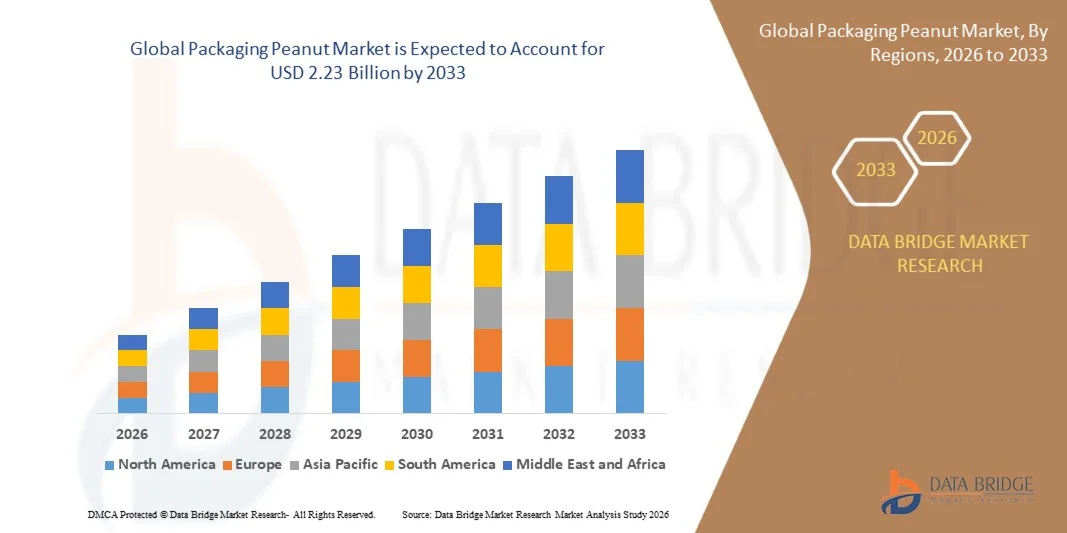
The Packaging Peanut Market was valued at USD 1.42 billion in 2025 and is projected to reach USD 2.23 billion by 2033, growing at a CAGR of 5.8% from 2026 to 2033. Market growth is supported by rising e-commerce activities, increasing demand for protective packaging solutions across various industries, expansion of manufacturing sectors in emerging economies, and heightened focus on product safety during transit and storage.
The growing volume of global trade and cross-border shipments is driving demand for lightweight, cost-effective cushioning materials that protect fragile goods from damage during transportation. Technological advancements in packaging peanut manufacturing, including biodegradable formulations, anti-static properties, and enhanced shock absorption capabilities, are improving functionality and environmental compliance across packaging applications. In addition, regulatory requirements and sustainability mandates are prompting packaging manufacturers to develop eco-friendly alternatives to traditional polystyrene-based products.
Rising consumer spending in Asia-Pacific, Latin America, and the Middle East is creating new opportunities for market expansion, as manufacturers and logistics providers invest in modernizing packaging infrastructure. The shift toward sustainable packaging solutions and the expansion of omnichannel retail distribution are further diversifying demand across product types and application segments.
Key Market Trends & Insights
- North America dominated the Packaging Peanut Market with the largest revenue share of 34.8% in 2025, supported by advanced logistics infrastructure, high e-commerce penetration, and stringent product safety standards for shipping and handling.
- Asia-Pacific is expected to be the fastest-growing region at a CAGR of 7.2% from 2026 to 2033, driven by expanding manufacturing sectors, rising e-commerce activities, and increasing demand for protective packaging solutions across consumer goods industries.
- The Polystyrene Packaging Peanut segment led the market with a 62.4% market share in 2025, reflecting widespread adoption due to cost-effectiveness, lightweight properties, and superior cushioning performance across shipping applications.
- The Starch-based Packaging Peanut segment is anticipated to be the fastest-growing product category, driven by increasing environmental regulations, consumer preference for sustainable packaging, and corporate sustainability initiatives.
- The Electrical and Electronics Industry segment dominated the application category with a 38.6% market share in 2025, supported by the need for superior protection of sensitive electronic components during shipping and handling.
- The Automotive Industry segment is expected to witness the highest CAGR of 6.9% during the forecast period, driven by increasing automotive parts shipments, aftermarket distribution growth, and global supply chain expansion.
Market Size & Forecast
- Global Market Value (2025): USD 1.42 Billion
- Expected Market Value (2033): USD 2.23 Billion
- Forecast CAGR (2026–2033): 5.8%
- Leading Region in 2025: North America
- Fastest Growing Region: Asia-Pacific
Report Scope and Packaging Peanut Market Segmentation
|
Attributes |
Packaging Peanut Key Market Insights |
|
Segments Covered |
|
|
Countries Covered |
North America · U.S. · Canada · Mexico Europe · Germany · France · U.K. · Netherlands · Switzerland · Belgium · Russia · Italy · Spain · Turkey · Rest of Europe Asia-Pacific · China · Japan · India · South Korea · Singapore · Malaysia · Australia · Thailand · Indonesia · Philippines · Rest of Asia-Pacific Middle East and Africa · Saudi Arabia · U.A.E. · South Africa · Egypt · Israel · Rest of Middle East and Africa South America · Brazil · Argentina · Rest of South America |
|
Key Market Players |
· Storopack Hans Reichenecker GmbH (Germany) · Sealed Air Corporation (U.S.) · Pregis LLC (U.S.) · Ranpak Holdings Corp. (U.S.) · Nefab Group (Sweden) · Davpack Ltd (U.K.) · Foam Factory Inc. (U.S.) · Lollicup USA Inc. (U.S.) · TransPak Inc. (U.S.) · Green Light Packaging Ltd (U.K.) · Puffy Stuff LLC (U.S.) · Packaging Peanut Company (U.S.) |
|
Market Opportunities |
· Expansion of e-commerce logistics networks in emerging markets with growing shipment volumes and protective packaging requirements · Development of biodegradable, compostable, and water-soluble packaging peanut formulations enabling adoption across sustainability-focused industries and retail channels |
|
Value Added Data Infosets |
In addition to the insights on market scenarios such as market value, growth rate, segmentation, geographical coverage, and major players, the market reports curated by the Data Bridge Market Research also include depth expert analysis, patient epidemiology, pipeline analysis, pricing analysis, and regulatory framework. |
Packaging Peanut Market Trends
Trend: Shift Toward Biodegradable and Sustainable Packaging Solutions
Packaging manufacturers and end-users are increasingly adopting biodegradable and compostable packaging peanuts to meet environmental regulations and corporate sustainability goals. The heightened awareness of plastic pollution and landfill accumulation following global environmental initiatives has accelerated demand for packaging materials that minimize ecological impact and support circular economy principles. Innovations such as starch-based formulations, water-soluble packaging peanuts, and plant-derived cushioning materials are improving both environmental performance and consumer acceptance.
For instance,
In March 2025, Storopack Hans Reichenecker GmbH expanded its PELASPAN BIO product line with enhanced starch-based packaging peanuts featuring improved moisture resistance and compostability certifications, addressing growing demand from e-commerce retailers seeking sustainable void-fill solutions.
In addition, packaging peanut manufacturers are increasingly integrating recycled content and renewable feedstocks into production processes to meet environmental standards and reduce lifecycle carbon footprints. These sustainability-driven advancements are expected to drive continued product innovation and market growth through the forecast period.
Packaging Peanut Market Dynamics
Key Market Driver: Rising E-Commerce Activities and Shipping Volumes
The exponential growth of e-commerce retail, direct-to-consumer shipping, and cross-border trade is the primary driver of packaging peanut market growth. Online retailers and logistics providers require lightweight, cost-effective cushioning materials to protect products during transit and reduce damage-related returns. The expansion of omnichannel retail distribution and same-day delivery services is driving demand for versatile packaging solutions that accommodate diverse product categories.
For instance,
According to the United Nations Conference on Trade and Development (UNCTAD) Digital Economy Report, 2024, global e-commerce sales exceeded USD 5.8 trillion in 2023, with cross-border e-commerce shipments growing at approximately 15% annually across major markets.
As e-commerce penetration continues to expand across developed and emerging markets, demand for protective packaging materials including packaging peanuts is expected to increase correspondingly. Rising shipment volumes and consumer expectations for undamaged product delivery are expected to sustain strong demand for packaging peanuts across application segments globally.
Key Restraint/Challenge: Environmental Concerns and Regulatory Restrictions on Polystyrene
Growing environmental awareness and regulatory restrictions on expanded polystyrene (EPS) foam products present significant challenges to traditional packaging peanut adoption. Single-use plastic bans, extended producer responsibility (EPR) regulations, and corporate sustainability commitments are limiting the use of non-biodegradable packaging materials across multiple jurisdictions.
For instance,
The European Union's Single-Use Plastics Directive and similar regulations in California, New York, and other jurisdictions have restricted or banned specific EPS foam applications, requiring packaging manufacturers to transition toward biodegradable alternatives or face compliance penalties.
Regulatory restrictions and consumer backlash against non-recyclable packaging materials may constrain polystyrene packaging peanut adoption, particularly among environmentally conscious brands and sustainability-focused retail channels.
Key Market Opportunity: Expansion into Emerging Markets and E-Commerce Logistics Networks
The rapid expansion of e-commerce infrastructure and logistics networks in Asia-Pacific, Latin America, and the Middle East is creating significant opportunities for packaging peanut adoption. Growing middle-class populations, increasing smartphone penetration, and expanding online retail platforms are driving shipment volumes and protective packaging demand in previously underserved markets. Simultaneously, the development of specialized packaging solutions for temperature-sensitive, fragile, and high-value goods is enabling market diversification across application segments.
Expansion into emerging market e-commerce channels and specialty packaging applications represents a significant growth opportunity for packaging peanut manufacturers and distributors.
Packaging Peanut Market Scope
The packaging peanut market is segmented on the basis of type and application.
By Type
On the basis of type, the Packaging Peanut Market is segmented into polystyrene packaging peanut and starch-based packaging peanut. The Polystyrene Packaging Peanut segment dominated the market with a 62.4% market share in 2025, reflecting widespread adoption due to cost-effectiveness, lightweight properties, and superior cushioning performance across shipping and storage applications. Established manufacturing infrastructure, extensive distribution networks, and proven shock absorption capabilities have driven strong adoption across logistics, manufacturing, and retail sectors. High-volume applications in electronics, automotive parts, and consumer goods shipping contribute to segment leadership.
The Starch-based Packaging Peanut segment is expected to witness the fastest growth at a CAGR of 8.4% from 2026 to 2033, driven by increasing environmental regulations, corporate sustainability commitments, and consumer preference for eco-friendly packaging alternatives. Technological advancements enabling improved moisture resistance, enhanced cushioning properties, and cost-competitive production are expanding the commercial viability of biodegradable packaging peanuts across mainstream applications.
By Application
On the basis of application, the Packaging Peanut Market is segmented into automotive industry, food and beverage industry, electrical and electronics industry, and others. The Electrical and Electronics Industry segment dominated the market with a 38.6% market share in 2025, supported by the critical need for superior protection of sensitive electronic components, consumer electronics, and precision instruments during shipping and handling. The high value and fragility of electronic products necessitate effective cushioning solutions to prevent damage, reduce returns, and maintain product integrity throughout the supply chain. Growing global electronics manufacturing and distribution volumes contribute to segment dominance.
The Automotive Industry segment is expected to witness the fastest growth at a CAGR of 6.9% from 2026 to 2033, driven by increasing automotive parts shipments, aftermarket distribution expansion, and globalization of automotive supply chains. Rising demand for protective packaging in electric vehicle component distribution and just-in-time manufacturing logistics is supporting segment expansion.
Packaging Peanut Market Regional Analysis
North America dominated the packaging peanut market with a revenue share of 34.8% in 2025, supported by advanced logistics infrastructure, high e-commerce penetration, stringent product safety standards, and the presence of leading market players including Sealed Air Corporation, Pregis LLC, and Ranpak Holdings Corp. Established distribution networks, robust packaging industry capabilities, and extensive manufacturing sector demand contribute to regional market leadership.
U.S. Packaging Peanut Market Insight
The U.S. packaging peanut market benefits from high e-commerce penetration, extensive logistics networks, and strong demand for protective packaging across manufacturing and retail sectors. Major e-commerce platforms, third-party logistics providers, and manufacturing companies continue to invest in cushioning solutions to reduce product damage and improve customer satisfaction. The U.S. accounted for approximately 28.6% of the global market share in 2025, driven by high shipment volumes and packaging technology adoption.
Europe Packaging Peanut Market Insight
The Europe packaging peanut market remains a significant contributor, with strong demand across manufacturing, retail, and e-commerce channels in Germany, the U.K., France, and the Netherlands. Growing adoption of biodegradable and sustainable packaging solutions is reshaping market dynamics as regulatory requirements and corporate sustainability commitments drive transition toward eco-friendly alternatives. Circular economy initiatives and extended producer responsibility regulations are standardizing sustainable packaging practices and supporting market evolution.
U.K. Packaging Peanut Market Insight
The U.K. packaging peanut market is characterized by expanding e-commerce logistics operations and increasing adoption of sustainable packaging materials. Investment in biodegradable void-fill solutions and recycled-content packaging is improving environmental compliance and reducing packaging waste across retail and manufacturing sectors.
Germany Packaging Peanut Market Insight
Germany's robust manufacturing sector and advanced logistics infrastructure support comprehensive protective packaging adoption across automotive, electronics, and industrial equipment industries. Strong environmental regulations and corporate sustainability initiatives contribute to growing demand for biodegradable packaging alternatives.
Asia-Pacific Packaging Peanut Market Insight
The Asia-Pacific packaging peanut market is poised for rapid growth with a CAGR of 7.2% during the forecast period, driven by expanding manufacturing sectors, rising e-commerce activities, and increasing demand for protective packaging across consumer electronics and automotive industries. Private sector investments in logistics infrastructure and packaging manufacturing capabilities are supporting market expansion across China, Japan, India, and South Korea. China accounted for approximately 16.4% of the global market share in 2025, reflecting substantial manufacturing and e-commerce growth.
Japan Packaging Peanut Market Insight
The Japan packaging peanut market benefits from advanced manufacturing capabilities, high-quality packaging standards, and strong electronics industry demand. Protective packaging solutions for precision electronics, automotive components, and consumer goods are well-established, with expanding applications across e-commerce and cross-border shipping.
China Packaging Peanut Market Insight
The China packaging peanut market is experiencing rapid growth driven by e-commerce expansion, manufacturing sector growth, and increasing consumer goods shipment volumes. Domestic manufacturing capabilities are complementing imported packaging products, improving market accessibility and supporting diverse application requirements.
Packaging Peanut Market Share
The packaging peanut industry is primarily led by well-established companies, including:
- Storopack Hans Reichenecker GmbH (Germany)
- Sealed Air Corporation (U.S.)
- Pregis LLC (U.S.)
- Ranpak Holdings Corp. (U.S.)
- Nefab Group (Sweden)
- Davpack Ltd (U.K.)
- Foam Factory Inc. (U.S.)
- Lollicup USA Inc. (U.S.)
- TransPak Inc. (U.S.)
- Green Light Packaging Ltd (U.K.)
- Puffy Stuff LLC (U.S.)
- Packaging Peanut Company (U.S.)
Latest Developments in Packaging Peanut Market
- In February 2026, Sealed Air Corporation announced the expansion of its sustainable void-fill portfolio with the launch of biodegradable packaging peanuts manufactured from renewable plant-based materials. The launch supports the company's commitment to reducing plastic packaging waste and meeting growing customer demand for eco-friendly cushioning solutions.
- In November 2025, Storopack Hans Reichenecker GmbH introduced its next-generation PELASPAN PAC starch-based packaging peanuts with enhanced anti-static properties designed for electronics industry applications. The product expansion addresses the need for sustainable protective packaging that meets electronic component handling requirements.
- In September 2025, Pregis LLC expanded its manufacturing capacity in Ohio with a new production facility dedicated to sustainable packaging materials, including biodegradable loose-fill products. The expansion supports growing demand for environmentally responsible packaging solutions across North American markets.
- In June 2025, Ranpak Holdings Corp. announced a strategic partnership with major European e-commerce retailers to supply paper-based and biodegradable void-fill solutions, including sustainable alternatives to traditional packaging peanuts. The partnership aims to reduce plastic packaging across European fulfillment operations.
- In April 2025, Nefab Group launched its EcoFill line of compostable packaging peanuts derived from agricultural waste materials, targeting sustainability-focused brands across consumer goods and electronics industries. The launch demonstrates the company's commitment to circular economy principles in protective packaging.
- In January 2025, Green Light Packaging Ltd expanded its distribution network across the U.K. and Europe with enhanced availability of water-soluble and compostable packaging peanut products. The expansion supports growing retailer demand for plastic-free shipping materials.
- In October 2024, Sealed Air Corporation invested in advanced manufacturing technology to improve the production efficiency and environmental performance of its loose-fill packaging operations. The investment supports cost competitiveness and sustainability improvements across the product portfolio.
- In July 2024, Foam Factory Inc. introduced custom-colored packaging peanuts with enhanced brand visibility features for premium consumer goods applications. The product innovation addresses retailer demand for differentiated unboxing experiences and brand presentation.

- Interactive Data Analysis Dashboard
- Company Analysis Dashboard for high growth potential opportunities
- Research Analyst Access for customization & queries
- Competitor Analysis with Interactive dashboard
- Latest News, Updates & Trend analysis
- Harness the Power of Benchmark Analysis for Comprehensive Competitor Tracking
Global Packaging Peanut Market, Supply Chain Analysis and Ecosystem Framework
To support market growth and help clients navigate the impact of geopolitical shifts, DBMR has integrated in-depth supply chain analysis into its Global Packaging Peanut Market research reports. This addition empowers clients to respond effectively to global changes affecting their industries. The supply chain analysis section includes detailed insights such as Global Packaging Peanut Market consumption and production by country, price trend analysis, the impact of tariffs and geopolitical developments, and import and export trends by country and HSN code. It also highlights major suppliers with data on production capacity and company profiles, as well as key importers and exporters. In addition to research, DBMR offers specialized supply chain consulting services backed by over a decade of experience, providing solutions like supplier discovery, supplier risk assessment, price trend analysis, impact evaluation of inflation and trade route changes, and comprehensive market trend analysis.
Data collection and base year analysis are done using data collection modules with large sample sizes. The stage includes obtaining market information or related data through various sources and strategies. It includes examining and planning all the data acquired from the past in advance. It likewise envelops the examination of information inconsistencies seen across different information sources. The market data is analysed and estimated using market statistical and coherent models. Also, market share analysis and key trend analysis are the major success factors in the market report. To know more, please request an analyst call or drop down your inquiry.
The key research methodology used by DBMR research team is data triangulation which involves data mining, analysis of the impact of data variables on the market and primary (industry expert) validation. Data models include Vendor Positioning Grid, Market Time Line Analysis, Market Overview and Guide, Company Positioning Grid, Patent Analysis, Pricing Analysis, Company Market Share Analysis, Standards of Measurement, Global versus Regional and Vendor Share Analysis. To know more about the research methodology, drop in an inquiry to speak to our industry experts.
Data Bridge Market Research is a leader in advanced formative research. We take pride in servicing our existing and new customers with data and analysis that match and suits their goal. The report can be customized to include price trend analysis of target brands understanding the market for additional countries (ask for the list of countries), clinical trial results data, literature review, refurbished market and product base analysis. Market analysis of target competitors can be analyzed from technology-based analysis to market portfolio strategies. We can add as many competitors that you require data about in the format and data style you are looking for. Our team of analysts can also provide you data in crude raw excel files pivot tables (Fact book) or can assist you in creating presentations from the data sets available in the report.













