


What is the Packer Bottles Market Size and Growth Rate?
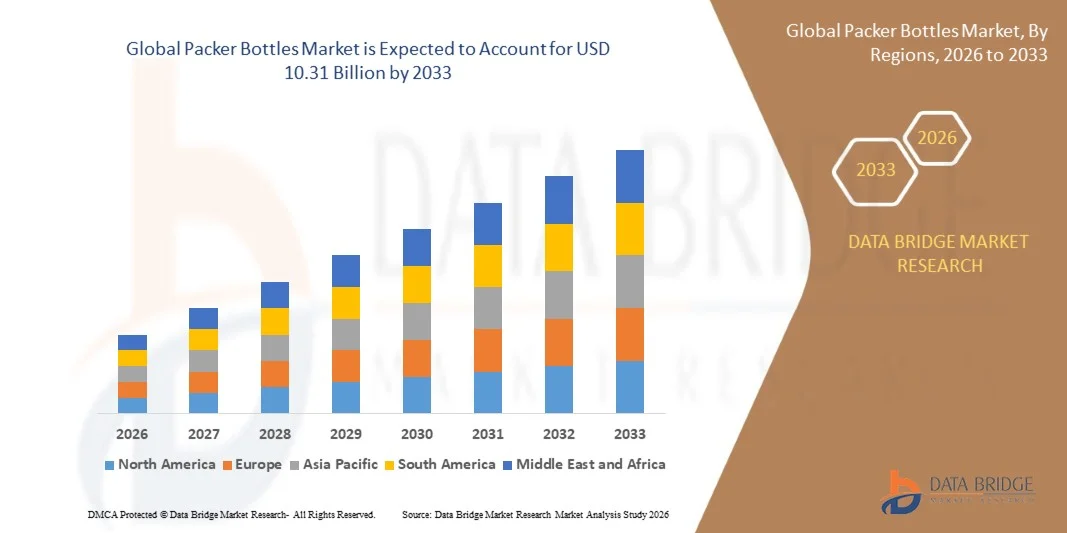
- As per Data Bridge Market Research analysis, the packer bottles market was valued at USD 6.52 billion in 2025 and is projected to reach USD 10.31 billion by 2033, growing at a CAGR of 5.90% from 2026 to 2033.
- The market is experiencing consistent growth driven by the increasing demand for everyday packaging applications, rising preference for cost-efficient and lightweight packaging solutions, and growing adoption of protective and easy packaging solutions across industries. Packer bottles are particularly important in pharmaceutical and nutraceutical applications because their wide-mouth designs facilitate the filling and dispensing of tablets, capsules, vitamins, supplements, and other products
- The increasing demand for packer bottles from the pharmaceutical and nutraceutical industries, combined with the need for packaging that provides protection against moisture, contamination, and light, is supporting market expansion. Wide-mouth and round-shaped packer bottles are increasingly preferred because they facilitate filling, dispensing, labeling, handling, and storage of tablets, capsules, and supplements.
Market Size & Forecast
- Global Market Value (2025): USD 6.52 Billion
- Expected Market Value (2033): USD 10.31 Billion
- Forecast CAGR (2026–2033): 5.90%
- Leading Region in 2025: North America
- Fastest Growing Region: Asia Pacific
What are the Major Takeaways of the Packer Bottles Market?
- North America dominated the packer bottles market with the largest revenue share of 37.3% in 2025, supported by advancement in technology and easy availability of petroleum-based raw material, which contributes to higher demand for bulk plastic raw material
- Asia-Pacific is expected to be the fastest-growing region at a CAGR of 5.1% from 2026 to 2033, fueled by expanding pharmaceutical and nutraceutical industries and increasing demand for safe and reliable packaging solutions.
- The plastic segment led the market with a 52.3% share in 2025, driven by its lightweight characteristics, durability, cost-effectiveness, and versatility.
- Glass is the fastest-growing material type, projected to register a CAGR of 5.6%, reflecting the surge in demand for sustainable, recyclable, and chemically stable packaging solutions, particularly across pharmaceutical and nutraceutical applications.
- The 300cc segment dominated the capacity type category with a 38% revenue share in 2025, led by its suitability for tablets, capsules, dietary supplements, and other pharmaceutical products.
- Screw cap accounted for 35% of the market share in 2025, preferred by its simple design, reliable sealing performance, and broad compatibility with packer bottles.
- The liquid segment is the fastest-growing application category, with a CAGR of 6.0%, driven by increasing demand for liquid pharmaceuticals, syrups, oral solutions, and nutraceutical products, along with growing preference for convenient and easy-to-administer packaging solutions.
Report Scope and Packer Bottles Market Segmentation
|
Attributes |
Packer Bottles Key Market Insights |
|
Segments Covered |
|
|
Countries Covered |
North America
Europe
Asia-Pacific
Middle East and Africa
South America
|
|
Key Market Players |
|
|
Market Opportunities |
|
|
Value Added Data Infosets |
In addition to the insights on market scenarios such as market value, growth rate, segmentation, geographical coverage, and major players, the market reports curated by the Data Bridge Market Research also include import export analysis, production capacity overview, production consumption analysis, price trend analysis, climate change scenario, supply chain analysis, value chain analysis, raw material/consumables overview, vendor selection criteria, PESTLE Analysis, Porter Analysis, and regulatory framework. |
What is the Key Trend in the Packer Bottles Market?
- Growing demand for safe pharmaceutical packaging is increasing adoption of packer bottles that protect tablets, capsules, supplements, and liquid medicines from moisture, contamination, light, and handling damage securely.
- For instance, in January 2024, Bormioli Pharma and Loop Industries unveiled a pharmaceutical packaging bottle manufactured with 100% recycled virgin-quality Loop PET resin at Pharmapack Europe 2024, demonstrating the growing shift toward sustainable and recyclable materials in pharmaceutical bottle packaging. The bottle underwent testing against European and U.S. Pharmacopeia requirements for pharmaceutical packaging applications.
- Manufacturers increasingly develop lightweight packer bottles using PET, HDPE, and recycled polymers to reduce material consumption, transportation costs, and environmental impacts while maintaining product protection and performance requirements.
- Round and wide-mouth packer bottle designs continue gaining preference because they simplify filling, labeling, storage, dispensing, and handling across pharmaceutical, nutraceutical, and dietary supplement applications globally today widely.
- E-commerce growth is strengthening demand for durable packer bottles that withstand transportation, handling, and distribution requirements while maintaining product integrity throughout increasingly complex pharmaceutical supply chains worldwide today.
- For instance, in October 2024, Berry Global launched its ClariPPil clarified polypropylene pill bottles for healthcare applications, offering improved recyclability, a reduced carbon footprint, and product protection compared with conventional colored PET pill bottles, demonstrating the shift toward more sustainable pharmaceutical bottle packaging.
- Growing health and wellness awareness is increasing consumption of vitamins, dietary supplements, and nutraceutical products, creating additional demand for convenient, durable, and tamper-evident packer bottle packaging formats globally.
What are the Key Drivers of the Packer Bottles Market?
- The expansion of pharmaceutical manufacturing is increasing demand for packer bottles because tablets, capsules, and liquid medicines require packaging that maintains product stability, safety, integrity, and convenient handling effectively.
- For instance, in December 2024, Berry Global launched a new 10 ml LDPE ophthalmic bottle qualified for Aptar Pharma’s Ophthalmic Squeeze Dispenser, addressing demand for reliable pharmaceutical packaging for prescription and over-the-counter eye-care formulations and supporting precise dispensing
- Rising consumption of dietary supplements and nutraceuticals is strengthening demand for packer bottles that provide lightweight, airtight, durable, and convenient packaging for vitamins, minerals, probiotics, and nutrition products.
- Strict pharmaceutical packaging requirements are increasing demand for bottles with moisture barriers, tamper-evident features, child-resistant closures, and reliable sealing systems that support product protection and regulatory compliance globally.
- For instance, in June 2026, Amcor invested in expanding its healthcare packaging production capabilities at its Sira facility in Karnataka, India, to meet rapidly growing healthcare packaging demand across India and South Asia, demonstrating expanding pharmaceutical and healthcare packaging requirements in the Asia-Pacific region
- Growing pharmaceutical production in emerging economies is creating additional demand for packer bottles as manufacturers expand domestic medicine supply, exports, and packaging capabilities across rapidly developing healthcare markets.
Which Factors are Challenging the Growth of the Packer Bottles Market?
- Fluctuating prices of PET, HDPE, and other petroleum-based raw materials can increase manufacturing costs, pressuring packer bottle producers and limiting margins across highly competitive packaging supply chains worldwide.
- For instance, in March 2025, Amcor highlighted that pharmaceutical packaging companies face challenges from evolving regulatory requirements and cost-prohibitive packaging requalification when transitioning to more sustainable packaging formats, increasing compliance costs and potentially slowing adoption of new packer bottle materials and designs
- Strict pharmaceutical packaging regulations can increase testing, qualification, documentation, and compliance costs, making market entry more difficult for smaller packer bottle manufacturers and suppliers serving regulated healthcare applications.
- Competition from alternative packaging formats, including blister packs, pouches, cartons, and other containers, can constrain packer bottle adoption where products require different protection, portability, or material efficiency characteristics.
- Growing environmental concerns surrounding plastic packaging are increasing pressure on manufacturers to adopt recyclable and sustainable materials, potentially raising production costs and reducing demand for conventional plastic packer bottles.
- For instance, in February 2025, the European Union’s Packaging and Packaging Waste Regulation (PPWR) entered into force, introducing requirements covering packaging manufacturing, composition, recyclability, and waste management, which increases regulatory obligations for conventional plastic packaging manufacturers, including packer bottle producers.
- Limited recycling infrastructure and difficulties handling pharmaceutical residues can restrict the circular use of plastic packer bottles, creating additional collection, cleaning, sorting, and compliance challenges for manufacturers and recyclers
How is the Packer Bottles Market Segmented?
The packer bottles market is segmented on the basis of material, capacity, closure type, application, and end user.
- By Material
On the basis of material, the packer bottles market is segmented into plastic and glass. The plastic segment dominated the market with a 52.3% share in 2025, driven by its lightweight characteristics, durability, cost-effectiveness, and versatility. Plastic packer bottles are extensively used for pharmaceutical tablets, capsules, powders, and liquid formulations. They also provide good chemical resistance and can be manufactured in a wide range of sizes and shapes. Their compatibility with high-speed automated filling and packaging systems supports large-scale production. Increasing demand for convenient, shatter-resistant packaging is further strengthening the segment. Growing adoption of recyclable and recycled-content plastics is also helping manufacturers address sustainability requirements.
The glass segment is projected to register the fastest growth at a CAGR of 5.6% during the forecast period. Glass provides excellent chemical stability and strong barrier protection against moisture, oxygen, and other environmental factors. It is particularly suitable for pharmaceutical products where product compatibility and stability are important. Increasing demand for sustainable packaging is also supporting glass because it can be recycled repeatedly. Pharmaceutical manufacturers continue to use glass for applications requiring high levels of chemical inertness. Premium positioning and strong product-protection characteristics are further supporting adoption. Advances in lightweight glass manufacturing are also helping reduce transportation and handling disadvantages.
- By Capacity
On the basis of capacity, the market is segmented into 100cc and below, 200cc, 300cc, and 400cc. The 300cc segment is estimated to be the dominated capacity segment with 38% in 2025, supported by its suitability for tablets, capsules, dietary supplements, and other pharmaceutical products. Medium-capacity bottles provide a balance between product volume and packaging efficiency. They are widely suitable for products requiring larger quantities than small-dose containers. Their size allows manufacturers to accommodate higher tablet or capsule counts while maintaining convenient handling. They also offer efficient storage and transportation characteristics. Growing consumption of pharmaceutical and nutraceutical products is supporting demand for this capacity range. The segment benefits from compatibility with standardized filling, capping, labeling, and sealing equipment.
The 400cc segment is projected to witness the fastest growth at an estimated CAGR of 6.5% during the forecast period. Larger-capacity bottles are increasingly suitable for high-count tablets, capsules, supplements, and other products sold in larger quantities. They can reduce the number of containers required for bulk products and improve packaging efficiency. Increasing consumer preference for value packs and extended-use pharmaceutical and nutraceutical products is supporting demand. These bottles can also incorporate resealable closures that allow repeated access while protecting the contents. Growth in dietary supplements and over-the-counter healthcare products is creating additional opportunities. Pharmaceutical manufacturers are increasingly focusing on packaging formats that combine convenience with efficient product utilization.
- By Closure Type
On the basis of closure type, the market is segmented into screw cap, snap cap, child-resistant cap, flip-top cap, dropper, and pump. The screw cap segment is estimated to dominated the market with 35% in 2025, supported by its simple design, reliable sealing performance, and broad compatibility with packer bottles. Screw caps are widely used for pharmaceutical tablets, capsules, powders, and several food and chemical products. They provide effective protection against contamination and moisture when properly sealed. Their compatibility with automated capping equipment makes them suitable for high-volume manufacturing. Screw closures can also incorporate tamper-evident rings, liners, and induction seals. Their relatively low cost and established manufacturing infrastructure further support adoption.
The child-resistant cap segment is projected to register the fastest growth at an estimated CAGR of 7.0% during the forecast period. Child-resistant closures are increasingly important for pharmaceutical and chemical products that could pose risks if accidentally accessed by children. Growing emphasis on packaging safety and regulatory compliance is encouraging manufacturers to adopt these systems. These closures provide an additional layer of protection while maintaining convenient operation for adults. Increasing consumption of prescription and over-the-counter medicines is creating additional demand. Manufacturers are also integrating child-resistant mechanisms with tamper-evident and moisture-protection features. Innovation in closure design is improving usability while maintaining safety performance.
- By Application
On the basis of application, the market is segmented into tablets and capsules, powder and granules, and liquid. The tablets and capsules segment is estimated to dominated the market with 47.8% in 2025, owing to the extensive use of packer bottles for solid oral pharmaceutical products. These bottles provide convenient storage, handling, transportation, and dispensing of tablets and capsules. Their rigid structure helps protect products against physical damage during distribution. Pharmaceutical manufacturers can also combine these bottles with desiccants, cotton, induction seals, and specialized closures. Rising consumption of prescription medicines, generic drugs, vitamins, and dietary supplements is supporting demand. The segment benefits from the widespread use of solid oral dosage forms across pharmaceutical markets.
The liquid segment is projected to register the fastest growth at an estimated CAGR of 6.0% during the forecast period. Liquid medicines, oral solutions, syrups, and suspensions require packaging that provides reliable sealing and minimizes leakage and contamination. Packer bottles can be combined with droppers, pumps, and specialized dispensing closures to improve dosing convenience. Increasing demand for pediatric medicines is particularly supporting liquid formulations. Expansion of nutraceuticals, healthcare products, and specialty liquid formulations is creating additional opportunities. Improvements in bottle barrier properties are also increasing suitability for sensitive liquid products. Growing demand for convenient dosing and user-friendly packaging is expected to further support the segment.
- By End User
On the basis of end user, the market is segmented into pharmaceuticals, chemicals, food and beverages, and others. The pharmaceuticals segment dominated the market with 50% in 2025, supported by extensive use of packer bottles for tablets, capsules, powders, liquids, vitamins, and dietary supplements. Pharmaceutical manufacturers require packaging capable of protecting products from moisture, contamination, physical damage, and environmental exposure. Packer bottles are compatible with a wide range of pharmaceutical closure and sealing technologies. Rising pharmaceutical production and increasing consumption of prescription and over-the-counter medicines are supporting demand. Expansion of generic drug manufacturing is also contributing to packaging requirements. The pharmaceutical industry's strict packaging and product-protection requirements further reinforce the segment's leading position.
The food and beverages segment is projected to witness the fastest growth at an estimated CAGR of 6.5% during the forecast period. Increasing demand for nutritional products, dietary supplements, food ingredients, and functional food products is expanding the use of rigid bottle packaging. Packer bottles provide convenient handling, resealability, and protection during transportation and storage. Growing consumer preference for portable and convenient packaging is further supporting adoption. Sustainability initiatives are encouraging manufacturers to develop recyclable and lightweight bottle formats. Expansion of nutraceutical and wellness products is also creating additional demand for bottle packaging. Increasing packaged-food consumption and growth of specialized nutritional products are expected to support continued expansion
Which Region Holds the Largest Share of the Packer Bottles Market?
- North America dominated the packer bottles market with the largest revenue share of 37.3% in 2025, supported by advancement in technology and easy availability of petroleum-based raw material, which contributes to higher demand for bulk plastic raw material
- The region also benefits from the widespread use of packer bottles for pharmaceutical and nutraceutical products, including tablets, capsules, vitamins, and dietary supplements. Strong demand for child-resistant closures, tamper-evident packaging, and traceable bottles further strengthens North America’s position. The United States represents the major contributor within the region, supported by its large pharmaceutical market and established packaging infrastructure.
U.S. Packer Bottles Market Insight
The U.S. packer bottles market is witnessing strong growth due to its large pharmaceutical industry, rising demand for prescription and over-the-counter medicines, and stringent requirements for safe and protective packaging. The U.S. pharmaceutical sector continues to generate substantial demand for bottles used for tablets, capsules, powders, and liquid formulations. In addition, the widespread use of child-resistant and tamper-evident packaging is supporting demand for advanced packer bottle solutions. The country’s established pharmaceutical manufacturing and packaging infrastructure is further strengthening market expansion. Increasing emphasis on product safety, contamination prevention, and regulatory compliance is also encouraging pharmaceutical manufacturers to adopt reliable packaging formats.
Asia-Pacific Packer Bottles Market Insight
The Asia-Pacific packer bottles market is expected to witness rapid growth, driven by expanding pharmaceutical manufacturing, rising healthcare expenditure, and increasing production of generic medicines across China, India, and other emerging economies. India’s pharmaceutical industry continues to expand its manufacturing capabilities, supported by strong domestic demand and increasing pharmaceutical exports. Growing healthcare access and demand for affordable medicines are supporting consumption of bottles for tablets, capsules, powders, and liquids. In addition, pharmaceutical manufacturing investments and expanding healthcare markets are accelerating demand for reliable and cost-effective packaging solutions. The region’s growing population and increasing prevalence of chronic diseases are further supporting pharmaceutical consumption and associated packaging requirements.
Japan Packer Bottles Market Insight
The Japan packer bottles market is witnessing consistent growth due to the country’s mature pharmaceutical sector, aging population, and increasing demand for medicines and healthcare products. Japan’s population aged 65 years and over accounted for 29.3% of the total population in 2024, highlighting the country’s significant demand for healthcare and pharmaceutical products. Pharmaceutical manufacturers require high-quality packaging that provides product protection, safety, and convenient handling. Furthermore, Japan’s advanced manufacturing capabilities and emphasis on quality and packaging safety are supporting continued adoption of packer bottles. Increasing demand for medicines associated with an aging population is creating additional requirements for pharmaceutical packaging
China Packer Bottles Market Insight
The China packer bottles market is growing rapidly, driven by expanding pharmaceutical manufacturing, rising healthcare expenditure, and increasing demand for generic and over-the-counter medicines. China continues to strengthen its domestic pharmaceutical manufacturing capabilities and healthcare infrastructure, creating additional demand for pharmaceutical packaging. Growing demand for convenient and protective packaging for tablets, capsules, powders, and liquid medicines is supporting packer bottle consumption. In addition, increasing pharmaceutical production and investments in healthcare manufacturing facilities are strengthening demand for packaging products. The country’s large population and expanding access to healthcare are also supporting long-term pharmaceutical packaging requirements.
U.K. Packer Bottles Market Insight
The U.K. packer bottles market is experiencing steady growth, supported by its established pharmaceutical manufacturing industry, strong healthcare system, and regulatory focus on pharmaceutical packaging quality and safety. The country has a well-developed life-sciences ecosystem and significant pharmaceutical manufacturing capabilities, supporting demand for bottles used for solid and liquid pharmaceutical products. Increasing emphasis on sustainable packaging and recyclable materials is encouraging manufacturers to develop improved bottle solutions. Furthermore, stringent requirements for pharmaceutical product quality and packaging safety are supporting the adoption of reliable packaging formats. The continued development of the U.K. life-sciences sector is expected to create additional opportunities for pharmaceutical packaging manufacturers.
Germany Packer Bottles Market Insight
The Germany packer bottles market is expanding steadily due to the country’s strong pharmaceutical manufacturing base, advanced chemical industry, and well-developed packaging infrastructure. Germany is one of Europe’s leading pharmaceutical manufacturing markets, supporting consistent demand for packaging used for medicines, supplements, and other healthcare products. The country’s established manufacturing capabilities and strong quality standards favor reliable bottles with effective sealing and product-protection characteristics. In addition, Germany’s growing focus on circular-economy practices and recyclable packaging materials is encouraging innovation in pharmaceutical packaging. Pharmaceutical manufacturers are increasingly focusing on packaging solutions that combine product protection, regulatory compliance, and sustainability.
Which are the Top Companies in Packer Bottles Market?
The packer bottles industry is primarily led by well-established companies, including:
- Amcor plc (Switzerland)
- Gerresheimer AG (Germany)
- ALPLA (Austria)
- AptarGroup, Inc. (U.S.)
- Comar, LLC (U.S.)
- Drug Plastics & Glass Co., Inc. (U.S.)
- TricorBraun, Inc. (U.S.)
- Plastipak Holdings, Inc. (U.S.)
- Graham Packaging Company, L.P. (U.S.)
- Origin Packaging Limited (U.K.)
- SGD Pharma (France)
- Weener Plastics Packaging (Netherlands)
- Raepak Limited (U.K.)
- Kaufman Container (U.S.)
- West Pharmaceutical Services, Inc. (U.S.)
- Stevanato Group S.p.A. (Italy)
- SCHOTT Pharma AG & Co. KGaA (Germany)
- Nipro PharmaPackaging International N.V. (Netherlands)
- Stoelzle Oberglas GmbH (Germany)
- Silgan Holdings Inc. (U.S.)
What are Latest Developments in Packer Bottles Market?
- In July 2025, Aptar Pharma announced that its Freepod nasal spray pump, used globally with the Otrivin brand, was converted to 52% bio-based feedstock. The development advances the use of renewable materials in dispensing systems while maintaining the functionality required for nasal drug delivery. The move reflects the growing focus on more sustainable pharmaceutical packaging and dispensing solutions. Aptar stated that the change supports its broader sustainability strategy and the transition toward lower-impact packaging materials. The development is relevant to the packer bottles market because dispensing pumps and closures are increasingly being designed alongside pharmaceutical bottle systems.
- In October 2024, Berry Global launched a range of clarified polypropylene bottles for healthcare applications. The ClariPPil™ bottles were introduced as a more sustainable alternative to traditional colored PET pill bottles and were designed to provide enhanced product protection. The bottles are available in 100cc, 120cc, and 150cc sizes and feature a universal 38mm neck compatible with standard closures, including child-resistant options. Berry reported that the bottles provide up to 84% improved moisture-ingress protection compared with PET. The launch highlights the growing development of lightweight, recyclable, and high-protection bottle solutions for healthcare packaging
- In November 2023, Berry Global introduced digital-cap technology designed to improve medicine adherence and patient engagement. The closure is compatible with 38-400 standard pharmaceutical packaging bottles and existing filling lines, allowing pharmaceutical manufacturers to incorporate the technology without major changes to packaging operations. The child-resistant closure includes a push-down-and-turn mechanism, pictorial opening instructions, and an audible click to provide confirmation during opening. Berry also offers pill jar bottles in different dimensions and shapes that can be paired with the closure. The development demonstrates increasing integration of smart functionality, safety, and patient convenience into pharmaceutical bottle packaging
- In April 2023, Berry Global opened a new healthcare manufacturing facility and Global Centre of Excellence in Bangalore, India. The 21,000-square-meter facility includes precision manufacturing equipment and an ISO 8 cleanroom and produces packaging products and medical devices for ophthalmic, nasal, inhalation, dispensing, and self-injection applications. The facility was designed to strengthen Berry’s ability to support healthcare customers in Asia and other global markets. It also supports the development of patient-centric packaging solutions addressing usability, functionality, medicine administration, and sustainability requirements. The investment strengthens regional manufacturing capabilities for advanced healthcare packaging and supports growing demand for pharmaceutical packaging solutions in Asia.
- In September 2021, Berry Global highlighted its Vistop® PP36 medical plastic bottle closure for pharmaceutical and healthcare applications. The closure incorporates a tamper-evident ring that breaks completely after initial opening, providing a clear indication that the package has been opened. Its flexible inner seal adapts to different bottle shapes and tolerances while maintaining tightness and product security. Berry reported that the solution had received commercialized approval in more than 70 countries, supporting its use by pharmaceutical and healthcare companies. The development reflects increasing emphasis on tamper evidence, product security, ease of opening, and reliable sealing in pharmaceutical bottle packaging

- Interactive Data Analysis Dashboard
- Company Analysis Dashboard for high growth potential opportunities
- Research Analyst Access for customization & queries
- Competitor Analysis with Interactive dashboard
- Latest News, Updates & Trend analysis
- Harness the Power of Benchmark Analysis for Comprehensive Competitor Tracking
Global Packer Bottles Market, Supply Chain Analysis and Ecosystem Framework
To support market growth and help clients navigate the impact of geopolitical shifts, DBMR has integrated in-depth supply chain analysis into its Global Packer Bottles Market research reports. This addition empowers clients to respond effectively to global changes affecting their industries. The supply chain analysis section includes detailed insights such as Global Packer Bottles Market consumption and production by country, price trend analysis, the impact of tariffs and geopolitical developments, and import and export trends by country and HSN code. It also highlights major suppliers with data on production capacity and company profiles, as well as key importers and exporters. In addition to research, DBMR offers specialized supply chain consulting services backed by over a decade of experience, providing solutions like supplier discovery, supplier risk assessment, price trend analysis, impact evaluation of inflation and trade route changes, and comprehensive market trend analysis.
Data collection and base year analysis are done using data collection modules with large sample sizes. The stage includes obtaining market information or related data through various sources and strategies. It includes examining and planning all the data acquired from the past in advance. It likewise envelops the examination of information inconsistencies seen across different information sources. The market data is analysed and estimated using market statistical and coherent models. Also, market share analysis and key trend analysis are the major success factors in the market report. To know more, please request an analyst call or drop down your inquiry.
The key research methodology used by DBMR research team is data triangulation which involves data mining, analysis of the impact of data variables on the market and primary (industry expert) validation. Data models include Vendor Positioning Grid, Market Time Line Analysis, Market Overview and Guide, Company Positioning Grid, Patent Analysis, Pricing Analysis, Company Market Share Analysis, Standards of Measurement, Global versus Regional and Vendor Share Analysis. To know more about the research methodology, drop in an inquiry to speak to our industry experts.
Data Bridge Market Research is a leader in advanced formative research. We take pride in servicing our existing and new customers with data and analysis that match and suits their goal. The report can be customized to include price trend analysis of target brands understanding the market for additional countries (ask for the list of countries), clinical trial results data, literature review, refurbished market and product base analysis. Market analysis of target competitors can be analyzed from technology-based analysis to market portfolio strategies. We can add as many competitors that you require data about in the format and data style you are looking for. Our team of analysts can also provide you data in crude raw excel files pivot tables (Fact book) or can assist you in creating presentations from the data sets available in the report.













