


Paddy Rice Market Size
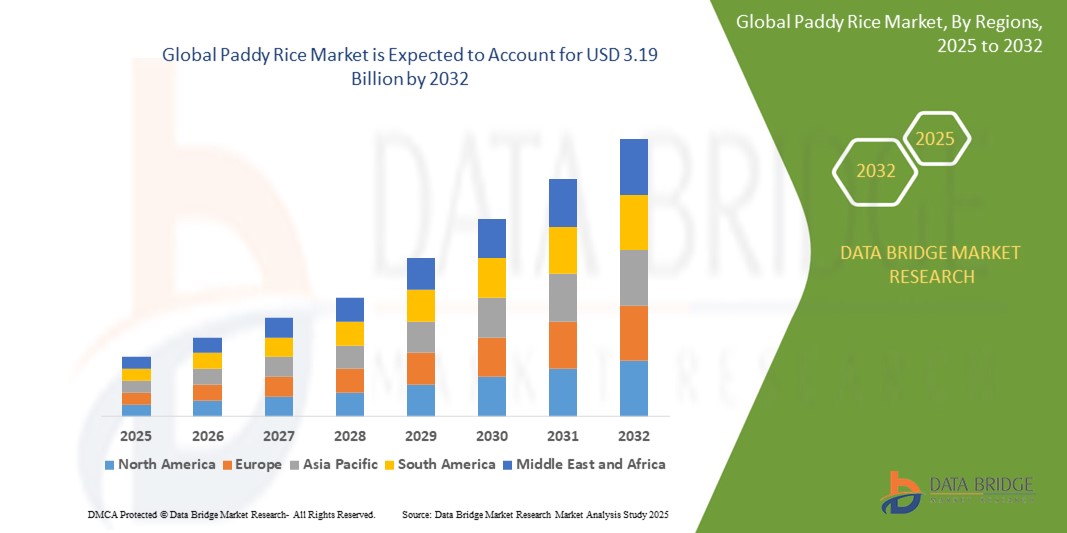
- The global paddy rice market size was valued at USD 1.92 billion in 2024 and is expected to reach USD 3.19 billion by 2032, at a CAGR of 6.50% during the forecast period
- The market growth is largely fueled by rising global demand for staple foods and increasing rice consumption across emerging and developed economies, supported by population growth and evolving dietary patterns favoring plant-based staples
- Furthermore, advancements in high-yield seed varieties, precision farming, and pest management solutions are enhancing productivity and resilience, enabling producers to meet domestic and export demands efficiently. These converging factors are accelerating rice cultivation and trade, thereby significantly boosting the industry's growth
Paddy Rice Market Analysis
- Paddy rice refers to the unmilled form of rice harvested from fields, which serves as a primary food source for over half the global population. It is processed through milling to produce white or brown rice used in households, foodservice, and industrial applications
- The demand for paddy rice is primarily driven by its role as a dietary staple in Asia-Pacific, increasing consumer shift toward health-conscious rice varieties, government support for food security, and continuous innovations in seed genetics and crop protection technologies
- Asia-Pacific dominated the paddy rice market with a share of over 90% in 2024, due to favorable climatic conditions, widespread cultivation, and high per capita rice consumption across densely populated countries
- North America is expected to be the fastest growing region in the paddy rice market with a share of during the forecast period due to the rising demand for ethnic cuisines, gluten-free foods, and clean-label products
- High carbohydrates segment dominated the market with a market share of 68.6% in 2024, due to the essential energy needs fulfilled by carbohydrate-rich staples, particularly in emerging economies where rice is a dietary cornerstone. High-carb paddy rice varieties are extensively cultivated and consumed due to their cost-effectiveness, shelf stability, and capacity to serve as a primary caloric source for billions
Report Scope and Paddy Rice Market Segmentation
|
Attributes |
Paddy Rice Key Market Insights |
|
Segments Covered |
|
|
Countries Covered |
North America
Europe
Asia-Pacific
Middle East and Africa
South America
|
|
Key Market Players |
|
|
Market Opportunities |
|
|
Value Added Data Infosets |
In addition to the insights on market scenarios such as market value, growth rate, segmentation, geographical coverage, and major players, the market reports curated by the Data Bridge Market Research also include in-depth expert analysis, pricing analysis, brand share analysis, consumer survey, demography analysis, supply chain analysis, value chain analysis, raw material/consumables overview, vendor selection criteria, PESTLE Analysis, Porter Analysis, and regulatory framework. |
Paddy Rice Market Trends
“Growing Expansion of Rice Consumption”
- Global rice consumption is steadily increasing due to population growth, especially in Asia and Africa, where rice is a dietary staple in both urban and rural areas. Demand is further boosted by shifts toward rice-based processed foods and rising middle-class incomes
- For instance, global domestic and residual use of rice is projected to reach a record 532.1 million tons in 2024/25 (milled basis), with India and Indonesia showing notable increases in both consumption and production over the past year
- Emerging urbanization, changing dietary habits, and the popularity of ready-to-eat and convenience rice products in rapidly developing nations are expanding the consumer base for paddy rice
- The expansion of premium and specialty rice varieties—such as basmati, japonica, and fragrant rice—is adding value to the market, as health and quality-conscious consumers seek differentiated products
- E-commerce, improved logistics, and online grocery platforms are enabling greater market access and facilitating the distribution of rice across borders and to new consumer segments
- Governments in Asia and Africa continue to implement fortification programs and food security initiatives that fuel production and consumption, counteracting market fluctuations and encouraging local self-sufficiency
Paddy Rice Market Dynamics
Driver
“Steady Increase in Population”
- The persistent, stable rise in global population remains the foundational driver for paddy rice market growth, as food demand surges to meet the needs of both expanding and urbanizing populations
- For instance, countries such as India and China are forecasted to increase milled rice production to 147 million and 145.3 million tons, respectively, in 2024/25, maintaining their status as the world’s largest producers and feeding hundreds of millions of people
- Rural-to-urban migration amplifies the consumption of rice in prepared and convenience foods, reshaping demand profiles in metropolitan regions
- Government price supports, minimum support prices (MSP), and input subsidies in major rice-producing nations create a stable research and investment climate for growers and processors
- Ongoing investments in high-yield seeds, irrigation, and modern agrotechnologies, especially in Asia and Africa, contribute to increased global output and market stability
Restraint/Challenge
“Extreme Weather Against Paddy Growth”
- The paddy rice market is highly vulnerable to extreme weather events—including droughts, floods, cyclones, and prolonged heat waves—which disrupt planting schedules, reduce yields, and threaten food security
- For instance, the 2024/25 production forecasts have been adjusted for countries such as Argentina and Sri Lanka due to unfavorable weather, highlighting regional volatility and yield unpredictability
- Climate change is intensifying weather variability, causing both short-term fluctuations in harvests and long-term impacts on soil health and water availability
- Rising sea levels and saline water intrusion in delta regions, such as the Mekong and Ganges, jeopardize future land suitability for paddy cultivation
- Such instability increases reliance on global stocks, government intervention, and insurance mechanisms, while also propelling research into drought- and flood-tolerant paddy varieties
Paddy Rice Market Scope
The market is segmented on the basis of type, nutrition, variety, and distribution channel.
• By Type
On the basis of type, the paddy rice market is segmented into Indica, Japonica, Javanica, and Others. The Indica segment dominated the largest market revenue share in 2024, attributed to its widespread cultivation across Asia and Africa and its adaptability to a broad range of climatic conditions. Indica rice varieties are commonly grown in tropical and subtropical regions, offering high yields and resilience to pests and diseases, making them a preferred choice among large-scale rice producers. Its long, slender grains and non-sticky texture after cooking appeal to consumer preferences in major markets such as India, Thailand, and Vietnam.
The Japonica segment is projected to witness the fastest growth rate from 2025 to 2032, driven by increasing consumption in East Asia, Europe, and parts of North America. Japonica rice is known for its short, round grains and sticky texture when cooked, making it ideal for dishes such as sushi and rice bowls. Rising global popularity of Asian cuisine, combined with growing health awareness around low-fat and gluten-free staples, is accelerating demand for premium Japonica rice, especially in urban and export-driven markets.
• By Nutrition
On the basis of nutrition, the market is categorized into High Fiber and High Carbohydrates. The High Carbohydrates segment held the largest revenue share of 68.6% in 2024, supported by the essential energy needs fulfilled by carbohydrate-rich staples, particularly in emerging economies where rice is a dietary cornerstone. High-carb paddy rice varieties are extensively cultivated and consumed due to their cost-effectiveness, shelf stability, and capacity to serve as a primary caloric source for billions.
The High Fiber segment is anticipated to register the fastest CAGR during the forecast period, reflecting a shift toward healthier dietary preferences. Rising consumer awareness around digestive health, lifestyle diseases, and obesity prevention is fueling demand for brown and unpolished rice types rich in dietary fiber. This trend is also being reinforced by governmental nutritional campaigns and the availability of organic, whole-grain rice options through modern retail outlets.
• By Variety
On the basis of variety, the market is segmented into Long-Grain Rice, Medium-Grain Rice, and Short-Grain Rice. The Long-Grain Rice segment led the market in 2024 owing to its superior cooking characteristics, including separation of grains and fluffiness, which align well with global culinary applications. Basmati and Jasmine rice—both long-grain types—are especially popular in international trade, enhancing the segment’s prominence across food service and retail sectors.
The Medium-Grain Rice segment is expected to experience the highest growth from 2025 to 2032 due to its expanding use in ready-to-eat meals, packaged food, and processed products. Its balanced texture and slightly sticky quality make it suitable for a range of cuisines, from Mediterranean to Asian. In addition, food manufacturers prefer medium-grain rice for its adaptability in frozen and microwavable meal formats, aligning with increasing demand for convenient, home-style foods.
• By Distribution Channel
On the basis of distribution channel, the market is segmented into Hypermarkets/Supermarkets, Departmental Stores, and Others. Hypermarkets/Supermarkets accounted for the largest revenue share in 2024, benefiting from their extensive product assortment, competitive pricing, and strategic placement in urban areas. These retail formats provide consumers with easy access to a wide range of rice types and packaging options, often under both branded and private labels.
The Departmental Stores segment is projected to grow at the fastest rate from 2025 to 2032, supported by a rising focus on specialty and premium rice offerings. Consumers increasingly prefer these channels for curated product lines, including organic, heritage, and imported rice varieties. As health-conscious shoppers seek traceability and higher-quality grains, departmental stores are enhancing their rice assortments to meet niche demands, especially in metropolitan regions.
Paddy Rice Market Regional Analysis
- Asia-Pacific dominated the paddy rice market with the largest revenue share of over 90% in 2024, driven by favorable climatic conditions, widespread cultivation, and high per capita rice consumption across densely populated countries
- Strong government support for rice farming, technological advancements in irrigation and seed varieties, and the region’s role as a major exporter are reinforcing Asia-Pacific’s leadership in global rice production and trade
- In addition, increasing domestic demand, improved post-harvest infrastructure, and rising global exports are fueling further expansion of the paddy rice market across the region
Japan Paddy Rice Market Insight
The Japan paddy rice market is supported by strong domestic consumption and traditional dietary habits that prioritize rice as a staple. Despite shrinking farmland, precision agriculture techniques and high-yield rice strains are maintaining production efficiency. Government subsidies and initiatives promoting rice self-sufficiency, along with increasing demand for premium japonica varieties, are strengthening market dynamics.
China Paddy Rice Market Insight
The China paddy rice market held the largest share in Asia-Pacific in 2024, driven by its dominance in both production and consumption. Rice remains a dietary cornerstone, and government programs promoting high-efficiency rice farming, hybrid seed adoption, and sustainable cultivation practices are ensuring continued growth. Increasing exports to Africa and Southeast Asia further support China's market leadership.
Europe Paddy Rice Market Insight
The Europe paddy rice market is projected to grow at a steady pace during the forecast period, driven by increasing demand for specialty rice varieties such as basmati and japonica. Rising health awareness, coupled with a shift toward gluten-free and plant-based diets, is boosting rice consumption. The region’s focus on sustainable and organic farming practices is also influencing growth in premium rice segments.
U.K. Paddy Rice Market Insight
The U.K. market is expanding gradually due to growing consumer interest in diverse rice varieties and health-focused diets. The demand for wholegrain, high-fiber rice is rising amid increasing awareness of digestive health and wellness. Importers are emphasizing fair-trade and sustainable sourcing, reflecting evolving purchasing behavior among health-conscious and ethically-minded consumers.
Germany Paddy Rice Market Insight
The Germany paddy rice market is benefiting from a robust retail infrastructure and increasing demand for organic, minimally processed rice. Consumer preference for clean-label and plant-based staples is encouraging imports of high-quality long-grain and specialty rice. The market is further supported by strong e-commerce penetration and expanding ethnic food consumption across urban centers.
North America Paddy Rice Market Insight
North America is projected to witness the fastest CAGR from 2025 to 2032, driven by the rising demand for ethnic cuisines, gluten-free foods, and clean-label products. Domestic production, especially in the southern U.S., is being complemented by increasing imports of premium rice varieties. Health-driven dietary trends and the popularity of rice in meal kits and ready-to-eat foods are expanding the market footprint.
U.S. Paddy Rice Market Insight
The U.S. paddy rice market captured the largest revenue share in North America in 2024, supported by large-scale production in states such as Arkansas, California, and Louisiana. A strong export base, especially to Latin America and East Asia, combined with rising domestic consumption of brown and specialty rice, is fueling growth. Technological innovations in water-efficient farming and storage are also contributing to the market’s expansion.
Paddy Rice Market Share
The paddy rice industry is primarily led by well-established companies, including:
- Barilla G. e R. Fratelli S.p.A (Italy)
- Sunshine Industries (India)
- LUXOFOOD (Indonesia)
- Ebro Foods, S.A. (Spian)
- F.lli De Cecco di Filippo (Italy)
- Dhula Rice Mill Private Limited (India)
- Skystar Exports Private Limited (India)
- Poseidon Overseas LLP (India)
- Rasi Seeds (P) Ltd, Rallis India Limited (India)
- J.K.AgriGenetics Ltd (India)
- Guard Rice Mills (India)
- Aamon Mahila Chasi Producer Company Limited. (India)
- SL-Agritech (Philippines)
Latest Developments in Global Paddy Rice Market
- In June 2025, Bayer AG announced the launch of BICOTA, a new solution targeting stem borer pests, a major threat to rice crops. This launch is expected to strengthen Bayer’s footprint in India’s core rice-producing regions and enhance crop protection practices. By improving yield stability and reducing pest-related losses, BICOTA is likely to contribute significantly to productivity gains in the Indian paddy rice market
- In May 2025, the Indian Council of Agricultural Research (ICAR) introduced two genome-edited rice varieties, marking India’s first such advancement using precision genome editing technology. This breakthrough is anticipated to enhance crop resilience and yield efficiency, supporting the long-term sustainability and competitiveness of the Indian paddy rice market, especially in the context of climate change and growing food demand
- In February 2025, BASF initiated registration for Prexio Active, a new insecticide targeting all four rice hopper species, with regulatory submissions made in major Asia Pacific markets. This step underlines BASF’s commitment to providing innovative, sustainable crop protection tools. The product’s potential to reduce pest impact across rice farms is expected to support yield preservation and drive growth across the regional paddy rice markets in Asia
- In April 2024, Vietnam is gearing up to introduce its first low-emission rice product by August of the same year. The Department of Crop Production is set to release foundational standards for these innovative rice products. Minister of Agriculture and Rural Development Le Minh Hoan is spearheading the inauguration ceremony for the Office of the Steering Committee for the Sustainable Development Project of 1 million hectares of high-quality, low-emission rice cultivation
- In March 2024, Farmers’ Rice Cooperative (FRC), the largest grower-owned rice marketing cooperative in California, announced the launch of Exceedient Foods. This new venture is an ingredient innovation and custom production company that provides a unique vertical integration from field to final product. Exceedient Foods aims to set a new standard of traceability and food safety for the gluten-free industry. The company specializes in creating products that offer exceptional taste, texture, size, shape, and cookability for food brands, manufacturers, and consumers

- Interactive Data Analysis Dashboard
- Company Analysis Dashboard for high growth potential opportunities
- Research Analyst Access for customization & queries
- Competitor Analysis with Interactive dashboard
- Latest News, Updates & Trend analysis
- Harness the Power of Benchmark Analysis for Comprehensive Competitor Tracking
Global Paddy Rice Market, Supply Chain Analysis and Ecosystem Framework
To support market growth and help clients navigate the impact of geopolitical shifts, DBMR has integrated in-depth supply chain analysis into its Global Paddy Rice Market research reports. This addition empowers clients to respond effectively to global changes affecting their industries. The supply chain analysis section includes detailed insights such as Global Paddy Rice Market consumption and production by country, price trend analysis, the impact of tariffs and geopolitical developments, and import and export trends by country and HSN code. It also highlights major suppliers with data on production capacity and company profiles, as well as key importers and exporters. In addition to research, DBMR offers specialized supply chain consulting services backed by over a decade of experience, providing solutions like supplier discovery, supplier risk assessment, price trend analysis, impact evaluation of inflation and trade route changes, and comprehensive market trend analysis.
Data collection and base year analysis are done using data collection modules with large sample sizes. The stage includes obtaining market information or related data through various sources and strategies. It includes examining and planning all the data acquired from the past in advance. It likewise envelops the examination of information inconsistencies seen across different information sources. The market data is analysed and estimated using market statistical and coherent models. Also, market share analysis and key trend analysis are the major success factors in the market report. To know more, please request an analyst call or drop down your inquiry.
The key research methodology used by DBMR research team is data triangulation which involves data mining, analysis of the impact of data variables on the market and primary (industry expert) validation. Data models include Vendor Positioning Grid, Market Time Line Analysis, Market Overview and Guide, Company Positioning Grid, Patent Analysis, Pricing Analysis, Company Market Share Analysis, Standards of Measurement, Global versus Regional and Vendor Share Analysis. To know more about the research methodology, drop in an inquiry to speak to our industry experts.
Data Bridge Market Research is a leader in advanced formative research. We take pride in servicing our existing and new customers with data and analysis that match and suits their goal. The report can be customized to include price trend analysis of target brands understanding the market for additional countries (ask for the list of countries), clinical trial results data, literature review, refurbished market and product base analysis. Market analysis of target competitors can be analyzed from technology-based analysis to market portfolio strategies. We can add as many competitors that you require data about in the format and data style you are looking for. Our team of analysts can also provide you data in crude raw excel files pivot tables (Fact book) or can assist you in creating presentations from the data sets available in the report.













