


What is the Paediatric Epilepsy Therapeutics Market Size and Growth Rate?
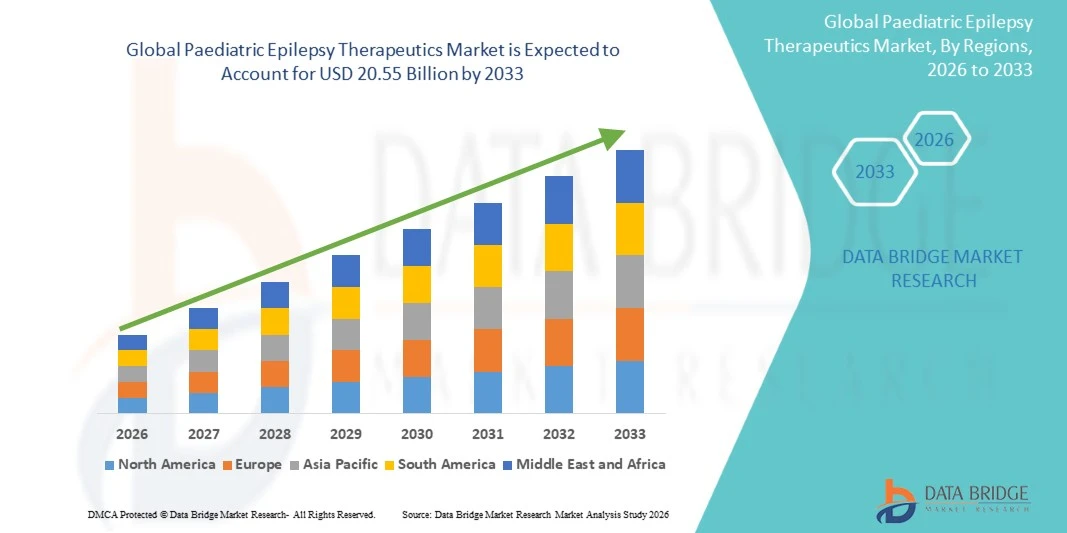
- As per Data Bridge Market Research analysis, the paediatric epilepsy therapeutics market was valued at USD 13.91 billion in 2025 and is projected to reach USD 20.55 billion by 2033, growing at a CAGR of 5.00% from 2026 to 2033.
- The market is experiencing consistent growth driven by the rising prevalence of epilepsy among children, increasing diagnosis of pediatric seizure disorders, growing adoption of advanced antiseizure medications, and continued development of targeted therapies for childhood epilepsy.
- The increasing need for effective seizure control in pediatric patients, combined with growing awareness of early diagnosis and advancements in pharmaceutical formulations, is encouraging healthcare providers to adopt specialized epilepsy therapeutics. Newer-generation antiseizure medicines, improved treatment approaches, and expanding access to pediatric neurological care are further supporting market growth.
Market Size & Forecast
- Global Market Value (2025): USD 13.91 Billion
- Expected Market Value (2033): USD 20.55 Billion
- Forecast CAGR (2026–2033): 5.00%
- Leading Region in 2025: North America
- Fastest Growing Region: Asia Pacific
What are the Major Takeaways of the Paediatric Epilepsy Therapeutics Market?
- North America dominated the paediatric epilepsy therapeutics market with the largest revenue share of 45% in 2025, supported by advanced training infrastructure and strong government investments in simulation technology.
- Asia-Pacific is expected to be the fastest-growing region at a CAGR of 6.8% from 2026 to 2033, fueled by improving healthcare access, rising awareness and diagnosis of pediatric epilepsy, and the large pediatric patient population.
- The lennox-gastaut syndrome segment led the market with a 38.0% share in 2025, driven by the severe and treatment-resistant nature of the disorder and the need for long-term therapeutic management.
- Infantile spasms are the fastest-growing disease type, projected to register a CAGR of 6.7%, reflecting the surge in awareness, earlier diagnosis, and the importance of rapid treatment initiation.
- The surgical therapies segment dominated the therapeutics category with a 35.0% revenue share in 2025, led by increasing adoption of surgical interventions for children with drug-resistant epilepsy and seizures that remain uncontrolled despite pharmacological treatment.
- Hospital pharmacy accounted for 61.0% of the market share in 2025, preferred by the high volume of pediatric epilepsy treatments initiated and dispensed through hospitals and specialized healthcare facilities.
- The vagal nerve stimulation segment is the fastest-growing therapeutics category, with a CAGR of 8.0%, driven by increasing use of neuromodulation for children with drug-resistant epilepsy.
Report Scope and Paediatric Epilepsy Therapeutics Market Segmentation
|
Attributes |
Paediatric Epilepsy Therapeutics Key Market Insights |
|
Segments Covered |
|
|
Countries Covered |
North America
Europe
Asia-Pacific
Middle East and Africa
South America
|
|
Key Market Players |
|
|
Market Opportunities |
|
|
Value Added Data Infosets |
In addition to the insights on market scenarios such as market value, growth rate, segmentation, geographical coverage, and major players, the market reports curated by the Data Bridge Market Research also include in-depth expert analysis, patient epidemiology, pipeline analysis, pricing analysis, and regulatory framework. |
What is the Key Trend in the Paediatric Epilepsy Therapeutics Market?
- Pediatric epilepsy treatment is increasingly shifting toward precision and syndrome-specific therapies, with newer antiseizure medicines targeting severe childhood epilepsies such as Dravet syndrome, Lennox-Gastaut syndrome, and tuberous sclerosis complex
- For instance, in April 2025, Nature Medicine reported the use of the antisense oligonucleotide elsunersen in a preterm infant with SCN2A developmental and epileptic encephalopathy, representing an individualized therapeutic approach targeting the underlying genetic mechanism.
- Genetic testing and molecular diagnosis are increasingly supporting personalized treatment selection for children whose epilepsy is associated with specific genetic variants, enabling therapies to be matched with underlying disease mechanisms.
- Therapeutic drug monitoring is also gaining attention as clinicians seek more precise dosing and safer long-term management of pediatric epilepsy medicines, particularly for newer therapies requiring individualized treatment.
- For instance, in February 2025, NHS England began funding fenfluramine for eligible patients aged two years and older with Lennox-Gastaut syndrome, providing a new non-cannabis treatment option for children with this severe form of epilepsy.
- As pharmaceutical companies and pediatric neurology centers continue developing targeted medicines, genetic therapies, and improved formulations, precision treatment is expected to become increasingly important in childhood epilepsy care.
What are the Key Drivers of the Paediatric Epilepsy Therapeutics Market?
- The rising prevalence of childhood epilepsy and substantial unmet need for effective seizure control are increasing demand for advanced antiseizure medicines and targeted therapies for pediatric patients with treatment-resistant conditions.
- For instance, in April 2025, Indian Pediatrics published an updated article on cannabinoid use in pediatric epilepsy, highlighting cannabidiol's clinical use for selected epilepsy syndromes and its role in reducing seizure frequency in children
- Increasing recognition of genetic and developmental epileptic encephalopathies is encouraging pharmaceutical companies and research institutions to develop mechanism-specific treatments addressing the underlying molecular causes of pediatric epilepsy.
- For instance, in March 2022, the U.S. Food and Drug Administration (FDA) approved Fintepla (fenfluramine) for the treatment of seizures associated with Lennox-Gastaut syndrome in patients 2 years of age and older. The approval expands pharmacological treatment options for children with this severe form of epilepsy and supports the adoption of newer targeted antiseizure therapies in the pediatric population
- With growing investment in novel antiseizure medicines, genetic therapies, and personalized treatment strategies, the paediatric epilepsy therapeutics market is expected to expand as clinicians seek improved seizure control and treatment outcomes.
Which Factors are Challenging the Growth of the Paediatric Epilepsy Therapeutics Market?
- High treatment costs, limited availability of specialized medicines, and unequal healthcare infrastructure continue to restrict access to advanced paediatric epilepsy therapeutics, particularly across low- and middle-income countries.
- For instance, in December 2024, Epilepsy & Behavior published a study examining antiseizure medication adherence in children with epilepsy. The study found that perceptions of medications and side effects attributed to antiseizure medicines were significantly associated with non-adherence, highlighting a challenge in maintaining consistent pediatric epilepsy treatment
- These access barriers can delay diagnosis and treatment, leaving many children without appropriate seizure management and limiting the adoption of newer, higher-cost therapies in resource-constrained healthcare systems.
- Safety monitoring requirements for certain advanced therapies can further increase treatment complexity, requiring specialized clinical supervision, regular assessments, and additional healthcare resources for pediatric patients.
- For instance, in November 2025, Seizure: European Journal of Epilepsy published an article of adjunctive lacosamide in children with drug-resistant epilepsy. The analysis of 503 pediatric patients found that 28% experienced adverse events, with drowsiness and irritability among the most common, while 24% discontinued treatment, highlighting tolerability and treatment-continuation challenges in pediatric epilepsy.
- The combination of treatment-access disparities, high medicine costs, specialist requirements, and safety-monitoring obligations continues to challenge widespread adoption of advanced paediatric epilepsy therapeutics, particularly in resource-limited markets.
How is the Paediatric Epilepsy Therapeutics Market Segmented?
The paediatric epilepsy therapeutics market is segmented on the basis of disease type, therapeutics, end-users, and distribution channel.
- By Disease Type
On the basis of disease type, the paediatric epilepsy therapeutics market is segmented into benign rolandic epilepsy, infantile spasms, lennox-gastaut syndrome, and others. The lennox-gastaut syndrome segment dominated the market with 38.0% share in 2025, owing to the severe and treatment-resistant nature of the disorder and the need for long-term therapeutic management. lennox-gastaut syndrome primarily affects children and is associated with multiple seizure types, creating a substantial need for effective treatment. The availability of approved therapies specifically targeting lennox-gastaut syndrome is supporting treatment adoption. Increasing diagnosis and clinical recognition of developmental and epileptic encephalopathies are also contributing to demand for specialized therapies. Continued research into novel antiseizure medicines is expanding treatment options for affected children.
The infantile spasms segment is projected to register the fastest growth at a CAGR of 6.7% from 2026 to 2033, driven by increasing awareness, earlier diagnosis, and the importance of rapid treatment initiation. Infantile spasms generally occur during early childhood and require prompt therapeutic intervention to reduce seizure burden and potential developmental consequences. Greater awareness among pediatricians and caregivers is supporting earlier recognition of the condition. The availability of established therapies, including hormonal treatments and vigabatrin, is strengthening disease management. Increasing research into genetic and neurological causes is also improving identification of affected children. Advances in pediatric neurology and diagnostic technologies are facilitating more timely treatment decisions.
- By Therapeutics
On the basis of therapeutics, the paediatric epilepsy therapeutics market is segmented into surgical therapies, dietary supplements, vagal nerve stimulation, and others. The surgical therapies segment dominated the market with 35.0% share in 2025, owing to increasing adoption of surgical interventions for children with drug-resistant epilepsy and seizures that remain uncontrolled despite pharmacological treatment. Surgical therapies can provide an important treatment option for patients with identifiable epileptogenic brain regions. Advances in neuroimaging, electroencephalography, and presurgical evaluation are improving the identification of suitable surgical candidates. Increasing availability of specialized pediatric epilepsy centers is supporting access to advanced surgical procedures. Growing clinical awareness of drug-resistant epilepsy is also encouraging earlier consideration of surgical treatment. Improvements in minimally invasive and image-guided neurosurgical techniques are further supporting treatment adoption.
The vagal nerve stimulation segment is expected to witness the fastest growth at a CAGR of 8.0% from 2026 to 2033, supported by increasing use of neuromodulation for children with drug-resistant epilepsy. Vagal nerve stimulation provides an additional treatment option for selected patients who do not achieve adequate seizure control through medication. Growing recognition of drug-resistant epilepsy is increasing demand for alternative and adjunctive treatment approaches. Technological improvements in implantable stimulation devices are supporting more effective and manageable treatment. Vagal nerve stimulation can also be used alongside antiseizure medicines, making it suitable for multimodal epilepsy management. Increasing clinical experience with neuromodulation in pediatric patients is supporting adoption among specialized epilepsy centers.
- By End-Users
On the basis of end-users, the paediatric epilepsy therapeutics market is segmented into hospitals, specialty clinics, and others. The hospitals segment dominated the market with 65.0% share in 2025, owing to the availability of multidisciplinary pediatric neurology services, diagnostic infrastructure, inpatient care, and advanced epilepsy management facilities. Hospitals are commonly preferred for children requiring comprehensive evaluation of recurrent or complex seizures. They provide access to neurologists, pediatricians, electroencephalography, imaging facilities, and other supporting services. Hospitals are also better equipped to manage severe seizure episodes and complications requiring immediate medical intervention. Children with drug-resistant epilepsy may require prolonged monitoring and specialized evaluation that can be provided through hospital-based epilepsy units. The availability of surgical and neuromodulation services further strengthens hospital-based treatment.
The specialty clinics segment is projected to register the fastest growth at a CAGR of 7.5% from 2026 to 2033, driven by increasing demand for specialized outpatient epilepsy management and focused pediatric neurological care. Specialty clinics provide targeted epilepsy assessment, medication management, and regular follow-up without requiring prolonged hospitalization. Growing emphasis on early diagnosis and continuous monitoring is encouraging the development of dedicated pediatric neurology services. Advances in outpatient diagnostic procedures and seizure-monitoring technologies are improving the capabilities of specialty clinics. These facilities can also support medication adjustments and long-term management of children with controlled or partially controlled epilepsy. Increasing healthcare access and expansion of specialized neurological services are further supporting this category.
- By Distribution Channel
On the basis of distribution channel, the paediatric epilepsy therapeutics market is segmented into hospital pharmacy, retail pharmacy, online pharmacies, and others. The hospital pharmacy segment dominated the market with 61.0% share in 2025, supported by the high volume of pediatric epilepsy treatments initiated and dispensed through hospitals and specialized healthcare facilities. Hospital pharmacies provide direct access to prescribed antiseizure medicines following diagnosis and specialist consultation. They are particularly important for children receiving treatment for severe or newly diagnosed epilepsy. Hospital pharmacists can support medication counseling, dosage management, and monitoring of potential drug interactions. The availability of specialized medicines within hospital settings facilitates timely treatment initiation. Increasing specialist management of complex pediatric epilepsy cases further supports demand through this channel.
The online pharmacies segment is expected to witness the fastest growth at a CAGR of 8.2% from 2026 to 2033, driven by increasing digitalization of healthcare services, greater internet penetration, and growing acceptance of online medicine purchasing. Parents and caregivers can use digital platforms to arrange prescription refills and access medicines without visiting a physical pharmacy. Online channels provide greater convenience for families managing long-term pediatric epilepsy treatment. Digital prescription systems and home-delivery services are improving accessibility for patients requiring regular medication refills. Increasing adoption of telemedicine is also creating greater integration between remote consultations and digital pharmacy services. Improvements in logistics and online prescription-management platforms are further supporting this distribution channel.
Which Region Holds the Largest Share of the Paediatric Epilepsy Therapeutics Market?
- North America dominated the paediatric epilepsy therapeutics market with the largest revenue share of 45% in 2025, supported by advanced training infrastructure and strong government investments in simulation technology.
- The region also benefits from extensive availability of specialized epilepsy centers, favorable regulatory support for pediatric therapies, and significant investment in research and development of novel antiseizure treatments. Increasing adoption of advanced surgical and neuromodulation therapies, along with growing awareness of drug-resistant epilepsy, continues to strengthen North America’s leadership position in the global market.
U.S. Paediatric Epilepsy Therapeutics Market Insight
The U.S. paediatric epilepsy therapeutics market is witnessing strong growth due to rising diagnosis of childhood epilepsy, advanced pediatric neurological care, and increasing adoption of innovative antiseizure therapies. The country’s mature healthcare ecosystem, along with increasing availability of specialized epilepsy centers, surgical interventions, and neuromodulation therapies, is driving demand across pediatric healthcare settings. In addition, growing emphasis on early diagnosis, effective seizure management, and treatment of drug-resistant epilepsy is accelerating the adoption of advanced therapeutics across the country.
Asia-Pacific Paediatric Epilepsy Therapeutics Market Insight
The Asia-Pacific paediatric epilepsy therapeutics market is expected to witness rapid growth, driven by increasing awareness of childhood epilepsy, expanding healthcare infrastructure, and rising access to pediatric neurological services across countries such as China, India, and Japan. Growing diagnosis of epilepsy, improving availability of antiseizure medicines, and increasing adoption of advanced treatment approaches are supporting regional market expansion. In addition, rising healthcare expenditure, development of specialized epilepsy centers, and growing awareness among parents and healthcare professionals are accelerating access to pediatric epilepsy treatment across the region.
Japan Paediatric Epilepsy Therapeutics Market Insight
The Japan paediatric epilepsy therapeutics market is witnessing consistent growth due to rising investments in pediatric neurological care, advanced diagnostic capabilities, and innovative epilepsy treatment approaches. Hospitals and specialized medical centers are increasingly adopting advanced antiseizure therapies, surgical procedures, and neuromodulation approaches for children with difficult-to-control epilepsy. Moreover, increasing focus on early diagnosis, precision treatment, and continuous management of childhood epilepsy is further contributing to market growth.
China Paediatric Epilepsy Therapeutics Market Insight
The China paediatric epilepsy therapeutics market is growing rapidly, driven by expanding healthcare infrastructure, increasing awareness of childhood epilepsy, and rising access to specialized pediatric neurological services. Growing adoption of advanced antiseizure medicines, surgical therapies, and diagnostic technologies across hospitals and specialist centers is significantly boosting market demand. In addition, rising healthcare expenditure, improvements in pediatric epilepsy diagnosis, and increasing government focus on neurological healthcare are supporting the expansion of pediatric epilepsy therapeutics across the country.
U.K. Paediatric Epilepsy Therapeutics Market Insight
The U.K. paediatric epilepsy therapeutics market is experiencing steady growth, supported by advanced pediatric healthcare infrastructure, specialized epilepsy services, and increasing adoption of innovative treatment approaches. Growing access to antiseizure medicines, epilepsy surgery, and specialist neurological care is contributing to market growth. Furthermore, increasing focus on early diagnosis, multidisciplinary epilepsy management, and improved treatment pathways is strengthening the availability and adoption of pediatric epilepsy therapeutics in the U.K.
Germany Paediatric Epilepsy Therapeutics Market Insight
The Germany paediatric epilepsy therapeutics market is expanding steadily due to the country’s advanced healthcare system, strong pediatric neurology capabilities, and increasing adoption of specialized epilepsy treatments. Hospitals and specialist centers are increasingly utilizing modern antiseizure therapies, surgical interventions, and neuromodulation approaches for children with drug-resistant epilepsy. Continuous improvements in diagnostic technologies, specialized epilepsy care, and clinical research, along with growing emphasis on early and individualized treatment, are further driving market growth in Germany.
Which are the Top Companies in Paediatric Epilepsy Therapeutics Market?
The paediatric epilepsy therapeutics industry is primarily led by well-established companies, including:
- UCB S.A. (Belgium)
- Biocodex (France)
- Eisai Co., Ltd. (Japan)
- SK Biopharmaceuticals Co., Ltd. (South Korea)
- Jazz Pharmaceuticals plc (Ireland)
- Supernus Pharmaceuticals, Inc. (U.S.)
- Neurocrine Biosciences, Inc. (U.S.)
- LivaNova PLC (U.K.)
- Otsuka Pharmaceutical Co., Ltd. (Japan)
- Takeda Pharmaceutical Company Limited (Japan)
- H. Lundbeck A/S (Denmark)
- Pfizer Inc. (U.S.)
- AbbVie Inc. (U.S.)
- Sun Pharmaceutical Industries Ltd. (India)
- Dr. Reddy’s Laboratories Ltd. (India)
- Cipla Limited (India)
- Torrent Pharmaceuticals Limited (India)
- Zydus Lifesciences Limited (India)
- Alkem Laboratories Limited (India)
- Teva Pharmaceutical Industries Ltd. (Israel)
What are Latest Developments in Paediatric Epilepsy Therapeutics Market?
- In December 2025, UCB announced positive Phase 3 results from the GEMZ study evaluating fenfluramine in patients with CDKL5 deficiency disorder, a rare developmental and epileptic encephalopathy. The study achieved its primary endpoint by demonstrating a statistically significant reduction in countable motor seizure frequency compared with placebo, supporting further regulatory development of fenfluramine for this pediatric epilepsy population.
- In March 2025, UCB announced publication of the final analysis of a long-term open-label extension study of FINTEPLA (fenfluramine) in children and adults with Dravet syndrome. The analysis reported sustained reductions in monthly convulsive seizure frequency and provided additional long-term safety and effectiveness data for the therapy in patients with this severe developmental epilepsy.
- In November 2024, Biocodex announced the development of a new oral-suspension formulation of DIACOMIT (stiripentol) for young children with Dravet syndrome. The formulation was being developed for patients aged 6 months and older who are taking clobazam, with the aim of providing a more suitable administration option for young children with this severe, treatment-resistant epilepsy.
- In July 2024, the U.S. Food and Drug Administration (FDA) issued final guidance on the clinical development of medicines for partial-onset seizures in pediatric patients aged 1 month and older. The guidance provides recommendations for using efficacy data from adults to support pediatric drug development, helping establish a regulatory pathway for expanding treatments to younger epilepsy patients.
- In August 2021, UCB announced that the FDA approved an expanded indication for BRIVIACT (brivaracetam) to treat partial-onset seizures in patients as young as 1 month of age. The expanded approval covered tablets, oral solution, and intravenous formulations, increasing the availability of an FDA-approved antiseizure treatment for very young pediatric patients.

- Interactive Data Analysis Dashboard
- Company Analysis Dashboard for high growth potential opportunities
- Research Analyst Access for customization & queries
- Competitor Analysis with Interactive dashboard
- Latest News, Updates & Trend analysis
- Harness the Power of Benchmark Analysis for Comprehensive Competitor Tracking
Data collection and base year analysis are done using data collection modules with large sample sizes. The stage includes obtaining market information or related data through various sources and strategies. It includes examining and planning all the data acquired from the past in advance. It likewise envelops the examination of information inconsistencies seen across different information sources. The market data is analysed and estimated using market statistical and coherent models. Also, market share analysis and key trend analysis are the major success factors in the market report. To know more, please request an analyst call or drop down your inquiry.
The key research methodology used by DBMR research team is data triangulation which involves data mining, analysis of the impact of data variables on the market and primary (industry expert) validation. Data models include Vendor Positioning Grid, Market Time Line Analysis, Market Overview and Guide, Company Positioning Grid, Patent Analysis, Pricing Analysis, Company Market Share Analysis, Standards of Measurement, Global versus Regional and Vendor Share Analysis. To know more about the research methodology, drop in an inquiry to speak to our industry experts.
Data Bridge Market Research is a leader in advanced formative research. We take pride in servicing our existing and new customers with data and analysis that match and suits their goal. The report can be customized to include price trend analysis of target brands understanding the market for additional countries (ask for the list of countries), clinical trial results data, literature review, refurbished market and product base analysis. Market analysis of target competitors can be analyzed from technology-based analysis to market portfolio strategies. We can add as many competitors that you require data about in the format and data style you are looking for. Our team of analysts can also provide you data in crude raw excel files pivot tables (Fact book) or can assist you in creating presentations from the data sets available in the report.












