


What is the Palm Oil Market Size and Growth Rate?
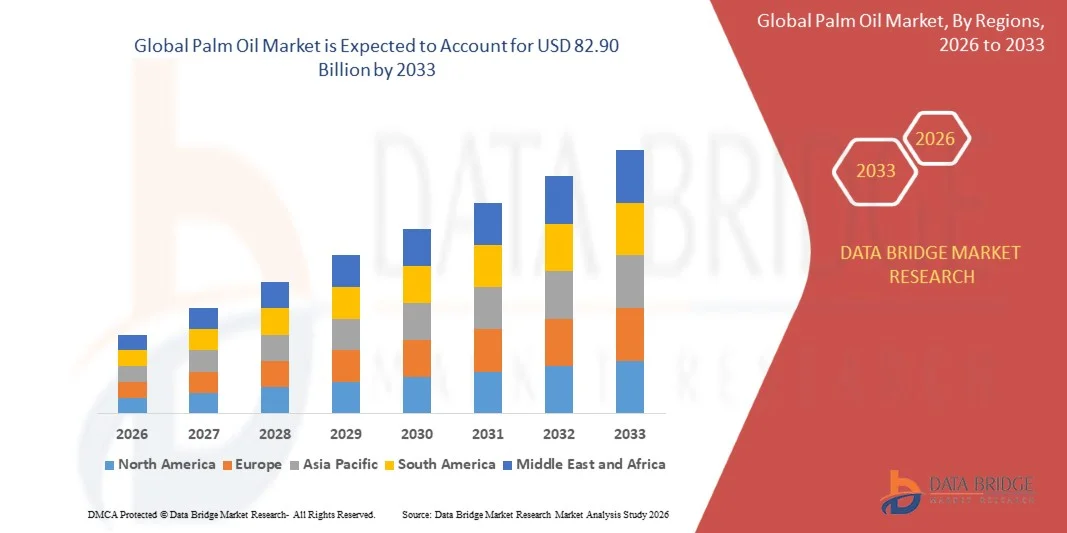
- As per Data Bridge Market Research analysis the palm oil market was valued at USD 59.65 billion in 2025 and is projected to reach USD 82.90 billion by 2033, growing at a CAGR of 4.20% from 2026 to 2033.
- The market is experiencing consistent growth driven by its deep integration into global food systems, personal care manufacturing, and the fast-expanding oleochemical and biofuel sectors. Its versatility, low cost, and long shelf life make it a preferred ingredient in a wide range of products, from bakery and confectionery to cosmetics and cleaning agents.
- Government-backed biodiesel blending mandates across Southeast Asia, such as Indonesia's B40 program, continue to underpin demand, absorbing millions of tons of crude palm oil annually and supporting price stability.
Market Size & Forecast
- Market Value (2025): USD 59.65 Billion
- Expected Market Value (2033): USD 82.90 Billion
- Forecast CAGR (2026–2033): 4.20%
- Leading Region in 2025: Asia-Pacific
- Fastest Growing Region: North America
What are the Major Takeaways of the Palm Oil Market?
- Asia-Pacific dominated the global palm oil market and accounted for the largest revenue share 74.60% in 2025, supported by the presence of major palm oil-producing countries such as Indonesia and Malaysia, expanding domestic consumption, and strong export activities across the region.
- North America is expected to witness steady growth from 2026 to 2033, supported by growing demand from the food processing, bakery, confectionery, personal care, and biofuel industries. The region's increasing consumption of processed and convenience foods, coupled with rising utilization of palm-based ingredients in cosmetics and household products, continues to drive market growth.
- The crude palm oil (CPO) segment dominated the market with the largest revenue share in 2025, owing to its extensive use as the primary feedstock for edible oils, food processing, oleochemicals, and biodiesel production.
- The palm kernel oil segment is projected to register the fastest growth from 2026 to 2033, driven by rising demand from the cosmetics, personal care, pharmaceutical, and specialty oleochemical industries. Increasing consumer preference for plant-based ingredients and expanding applications in high-value products are accelerating segment growth.
- The conventional segment accounted for the largest market share in 2025, owing to its large-scale production, competitive pricing, and extensive utilization across food processing, industrial manufacturing, and biofuel applications. The established supply chain and high production volumes continue to support the segment's market dominance.
- The organic segment is anticipated to witness the fastest CAGR from 2026 to 2033, driven by increasing consumer demand for sustainably produced and chemical-free food products. Growing awareness regarding environmental conservation, certified sustainable farming practices, and the rising popularity of organic personal care products are further supporting market expansion.
Report Scope and Palm Oil Market Segmentation
|
Attributes |
Palm Oil Market Key Market Insights |
|
Segments Covered |
|
|
Countries Covered |
North America
Europe
Asia-Pacific
Middle East and Africa
South America
|
|
Key Market Players |
|
|
Market Opportunities |
|
|
Value Added Data Infosets |
In addition to the insights on market scenarios such as market value, growth rate, segmentation, geographical coverage, and major players, the market reports curated by the Data Bridge Market Research also include import export analysis, production capacity overview, production consumption analysis, price trend analysis, climate change scenario, supply chain analysis, value chain analysis, raw material/consumables overview, vendor selection criteria, PESTLE Analysis, Porter Analysis, and regulatory framework. |
What is the Key Trend in the Palm Oil Market?
- The growing adoption of certified sustainable palm oil (CSPO) and fully traceable supply chains is a key trend shaping the global palm oil market, driven by increasing regulatory requirements, corporate sustainability commitments, and consumer demand for responsibly sourced products.
- For instance, in November 2024, the Roundtable on Sustainable Palm Oil (RSPO) adopted its revised 2024 Principles & Criteria and Independent Smallholder Standard, strengthening requirements for deforestation prevention, human rights due diligence, and supply chain traceability.
- Palm oil producers, processors, and consumer goods manufacturers are increasingly investing in digital traceability systems, satellite monitoring, and certification programs to improve supply chain transparency and meet evolving global sustainability regulations.
- Sustainability initiatives are also expanding support for independent smallholders through certification, climate-smart farming practices, and responsible sourcing programs to improve productivity while reducing environmental impact.
- As governments and multinational companies continue prioritizing sustainable sourcing and transparent supply chains, the adoption of certified and traceable palm oil is expected to accelerate, reinforcing sustainability as a core pillar of the global palm oil industry.
What are the Key Drivers of the Driving Simulators Market?
- The expanding demand for palm oil across the food & beverage, personal care, cosmetics, oleochemicals, and biofuel industries is significantly driving market growth due to its high yield, versatility, and cost competitiveness compared to alternative vegetable oils.
- For instance, in January 2025, S&P Global Commodity Insights reported that Indonesia's B40 biodiesel mandate and sustained demand from food and industrial applications are expected to keep the global palm oil market strong throughout 2025.
- Food manufacturers, consumer goods companies, and biofuel producers continue to increase palm oil utilization because of its functional properties, stable supply, and suitability for a wide range of industrial and consumer applications.
- As global consumption of packaged foods, personal care products, and renewable fuels continues to rise, demand for palm oil is expected to remain strong, supporting long-term market expansion.
Which Factors are Challenging the Growth of the Palm Oil Market?
- The palm oil industry faces increasing challenges from stringent environmental regulations, traceability requirements, climate-related production risks, and sustainability compliance costs across global supply chains.
- These evolving regulatory frameworks and certification requirements increase compliance costs for producers, particularly independent smallholders and exporters serving international markets.
- For instance, in February 2025, Malaysia announced stronger measures to improve traceability and prevent fraud in used cooking oil exports as preparations continued for compliance with the European Union's deforestation-related import requirements.
- Climate change, including prolonged droughts and irregular rainfall associated with El Niño, continues to affect plantation productivity and yields, while additional investments are required to improve resilience and sustainable cultivation practices.
- The increasing costs associated with regulatory compliance, certification, traceability, and climate adaptation continue to challenge market growth, particularly for smaller producers, limiting their ability to compete in premium international markets despite rising global demand.
How is the Palm Oil Market Segmented?
- By Product Type
On the basis of product type, the palm oil market is segmented into crude palm oil, rbd palm oil, fractionated palm oil, palm kernel oil, and others. The crude palm oil (CPO) segment dominated the market with the largest revenue share in 2025, owing to its extensive use as the primary feedstock for edible oils, food processing, oleochemicals, and biodiesel production. Its cost-effectiveness, high oil yield, and widespread availability have made it the preferred choice among refiners and industrial manufacturers worldwide.
The palm kernel oil segment is projected to register the fastest growth from 2026 to 2033, driven by rising demand from the cosmetics, personal care, pharmaceutical, and specialty oleochemical industries. Increasing consumer preference for plant-based ingredients and expanding applications in high-value products are accelerating segment growth.
- By Nature
On the basis of nature, the palm oil market is segmented into organic and conventional. The conventional segment accounted for the largest market share in 2025, owing to its large-scale production, competitive pricing, and extensive utilization across food processing, industrial manufacturing, and biofuel applications. The established supply chain and high production volumes continue to support the segment's market dominance.
The organic segment is anticipated to witness the fastest CAGR from 2026 to 2033, driven by increasing consumer demand for sustainably produced and chemical-free food products. Growing awareness regarding environmental conservation, certified sustainable farming practices, and the rising popularity of organic personal care products are further supporting market expansion.
- By Usage
On the basis of usage, the palm oil market is segmented into edible oil, bio-diesel, lubricants, Cosmetics, and others. The Edible Oil segment dominated the market in 2025, supported by widespread consumption in household cooking, processed foods, bakery products, confectionery, and foodservice applications. Palm oil's affordability, long shelf life, and excellent cooking properties continue to strengthen its position as one of the most widely consumed vegetable oils globally.
The bio-diesel segment is expected to witness the fastest growth from 2026 to 2033, driven by increasing government mandates promoting renewable fuels, rising investments in biofuel production, and growing efforts to reduce greenhouse gas emissions. Expanding adoption of biodiesel across transportation and industrial sectors is further supporting segment growth.
- By Application
On the basis of application, the palm oil market is segmented into household cooking, food and beverages, oleo chemicals, personal care, animal feed, and bio-fuel. The food and beverages segment held the largest market share in 2025, owing to extensive utilization of palm oil in processed foods, bakery products, snacks, confectionery, dairy alternatives, and ready-to-eat meals. The ingredient's functional properties, cost efficiency, and stability make it a preferred choice for food manufacturers worldwide.
The personal care segment is projected to register the fastest growth from 2026 to 2033, driven by rising demand for natural and plant-derived ingredients in cosmetics, skincare, haircare, and personal hygiene products. Increasing consumer preference for sustainable formulations and continuous innovation in beauty and wellness products are contributing to the rapid expansion of this segment.
Which Region Holds the Largest Share of the Palm Oil Market?
- Asia-Pacific dominated the palm oil market and accounted for the largest revenue share 74.60% in 2025, supported by the presence of major palm oil-producing countries such as Indonesia and Malaysia, expanding domestic consumption, and strong export activities across the region.
- The region also benefits from rapid population growth, rising demand for edible oils, expanding food processing and oleochemical industries, and increasing utilization of palm oil in biofuel production. Growing investments in sustainable palm cultivation, favorable climatic conditions, and well-established supply chains continue to strengthen Asia-Pacific's leadership position in the global palm oil market.
Japan Palm Oil Market Insight
The Japan palm oil market is expected to witness steady growth from 2026 to 2033 due to increasing demand from the processed food, confectionery, and personal care industries. The country's preference for high-quality food ingredients and growing consumption of convenience foods are supporting palm oil utilization. In addition, rising adoption of sustainable sourcing practices and demand for palm-derived specialty ingredients in cosmetics and household products are further contributing to market growth.
China Palm Oil Market Insight
The China palm oil market accounted for the largest market revenue share in Asia-Pacific among importing countries in 2025, attributed to strong demand from the food processing, instant noodle, bakery, confectionery, and edible oil industries. Rapid urbanization, increasing consumption of packaged foods, and expanding industrial applications continue to fuel market growth. Moreover, rising demand from the oleochemical and animal feed sectors, along with increasing imports to meet domestic consumption requirements, remains a key factor propelling the palm oil market in China.
North America Palm Oil Market Insight
North America is expected to witness steady growth from 2026 to 2033, supported by growing demand from the food processing, bakery, confectionery, personal care, and biofuel industries. The region's increasing consumption of processed and convenience foods, coupled with rising utilization of palm-based ingredients in cosmetics and household products, continues to drive market growth. Furthermore, the growing emphasis on sustainably sourced palm oil and certified supply chains is encouraging manufacturers to adopt RSPO-certified palm oil across various end-use industries.
U.S. Palm Oil Market Insight
The U.S. palm oil market is expected to witness steady growth from 2026 to 2033, fueled by strong demand from the food and beverage, personal care, and industrial sectors. Palm oil is extensively utilized in packaged foods, bakery products, snacks, and confectionery owing to its functional properties and cost efficiency. In addition, increasing demand for renewable feedstocks in biofuel production and growing consumer preference for sustainably certified palm oil are further contributing to market expansion.
Europe Palm Oil Market Insight
The Europe palm oil market is expected to witness steady growth from 2026 to 2033, primarily driven by increasing demand for certified sustainable palm oil across food, cosmetics, and industrial applications. Stringent environmental regulations and corporate sustainability commitments are encouraging manufacturers to source responsibly produced palm oil. Rising consumption of plant-based food products and growing demand for renewable raw materials in oleochemicals are further supporting market growth across the region.
U.K. Palm Oil Market Insight
The U.K. palm oil market is expected to witness notable growth from 2026 to 2033, driven by increasing demand for sustainably sourced palm oil in food manufacturing, bakery, confectionery, and personal care products. Growing consumer awareness regarding responsible sourcing and stronger sustainability commitments by retailers and food manufacturers are expected to support market expansion. The increasing popularity of plant-based and packaged food products is also contributing to market growth.
Germany Palm Oil Market Insight
The Germany palm oil market is expected to witness considerable growth from 2026 to 2033, fueled by rising demand from the food processing, cosmetics, and oleochemical industries. Germany's strong emphasis on sustainability and environmentally responsible sourcing has accelerated the adoption of certified sustainable palm oil. In addition, increasing applications in renewable chemicals, personal care formulations, and bio-based industrial products continue to support market development.
Which are the Top Companies in Palm Oil Market?
The palm oil market industry is primarily led by well-established companies, including:
- Wilmar International Limited (Singapore)
- Sime Darby Plantation Berhad (Malaysia)
- Golden Agri-Resources Ltd. (Singapore)
- IOI Corporation Berhad (Malaysia)
- Musim Mas Holdings Pte. Ltd. (Singapore)
- Kuala Lumpur Kepong Berhad (Malaysia)
- FGV Holdings Berhad (Malaysia)
- Astra Agro Lestari Tbk (Indonesia)
- Bumitama Agri Ltd. (Indonesia)
- Cargill, Incorporated (U.S.)
- ADM (Archer Daniels Midland Company) (U.S.)
- Apical Group Ltd. (Singapore)
- PT SMART Tbk (Indonesia)
- United Plantations Berhad (Malaysia)
What are Latest Developments in Palm Oil Market?
- In January 2026, Raj Oil Mills Limited expanded its edible oil portfolio with the launch of PALMRAJ, a new palm-based edible oil brand. The company disclosed the launch under SEBI Regulation 30 to both BSE Limited and the National Stock Exchange of India (NSE), reinforcing its commitment to regulatory compliance and corporate transparency.
- In November 2025, GS Caltex, through its ARC joint venture with POSCO International, inaugurated a palm oil refining facility in Balikpapan, Indonesia. The facility, built with an investment of KRW 260 billion, has an annual processing capacity of 500,000 tons and is designed to refine crude palm oil into biodiesel feedstock and edible oil products, supporting the company's long-term bioenergy strategy.
- In June 2020, Fuji Oil Group introduced its Responsible Palm Oil Procurement Policy, reaffirming its commitment to No Deforestation, No Peat, and No Exploitation (NDPE) principles. The policy extends across the company's entire palm oil supply chain, promoting sustainable sourcing and responsible procurement practices.

- Interactive Data Analysis Dashboard
- Company Analysis Dashboard for high growth potential opportunities
- Research Analyst Access for customization & queries
- Competitor Analysis with Interactive dashboard
- Latest News, Updates & Trend analysis
- Harness the Power of Benchmark Analysis for Comprehensive Competitor Tracking
Global Palm Oil Market, Supply Chain Analysis and Ecosystem Framework
To support market growth and help clients navigate the impact of geopolitical shifts, DBMR has integrated in-depth supply chain analysis into its Global Palm Oil Market research reports. This addition empowers clients to respond effectively to global changes affecting their industries. The supply chain analysis section includes detailed insights such as Global Palm Oil Market consumption and production by country, price trend analysis, the impact of tariffs and geopolitical developments, and import and export trends by country and HSN code. It also highlights major suppliers with data on production capacity and company profiles, as well as key importers and exporters. In addition to research, DBMR offers specialized supply chain consulting services backed by over a decade of experience, providing solutions like supplier discovery, supplier risk assessment, price trend analysis, impact evaluation of inflation and trade route changes, and comprehensive market trend analysis.
Data collection and base year analysis are done using data collection modules with large sample sizes. The stage includes obtaining market information or related data through various sources and strategies. It includes examining and planning all the data acquired from the past in advance. It likewise envelops the examination of information inconsistencies seen across different information sources. The market data is analysed and estimated using market statistical and coherent models. Also, market share analysis and key trend analysis are the major success factors in the market report. To know more, please request an analyst call or drop down your inquiry.
The key research methodology used by DBMR research team is data triangulation which involves data mining, analysis of the impact of data variables on the market and primary (industry expert) validation. Data models include Vendor Positioning Grid, Market Time Line Analysis, Market Overview and Guide, Company Positioning Grid, Patent Analysis, Pricing Analysis, Company Market Share Analysis, Standards of Measurement, Global versus Regional and Vendor Share Analysis. To know more about the research methodology, drop in an inquiry to speak to our industry experts.
Data Bridge Market Research is a leader in advanced formative research. We take pride in servicing our existing and new customers with data and analysis that match and suits their goal. The report can be customized to include price trend analysis of target brands understanding the market for additional countries (ask for the list of countries), clinical trial results data, literature review, refurbished market and product base analysis. Market analysis of target competitors can be analyzed from technology-based analysis to market portfolio strategies. We can add as many competitors that you require data about in the format and data style you are looking for. Our team of analysts can also provide you data in crude raw excel files pivot tables (Fact book) or can assist you in creating presentations from the data sets available in the report.













