


Parallel Robots Market Size
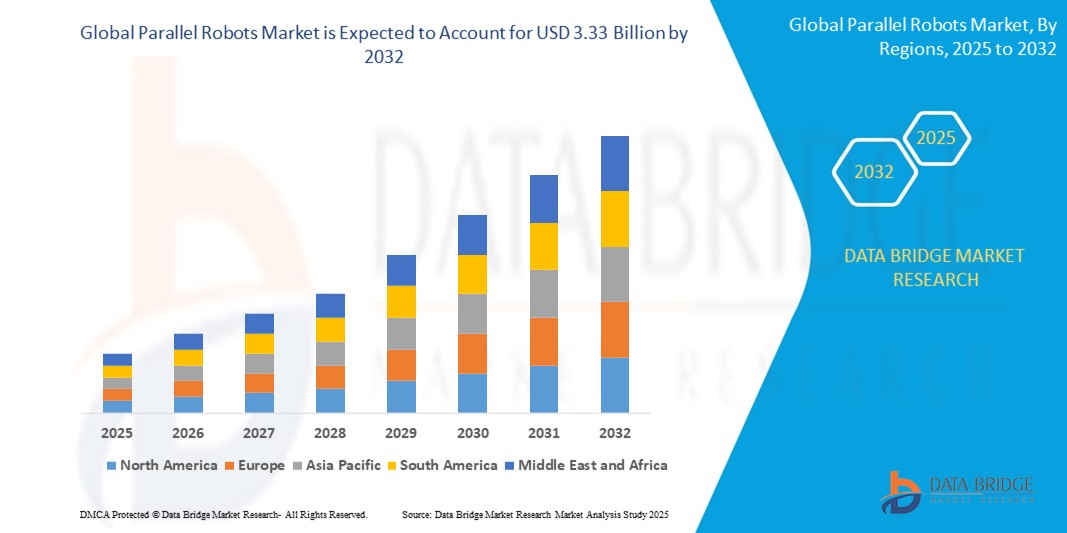
- The global Parallel Robots market size was valued at USD 1.6 billion in 2024 and is expected to reach USD 3.33 billion by 2032, at a CAGR of 9.6% during the forecast period
- The market growth is largely fueled by the rising demand for high-speed and high-precision automation across industries such as electronics, packaging, and automotive
- Furthermore, these robots are known for their stability, accuracy, and ability to handle lightweight parts at fast cycle times, making them ideal for assembly and pick-and-place tasks. Growing adoption of Industry 4.0 and smart manufacturing practices is pushing companies to upgrade their production lines with advanced robotic systems. Technological advancements, including improved control systems and AI integration, are further enhancing robot efficiency.
Parallel Robots Market Analysis
- Parallel robots have two or more arms that are interconnected through several joints and links. Parallel robots are generally of two types namely hexapods and delta robots. Hexapods are used due to their motion freedom in a wide range of applications.
- Delta robots on the other hand are used for simple pick and place applications. Parallel robots are closed consisting of fixed and moving platforms. Parallel robots incorporate both actuated and passive joints. Parallel robots have increased stability and arm rigidity with faster cycle times.
- Asia-Pacific dominates the Parallel Robots market with the largest revenue share of 39.56% in 2025, characterized by rising demand for automation in the industrial operations by the various end user verticals. Rising awareness and adoption of sustainable packaging solutions and green packaging materials is another factor fostering the growth of parallel robots market in this region
- North America is expected to be the fastest growing region in the Parallel Robots market during the forecast period due to Growth in the parallel robots market value is directly proportional to the growth and expansion of end user verticals. Rising contact manufacturing and rise in sale of self- medication and OTC drugs are another two factors bolstering the growth of market in this region
- Hexapods segment is expected to dominate the Parallel Robots market with a market share of 46.22% in 2025, driven by its superior precision and flexibility in complex motion control
Report Scope and Parallel Robots Market Segmentation
|
Attributes |
Parallel Robots Key Market Insights |
|
Segments Covered |
|
|
Countries Covered |
North America
Europe
Asia-Pacific
Middle East and Africa
South America
|
|
Key Market Players |
|
|
Market Opportunities |
|
|
Value Added Data Infosets |
In addition to the insights on market scenarios such as market value, growth rate, segmentation, geographical coverage, and major players, the market reports curated by the Data Bridge Market Research also include in-depth expert analysis, pricing analysis, brand share analysis, consumer survey, demography analysis, supply chain analysis, value chain analysis, raw material/consumables overview, vendor selection criteria, PESTLE Analysis, Porter Analysis, and regulatory framework. |
Parallel Robots Market Trends
“Surge in Specialized, Task-Specific Robots”
- The robotics industry is witnessing a shift towards specialized robots designed for specific tasks, such as heavy load transportation, supply delivery in healthcare, and industrial inspections.
- These task-focused robots are gaining significant investor interest due to their efficiency, cost-effectiveness, and clear paths to profitability. Unlike complex humanoid robots still struggling with real-world adaptability and high production costs, these utilitarian machines excel in singular tasks, making them ideal for industries like healthcare, manufacturing, and waste management.
- In Q1 2025, over $2.26 billion was invested globally in robotics, with more than 70% directed at companies building task-specific robots. Advances in AI chip technology, such as Nvidia's Orin NX, support the deployment of more sophisticated edge computing in these robots, enhancing their capabilities and efficiency.
- For Instance, In May 2025, Ati Motors, an Indian robotics company, secured a $50 million investment to develop autonomous mobile robots (AMRs) tailored for logistics and warehouse operations. These robots are designed to transport heavy loads efficiently within industrial settings, addressing labor shortages and improving operational efficiency. The investment underscores the growing demand for specialized robots capable of performing specific tasks with high efficiency.
Parallel Robots Market Dynamics
Driver
“Advancements in Robotics Technology”
- Continuous advancements in robotics technology are driving the adoption of parallel robots across various industries. Innovations in artificial intelligence (AI), machine learning, and sensor technologies have enhanced the capabilities of parallel robots, enabling them to perform complex tasks with greater precision and adaptability.
- The integration of these technologies allows for real-time data processing and decision-making, improving operational efficiency and reducing downtime.
- Furthermore, developments in materials science have led to the creation of lighter and more durable components, enhancing the performance and longevity of parallel robots. These technological advancements make parallel robots more versatile and cost-effective, expanding their applications in sectors such as healthcare, logistics, and pharmaceuticals.
- For Instance, In February 2025, a pharmaceutical company in Switzerland deployed AI-powered parallel robots in their packaging lines to improve accuracy and speed. Equipped with advanced sensors and machine learning algorithms, the robots were able to detect and correct packaging errors in real-time. This implementation led to a 30% reduction in packaging defects and a 25% increase in overall efficiency. The success of this project highlights the transformative impact of technological advancements on the capabilities and adoption of parallel robots in the pharmaceutical industry.
Restraint/Challenge
“High Initial Investment and Maintenance Costs”
- One major challenge for companies adopting parallel robots is the high upfront cost associated with purchasing and installing these advanced robotic systems. The initial investment can be substantial, especially for small and medium-sized enterprises (SMEs) that may have limited budgets. Additionally, maintenance and repair costs can add to the overall expenses, requiring specialized technicians and regular system upgrades.
- These financial barriers can slow down the adoption rate, especially in regions where industrial automation is still emerging. Some industries hesitate to invest heavily in robotics until they see a clear return on investment.
- Moreover, the complexity of programming and integrating parallel robots into existing workflows often demands additional training and system customization, further increasing costs. This restraint may limit the speed at which certain sectors fully embrace parallel robot technology.
- For instance, In January 2025, a mid-sized manufacturer in Eastern Europe postponed its planned upgrade to parallel robots due to budget constraints. Despite recognizing the efficiency benefits, the company found the initial costs and anticipated maintenance expenses prohibitive. This example highlights how financial hurdles can delay automation adoption, especially among smaller businesses.
Parallel Robots Market Scope
The market is segmented on the basis product, type and end users
- By Product
Based on the product, the parallel robots market is segmented into hexapods and delta robots. Hexapods segment is expected to dominate the Parallel Robots market with a market share of 46.22% in 2025, driven by its superior precision and flexibility in complex motion control
The delta robots segment is anticipated to witness the fastest growth rate of 22.3% from 2025 to 2032, fueled by high-speed precision in packaging and assembly tasks. Their lightweight design and flexibility make them ideal for industries like food processing and electronics.
- By Type
Based on the type, the parallel robots market is segmented into double arms and multiple arms. The double arms held the largest market revenue share in 2025 of, driven by the enhanced flexibility and ability to perform complex, synchronized tasks in industries like automotive and manufacturing. This design improves efficiency and precision in handling heavy or intricate components.
The multiple arms segment is expected to witness the fastest CAGR from 2025 to 2032, driven by its capability to handle complex, multi-task operations simultaneously, boosting productivity in sectors like electronics and aerospace. Its versatility and efficiency make it ideal for advanced automation needs.
- By End Users
Based on the end users, the parallel robots market is segmented into food and beverages, medical, electronics and others. The food and beverages held the largest market revenue share in 2025, driven by the rising demand for automation in packaging, sorting, and quality control to ensure food safety and efficiency. Growing consumer focus on hygiene and fast production also fuels this growth.
The medical electronics segment held a significant market share in 2025, favored for its need for high-precision and reliable automation in manufacturing delicate medical devices. Strict quality standards and growing healthcare demands further drive adoption.
Parallel Robots Market Regional Analysis
- Asia-Pacific dominates the Parallel Robots market with the largest revenue share of 39.56% in 2025, characterized by rising demand for automation in the industrial operations by the various end user verticals. Rising awareness and adoption of sustainable packaging solutions and green packaging materials is another factor fostering the growth of parallel robots market in this region
- Growth in the parallel robots market value is directly proportional to the growth and expansion of end user verticals. Rising contact manufacturing and rise in sale of self- medication and OTC drugs are another two factors bolstering the growth of market in this region.
India Parallel Robots Market Insight
India’s parallel robots market is emerging, fueled by growing automotive and electronics manufacturing sectors. Increasing investments in automation and smart factories support adoption. Government programs encouraging “Make in India” and Industry 4.0 help boost robotics use. Challenges like cost sensitivity exist but are gradually being addressed. The rising demand for efficiency and quality is pushing market growth.
China Parallel Robots Market Insight
China dominates the Asia-Pacific parallel robots market with its massive manufacturing sector and strong government backing. The push towards smart factories and automation in electronics, automotive, and consumer goods accelerates adoption. Local manufacturers are increasingly producing advanced robots. Rising labor costs and the need for precision manufacturing boost demand. China’s focus on innovation and technology upgrades drives continued market expansion.
North America Parallel Robots Market Insight
North America’s parallel robots market is expanding rapidly, driven by large-scale adoption in automotive, aerospace, and electronics manufacturing. Strong investments in AI and IoT integration improve robot capabilities. The U.S. government’s support for advanced manufacturing technologies fuels growth. Labor shortages also motivate companies to automate. The presence of key robotics companies bolsters innovation and market penetration.
U.S. Parallel Robots Market Insight
The U.S. market for parallel robots is growing fast, supported by a large industrial base and advanced technology adoption. The automotive and electronics sectors are major users of these robots for precision and speed. Increasing focus on smart factories and automation drives demand. Government incentives for automation help reduce costs for manufacturers. Research in AI-powered robotics further advances the market.
Europe Parallel Robots Market Insight
The Europe parallel robots market is growing steadily, led by strong demand from automotive, aerospace, and manufacturing industries. Countries like Germany, France, and Italy are key contributors due to their advanced industrial base. The region benefits from government initiatives supporting automation and Industry 4.0 adoption. Emphasis on precision, quality, and efficiency drives robotics integration. Growing investments in R&D and skilled workforce development further support market expansion.
U.K. Parallel Robots Market Insight
The U.K. parallel robots market is growing steadily as industries like automotive and pharmaceuticals adopt automation for precision tasks. Government initiatives supporting Industry 4.0 boost demand. Investments in research and development also enhance local capabilities. The manufacturing sector is driving most of the growth. The focus on high-quality production standards encourages wider robot integration.
Germany Parallel Robots Market Insight
Germany leads the parallel robots market in Europe due to its strong automotive and industrial machinery sectors. Strict quality and efficiency standards push manufacturers to automate with high-precision robotics. The country’s advanced engineering ecosystem fosters innovation and adoption. Growing emphasis on Industry 4.0 practices accelerates market expansion. Germany’s export-oriented economy benefits from robotics-driven productivity gains.
Parallel Robots Market Share
The Parallel Robots industry is primarily led by well-established companies, including:
- FANUC CORPORATION,
- Epson America, Inc.,
- Yamaha Motor Co., Ltd.,
- ABB,
- Penta Robotics,
- OMRON Corporation,
- Codian Robotics,
- Kawasaki Heavy Industries, Ltd.,
- Stäubli International AG.,
- Guangzhou CNC Equipment Co., Ltd.,
- Hiwin Corporation,
- Shenzhen City TEDA Roboter record,
- Shenyang SIASUN robot,
- Asyril SA,
- Mitsubishi Electric Corporation,
- DENSO Products and Services Americas, Inc.,
- Yaskawa America, Inc.,
- KUKA AG,
- Bekannter (Yuyao) Robotics Technology Co., Ltd.
- AtomRobot.
Latest Developments in Global Parallel Robots Market
-
In February 2025, At MD&M West Epson Robots demonstrated its high-performance SCARA robots and automation solutions. The showcase emphasized Epson's commitment to advancing automation in industries such as medical device manufacturing, packaging, and electronics. The company highlighted its four decades of automation experience and engaged with attendees to understand their unique needs.
- In April 2025, Yamaha Motor Co. introduced its new line of parallel robots designed for high-speed assembly and packaging applications. The robots feature advanced motion control systems and are optimized for precision tasks in electronics and automotive industries. The launch aims to address the growing demand for automation solutions that enhance productivity and reduce operational costs.
- In May 2025, At Automate ABB unveiled its OmniCore™ controller, a transformative control platform delivering faster, more precise, and more autonomous automation across ABB’s entire robot portfolio. The modular design allows users to build and manage robotics systems ranging from single cobots to large-scale, multi-robot production cells. The launch underscores ABB's commitment to advancing automation technology.
- In March 2025, Penta Robotics launched its new series of parallel robots tailored for the food processing industry. The robots are designed to handle delicate tasks such as sorting and packaging perishable goods, ensuring hygiene and efficiency. The introduction aims to meet the increasing demand for automation solutions in the food sector.
- In February 2025, Codian Robotics introduced its new parallel robots optimized for high-speed pick-and-place applications in the electronics industry. The robots feature advanced vision systems and are capable of handling small components with precision. The launch aims to address the growing need for automation solutions in electronics manufacturing.

- Interactive Data Analysis Dashboard
- Company Analysis Dashboard for high growth potential opportunities
- Research Analyst Access for customization & queries
- Competitor Analysis with Interactive dashboard
- Latest News, Updates & Trend analysis
- Harness the Power of Benchmark Analysis for Comprehensive Competitor Tracking
Global Parallel Robots Market, Supply Chain Analysis and Ecosystem Framework
To support market growth and help clients navigate the impact of geopolitical shifts, DBMR has integrated in-depth supply chain analysis into its Global Parallel Robots Market research reports. This addition empowers clients to respond effectively to global changes affecting their industries. The supply chain analysis section includes detailed insights such as Global Parallel Robots Market consumption and production by country, price trend analysis, the impact of tariffs and geopolitical developments, and import and export trends by country and HSN code. It also highlights major suppliers with data on production capacity and company profiles, as well as key importers and exporters. In addition to research, DBMR offers specialized supply chain consulting services backed by over a decade of experience, providing solutions like supplier discovery, supplier risk assessment, price trend analysis, impact evaluation of inflation and trade route changes, and comprehensive market trend analysis.
Data collection and base year analysis are done using data collection modules with large sample sizes. The stage includes obtaining market information or related data through various sources and strategies. It includes examining and planning all the data acquired from the past in advance. It likewise envelops the examination of information inconsistencies seen across different information sources. The market data is analysed and estimated using market statistical and coherent models. Also, market share analysis and key trend analysis are the major success factors in the market report. To know more, please request an analyst call or drop down your inquiry.
The key research methodology used by DBMR research team is data triangulation which involves data mining, analysis of the impact of data variables on the market and primary (industry expert) validation. Data models include Vendor Positioning Grid, Market Time Line Analysis, Market Overview and Guide, Company Positioning Grid, Patent Analysis, Pricing Analysis, Company Market Share Analysis, Standards of Measurement, Global versus Regional and Vendor Share Analysis. To know more about the research methodology, drop in an inquiry to speak to our industry experts.
Data Bridge Market Research is a leader in advanced formative research. We take pride in servicing our existing and new customers with data and analysis that match and suits their goal. The report can be customized to include price trend analysis of target brands understanding the market for additional countries (ask for the list of countries), clinical trial results data, literature review, refurbished market and product base analysis. Market analysis of target competitors can be analyzed from technology-based analysis to market portfolio strategies. We can add as many competitors that you require data about in the format and data style you are looking for. Our team of analysts can also provide you data in crude raw excel files pivot tables (Fact book) or can assist you in creating presentations from the data sets available in the report.













