


What is the Parametric Insurance Market Size and Growth Rate?
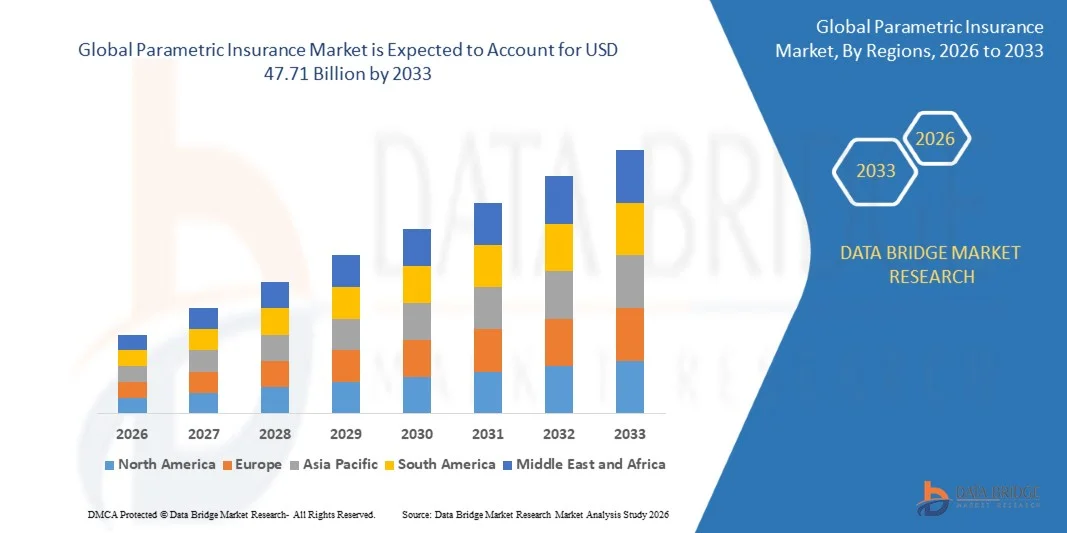
- As per Data Bridge Market Research analysis, the parametric insurance market was valued at USD 19.2 billion in 2025 and is projected to reach USD 47.71 billion by 2033, growing at a CAGR of 12.05% from 2026 to 2033.
- The market is experiencing rapid expansion driven by the increasing frequency and severity of natural disasters, advancements in data analytics and technology, and a growing demand for faster, more transparent insurance payouts. Unlike traditional indemnity-based policies, parametric insurance provides payouts based on predefined triggers (e.g., wind speed, rainfall levels), significantly speeding up the claims process and providing crucial liquidity when it is needed most.
- The rising economic losses from climate-related events are compelling governments, businesses, and agricultural stakeholders to increasingly adopt these innovative risk transfer solutions to enhance financial resilience
Market Size & Forecast
- Market Value (2025): USD 19.2 Billion
- Expected Market Value (2033): USD 47.71 Billion
- Forecast CAGR (2026–2033): 12.05%
- Leading Region in 2025: North America
- Fastest Growing Region: Asia-Pacific
What are the Major Takeaways of the Parametric Insurance Market?
- North America dominated the parametric insurance market in 2025, holding an estimated 45.5% revenue share. The region's growth is driven by increasing awareness of climate risks, technological advancements in data analytics, and supportive regulatory frameworks.
- The Asia-Pacific parametric insurance market is expected to witness the fastest growth rate from 2026 to 2033, supported by increasing climate risks, expanding agricultural activities, rising insurance awareness, and rapid digital transformation.
- The index-based insurance segment held the largest market revenue share in 2025, driven by its extensive adoption across agriculture, disaster risk financing, and climate-risk management programs. Index-based products provide predefined payouts based on measurable parameters such as rainfall levels, temperature fluctuations, or crop yield indices, enabling faster and more transparent claims settlement.
- The weather-based insurance segment is projected to register the fastest growth at a CAGR from 2026 to 2033, driven by increasing climate volatility, rising exposure to extreme weather events, and growing demand from agriculture, energy, and infrastructure sectors. The adoption of advanced weather analytics, satellite monitoring, and real-time data platforms is accelerating segment expansion.
- The agriculture segment held the largest market revenue share in 2025, driven by increasing adoption of weather-index insurance products to protect crops and livestock against droughts, floods, storms, and other climate-related events. Government-supported insurance initiatives and growing awareness of climate resilience strategies continue to support segment dominance.
- The property and casualty segment is projected to register the fastest growth at a CAGR from 2026 to 2033, driven by rising exposure to natural catastrophes, increasing demand for rapid claims settlement, and growing adoption of parametric solutions for commercial properties and infrastructure assets. Businesses are increasingly utilizing parametric coverage to minimize financial losses and operational disruptions following catastrophic events.
Report Scope and Parametric Insurance Market Segmentation
|
Attributes |
Parametric Insurance Key Market Insights |
|
Segments Covered |
|
|
Countries Covered |
North America
Europe
Asia-Pacific
Middle East and Africa
South America
|
|
Key Market Players |
|
|
Market Opportunities |
|
|
Value Added Data Infosets |
In addition to the market insights such as market value, growth rate, market segments, geographical coverage, market players, and market scenario, the market report curated by the Data Bridge Market Research team includes in-depth expert analysis, import/export analysis, pricing analysis, production consumption analysis, and pestle analysis. |
What is the Key Trend in the Parametric Insurance Market?
- Parametric insurance providers are increasingly adopting artificial intelligence (AI), satellite imagery, Internet of Things (IoT) sensors, and advanced climate analytics to automate risk assessment, trigger validation, and rapid claims payouts. These technologies improve underwriting accuracy while enabling insurers to provide transparent, data-driven coverage for weather-related and catastrophe risks.
- For instance, in October 2021, Descartes Underwriting partnered with ICEYE to integrate synthetic aperture radar (SAR) satellite imagery into its parametric flood insurance products, enabling near real-time flood monitoring and rapid claims validation following catastrophic events.
- Real-time weather monitoring, remote sensing technologies, and predictive analytics are enabling insurers to continuously track environmental events and automatically activate payouts once predefined parameters such as wind speed, rainfall, earthquake magnitude, or temperature thresholds are met.
- Businesses across agriculture, energy, construction, logistics, and commercial property sectors are increasingly adopting parametric insurance products to enhance climate resilience, reduce business interruption risks, and obtain faster financial recovery compared with traditional indemnity-based insurance.
- For instance, in June 2026, Liberty and ICEYE, a global leader in satellite-based Earth observation and sovereign intelligence, announced the launch of a pioneering building-level parametric wildfire insurance solution that combines AI, weather intelligence, and satellite-based hazard monitoring to accelerate disaster response, improve risk assessment, and simplify claims processing for climate-related events.
- As climate change increases the frequency and severity of extreme weather events and organizations seek faster, technology-enabled risk transfer mechanisms, the adoption of AI-powered, data-driven parametric insurance solutions is expected to accelerate, strengthening their role in modern catastrophe and climate risk management
What are the Key Drivers of the Parametric Insurance Market?
- The increasing frequency and severity of climate-related disasters, including floods, hurricanes, wildfires, droughts, and earthquakes, are significantly driving demand for parametric insurance solutions that provide rapid payouts based on predefined event parameters rather than lengthy loss assessments.
- For instance, in October 2023, CCRIF provided rapid parametric insurance payouts of USD 3.4 million to Antigua and Barbuda and the British Virgin Islands after Tropical Storm Philippe caused heavy rainfall and flooding. The payout was triggered based on predefined hazard parameters rather than traditional loss assessment. Governments, insurers, reinsurers, and corporations are increasingly adopting satellite imagery, weather stations, IoT sensors, and advanced catastrophe modeling to improve trigger accuracy and expand parametric insurance offerings for climate and natural disaster risks.
- As climate change continues to increase the financial impact of natural disasters and businesses seek faster liquidity following catastrophic events, parametric insurance is expected to witness strong adoption across agriculture, energy, infrastructure, commercial property, and public-sector risk management, supporting sustained market growth.
Which Factors are Challenging the Growth of the Parametric Insurance Market?
- Parametric insurance products rely on accurate historical risk data, real-time monitoring systems, satellite observations, and scientifically validated trigger mechanisms to ensure fair and transparent payouts. Designing reliable triggers that closely match actual financial losses remains a significant challenge, particularly in regions with limited weather stations or incomplete catastrophe data.
- Basis risk—the possibility that a policyholder experiences a loss but the predefined trigger is not activated, or vice versa—continues to be one of the biggest barriers to wider adoption of parametric insurance, reducing customer confidence and limiting market penetration.
- For instance, in October 2021, Descartes Underwriting partnered with ICEYE to integrate high-resolution satellite flood monitoring into its parametric insurance solutions, aiming to improve flood event detection accuracy and reduce basis risk through enhanced trigger design.
- The continued challenge of obtaining high-quality exposure data, minimizing basis risk, and developing transparent, scientifically robust trigger mechanisms remains a key constraint on the broader adoption of parametric insurance, particularly in developing markets and regions with limited climate and disaster monitoring infrastructure.
How is the Parametric Insurance Market Segmented?
The parametric insurance market is segmented on the basis of insurance type, application, deployment and use case.
- By Insurance Type
On the basis of insurance type, the parametric insurance market is segmented into index-based insurance, weather-based insurance, catastrophe bonds, and others. The index-based insurance segment held the largest market revenue share in 2025, driven by its extensive adoption across agriculture, disaster risk financing, and climate-risk management programs. Index-based products provide predefined payouts based on measurable parameters such as rainfall levels, temperature fluctuations, or crop yield indices, enabling faster and more transparent claims settlement.
The weather-based insurance segment is projected to register the fastest growth at a CAGR from 2026 to 2033, driven by increasing climate volatility, rising exposure to extreme weather events, and growing demand from agriculture, energy, and infrastructure sectors. The adoption of advanced weather analytics, satellite monitoring, and real-time data platforms is accelerating segment expansion.
- By Application
On the basis of application, the parametric insurance market is segmented into agriculture, property and casualty, energy, and others. The agriculture segment held the largest market revenue share in 2025, driven by increasing adoption of weather-index insurance products to protect crops and livestock against droughts, floods, storms, and other climate-related events. Government-supported insurance initiatives and growing awareness of climate resilience strategies continue to support segment dominance.
The property and casualty segment is projected to register the fastest growth at a CAGR from 2026 to 2033, driven by rising exposure to natural catastrophes, increasing demand for rapid claims settlement, and growing adoption of parametric solutions for commercial properties and infrastructure assets. Businesses are increasingly utilizing parametric coverage to minimize financial losses and operational disruptions following catastrophic events.
- By Deployment Model
On the basis of deployment model, the parametric insurance market is segmented into cloud-based, on-premise, and hybrid. The cloud-based segment held the largest market revenue share in 2025, driven by increasing adoption of digital insurance platforms, real-time risk monitoring systems, and automated claims processing technologies. Cloud infrastructure enables insurers to efficiently integrate weather data, satellite imagery, AI analytics, and IoT-enabled risk assessment tools.
The hybrid segment is projected to register the fastest growth at a CAGR from 2026 to 2033, driven by growing demand for scalable infrastructure that combines cloud flexibility with enhanced security, regulatory compliance, and data control. Large insurers and reinsurers are increasingly adopting hybrid environments to manage sensitive customer information while leveraging advanced analytics capabilities.
- By Use Case
On the basis of use case, the parametric insurance market is segmented into risk mitigation, index tracking, catastrophe response, and other use cases. The risk mitigation segment held the largest market revenue share in 2025, driven by increasing demand from organizations seeking proactive protection against climate-related, operational, and financial risks. Businesses across agriculture, energy, transportation, and infrastructure sectors are increasingly adopting parametric insurance solutions to strengthen resilience and business continuity planning.
The catastrophe response segment is projected to register the fastest growth at a CAGR from 2026 to 2033, driven by the increasing frequency and severity of hurricanes, floods, wildfires, earthquakes, and other natural disasters worldwide. The ability of parametric insurance to deliver rapid payouts based on predefined triggers is accelerating adoption among governments, enterprises, and disaster recovery organizations.
Which Region Holds the Largest Share of the Parametric Insurance Market?
- North America dominated the parametric insurance market in 2025, holding an estimated 45.5% revenue share. The region's growth is driven by increasing awareness of climate risks, technological advancements in data analytics, and supportive regulatory frameworks. The demand for quick and efficient claims processing is also a significant catalyst, as businesses seek to mitigate risks associated with natural disasters and other unforeseen events. The United States and Canada are the leading countries in this market, with major players such as Swiss Re, Aon, and Evergreen establishing a strong presence.
- The region also benefits from strong regulatory support for innovative insurance products, high adoption of AI and satellite-based monitoring platforms, and growing use of parametric insurance across corporate risk management, agriculture, and infrastructure sectors. Increasing focus on climate resilience and disaster recovery continues to strengthen North America's leadership position in the global market.
Europe Parametric Insurance Market Insight
The Europe parametric insurance market is expected to witness significant growth from 2026 to 2033, primarily driven by increasing climate volatility, regulatory focus on disaster resilience, and rising demand for innovative risk transfer mechanisms. European countries are increasingly adopting parametric solutions to address risks associated with floods, droughts, storms, and agricultural losses. The presence of mature insurance markets, supportive sustainability initiatives, and growing partnerships between insurers, governments, and technology providers are further promoting the integration of parametric insurance into climate adaptation strategies.
U.K. Parametric Insurance Market Insight
The U.K. parametric insurance market is expected to witness strong growth from 2026 to 2033, supported by increasing adoption of alternative risk management solutions and rising concerns regarding extreme weather events. The country’s developed insurance ecosystem and strong presence of global insurers and reinsurers are encouraging innovation in parametric products for flood, agriculture, infrastructure, and business interruption risks. In addition, the increasing use of sensor-based technologies and data-driven underwriting approaches is expected to strengthen market expansion in the U.K.
Germany Parametric Insurance Market Insight
The Germany parametric insurance market is expected to experience notable growth from 2026 to 2033, driven by increasing awareness of climate-related financial risks and the demand for advanced insurance solutions. Germany’s strong industrial base, emphasis on sustainability, and focus on climate resilience are encouraging businesses to adopt parametric insurance for protecting critical assets and operations. Moreover, the integration of digital technologies, predictive analytics, and innovative risk modelling approaches is supporting the expansion of parametric insurance applications across commercial and industrial sectors.
Asia-Pacific Parametric Insurance Market Insight
The Asia-Pacific parametric insurance market is expected to witness the fastest growth rate from 2026 to 2033, supported by increasing climate risks, expanding agricultural activities, rising insurance awareness, and rapid digital transformation. Countries across the region are increasingly adopting parametric solutions to address natural catastrophes such as typhoons, floods, earthquakes, and droughts. In addition, government-backed insurance programs, growing use of satellite-based monitoring systems, and the expansion of digital financial services are improving accessibility and adoption of parametric insurance solutions across emerging economies.
Japan Parametric Insurance Market Insight
The Japan parametric insurance market is expected to witness steady growth from 2026 to 2033 due to the country’s high exposure to earthquakes, typhoons, and other natural disasters. The increasing need for rapid recovery financing and business continuity solutions is encouraging organizations to adopt parametric insurance products. Furthermore, Japan’s advanced technology ecosystem, strong disaster management capabilities, and growing adoption of data-driven insurance models are supporting the integration of parametric solutions across residential, commercial, and industrial applications.
China Parametric Insurance Market Insight
The China parametric insurance market accounted for a significant share of the Asia-Pacific market in 2025, supported by increasing climate risks, agricultural insurance demand, and the country’s rapid digitalization initiatives. The growing occurrence of floods, droughts, and extreme weather events is encouraging the adoption of index-based insurance solutions among farmers, businesses, and government entities. In addition, China’s expanding insurance sector, strong technology capabilities, and increasing use of artificial intelligence, satellite data, and predictive analytics are accelerating the development of parametric insurance solutions.
Which are the Top Companies in Parametric Insurance Market?
The parametric insurance industry is primarily led by well-established companies, including:
- Allianz SE (Germany)
- Munich Reinsurance Company (Germany)
- AXA SA (France)
- Zurich Insurance Group Ltd. (Switzerland)
- Chubb Limited (Switzerland)
- Swiss Re (Switzerland)
- Lloyd's of London (U.K.)
- Hannover Rück SE (Germany)
- QBE Insurance Group Limited (Australia)
- Beazley Group (U.K.)
- Aon plc (U.K.)
- Sompo Holdings, Inc. (Japan)
- Berkshire Hathaway Specialty Insurance (U.S.)
- Global Parametrics (U.K.)
- FloodFlash (U.K.)
- Descartes Underwriting (France)
What are Latest Developments in Parametric Insurance Market?
- In January 2026, Berkshire Hathaway Specialty Insurance (BHSI) launched Executive First D&O Liability+ in the United Kingdom, offering large commercial enterprises and financial institutions enhanced directors and officers (D&O) liability protection. The solution features expanded Side A coverage, broader risk protection, and dedicated support services to address the evolving liability exposures faced by corporate executives.
- In January 2026, Berkshire Hathaway Specialty Insurance (BHSI) introduced BH FastCAT, a parametric insurance solution in Germany under the leadership of Kim Schumacher, Head of General Property. The product provides innovative coverage for complex property, technical, and specialty risks while strengthening BHSI's portfolio of advanced risk management solutions.
- In December 2025, Zurich Insurance Group Ltd. launched Data Center Project Guard, an innovative Builders Risk insurance solution designed specifically for hyperscale and AI-driven data center construction projects. The offering combines parametric weather coverage with operational property protection to mitigate construction delays, climate-related risks, and complex loss exposures.
- In October 2025, Munich Re Group, in collaboration with Gallagher and The New India Assurance Company Limited, introduced India's first parametric pandemic insurance policy. The solution provides trigger-based payouts for business interruption losses resulting from epidemic and pandemic events, enabling faster financial recovery without the need for traditional claims assessment.

- Interactive Data Analysis Dashboard
- Company Analysis Dashboard for high growth potential opportunities
- Research Analyst Access for customization & queries
- Competitor Analysis with Interactive dashboard
- Latest News, Updates & Trend analysis
- Harness the Power of Benchmark Analysis for Comprehensive Competitor Tracking
Data collection and base year analysis are done using data collection modules with large sample sizes. The stage includes obtaining market information or related data through various sources and strategies. It includes examining and planning all the data acquired from the past in advance. It likewise envelops the examination of information inconsistencies seen across different information sources. The market data is analysed and estimated using market statistical and coherent models. Also, market share analysis and key trend analysis are the major success factors in the market report. To know more, please request an analyst call or drop down your inquiry.
The key research methodology used by DBMR research team is data triangulation which involves data mining, analysis of the impact of data variables on the market and primary (industry expert) validation. Data models include Vendor Positioning Grid, Market Time Line Analysis, Market Overview and Guide, Company Positioning Grid, Patent Analysis, Pricing Analysis, Company Market Share Analysis, Standards of Measurement, Global versus Regional and Vendor Share Analysis. To know more about the research methodology, drop in an inquiry to speak to our industry experts.
Data Bridge Market Research is a leader in advanced formative research. We take pride in servicing our existing and new customers with data and analysis that match and suits their goal. The report can be customized to include price trend analysis of target brands understanding the market for additional countries (ask for the list of countries), clinical trial results data, literature review, refurbished market and product base analysis. Market analysis of target competitors can be analyzed from technology-based analysis to market portfolio strategies. We can add as many competitors that you require data about in the format and data style you are looking for. Our team of analysts can also provide you data in crude raw excel files pivot tables (Fact book) or can assist you in creating presentations from the data sets available in the report.













