


What is the Parking Occupancy Sensing Market Size and Growth Rate ?
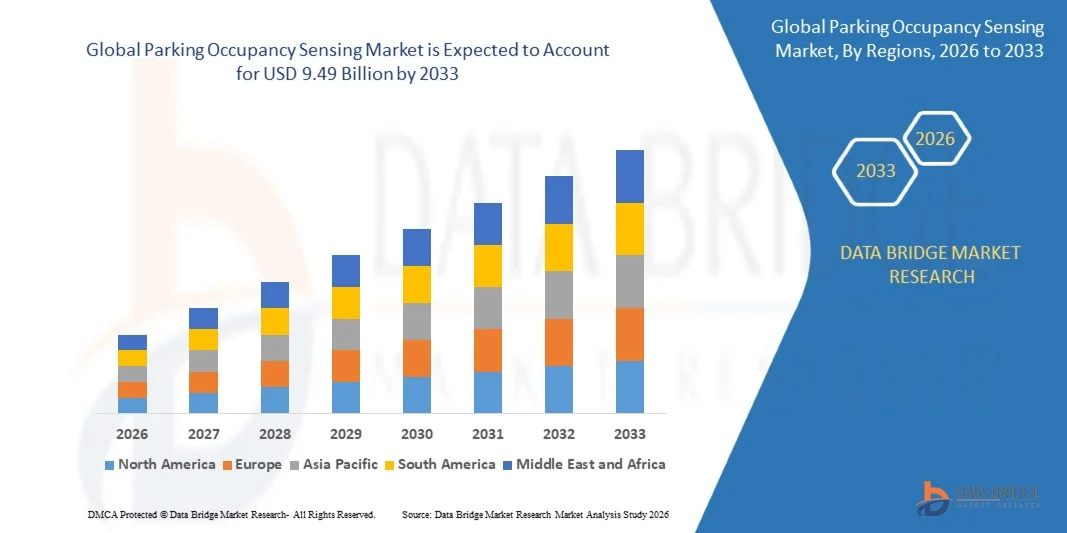
- As per Data Bridge Market Research analysis, the parking occupancy sensing market was valued at USD 3.70 Billion in 2025 and is projected to reach USD 9.49 Billion by 2033, growing at a CAGR of 12.50% from 2026 to 2033.
- The market is experiencing strong growth driven by rising vehicle density in urban centers outpacing the physical expansion of parking supply, growing smart city investment, and increasing municipal adoption of sensor-based occupancy detection to improve curbside and facility utilization without adding new land or structures.
- Expanding integration of occupancy sensing with cloud-connected revenue control, mobile payment platforms, and real-time guidance applications is further accelerating adoption across airports, hospitals, universities, and commercial retail developments seeking to reduce search traffic and improve visitor experience.
Market Size & Forecast
- Global Market Value (2025): USD 3.70 Billion
- Expected Market Value (2033): USD 9.49 Billion
- Forecast CAGR (2026–2033): 12.50%
- Leading Region in 2025: North America
- Fastest Growing Region: Asia-Pacific
What are the Major Takeaways of the Parking Occupancy Sensing Market ?
- North America dominated the global parking occupancy sensing market with the largest revenue share in 2025, supported by early smart city adoption, mature urban parking infrastructure, and strong municipal technology procurement budgets.
- Asia-Pacific is expected to be the fastest-growing region at a CAGR of 14.20% from 2026 to 2033, fueled by large-scale government-led smart city and digital transformation programs across Singapore, Hong Kong, and mainland China.
- The camera/video-based sensors segment led the market in 2025, driven by its ability to monitor multiple parking spaces simultaneously and support integrated license plate recognition and enforcement capabilities.
- Wireless/IoT-enabled connectivity is the fastest-growing category, reflecting the lower installation cost and retrofit flexibility of battery-powered wireless sensors compared with wired infrastructure.
- The municipal/government end-use segment dominated the market in 2025, driven by widespread city-led investment in curbside management and dynamic pricing programs.
- The software segment is expanding rapidly as cities increasingly value the analytics, dashboards, and dynamic pricing engines layered on top of physical sensor hardware.
- The cloud-based deployment segment is the fastest-growing category, driven by lower upfront costs and simpler multi-site management for municipal and commercial operators.
Report Scope and Parking Occupancy Sensing Market Segmentation
|
Attributes |
Parking Occupancy Sensing Key Market Insights |
|
Segments Covered |
|
|
Countries Covered |
North America
Europe
Asia-Pacific
Middle East and Africa
South America
|
|
Key Market Players |
|
|
Market Opportunities |
|
|
Value Added Data Infosets |
In addition to the market insights such as market value, growth rate, market segments, geographical coverage, market players, and market scenario, the market report curated by the Data Bridge Market Research team includes in-depth expert analysis, import/export analysis, pricing analysis, production consumption analysis, and pestle analysis. |
What is the Key Trend in the Parking Occupancy Sensing Market ?
- Leading intelligent transportation vendors are increasingly pursuing acquisitions to broaden their occupancy sensing and traffic management portfolios and expand geographic coverage.
- For instance, in January 2025, SWARCO AG, an Austrian company specializing in intelligent transportation systems and traffic solutions, acquired Lacroix Traffic, strengthening its combined position in connected parking and traffic infrastructure across Europe.
- Vendors are increasingly deploying large-scale, campus-wide wireless sensor networks that pair occupancy detection with license plate recognition to deliver comprehensive facility visibility.
- For instance, in May 2025, Lynkwell announced that more than 10,000 wireless occupancy sensors would be installed across a 17,000-acre university campus, making it the largest university smart parking program in North America, while Genetec's AutoVu automatic license plate recognition technology was deployed in parallel across the same campus.
- As transit authorities and large institutional campuses continue to prioritize fully digital, sensor-connected parking ecosystems, vendors are expected to expand integrated sensing, guidance, and enforcement platforms, reinforcing large-scale digital transformation as a core market trend.
What are the Key Drivers of the Parking Occupancy Sensing Market ?
- Rising vehicle density in urban centers continues to outpace the physical expansion of parking supply, strengthening the procurement case for sensor-based occupancy detection that improves utilization without adding new land or structures.
- For instance, in March 2025, smart parking solutions provider ParkHelp completed the initial installation of its parking guidance sensors for LA Metro at the Arcadia parking lot, marking the first U.S. deployment of ParkHelp's G5 in-ground sensor and the start of a planned rollout across all LA Metro parking facilities.
- Growing municipal and transit-agency interest in reducing traffic congestion associated with vehicles circling in search of parking is driving investment in real-time occupancy and guidance systems at high-traffic transit and commuter facilities.
- For instance, in May 2025, Portier USA completed installation of a smart parking technology suite, comprising 1,200 sonic parking guidance sensors, 40 digital displays, rooftop ultrasonic counters, and an outdoor camera system, at the new Neabsco Mills Potomac Commuter Garage in Woodbridge, Virginia.
- With urban vehicle density continuing to rise and transit agencies increasingly prioritizing data-driven curb and facility management, sustained investment in occupancy sensing infrastructure is expected to remain a key growth driver for the market.
Which Factors are Challenging the Growth of the Parking Occupancy Sensing Market ?
- The upfront cost of installing sensors, software systems, and supporting infrastructure remains a significant barrier for smaller municipalities and parking operators, particularly in emerging markets where budgets are constrained.
- 30% of small and medium-sized parking lot operators report hesitancy toward adopting occupancy sensing systems due to installation and ongoing maintenance costs, despite acknowledging the long-term operational benefits.
- Fragmented technology standards across different sensor vendors and municipal IT systems can complicate large-scale, multi-jurisdiction deployments and increase integration costs for system integrators.
- For instance, in May 2025, the City of West Palm Beach, Florida, partnered with Cleverciti to deploy curb detection and guidance technology, illustrating the vendor-by-vendor, city-by-city integration work still required to build a nationally standardized occupancy sensing infrastructure.
- The combination of high upfront investment requirements, disproportionate cost burden on smaller operators, and technology fragmentation across vendors continues to moderate the pace of adoption despite clear operational and congestion-reduction benefits.
How is the Parking Occupancy Sensing Market Segmented ?
The parking occupancy sensing market is segmented on the basis of sensor technology, component, parking type, connectivity, deployment mode, end-use, application, vehicle type coverage, sales channel, and organization size.
- By Sensor Technology
On the basis of sensor technology, the global parking occupancy sensing market is segmented into ultrasonic sensors, infrared sensors, magnetic sensors, camera/video-based sensors, and radar-based sensors. The camera/video-based sensors segment dominated the market with a 34.60% share in 2025, owing to its ability to monitor multiple parking spaces simultaneously from a single vantage point and support integrated license plate recognition, reducing per-space hardware cost compared with individual in-ground sensors.
The radar-based sensors segment is projected to register the fastest growth at a CAGR of 14.80% from 2026 to 2033, driven by its superior performance in adverse weather and lighting conditions and its growing adoption in outdoor and multi-level parking structure deployments.
- By Component
On the basis of component, the global parking occupancy sensing market is segmented into hardware, software, and services. The hardware segment dominated the market with a 48.30% share in 2025, comprising the physical sensors, gateways, and cameras that form the foundational infrastructure of any occupancy sensing deployment.
The software segment is expected to witness the fastest CAGR of 15.60% from 2026 to 2033, driven by rising municipal demand for analytics dashboards, dynamic pricing engines, and integration with mobile payment and wayfinding applications.
- By Parking Type
On the basis of parking type, the global parking occupancy sensing market is segmented into on-street parking and off-street parking. The off-street parking segment dominated the market with a 58.70% share in 2025, supported by widespread sensor deployment across commercial garages, airport facilities, and shopping center lots seeking to optimize space utilization and reduce operational costs.
The on-street parking segment is projected to witness the fastest CAGR of 14.10% from 2026 to 2033, driven by expanding municipal curbside management programs and dynamic pricing initiatives in dense urban centers.
- By Connectivity
On the basis of connectivity, the global parking occupancy sensing market is segmented into wired and wireless/IoT-enabled. The wireless/IoT-enabled segment dominated the market with a 63.40% share in 2025, driven by significantly lower installation costs, retrofit flexibility for existing parking facilities, and battery-powered sensor designs that eliminate the need for trenching or hardwiring.
The wireless/IoT-enabled segment is also anticipated to remain the fastest-growing category, projected to register a CAGR of 15.20% from 2026 to 2033, as expanding low-power wide-area network coverage continues to improve deployment economics.
- By Deployment Mode
On the basis of deployment mode, the global parking occupancy sensing market is segmented into cloud-based and on-premise. The cloud-based segment dominated the market with a 56.80% share in 2025, supported by lower upfront infrastructure costs and simplified multi-site management for municipal and commercial operators overseeing distributed parking assets.
The cloud-based segment is expected to witness the fastest CAGR of 15.90% from 2026 to 2033, driven by rising demand for centralized, real-time occupancy dashboards accessible across multiple facilities and jurisdictions.
- By End-Use
On the basis of end-use, the global parking occupancy sensing market is segmented into municipal/government, commercial retail, airports, hospitals & healthcare facilities, and educational institutions. The municipal/government segment dominated the market with a 36.90% share in 2025, driven by widespread city-led investment in curbside management, dynamic pricing, and digital enforcement programs.
The airports segment is projected to witness the fastest CAGR of 13.60% from 2026 to 2033, driven by rising passenger traffic and growing airport operator investment in guided parking systems that reduce terminal-area congestion.
- By Application
On the basis of application, the global parking occupancy sensing market is segmented into real-time occupancy detection, dynamic pricing & revenue management, guidance & wayfinding, and enforcement & violation detection. The real-time occupancy detection segment dominated the market with a 41.20% share in 2025, reflecting its role as the foundational use case underpinning all other higher-value applications.
The dynamic pricing & revenue management segment is anticipated to witness the fastest CAGR of 14.90% from 2026 to 2033, driven by growing municipal adoption of demand-responsive pricing models designed to maintain target occupancy levels and reduce vehicle circling.
- By Vehicle Type Coverage
On the basis of vehicle type coverage, the global parking occupancy sensing market is segmented into passenger vehicles, commercial/truck parking, and EV charging-integrated parking. The passenger vehicles segment dominated the market with a 74.50% share in 2025, reflecting the overwhelming majority of monitored parking infrastructure serving standard passenger vehicle traffic.
The EV charging-integrated parking segment is projected to witness the fastest CAGR of 17.30% from 2026 to 2033, driven by rising electric vehicle adoption and growing need to monitor and manage charging-bay occupancy and turnover.
- By Sales Channel
On the basis of sales channel, the global parking occupancy sensing market is segmented into direct sales/OEM contracts, system integrators, and distributors. The system integrators segment dominated the market with a 44.60% share in 2025, reflecting the complex, multi-vendor nature of most municipal and commercial occupancy sensing deployments, which typically require specialized installation and integration expertise.
The direct sales/OEM contracts segment is expected to witness the fastest CAGR of 13.80% from 2026 to 2033, driven by growing large-scale municipal procurement programs that favor direct vendor relationships for long-term system support.
- By Organization Size
On the basis of organization size, the global parking occupancy sensing market is segmented into large enterprises/municipalities and small & medium operators. The large enterprises/municipalities segment dominated the market with a 67.00% share in 2025, supported by large-scale, city-wide sensor deployment budgets and multi-year smart city technology programs.
The small & medium operators segment is anticipated to witness the fastest CAGR of 14.60% from 2026 to 2033, driven by falling sensor hardware costs and growing availability of subscription-based, low-commitment occupancy sensing platforms.
Which Region Holds the Largest Share of the Parking Occupancy Sensing Market ?
- North America dominated the parking occupancy sensing market and accounted for the largest revenue share in 2025, supported by early smart city technology adoption, mature urban parking infrastructure, and strong municipal procurement budgets for digital curb management programs.
- The region also benefits from active pilot programs demonstrating measurable congestion and emissions reductions, growing electric vehicle infrastructure integration, and the presence of leading intelligent transportation technology vendors, which continues to reinforce North America's leadership position in the global market.
U.S. Parking Occupancy Sensing Market Insight
The U.S. parking occupancy sensing market is experiencing strong growth, supported by municipal programs such as San Francisco's SF Park initiative, which has demonstrated measurable congestion reductions through sensor-based dynamic pricing. Leading vendors continue to expand cloud-connected analytics platforms tailored to city-wide curb management. Growing integration with EV charging infrastructure is further contributing to market growth in the U.S.
Germany Parking Occupancy Sensing Market Insight
The Germany parking occupancy sensing market is expanding steadily, supported by the presence of leading global technology vendors including Bosch, Siemens, and Cleverciti, and strong municipal investment in smart city infrastructure. Continued innovation in camera-based and radar sensing technology is supporting deployment across both on-street and off-street parking facilities in Germany.
Asia-Pacific Parking Occupancy Sensing Market Insight
The Asia-Pacific parking occupancy sensing market is expected to witness the fastest growth globally, driven by large-scale government-led smart city and digital transformation programs across Singapore, Hong Kong, and mainland China. Singapore's Parking.sg system and Hong Kong's smart meter network illustrate the scale of regional investment in fully digital, sensor-enabled parking infrastructure.
Singapore Parking Occupancy Sensing Market Insight
The Singapore parking occupancy sensing market continues to serve as a regional benchmark following the Land Transport Authority's rollout of the nationwide Parking.sg system, which replaced paper coupons with app-based payments and remote extensions across all public on-street parking spaces, supporting real-time occupancy visibility and digital enforcement.
Australia Parking Occupancy Sensing Market Insight
The Australia parking occupancy sensing market is growing steadily, supported by state-level digital parking initiatives such as New South Wales' Park'nPay program, which is expanding across local councils, including the City of Ryde, to offer live availability data, ticketless payments, and accessibility-focused features.
Which are the Top Companies in Parking Occupancy Sensing Market ?
The parking occupancy sensing industry is primarily led by well-established companies, including:
- Robert Bosch GmbH (Germany)
- Siemens AG (Germany)
- SWARCO AG (Austria)
- Nedap N.V. (Netherlands)
- INRIX, Inc. (U.S.)
- Haltian Oy (Finland)
- Smart Parking Limited (Australia)
- Worldsensing S.L. (Spain)
- Urbiotica S.L. (Spain)
- CivicSmart, Inc. (U.S.)
- Cleverciti Systems GmbH (Germany)
- Fybr, Inc. (U.S.)
- Parklio d.o.o. (Croatia)
- ParkPlus Inc. (Canada)
- Libelium Comunicaciones Distribuidas S.L. (Spain)
What are Latest Developments in Parking Occupancy Sensing Market ?
- In January 2025, SWARCO AG, an Austrian company specializing in intelligent transportation systems and traffic solutions, acquired Lacroix Traffic, expanding its combined footprint in connected parking and traffic infrastructure across Europe.
- In January 2025, Park+, an Indian auto-tech super app, introduced a smart parking management system using FASTag-based cashless technology for the Maha Kumbh 2025 event, enabling pilgrims to locate, reserve, and prepay for parking across more than 30 government-approved zones accommodating around 500,000 vehicles.
- In March 2025, smart parking solutions provider ParkHelp completed the initial installation of its parking guidance sensors for LA Metro at the Arcadia parking lot, marking the first U.S. deployment of its G5 in-ground sensor technology.
- In May 2025, Portier USA completed installation of a smart parking technology suite comprising 1,200 sonic parking guidance sensors, 40 digital displays, rooftop ultrasonic counters, and an outdoor camera system at the new Neabsco Mills Potomac Commuter Garage in Woodbridge, Virginia.
- In May 2025, Lynkwell announced the installation of more than 10,000 wireless occupancy sensors across a 17,000-acre university campus, forming the largest university smart parking program in North America, alongside a parallel deployment of Genetec's AutoVu automatic license plate recognition technology.

- Interactive Data Analysis Dashboard
- Company Analysis Dashboard for high growth potential opportunities
- Research Analyst Access for customization & queries
- Competitor Analysis with Interactive dashboard
- Latest News, Updates & Trend analysis
- Harness the Power of Benchmark Analysis for Comprehensive Competitor Tracking
Data collection and base year analysis are done using data collection modules with large sample sizes. The stage includes obtaining market information or related data through various sources and strategies. It includes examining and planning all the data acquired from the past in advance. It likewise envelops the examination of information inconsistencies seen across different information sources. The market data is analysed and estimated using market statistical and coherent models. Also, market share analysis and key trend analysis are the major success factors in the market report. To know more, please request an analyst call or drop down your inquiry.
The key research methodology used by DBMR research team is data triangulation which involves data mining, analysis of the impact of data variables on the market and primary (industry expert) validation. Data models include Vendor Positioning Grid, Market Time Line Analysis, Market Overview and Guide, Company Positioning Grid, Patent Analysis, Pricing Analysis, Company Market Share Analysis, Standards of Measurement, Global versus Regional and Vendor Share Analysis. To know more about the research methodology, drop in an inquiry to speak to our industry experts.
Data Bridge Market Research is a leader in advanced formative research. We take pride in servicing our existing and new customers with data and analysis that match and suits their goal. The report can be customized to include price trend analysis of target brands understanding the market for additional countries (ask for the list of countries), clinical trial results data, literature review, refurbished market and product base analysis. Market analysis of target competitors can be analyzed from technology-based analysis to market portfolio strategies. We can add as many competitors that you require data about in the format and data style you are looking for. Our team of analysts can also provide you data in crude raw excel files pivot tables (Fact book) or can assist you in creating presentations from the data sets available in the report.













