


What is the Particle Counters Market Size and Growth Rate?
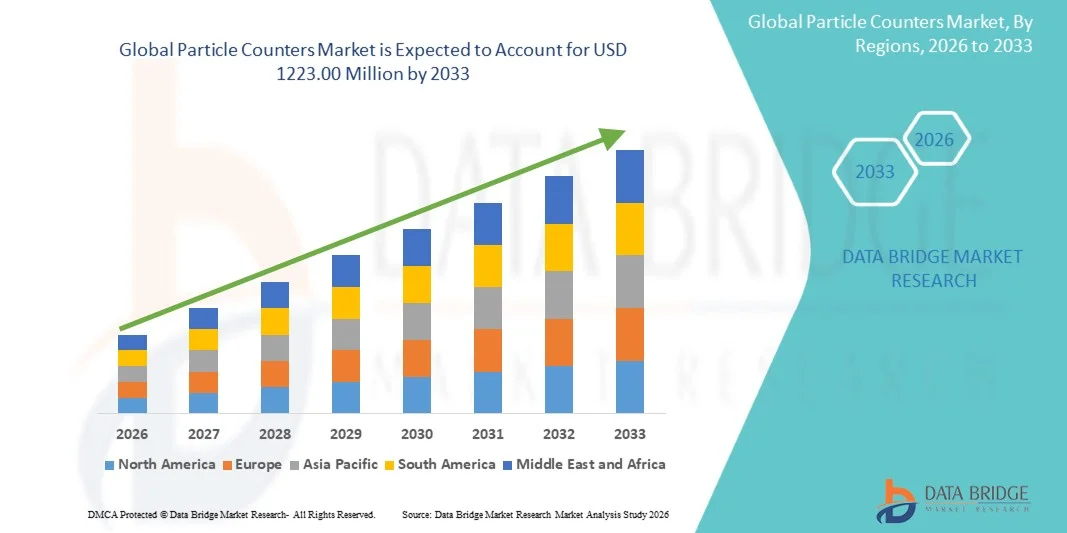
The Particle Counters Market was valued at USD 562.31 Million in 2025 and is projected to reach USD 1223.00 Million by 2033, growing at a CAGR of 10.20% from 2026 to 2033. The market is experiencing consistent growth driven by rising demand for safe and realistic driver training solutions, rapid advancements in simulation hardware and software, and expanding applications across automotive R&D, defense, and professional motorsport.
The increasing incidence of road accidents globally, combined with stricter government regulations on driver training and road safety, is compelling transportation authorities, driving schools, and military organizations to adopt advanced simulation technologies. Fixed-base and VR/AR-enabled simulators are replacing traditional on-road training in many markets, offering cost-effective, repeatable, and risk-free environments for skill development and autonomous vehicle validation.
Key Market Trends & Insights
- North America dominated the Particle Counters Market with the largest revenue share of 58% in 2025, supported by stringent regulatory requirements in pharmaceutical and semiconductor manufacturing, advanced cleanroom infrastructure, high adoption of contamination monitoring technologies, and significant investments in life sciences research and healthcare quality assurance.
- The Airborne Particle Counters segment led the market with a 24% share in 2025, driven by widespread use in cleanroom monitoring, pharmaceutical manufacturing, semiconductor fabrication facilities, hospitals, and research laboratories where continuous air quality assessment is critical for regulatory compliance.
- Asia-Pacific is expected to be the fastest-growing region at a CAGR of 8.3% from 2026 to 2033, fueled by rapid expansion of semiconductor manufacturing, increasing pharmaceutical production, growing healthcare infrastructure investments, and rising adoption of cleanroom technologies across China, India, Japan, South Korea, and Southeast Asia.
- The Online Particle Counters segment is the fastest-growing technology category, projected to register a CAGR of 8.6% from 2026 to 2033, reflecting increasing demand for real-time contamination monitoring, automated data collection, regulatory compliance management, and continuous environmental monitoring in critical manufacturing environments.
- The Portable Particle Counters segment dominates the modularity category with a 76% revenue share in 2025, led by their flexibility, ease of deployment, mobility, and widespread use for routine cleanroom validation, environmental monitoring, and contamination control applications.
- The Cleanroom Monitoring segment accounts for 92% of the market, supported by stringent contamination control requirements in pharmaceutical, biotechnology, semiconductor, and medical device manufacturing facilities.
- The Life Sciences and Medical Device Industry segment is the fastest-growing end-user category, with a CAGR of 8.8%, driven by increasing biologics production, expanding pharmaceutical manufacturing capacity, growing regulatory scrutiny regarding contamination control, and rising investments in advanced healthcare and laboratory infrastructure worldwide.
- The Airborne Particle Counters segment dominated the market with a 24% share in 2025 due to its extensive use in cleanroom monitoring across pharmaceutical manufacturing, biotechnology facilities, semiconductor fabrication plants, hospitals, and research laboratories
Market Size & Forecast
- Global Market Value (2025): USD 562.31 Million
- Expected Market Value (2033): USD 1223.00 Million
- Forecast CAGR (2026–2033): 10.20%
- Leading Region in 2025: North America
- Fastest Growing Region: Asia-Pacific
Report Scope and Particle Counters Market Segmentation
|
Attributes |
Particle Counters Key Market Insights |
|
Segments Covered |
|
|
Countries Covered |
North America · U.S. · Canada · Mexico Europe · Germany · France · U.K. · Netherlands · Switzerland · Belgium · Russia · Italy · Spain · Turkey · Rest of Europe Asia-Pacific · China · Japan · India · South Korea · Singapore · Malaysia · Australia · Thailand · Indonesia · Philippines · Rest of Asia-Pacific Middle East and Africa · Saudi Arabia · U.A.E. · South Africa · Egypt · Israel · Rest of Middle East and Africa South America · Brazil · Argentina · Rest of South America |
|
Key Market Players |
· Beckman Coulter, Inc. (U.S.) · Particle Measuring Systems, Inc. (U.S.) · Lighthouse Worldwide Solutions (U.S.) · TSI Incorporated (U.S.) · RION Co., Ltd. (Japan) · Climet Instruments Company (U.S.) · Met One Instruments, Inc. (U.S.) · Kanomax USA, Inc. (U.S.) · PAMAS GmbH (Germany) · Chemtrac Systems, Inc. (U.S.) · HAL Technology, LLC (U.S.) · GrayWolf Sensing Solutions (U.S.) · Suzhou Sujing Automation Instrument Equipment Co., Ltd. (China) · Topas GmbH (Germany) · Markus Klotz GmbH (Germany) · MicronView Co., Ltd. (China) · Spectrex Corporation (U.S.) · HCT Co., Ltd. (South Korea) · EMTEK, LLC (U.S.) · AIRY Technology Inc. (U.S.) |
|
Market Opportunities |
· Expansion of Semiconductor Manufacturing and Advanced Electronics Productio · Growing Adoption of Cleanroom Technologies in Pharmaceuticals and Biotechnology · Increasing Demand for Continuous Environmental and Indoor Air Quality Monitoring |
|
Value Added Data Infosets |
In addition to the insights on market scenarios such as market value, growth rate, segmentation, geographical coverage, and major players, the market reports curated by the Data Bridge Market Research also include in-depth expert analysis, geographically represented company-wise production and capacity, network layouts of distributors and partners, detailed and updated price trend analysis and deficit analysis of supply chain and demand. |
What is the Key Trend in the Particle Counters Market?
Trend: Growing Adoption of Real-Time Contamination Monitoring and Cleanroom Automation
The Particle Counters market is witnessing a strong trend toward real-time contamination monitoring and automated cleanroom management systems across pharmaceutical, biotechnology, semiconductor, healthcare, and advanced manufacturing industries. Organizations are increasingly deploying network-connected particle counters capable of continuous environmental monitoring to ensure compliance with stringent regulatory standards such as ISO 14644, EU GMP Annex 1, and FDA guidelines. The integration of cloud connectivity, IoT-enabled sensors, and automated reporting platforms allows facilities to identify contamination events immediately and take corrective actions before product quality is compromised. Semiconductor manufacturers, sterile drug producers, and medical device companies are increasingly investing in advanced particle monitoring infrastructure to improve operational efficiency, reduce product recalls, and maintain regulatory compliance.
Particle Counters Market Dynamics
Key Market Driver: Increasing Demand for Contamination Control in Pharmaceutical and Semiconductor Manufacturing
Manufacturing
The growing emphasis on contamination control across pharmaceutical manufacturing, biotechnology research, semiconductor fabrication, and healthcare facilities is a major factor driving demand for particle counters. Pharmaceutical companies rely on airborne and liquid particle monitoring systems to maintain sterile production environments and comply with global regulatory requirements. According to industry estimates, the semiconductor manufacturing process involves thousands of highly sensitive production steps where microscopic particle contamination can significantly impact product yield and performance.
Furthermore, increasing investments in biologics manufacturing, vaccine production, cell and gene therapy development, and advanced semiconductor fabrication facilities are accelerating the adoption of high-precision particle counting technologies. The expansion of cleanroom infrastructure worldwide, coupled with stricter quality assurance requirements, continues to support sustained market growth. Growing adoption of Industry 4.0 practices and automated environmental monitoring systems is further strengthening demand for real-time particle counting solutions.
Key Restraint/Challenge: High Cost of Advanced Monitoring Systems and Regulatory Compliance Requirements
A significant challenge in the Particle Counters Market is the substantial investment required for advanced contamination monitoring systems. High-accuracy particle counters equipped with real-time monitoring capabilities, data management software, cloud connectivity, and regulatory compliance features often involve considerable procurement, calibration, validation, and maintenance costs.
In addition, industries such as pharmaceuticals, biotechnology, and semiconductors operate under stringent regulatory frameworks that require regular equipment qualification, performance verification, and documentation. Compliance with standards such as ISO 14644, GMP regulations, and FDA requirements can increase operational complexity and ownership costs. Smaller laboratories, healthcare facilities, and manufacturing organizations often face budget constraints that limit adoption of advanced particle monitoring technologies. For instance, the implementation of continuous environmental monitoring systems in pharmaceutical cleanrooms requires not only particle counting hardware but also software validation, network infrastructure, staff training, and ongoing calibration programs, significantly increasing total deployment costs.
Key Market Opportunity: Integration of AI, IoT, and Smart Environmental Monitoring Platforms
The integration of artificial intelligence, machine learning, and Internet of Things (IoT) technologies into particle counting systems presents a significant market opportunity. AI-enabled particle monitoring platforms can automate contamination trend analysis, identify abnormal environmental conditions, predict potential contamination events, and generate proactive maintenance alerts.
Modern particle counters are increasingly being integrated with cloud-based environmental monitoring systems that provide centralized visibility across multiple facilities and cleanroom environments. These technologies enable real-time data access, remote monitoring, automated compliance reporting, and predictive quality management. In addition, the growing adoption of smart manufacturing, digital healthcare infrastructure, and connected cleanroom ecosystems is creating new opportunities for advanced particle monitoring solutions.
How is the Particle Counters Market Segmented?
The Particle Counters market is segmented on the basis of type, technology, modularity, application, and end-user.
- By Type
On the basis of type, the Particle Counters Market is segmented into Airborne Particle Counters and Liquid Particle Counters. The Airborne Particle Counters segment dominated the market with a 61.24% share in 2025 due to its extensive use in cleanroom monitoring across pharmaceutical manufacturing, biotechnology facilities, semiconductor fabrication plants, hospitals, and research laboratories. These systems play a critical role in maintaining compliance with ISO 14644, GMP, and FDA contamination-control standards. The increasing adoption of environmental monitoring programs, stringent regulatory requirements for sterile manufacturing, and growing investments in advanced cleanroom infrastructure are supporting segment growth. Airborne particle counters provide real-time contamination detection, rapid response capabilities, and continuous monitoring of controlled environments. Their ability to improve product quality, reduce contamination risks, and support regulatory compliance has made them indispensable across highly regulated industries. Furthermore, the expansion of biologics manufacturing, vaccine production, and precision electronics manufacturing continues to strengthen demand for airborne particle monitoring systems globally.
The Liquid Particle Counters segment is expected to witness the fastest CAGR of 8.1% from 2026 to 2033, driven by increasing demand for contamination monitoring in pharmaceutical water systems, injectable drug manufacturing, semiconductor process chemicals, and industrial fluid applications. These systems help manufacturers identify particulate contamination in liquids before product quality is compromised. Growing adoption of ultrapure water systems, increasing biologics production, and rising quality assurance requirements are accelerating segment growth. In addition, expanding investments in semiconductor fabrication and advanced healthcare manufacturing facilities are creating strong demand for high-precision liquid particle monitoring solutions worldwide.
- By Technology
On the basis of technology, the Particle Counters Market is segmented into Online Particle Counters and Offline Particle Counters. The Offline Particle Counters segment dominated the market with a 54.36% share in 2025 owing to their widespread adoption for periodic contamination assessments, cleanroom certification activities, and routine quality control applications. These systems offer cost-effective contamination monitoring and are extensively used in laboratories, manufacturing facilities, healthcare institutions, and environmental monitoring programs. Their portability, operational flexibility, and lower installation costs make them attractive for organizations conducting scheduled monitoring activities. Furthermore, growing regulatory requirements for periodic cleanroom validation and contamination testing continue to support segment dominance across multiple industries.
The Online Particle Counters segment is projected to register the fastest CAGR of 8.6% from 2026 to 2033, driven by increasing demand for real-time contamination monitoring and automated environmental control systems. These systems provide continuous data collection, instant contamination alerts, and seamless integration with facility monitoring platforms. Pharmaceutical manufacturers, semiconductor companies, and biotechnology facilities are increasingly adopting online monitoring systems to improve operational efficiency and regulatory compliance. The growing integration of IoT connectivity, cloud analytics, and predictive monitoring technologies is further accelerating segment growth.
- By Modularity
On the basis of modularity, the Particle Counters Market is segmented into Portable Particle Counters, Remote Particle Counters, and Handheld Particle Counters. The Portable Particle Counters segment dominated the market with a 43.76% share in 2025 due to their versatility, mobility, and widespread use across cleanroom validation, contamination control, and environmental monitoring applications. These devices offer high measurement accuracy while allowing operators to perform monitoring activities across multiple locations. Their extensive use in pharmaceutical facilities, healthcare environments, semiconductor manufacturing plants, and food processing facilities supports strong market demand. In addition, ease of deployment and relatively lower operational complexity contribute to segment leadership.
The Remote Particle Counters segment is anticipated to witness the fastest CAGR of 8.4% from 2026 to 2033, driven by increasing deployment of continuous monitoring systems in highly regulated environments. These systems provide centralized monitoring capabilities, automated reporting, and real-time contamination tracking. The growing trend toward smart cleanrooms, automated facility management, and cloud-based environmental monitoring is accelerating adoption. Furthermore, increasing demand for unattended monitoring solutions in pharmaceutical and semiconductor facilities is supporting rapid market expansion.
- By Application
On the basis of application, the Particle Counters Market is segmented into Cleanroom Monitoring, Contamination Monitoring of Liquids, Indoor Air Quality Monitoring, Aerosol Monitoring and Research, Chemical Contamination Monitoring, Drinking Water Contamination Monitoring, and Other Applications. The Cleanroom Monitoring segment dominated the market with a 38.92% share in 2025 due to stringent contamination-control requirements across pharmaceutical, biotechnology, semiconductor, and medical device manufacturing facilities. Regulatory agencies mandate continuous monitoring of airborne particles to ensure product quality and patient safety. Growing investments in sterile manufacturing, biologics production, and advanced semiconductor fabrication are driving demand for cleanroom monitoring solutions. The increasing implementation of automated environmental monitoring systems and regulatory compliance programs further reinforces segment dominance.
The Indoor Air Quality Monitoring segment is expected to register the fastest CAGR of 8.3% from 2026 to 2033, driven by growing awareness regarding air pollution, occupational health, and environmental safety. Commercial buildings, healthcare facilities, educational institutions, and industrial organizations are increasingly deploying particle monitoring systems to assess air quality and ensure healthy indoor environments. Rising government regulations and sustainability initiatives are further supporting adoption globally.
- By End-User
On the basis of end-user, the Particle Counters Market is segmented into Life Sciences and Medical Device Industry, Semiconductor Industry, Automotive Industry, Aerospace Industry, Food and Beverage Industry, and Other End-Users. The Life Sciences and Medical Device Industry segment dominated the market with a 34.81% share in 2025 due to extensive contamination-control requirements in pharmaceutical manufacturing, biotechnology research, vaccine production, and medical device manufacturing. Regulatory standards governing sterile production environments require continuous particle monitoring to ensure product safety and compliance. Growing investments in biologics, cell and gene therapies, and advanced healthcare manufacturing facilities continue to support strong demand. Furthermore, increasing focus on quality assurance and patient safety reinforces the segment's leading position.
The Semiconductor Industry segment is projected to witness the fastest CAGR of 8.8% from 2026 to 2033, driven by expanding global semiconductor production capacity and increasing demand for advanced electronic devices. Semiconductor fabrication processes require ultra-clean environments where microscopic contamination can significantly impact production yields. Growing investments in next-generation chip manufacturing facilities across Asia-Pacific, North America, and Europe are accelerating adoption of advanced particle counting solutions. Additionally, increasing complexity of semiconductor manufacturing processes is driving demand for highly sensitive contamination monitoring technologies.
Which Region Holds the Largest Share of the Particle Counters Market?
North America dominated the Particle Counters market and accounted for the largest revenue share of 37.58% in 2025, supported by stringent regulatory requirements in pharmaceutical manufacturing, biotechnology research, medical device production, and semiconductor fabrication. The region benefits from advanced cleanroom infrastructure, strong adoption of contamination monitoring technologies, and substantial investments in healthcare quality assurance and life sciences research. The presence of leading pharmaceutical companies, semiconductor manufacturers, and healthcare institutions continues to drive demand for airborne and liquid particle monitoring systems. In addition, increasing implementation of automated environmental monitoring systems and growing emphasis on regulatory compliance are strengthening North America's leadership position in the global market.
U.S. Particle Counters Market Insight
The U.S. Particle Counters market is witnessing strong growth due to rising investments in pharmaceutical manufacturing, biotechnology innovation, semiconductor production, and advanced healthcare infrastructure. The country's extensive network of cleanrooms, research laboratories, and medical device manufacturing facilities is generating substantial demand for contamination monitoring solutions. In addition, increasing adoption of real-time particle monitoring systems, cloud-connected environmental monitoring platforms, and stringent FDA compliance requirements are accelerating market expansion. Growing investments in biologics production, cell and gene therapy facilities, and semiconductor fabrication plants are further supporting demand across the United States.
Europe Particle Counters Market Insight
The Europe Particle Counters market remains a major contributor to global revenue, driven by strict regulatory standards, technological innovation, and widespread adoption of cleanroom monitoring solutions across pharmaceutical, biotechnology, healthcare, and semiconductor industries. Increasing investments in contamination control systems, environmental monitoring technologies, and advanced manufacturing facilities are supporting market growth throughout the region. Furthermore, growing focus on product quality, patient safety, and compliance with EU GMP regulations continues to strengthen adoption of particle counters across European industries.
U.K. Particle Counters Market Insight
The U.K. Particle Counters market is experiencing steady growth, supported by increasing investments in pharmaceutical research, biotechnology development, healthcare infrastructure, and laboratory modernization initiatives. The growing need for contamination control in sterile manufacturing environments and research laboratories is driving demand for advanced particle monitoring systems. Furthermore, increasing adoption of automated cleanroom monitoring technologies, coupled with rising focus on regulatory compliance and product quality assurance, is contributing significantly to market expansion across the country.
Germany Particle Counters Market Insight
The Germany Particle Counters market is expanding steadily due to the country's strong pharmaceutical manufacturing sector, advanced industrial base, and growing semiconductor industry. German manufacturers are increasingly investing in contamination monitoring technologies to maintain high product quality standards and regulatory compliance. The widespread adoption of particle counters across cleanrooms, research facilities, healthcare institutions, and industrial production environments is supporting market growth. In addition, increasing investments in Industry 4.0 technologies and automated environmental monitoring systems are further accelerating adoption throughout Germany.
Asia-Pacific Particle Counters Market Insight
The Asia-Pacific Particle Counters market is expected to witness rapid growth and is projected to register the fastest CAGR of 8.3% from 2026 to 2033, driven by expanding semiconductor manufacturing capacity, increasing pharmaceutical production, and rising investments in healthcare infrastructure across China, India, Japan, South Korea, and Southeast Asia. Growing awareness regarding contamination control, increasing adoption of cleanroom technologies, and rising regulatory requirements are supporting strong regional market expansion. Additionally, significant investments in biotechnology research, electronics manufacturing, and advanced industrial production are accelerating demand for particle monitoring solutions throughout the region.
Japan Particle Counters Market Insight
The Japan Particle Counters market is witnessing consistent growth due to the country's advanced semiconductor industry, strong pharmaceutical manufacturing capabilities, and increasing focus on precision manufacturing. Companies across healthcare, biotechnology, electronics, and industrial sectors are adopting advanced particle counting technologies to improve quality assurance and contamination control. Moreover, increasing investments in cleanroom modernization, environmental monitoring systems, and advanced research facilities are further contributing to market growth across Japan.
China Particle Counters Market Insight
The China Particle Counters market is growing rapidly, driven by expanding pharmaceutical manufacturing, increasing semiconductor fabrication activities, and rising government support for advanced industrial production. Growing adoption of cleanroom technologies, increasing investments in biotechnology research, and strengthening regulatory oversight regarding contamination control are significantly boosting market demand. In addition, the rapid expansion of electronics manufacturing, healthcare infrastructure development, and environmental monitoring initiatives is positioning China as one of the fastest-growing markets for Particle Counters globally.
Particle Counters Market Share
The Particle Counters industry is primarily led by well-established companies, including:
- Beckman Coulter, Inc. (U.S.)
- Particle Measuring Systems, Inc. (U.S.)
- Lighthouse Worldwide Solutions (U.S.)
- TSI Incorporated (U.S.)
- RION Co., Ltd. Japan)
- Climet Instruments Company (U.S.)
- Met One Instruments, Inc. (U.S.)
- Kanomax USA, Inc. (U.S.)
- PAMAS GmbH (Germany)
- Chemtrac Systems, Inc. (U.S.)
- HAL Technology, LLC (U.S.)
- GrayWolf Sensing Solutions (U.S.)
- Suzhou Sujing Automation Instrument Equipment Co., Ltd. (China)
- Topas GmbH (Germany)
- Markus Klotz GmbH (Germany)
- MicronView Co., Ltd. (China)
- Spectrex Corporation (U.S.)
- HCT Co., Ltd. (South Korea)
- EMTEK, LLC (U.S.)
- AIRY Technology Inc. (U.S.)
Latest Developments in Particle Counters Market
- In February 2021, Beckman Coulter Life Sciences, a leading provider of contamination monitoring and analytical solutions, announced that its MET ONE 3400+ Air Particle Counter received both the Pharma Manufacturing Innovation Award and The Analytical Scientist Innovation Award. The recognition highlighted the instrument’s advanced cleanroom monitoring capabilities, electronic data integrity features, and compliance support for regulated pharmaceutical manufacturing environments, reinforcing the company's position in contamination control technologies
- In March 2021, Beckman Coulter Life Sciences expanded the commercial rollout of its MET ONE 3400+ Portable Air Particle Counter, enabling pharmaceutical and biotechnology manufacturers to enhance environmental monitoring programs. The system offers electronic signatures, secure audit trails, and remote browser-based access, supporting compliance with FDA 21 CFR Part 11 requirements and improving cleanroom contamination monitoring efficiency
- In June 2022, Particle Measuring Systems (PMS) enhanced its cleanroom contamination monitoring portfolio by strengthening integration capabilities across facility monitoring systems for pharmaceutical and semiconductor manufacturing environments. The development enabled real-time particle monitoring, centralized data management, and improved compliance with increasingly stringent contamination-control regulations
- In October 2022, TSI Incorporated, a leading manufacturer of particle measurement instruments, expanded adoption of its airborne particle counting technologies across pharmaceutical, healthcare, and semiconductor industries. The company focused on advanced contamination monitoring solutions designed to improve cleanroom performance verification and environmental quality management
- In May 2023, Lighthouse Worldwide Solutions, a global provider of contamination monitoring systems, strengthened its airborne and liquid particle counting product portfolio with enhanced connectivity and facility monitoring integration capabilities. The development supported real-time contamination analysis and improved operational efficiency for cleanroom-intensive industries
- In September 2023, Beckman Coulter Life Sciences continued expanding deployment of its MET ONE 3400+ Series across pharmaceutical manufacturing facilities worldwide. The platform’s secure data management, wireless connectivity, and automated reporting capabilities helped manufacturers meet evolving regulatory requirements for environmental monitoring and contamination control
- In April 2024, Lighthouse Worldwide Solutions expanded market availability of its Vertex50 Liquid Particle Counter, designed for ultra-pure liquid monitoring applications in semiconductor and pharmaceutical manufacturing. The system offers detection sensitivity down to 50 nanometers, enabling manufacturers to identify microscopic contaminants and improve product quality assurance
- In August 2024, leading particle counter manufacturers accelerated investments in digital contamination monitoring platforms featuring cloud connectivity, automated reporting, and real-time analytics. These advancements addressed growing demand for continuous monitoring solutions in pharmaceutical production, healthcare facilities, and semiconductor fabrication plants
- In January 2025, several particle counter vendors introduced enhanced enterprise-level contamination monitoring capabilities integrating remote diagnostics, predictive maintenance tools, and centralized data management systems. These innovations were developed to support increasingly complex cleanroom operations and stricter regulatory compliance requirements
- In March 2025, industry participants expanded development of ultra-fine particle detection technologies capable of monitoring particles below conventional optical particle counter detection thresholds. These advancements are expected to support emerging applications in advanced semiconductor manufacturing, nanotechnology research, and next-generation cleanroom validation processes

- Interactive Data Analysis Dashboard
- Company Analysis Dashboard for high growth potential opportunities
- Research Analyst Access for customization & queries
- Competitor Analysis with Interactive dashboard
- Latest News, Updates & Trend analysis
- Harness the Power of Benchmark Analysis for Comprehensive Competitor Tracking
Data collection and base year analysis are done using data collection modules with large sample sizes. The stage includes obtaining market information or related data through various sources and strategies. It includes examining and planning all the data acquired from the past in advance. It likewise envelops the examination of information inconsistencies seen across different information sources. The market data is analysed and estimated using market statistical and coherent models. Also, market share analysis and key trend analysis are the major success factors in the market report. To know more, please request an analyst call or drop down your inquiry.
The key research methodology used by DBMR research team is data triangulation which involves data mining, analysis of the impact of data variables on the market and primary (industry expert) validation. Data models include Vendor Positioning Grid, Market Time Line Analysis, Market Overview and Guide, Company Positioning Grid, Patent Analysis, Pricing Analysis, Company Market Share Analysis, Standards of Measurement, Global versus Regional and Vendor Share Analysis. To know more about the research methodology, drop in an inquiry to speak to our industry experts.
Data Bridge Market Research is a leader in advanced formative research. We take pride in servicing our existing and new customers with data and analysis that match and suits their goal. The report can be customized to include price trend analysis of target brands understanding the market for additional countries (ask for the list of countries), clinical trial results data, literature review, refurbished market and product base analysis. Market analysis of target competitors can be analyzed from technology-based analysis to market portfolio strategies. We can add as many competitors that you require data about in the format and data style you are looking for. Our team of analysts can also provide you data in crude raw excel files pivot tables (Fact book) or can assist you in creating presentations from the data sets available in the report.













