


Passenger Air Brake Market Overview
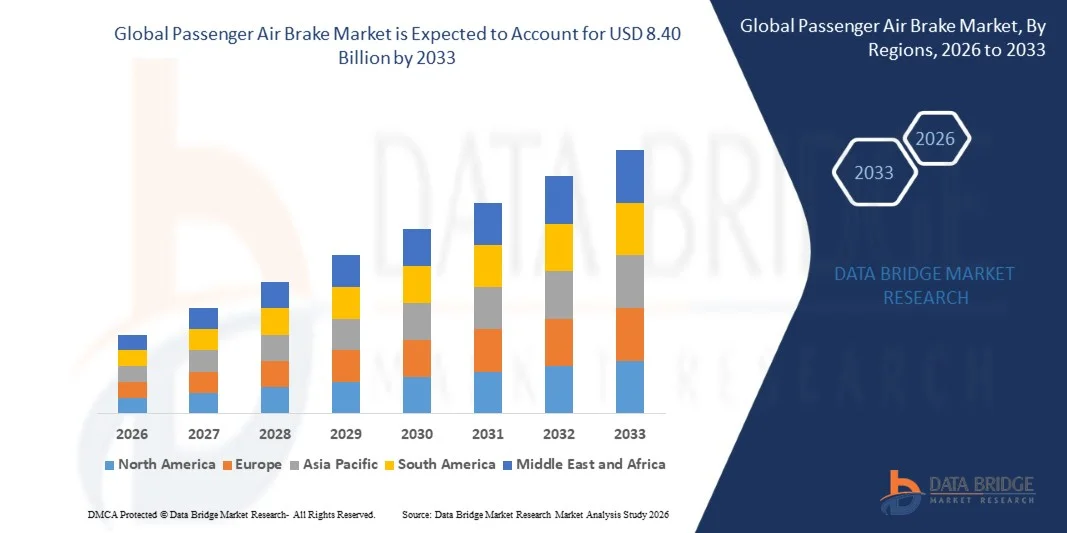
As per Data Bridge Market Research analysis The passenger air brake market was valued at USD 6.05 billion in 2025 and is projected to reach USD 8.40 billion by 2033, growing at a CAGR of 4.2% from 2026 to 2033. The market is experiencing consistent growth driven by increasing number of daily passengers, rising adoption of advanced automotive manufacturing technologies, and the expansion of the automotive industry. The market is further supported by the growing integration of advanced passenger safety and security systems in buses, trains, and other heavy passenger vehicles that rely on compressed air braking systems.
The increasing emphasis on vehicle safety regulations, expanding public transportation networks, and continuous investments in urban infrastructure are accelerating the adoption of passenger air brake systems worldwide. Furthermore, manufacturers are focusing on improving durability, reducing maintenance requirements, and integrating electronically controlled braking technologies to enhance braking efficiency and operational reliability across passenger transport applications.
Market Size & Forecast
- Global Market Value (2025): USD 6.05 Billion
- Expected Market Value (2033): USD 8.40 Billion
- Forecast CAGR (2026–2033): 4.2%
- Leading Region in 2025: North America
- Fastest Growing Region: Asia Pacific
Key Market Trends & Insights
- North America dominated the passenger air brake market with the largest revenue share of 36.5% in 2025, supported by stringent transportation safety regulations, a well-established passenger bus fleet, and continued investments in railway modernization and public transit infrastructure.
- The brake chamber segment led the market with a 22.6% share in 2025, driven by its essential function in converting compressed air into the mechanical force required to activate braking systems
- Asia-Pacific is expected to be the fastest-growing region at a CAGR of 5.5% during the forecast period, fueled by rapid urbanization, expanding railway networks, increasing public transportation investments, and growing vehicle production in China and India.
- Air dryer are the fastest-growing component type, projected to register a CAGR of 7.4%, reflecting the surge in emphasis on air brake system reliability, safety, and maintenance efficiency.
- The drum brakes segment dominated the brake type category with a 54.3% revenue share in 2025, led by widespread adoption across buses, rolling stock, and other heavy-duty passenger transportation applications.
- Trucks accounted for 46.8% of the market, preferred by the extensive deployment of air brake systems in medium- and heavy-duty commercial vehicles.
- The rolling stock segment is the fastest-growing vehicle type category, with a CAGR of 5.9%, driven by increasing investments in railway modernization, high-speed rail projects, and urban transit systems worldwide.
Report Scope and Passenger Air Brake Market Segmentation
|
Attributes |
Passenger Air Brake Key Market Insights |
|
Segments Covered |
|
|
Countries Covered |
North America · U.S. · Canada · Mexico Europe · Germany · France · U.K. · Netherlands · Switzerland · Belgium · Russia · Italy · Spain · Turkey · Rest of Europe Asia-Pacific · China · Japan · India · South Korea · Singapore · Malaysia · Australia · Thailand · Indonesia · Philippines · Rest of Asia-Pacific Middle East and Africa · Saudi Arabia · U.A.E. · South Africa · Egypt · Israel · Rest of Middle East and Africa South America · Brazil · Argentina · Rest of South America |
|
Key Market Players |
· Knorr-Bremse AG (Germany) · Wabtec Corporation (U.S.) · Nabtesco Corporation (Japan) · Bendix Commercial Vehicle Systems LLC (U.S.) · Haldex AB (Sweden) · TSE Brakes, Inc. (U.S.) · ARFESAN (Türkiye) · TBK Co., Ltd. (Japan) · Federal-Mogul Motorparts LLC (U.S.) · MAT Holdings, Inc. (U.S.) · SORL Auto Parts, Inc. (China) · Zhejiang VIE Science & Technology Co., Ltd. (China) · Ningbo Shenfeng Auto Parts Co., Ltd. (China) · Cosmo Teck Co., Ltd. (Taiwan) · FUWA K HITCH (China) · WANXIANG GROUP CO (China) |
|
Market Opportunities |
· The development of advanced braking technologies that enhance safety and performance · The integration of sensors and IoT technology in braking systems · The growing demand for sustainable and eco-friendly braking solutions. |
|
Value Added Data Infosets |
In addition to the market insights such as market value, growth rate, market segments, geographical coverage, market players, and market scenario, the market report curated by the Data Bridge Market Research team includes in-depth expert analysis, import/export analysis, pricing analysis, production consumption analysis, and pestle analysis. |
Passenger Air Brake Market Trends
Trend: Shift Toward Smart and Electrically Controlled Braking Systems
The transition from hydraulic to electric braking systems marks a pivotal shift in the passenger air brake market, driven by the need for precise control, reduced weight, and enhanced reliability. Brake-by-wire systems eliminate hydraulic lines, replacing them with electronic control units that communicate with aircraft avionics. This transition enables finer deceleration control, reduces maintenance complexity, and facilitates integration with other digital aircraft systems. The electrification trend is also aligned with broader aircraft modernization efforts aimed at reducing fuel consumption and emissions, as lighter brake systems contribute to overall weight savings. Future developments will likely focus on integrating regenerative braking capabilities and advanced sensor networks to optimize energy recovery and system health monitoring. As regulatory bodies endorse digital and electric systems, OEMs will accelerate adoption, making electrification a defining trend in passenger air brakes.
In June 2024, Safran Landing Systems highlighted its electric braking technology used on the Boeing 787 Dreamliner, which was the first commercial aircraft equipped with this technology. The electric brake system enables easier installation and maintenance, provides real-time carbon brake wear assessment, and contributes to weight reduction and lower fuel consumption through optimized system design.
Passenger Air Brake Market Dynamics
Key Market Driver: Rising Demand for Air Brakes in Railway and Heavy Commercial Vehicle Applications
Rail freight vehicles equipped with an air brake system have a single pipe or a twin pipe graduated release mechanism, and the air brake system remains the most effective and dependable stopping technology for large, long trains operating at high speeds. According to the Federal Railroad Administration (FRA), the volume of rail freight traffic in the U.S. alone accounts for billions of ton-miles annually, with a significant proportion of locomotives and rolling stock relying on pneumatic braking systems to ensure safe operations at varying speeds and grades. The coach's entire length is covered by the feed and braking pipes, and to create a continuous air path from the locomotive to the train's rear end, the brake pipe and feed pipe on each following coach are connected to one another by the appropriate hose couplings, providing a highly integrated and reliable braking architecture, which is one of the key factors driving revenue growth of the market.
In addition, growing demand for heavy trucks and commercial vehicles is significantly contributing to the uptake of air braking systems globally. According to the National Highway Traffic Safety Administration (NHTSA), ensuring adequate braking performance in heavy commercial vehicles is a central pillar of road safety regulation, with air brake systems mandated across most Class 7 and Class 8 truck categories in regulated markets.
Key Restraint/Challenge: Higher Cost of Air Brake Systems Compared to Conventional Hydraulic Alternatives
The higher cost of passenger air brake systems is significantly hampering revenue growth of the air brake system market. Air brake systems cost considerably more than regular hydraulic disc brake systems, and the initial capital outlay required for installation, maintenance, and repair of air brake components including compressors, governors, air dryers, and brake chambers adds to the total cost of ownership for fleet operators and vehicle manufacturers.
According to the U.S. Department of Transportation (DOT), smaller fleet operators and transport companies in price-sensitive emerging markets often face financial constraints that limit their ability to invest in premium braking technologies, which can slow the rate of adoption of air brake systems in certain vehicle segments and geographies. These factors are expected to restrain revenue growth of the market.
Key Market Opportunity: Adoption of Smart, Sensor-Enabled Brake Systems
The integration of sensors and IoT technology into brake systems is revolutionizing maintenance and operational strategies. Smart brakes equipped with accelerometers, temperature sensors, and wear indicators provide real-time data on system performance, enabling proactive maintenance and reducing unscheduled repairs. This approach minimizes aircraft downtime and extends component lifespan, translating into significant cost savings for airlines. Companies such as Honeywell and Safran are pioneering sensor-enabled brake architectures that communicate with aircraft health management systems, providing predictive insights and early fault detection. The proliferation of digital diagnostics also facilitates compliance with safety standards by providing traceability and detailed performance logs. As sensor technology becomes more affordable and miniaturized, its adoption will expand across a broader range of aircraft types, including regional jets and narrow-body fleets. The trend toward smart brakes aligns with the industry’s broader digital transformation, emphasizing data-driven decision-making and operational resilience.
Passenger Air Brake Market Scope
The passenger air brake market is segmented on the basis of component, brake type, and vehicle type, actuation type, and application.
- By Component
On the basis of component, the passenger air brake market is segmented into compressor, reservoir, foot valve, brake chamber, air dryer and others. The brake chamber segment dominated the market in 2025 with a market share of 22.6%, owing to its critical role in converting compressed air energy into mechanical braking force across passenger buses and rolling stock. Brake chambers are indispensable components of air brake systems and are installed on virtually every air-brake-equipped vehicle. Their widespread adoption is supported by increasing safety regulations and the need for reliable braking performance in passenger transportation. Manufacturers are focusing on enhancing durability and corrosion resistance to improve operational life and reduce maintenance requirements. The segment also benefits from growing investments in railway modernization and public transit infrastructure projects. Continuous replacement demand from aging fleets further strengthens its market position.
The air dryer segment is expected to register the fastest growth at a CAGR of 7.4% during the forecast period, driven by increasing emphasis on air brake system reliability, safety, and maintenance efficiency. Air dryers play a crucial role in removing moisture and contaminants from compressed air, preventing corrosion, freezing, and component failures within braking systems. Growing adoption of advanced and electronically controlled air brake technologies is increasing the need for high-performance air drying solutions. The segment is also benefiting from stricter vehicle safety regulations and rising demand for preventive maintenance practices across passenger transportation fleets. Manufacturers are developing more efficient and compact air dryers to improve operational performance and extend component life. Expanding railway modernization projects, fleet upgrades, and investments in public transportation infrastructure are expected to further accelerate segment growth.
- By Brake Type
On the basis of brake type, the passenger air brake market is segmented into disc brakes and drum brakes. The drum brakes segment led the market in 2025 with a market share of 54.3%, driven by its long-standing adoption across passenger buses and railway coaches due to durability, lower acquisition costs, and proven operational reliability. Drum brakes offer strong braking force and remain widely preferred for heavy passenger transportation applications where cost efficiency and robustness are critical considerations. Their ability to perform effectively under demanding operating conditions continues to support widespread deployment. In addition, established manufacturing infrastructure and extensive aftermarket availability contribute to segment dominance. Ongoing replacement demand from existing vehicle fleets further reinforces market leadership. Their cost advantages remain particularly attractive in emerging transportation markets.
The disc brakes segment is expected to register the fastest growth at a CAGR of 6.8% during the forecast period, fueled by increasing emphasis on passenger safety, shorter stopping distances, and improved thermal performance. Disc brakes provide superior heat dissipation and more consistent braking efficiency compared with traditional drum brake systems. Growing deployment in modern passenger rail vehicles and premium bus fleets is supporting adoption. Regulatory requirements for enhanced braking performance and vehicle safety are further driving demand. Manufacturers are also investing in lightweight materials and advanced friction technologies to improve operational efficiency. Rising modernization of transportation fleets is expected to sustain strong growth momentum.
- By Vehicle Type
On the basis of vehicle type, the passenger air brake market is segmented into trucks, bus, and rolling stock. The trucks segment dominated the market with a 46.8% revenue share in 2025, driven by the widespread use of air brake systems in medium- and heavy-duty commercial vehicles that require reliable braking performance under high-load operating conditions. Air brakes are preferred in trucks due to their superior stopping power, durability, and ability to function effectively in demanding transportation environments. Increasing freight movement, fleet expansion activities, and stricter vehicle safety regulations continue to support demand for advanced air brake systems. Manufacturers are also integrating electronically controlled braking technologies to enhance operational safety and vehicle control. Growing investments in commercial transportation infrastructure and logistics networks further strengthen segment growth. The segment continues to benefit from the rising adoption of connected and safety-focused vehicle technologies.
The rolling stock segment is expected to register the fastest growth at a CAGR of 5.9% during the forecast period, driven by increasing investments in railway modernization, high-speed rail projects, and urban transit systems worldwide. Growing passenger traffic and government initiatives to expand sustainable public transportation networks are accelerating the adoption of advanced air brake systems in passenger rail vehicles. Air brake systems play a critical role in ensuring operational safety, reliability, and braking efficiency across metro trains, commuter rail systems, and long-distance passenger trains. Continuous upgrades of existing rail fleets and the integration of electronically controlled braking technologies are further supporting demand. Rising infrastructure spending across Asia-Pacific, Europe, and the Middle East is creating significant growth opportunities for manufacturers. The segment is also benefiting from increasing emphasis on passenger safety and efficient rail operations.
- By Actuation Type
On the basis of actuation type, the passenger air brake market is segmented into pneumatic actuation, hydraulic actuation, and electric actuation. The pneumatic actuation segment dominated the market with an estimated 62.4% share in 2025, owing to its extensive adoption in passenger rail systems, buses, and heavy-duty transportation applications. Pneumatic braking systems are widely preferred due to their high reliability, strong braking force, and ability to provide consistent performance under demanding operating conditions. These systems utilize compressed air components such as compressors, reservoirs, valves, and brake chambers, making them suitable for large passenger vehicles. Increasing railway infrastructure development, fleet modernization programs, and rising demand for safe transportation solutions are supporting segment dominance. The long operational life, established supply chain, and proven safety performance of pneumatic systems continue to maintain their leading position globally.
The electric actuation segment is projected to register the fastest growth at a CAGR of 7.1% from 2026 to 2033, driven by increasing adoption of electronically controlled braking technologies and intelligent transportation solutions. Electric actuation systems provide improved braking precision, faster response times, and enhanced compatibility with advanced vehicle control systems. Growing integration of automation, digital monitoring, and predictive maintenance technologies is accelerating demand for electrically controlled braking solutions. The transition toward electric and hybrid mobility platforms is creating new opportunities for electric actuation technologies. Continuous advancements in lightweight components, energy efficiency, and smart braking systems are further supporting segment growth.
- By Application
On the basis of application, the passenger air brake market is segmented into railways, automotive, and aerospace. The railways segment dominated the market with an estimated 58.7% share in 2025, owing to the widespread deployment of air brake systems across passenger trains, metro systems, and high-speed rail networks. Railway operators extensively utilize air brake technologies due to their reliability, safety performance, and ability to control braking across long passenger train formations. Increasing investments in railway modernization, urban transit expansion, and high-speed rail infrastructure are strengthening demand for advanced braking systems. Growing passenger traffic and government initiatives focused on sustainable transportation are further supporting market growth. The adoption of electronically controlled pneumatic braking systems is enhancing operational efficiency, safety, and maintenance capabilities across railway applications.
The aerospace segment is expected to register the fastest growth at a CAGR of 6.5% from 2026 to 2033, driven by rising aircraft production, increasing air passenger traffic, and growing demand for lightweight and efficient braking technologies. Aircraft manufacturers are focusing on advanced brake systems that reduce weight, improve fuel efficiency, and enhance landing safety. Increasing adoption of electric braking technologies and advanced materials is creating new opportunities for aerospace brake manufacturers. The expansion of commercial aviation fleets and modernization of existing aircraft are further contributing to segment growth. Growing emphasis on sustainable aviation and improved aircraft operational efficiency is expected to accelerate adoption of next-generation braking solutions.
Passenger Air Brake Market Regional Analysis
North America dominated the passenger air brake market with the largest revenue share of 36.5% in 2025, supported by stringent transportation safety regulations, a well-established passenger bus fleet, and continued investments in railway modernization and public transit infrastructure. The region also benefits from continuous investments in railway modernization, public transportation upgrades, and advanced vehicle safety technologies. Growing adoption of electronically controlled air brake systems, predictive maintenance solutions, and intelligent braking technologies is accelerating market expansion. Increasing focus on operational reliability, passenger safety, and compliance with evolving regulatory standards continues to support market growth. Furthermore, ongoing fleet replacement programs and investments in sustainable transportation infrastructure are strengthening North America's leadership position in the global passenger air brake market.
U.S. Passenger Air Brake Market Insight
The U.S. passenger air brake market is witnessing steady growth due to increasing investments in public transportation modernization, railway infrastructure upgrades, and advanced vehicle safety systems. U.S. market’s growth is driven by ongoing investments in high-speed rail corridors, urban transit modernization, and freight safety enhancements. The deployment of electro-pneumatic and hybrid braking systems in projects such as California’s high-speed rail and regional commuter networks exemplifies the country’s focus on safety and operational efficiency. The presence of leading manufacturers such as Wabtec and Knorr-Bremse, along with a robust aftermarket for retrofitting and maintenance, sustains a dynamic market environment. Future growth will likely be influenced by federal and state funding initiatives, technological innovations in predictive diagnostics, and the push toward autonomous train operations. Challenges include the high costs of system upgrades and the need for extensive workforce training, which could slow short-term expansion but ultimately foster a more resilient and technologically advanced rail network.
Europe Passenger Air Brake Market Insight
The Europe passenger air brake market remains a significant contributor to global revenue, driven by extensive railway networks, strong transportation safety standards, and continuous investments in rail modernization projects. Europe’s extensive high-speed rail network, coupled with stringent safety and environmental regulations, drives demand for advanced, energy-efficient braking systems. The adoption of electro-pneumatic brakes with integrated diagnostics is prominent in flagship projects such as the Eurostar and TGV lines, where safety and operational reliability are critical. The European market benefits from a mature supply chain, with key players such as Knorr-Bremse and Wabtec investing heavily in R&D to develop next-generation systems supporting automation and connectivity. The push toward decarbonization and energy efficiency is accelerating the deployment of regenerative braking solutions, especially in urban transit and high-speed corridors. The future growth landscape will be shaped by regulatory mandates for safety upgrades, digitalization of maintenance, and the expansion of smart, autonomous train systems. Challenges include high system integration costs and the need for extensive retraining of maintenance personnel to handle sophisticated electronic systems.
U.K. Passenger Air Brake Market Insight
The U.K. passenger air brake market is experiencing stable growth, supported by ongoing investments in railway modernization, public transportation upgrades, and transportation safety improvements. UK’s rail modernization initiatives, including the Thameslink and Crossrail projects, are key drivers for advanced braking system adoption. The focus on safety, energy efficiency, and automation aligns with the country’s broader transportation and environmental policies. The deployment of electro-pneumatic brakes with IoT-enabled diagnostics is increasingly prevalent in new rolling stock, supporting predictive maintenance and operational reliability. The presence of leading manufacturers such as Bombardier and Knorr-Bremse, along with strategic collaborations, enhances technological innovation and competitiveness. The future outlook involves integrating regenerative braking technologies and AI-driven diagnostics to optimize safety and efficiency. Challenges include high system integration costs and the need for workforce upskilling, which could influence the pace of adoption in the short term but will ultimately support a more resilient and sustainable rail network.
Germany Passenger Air Brake Market Insight
The Germany passenger air brake market is expanding steadily due to the country's advanced transportation infrastructure, strong rail manufacturing industry, and increasing focus on passenger safety. Germany’s leadership in rail technology, exemplified by companies such as Siemens Mobility and Bombardier, emphasizes innovation, safety, and sustainability. The country’s focus on upgrading its high-speed and regional rail networks with advanced electro-pneumatic and hybrid braking systems aligns with its broader climate and safety policies. Recent investments in digitalization, IoT integration, and predictive maintenance are transforming the German rail landscape, enabling more efficient and safer operations. The emphasis on energy-efficient regenerative braking solutions supports Germany’s decarbonization commitments, especially in urban transit systems. The future growth will be driven by the need to retrofit aging rolling stock, expand autonomous train operations, and meet evolving safety standards. Challenges include high costs associated with system upgrades and the need for specialized workforce training, which could influence the pace of market expansion.
Asia-Pacific Passenger Air Brake Market Insight
The Asia-Pacific passenger air brake market is expected to witness rapid growth, driven by expanding railway infrastructure, rising urbanization, and increasing investments in public transportation systems. The region’s rapid urbanization, expanding high-speed rail networks, and government initiatives toward sustainable transportation are primary drivers. Countries such as China and India are investing heavily in rail infrastructure, with China’s extensive high-speed rail network and India’s ambitious railway modernization plans fueling demand for advanced braking systems. The deployment of electro-pneumatic brakes with integrated diagnostics is accelerating, supported by technological collaborations with global manufacturers. The region’s manufacturing capabilities, combined with increasing local content requirements and cost-sensitive procurement strategies, are shaping the competitive landscape. Future opportunities include the integration of IoT-enabled predictive maintenance and energy-efficient regenerative braking systems, which will enhance operational reliability and sustainability. Challenges include supply chain complexities, import dependencies, and the need for skill development in advanced system maintenance.
Japan Passenger Air Brake Market Insight
The Japan passenger air brake market is witnessing consistent growth due to continued investments in railway modernization, high-speed rail operations, and advanced transportation safety technologies. Japan’s mature rail infrastructure, characterized by high-speed Shinkansen and urban transit systems, emphasizes safety, precision, and technological innovation. The country’s focus on energy efficiency and system integration has led to the adoption of electro-pneumatic brakes with advanced diagnostics and remote monitoring capabilities. Recent initiatives include the retrofitting of older trains with hybrid braking solutions to meet evolving safety standards and sustainability goals. The Japanese market benefits from the presence of leading manufacturers such as Nippon Sharyo and Mitsubishi Electric, which are investing in next-generation brake technologies. Future growth will be driven by the need to upgrade aging rolling stock, integrate IoT-based diagnostics, and support Japan’s push toward autonomous and connected transportation. Challenges include high system integration costs and the necessity for specialized maintenance skills, which could influence the pace of adoption.
China Passenger Air Brake Market Insight
The China passenger air brake market is growing rapidly, driven by extensive investments in railway expansion projects, urban transit systems, and public transportation infrastructure. China’s aggressive infrastructure expansion, including the development of new high-speed rail corridors and urban transit systems, underpins the rapid adoption of advanced braking solutions. The government’s focus on safety, energy efficiency, and technological self-reliance has led to increased localization of manufacturing and system integration. The deployment of electro-pneumatic brakes with IoT-enabled diagnostics is widespread in new high-speed trains, such as the CRH and Fuxing series, which are setting benchmarks for safety and operational efficiency. The competitive landscape is characterized by collaborations between domestic manufacturers such as CSR and CRRC with global technology providers, fostering innovation and cost competitiveness. Future growth will be driven by the expansion of high-speed rail into less developed regions, adoption of regenerative braking technologies, and the integration of AI-based predictive maintenance systems. Challenges include supply chain disruptions, import restrictions on critical components, and the need for workforce upskilling in advanced system maintenance.
Passenger Air Brake Market Share
The passenger air brake industry is primarily led by well-established companies, including:
- Knorr-Bremse AG (Germany)
- Wabtec Corporation (U.S.)
- Nabtesco Corporation (Japan)
- Bendix Commercial Vehicle Systems LLC (U.S.)
- Haldex AB (Sweden)
- TSE Brakes, Inc. (U.S.)
- ARFESAN (Türkiye)
- TBK Co., Ltd. (Japan)
- Federal-Mogul Motorparts LLC (U.S.)
- MAT Holdings, Inc. (U.S.)
- SORL Auto Parts, Inc. (China)
- Zhejiang VIE Science & Technology Co., Ltd. (China)
- Ningbo Shenfeng Auto Parts Co., Ltd. (China)
- Cosmo Teck Co., Ltd. (Taiwan)
- FUWA K HITCH (China)
- Wanxiang Group Corporation (China)
Latest Developments in Passenger Air Brake Market
- In September 2025, Knorr-Bremse announced that it had secured a contract with BEML Ltd. to supply braking and entrance systems for India's first high-speed trains. The agreement covers at least two prototype trainsets and includes advanced brake systems designed to enhance passenger safety, operational reliability, and performance. The project marks a significant milestone in India's high-speed rail development and strengthens Knorr-Bremse's presence in the passenger rail braking market.
- In June 2024, Wabtec Corporation announced the commercial deployment of its Green Friction braking technology on the Paris RER A rail network. The new brake friction material is designed to reduce particulate emissions generated during braking by up to 90%, improving underground air quality while maintaining braking performance for more than one million daily passengers
- In January 2024, Wabtec Corporation received a US$157 million order from Siemens Limited to supply advanced brake systems for 1,200 electric locomotives for Indian Railways. The contract includes manufacturing of brake systems over 11 years and maintenance support for 35 years, providing high-performance braking technology to improve safety, reliability, and operational efficiency
- In October 2023, Wabtec Corporation announced that it would supply advanced brake systems and couplers for 640 new New York City Transit subway cars through Kawasaki Rail Car. The project supports modernization of the MTA fleet by delivering enhanced braking performance, improved reliability, and increased passenger safety for one of the world's largest urban transit systems
- In March 2023, Wabtec Corporation announced a brake system order from Alstom Transport India for the Pune Metro Line 3 project. Wabtec will supply its latest braking technology for new metro trains, improving braking performance, operational efficiency, and passenger safety while supporting India's expanding urban rail infrastructure

- Interactive Data Analysis Dashboard
- Company Analysis Dashboard for high growth potential opportunities
- Research Analyst Access for customization & queries
- Competitor Analysis with Interactive dashboard
- Latest News, Updates & Trend analysis
- Harness the Power of Benchmark Analysis for Comprehensive Competitor Tracking
Data collection and base year analysis are done using data collection modules with large sample sizes. The stage includes obtaining market information or related data through various sources and strategies. It includes examining and planning all the data acquired from the past in advance. It likewise envelops the examination of information inconsistencies seen across different information sources. The market data is analysed and estimated using market statistical and coherent models. Also, market share analysis and key trend analysis are the major success factors in the market report. To know more, please request an analyst call or drop down your inquiry.
The key research methodology used by DBMR research team is data triangulation which involves data mining, analysis of the impact of data variables on the market and primary (industry expert) validation. Data models include Vendor Positioning Grid, Market Time Line Analysis, Market Overview and Guide, Company Positioning Grid, Patent Analysis, Pricing Analysis, Company Market Share Analysis, Standards of Measurement, Global versus Regional and Vendor Share Analysis. To know more about the research methodology, drop in an inquiry to speak to our industry experts.
Data Bridge Market Research is a leader in advanced formative research. We take pride in servicing our existing and new customers with data and analysis that match and suits their goal. The report can be customized to include price trend analysis of target brands understanding the market for additional countries (ask for the list of countries), clinical trial results data, literature review, refurbished market and product base analysis. Market analysis of target competitors can be analyzed from technology-based analysis to market portfolio strategies. We can add as many competitors that you require data about in the format and data style you are looking for. Our team of analysts can also provide you data in crude raw excel files pivot tables (Fact book) or can assist you in creating presentations from the data sets available in the report.













