


Passenger Boarding Bridge Market Size
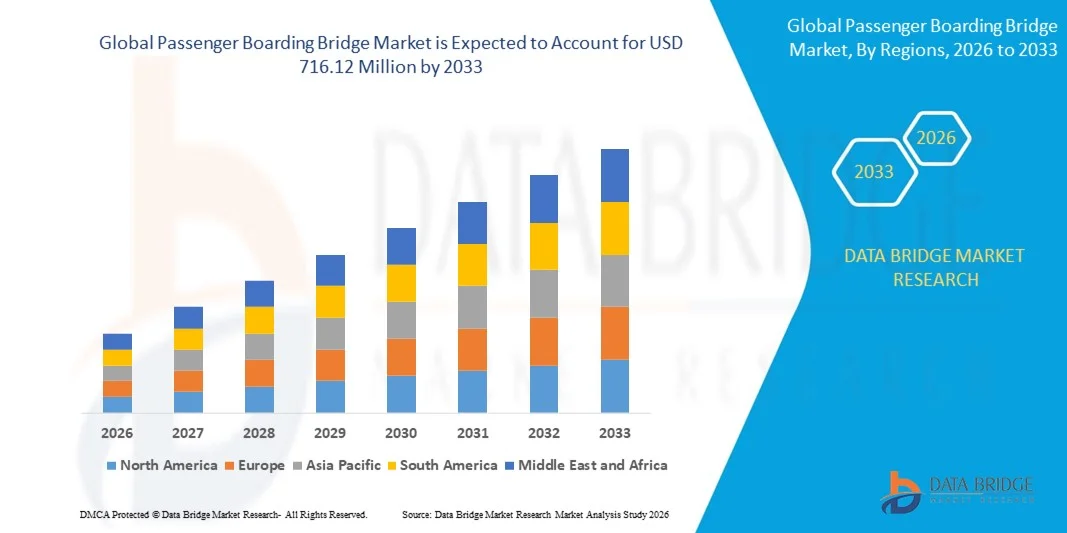
- The global passenger boarding bridge market size was valued at USD 471.00 million in 2025 and is expected to reach USD 716.12 million by 2033, at a CAGR of 6.20% during the forecast period
- The market growth is largely fueled by the rising demand for modern airport infrastructure and the ongoing modernization of domestic and international terminals, which is driving the adoption of advanced passenger boarding bridges with automated and intelligent features
- Furthermore, increasing air passenger traffic, coupled with a focus on operational efficiency and passenger safety, is establishing automated and smart boarding bridges as essential airport ground support equipment. These converging factors are accelerating the deployment of technologically advanced boarding solutions, thereby significantly boosting the industry’s growth
Passenger Boarding Bridge Market Analysis
- Passenger boarding bridges, providing safe and efficient passenger transfer between terminals and aircraft, are increasingly critical in airports worldwide due to their ability to improve boarding efficiency, enhance passenger comfort, and support operational reliability
- The escalating demand for boarding bridges is primarily driven by airport expansion projects, rising air travel volumes, the need for reduced aircraft turnaround times, and growing adoption of automated, air-conditioned, and intelligent docking systems in both high-traffic and regional airports
- North America dominated the passenger boarding bridge market with a share of in 2025, due to the presence of major international airports, high air traffic volume, and ongoing airport modernization projects
- Asia-Pacific is expected to be the fastest growing region in the passenger boarding bridge market during the forecast period due to rapid airport development, increasing passenger traffic, and modernization of domestic and international terminals in countries such as China, Japan, and India
- Intelligent segment dominated the market with a market share of 58.1% in 2025, due to by the growing automation in airport operations and the demand for precision alignment with aircraft doors. Intelligent docking systems reduce human intervention, minimize operational errors, and enhance safety for passengers and ground staff. Airports implementing smart technologies integrate these systems with aircraft guidance and terminal management platforms, ensuring faster turnaround and higher operational efficiency
Report Scope and Passenger Boarding Bridge Market Segmentation
|
Attributes |
Passenger Boarding Bridge Key Market Insights |
|
Segments Covered |
|
|
Countries Covered |
North America
Europe
Asia-Pacific
Middle East and Africa
South America
|
|
Key Market Players |
|
|
Market Opportunities |
|
|
Value Added Data Infosets |
In addition to the insights on market scenarios such as market value, growth rate, segmentation, geographical coverage, and major players, the market reports curated by the Data Bridge Market Research also include in-depth expert analysis, geographically represented company-wise production and capacity, network layouts of distributors and partners, detailed and updated price trend analysis and deficit analysis of supply chain and demand. |
Passenger Boarding Bridge Market Trends
Increasing Use of Intelligent Passenger Boarding Bridges
- A prominent trend in the passenger boarding bridge market is the rising deployment of intelligent and automated boarding solutions at airports to enhance operational efficiency and passenger experience. These systems integrate advanced sensors, real-time monitoring, and remote control capabilities to reduce turnaround time for aircraft and improve safety standards
- For instance, Thyssenkrupp Airport Systems and JBT AeroTech supply intelligent boarding bridges equipped with automated docking systems and advanced alignment sensors, enabling smoother aircraft boarding and minimizing human intervention. Such installations are increasingly preferred at international hubs to optimize gate operations and passenger flow
- Airports are investing in smart boarding bridges that support multi-level and flexible aircraft types, improving compatibility across diverse fleets. These technologies allow operators to adapt quickly to different aircraft configurations, enhancing operational versatility
- Integration of IoT and predictive maintenance features in passenger boarding bridges is growing, allowing airport authorities to monitor performance, schedule timely servicing, and prevent operational disruptions. This approach is reinforcing the adoption of intelligent infrastructure at major airports
- Passenger boarding bridges are being designed with energy-efficient motors, LED signaling, and lightweight materials that reduce energy consumption and operational costs. Sustainability considerations are driving manufacturers to innovate for greener airport operations
- The market is witnessing expansion in retrofit projects where existing conventional bridges are upgraded with intelligent systems to meet evolving safety and automation standards. This trend is strengthening the overall modernization of airport boarding operations
Passenger Boarding Bridge Market Dynamics
Driver
Expanding Airport Infrastructure and Passenger Volumes
- The growth in global air travel and the expansion of airport infrastructure are driving demand for passenger boarding bridges, as airports require advanced systems to manage increasing passenger volumes efficiently. Modern boarding bridges facilitate faster aircraft turnaround, improved passenger safety, and operational reliability
- For instance, Honeywell and Thyssenkrupp Airport Systems have provided advanced boarding bridges for expanding airports such as Dubai International Airport, supporting higher passenger throughput and enhanced operational control. These solutions help accommodate growing flight schedules and reduce delays
- New airport projects, particularly in the Middle East and Asia-Pacific, are incorporating state-of-the-art boarding bridges to align with modern airport design standards. These investments ensure scalable infrastructure that can handle future traffic growth
- Airports are increasingly focusing on passenger comfort and accessibility, encouraging the adoption of automated and flexible boarding bridges that cater to different aircraft and passenger needs. This demand fuels innovation in design and automation technologies
- Government initiatives and airline strategies targeting increased connectivity and regional mobility are driving investments in boarding infrastructure. The requirement for reliable, safe, and efficient boarding solutions strengthens market demand and sustains industry growth
Restraint/Challenge
High Capital Expenditure and Upkeep Costs
- Passenger boarding bridges require significant initial investment in procurement, installation, and integration with airport infrastructure, which poses a challenge for smaller or budget-constrained airports. High costs may slow adoption despite the operational benefits offered by advanced systems
- For instance, airports upgrading to automated boarding bridges from companies such as JBT AeroTech face substantial expenditure for specialized equipment, civil works, and software integration. These costs can limit deployment in emerging markets or regional airports
- Ongoing maintenance, including mechanical servicing, software updates, and safety inspections, adds to the total cost of ownership, making operational budgeting a key concern for airport authorities
- Specialized training is required for personnel to operate and maintain intelligent boarding bridges safely and effectively, adding to indirect costs and resource allocation challenges
- The market continues to face constraints due to balancing technology investment with cost efficiency, particularly when retrofitting older infrastructure. These factors collectively impact the pace of market expansion and adoption of next-generation boarding solutions
Passenger Boarding Bridge Market Scope
The market is segmented on the basis of elevation system, product type, tunnel type, docking type, foundation, structure, and point of sale.
- By Elevation System
On the basis of elevation system, the passenger boarding bridge market is segmented into hydraulic and electro-mechanical. The electro-mechanical segment dominated the market with the largest revenue share in 2025, driven by its energy-efficient operation and precise control over bridge movement. Airports often prefer electro-mechanical systems for their reduced maintenance requirements and longer operational lifespan, ensuring uninterrupted boarding and disembarking processes. The system’s smooth operation and ability to integrate with automated airport management systems make it a preferred choice for high-traffic terminals. Its compatibility with variable aircraft heights and reduced risk of hydraulic fluid leakage further support its adoption.
The hydraulic segment is expected to witness the fastest growth rate from 2026 to 2033, fueled by its robustness and higher lifting capacity, making it suitable for large aircraft and cargo operations. For instance, Liebherr’s hydraulic boarding bridges are increasingly adopted in developing airports where heavy-duty operation is prioritized. The simplicity of hydraulic mechanisms and ease of retrofitting into existing airport infrastructure contribute to its growing popularity, especially in regions focusing on upgrading older terminals.
- By Product Type
On the basis of product type, the market is segmented into apron drive, commuter bridge, nose-loader bridge, T-bridge, and over-the-wing bridge. The nose-loader bridge segment dominated the market in 2025, owing to its widespread use for medium to large aircraft at commercial airports. Airlines and airport operators value nose-loader bridges for their ability to provide safe and efficient passenger transfer directly to the aircraft door, minimizing turnaround time. The flexibility in adjusting the bridge to accommodate different aircraft sizes and the integration with automated docking systems support its market leadership.
The commuter bridge segment is expected to witness the fastest CAGR from 2026 to 2033, driven by increasing adoption in regional airports and smaller terminals. For instance, ThyssenKrupp’s commuter bridges are widely deployed in urban airports to facilitate short-haul flights efficiently. Their compact design, ease of installation, and cost-effectiveness make them a preferred choice for airports managing high passenger volumes without large infrastructure investments.
- By Tunnel Type
On the basis of tunnel type, the market is segmented into air-conditioned and un-air-conditioned. The air-conditioned segment dominated the market in 2025 due to passenger comfort requirements and the need to maintain controlled environments in modern airports. Air-conditioned tunnels prevent exposure to extreme temperatures, improving the passenger experience during boarding and disembarking. They are particularly critical in tropical and extreme-climate regions and integrate easily with energy-efficient HVAC solutions, supporting sustainability goals.
The un-air-conditioned segment is projected to witness the fastest growth rate from 2026 to 2033, driven by airports in developing regions focusing on cost-effective solutions. For instance, local airport authorities in Southeast Asia increasingly prefer un-air-conditioned bridges for short-haul domestic flights. Their lower maintenance and installation costs, combined with operational simplicity, make them a viable option where environmental comfort is secondary to efficiency.
- By Docking Type
On the basis of docking type, the market is segmented into manual and intelligent. The intelligent docking segment dominated the market with the largest share of 58.1% in 2025, fueled by the growing automation in airport operations and the demand for precision alignment with aircraft doors. Intelligent docking systems reduce human intervention, minimize operational errors, and enhance safety for passengers and ground staff. Airports implementing smart technologies integrate these systems with aircraft guidance and terminal management platforms, ensuring faster turnaround and higher operational efficiency.
The manual docking segment is expected to witness the fastest CAGR from 2026 to 2033, driven by smaller airports and budget terminals prioritizing lower initial investment. For instance, local airports in Latin America continue to adopt manual docking solutions for cost savings. The ease of operation and minimal technical complexity make manual docking systems suitable for regions with limited technical maintenance capabilities.
- By Foundation
On the basis of foundation, the market is segmented into fixed and movable. The movable foundation segment dominated the market in 2025, owing to its adaptability across different gate layouts and aircraft types. Airports favor movable foundations as they allow repositioning of bridges based on operational requirements and peak traffic variations. The capability to handle multiple aircraft sizes and terminal configurations ensures efficient gate utilization, reducing congestion.
The fixed foundation segment is expected to witness the fastest growth rate from 2026 to 2033, driven by its stability and lower long-term maintenance costs. For instance, airports in the U.K. and Europe are increasingly installing fixed foundations for heavy-duty nose-loader bridges. Their rigid structure provides enhanced durability and supports repeated heavy operations, especially in high-traffic terminals.
- By Structure
On the basis of structure, the market is segmented into glass-walled, steel-walled, and glass-steel-walled. The glass-walled segment dominated the market in 2025, driven by aesthetic appeal, passenger experience, and natural lighting inside the bridge. Airports invest in glass-walled designs to provide visual comfort, enhance transparency, and align with modern terminal architecture. The structural design allows easy monitoring of passenger flow and ensures safety without compromising operational efficiency.
The glass-steel-walled segment is expected to witness the fastest CAGR from 2026 to 2033, fueled by its combination of strength, durability, and aesthetic appeal. For instance, GSE manufacturers are promoting glass-steel composite bridges for terminals requiring both robustness and modern architectural alignment. Their hybrid structure withstands environmental stress while maintaining design flexibility for different airport layouts.
- By Point of Sale
On the basis of point of sale, the market is segmented into OEM and aftermarket. The OEM segment dominated the market in 2025, driven by initial infrastructure development and large-scale procurement by airport authorities. OEMs provide fully integrated solutions with guaranteed compatibility, performance, and after-sales support, making them the preferred choice for new terminal projects. Partnerships between airports and leading OEMs also ensure long-term service contracts and technological upgrades.
The aftermarket segment is projected to witness the fastest growth rate from 2026 to 2033, driven by modernization projects and retrofitting of older bridges. For instance, airports in North America are increasingly opting for aftermarket solutions to upgrade existing boarding bridges with automated docking and enhanced safety features. The flexibility to adapt existing infrastructure with minimal downtime and cost-effective enhancements fuels the aftermarket segment growth.
Passenger Boarding Bridge Market Regional Analysis
- North America dominated the passenger boarding bridge market with the largest revenue share in 2025, driven by the presence of major international airports, high air traffic volume, and ongoing airport modernization projects
- Airlines and airport authorities in the region highly value advanced boarding bridge solutions that enhance operational efficiency, safety, and passenger experience
- The widespread adoption is further supported by strong infrastructure investments, technological advancement in airport operations, and a focus on reducing aircraft turnaround time, making automated and intelligent boarding bridges a preferred choice
U.S. Passenger Boarding Bridge Market Insight
The U.S. market captured the largest revenue share in North America in 2025, fueled by ongoing airport expansion projects and replacement of older boarding bridges. Airports are increasingly adopting electro-mechanical and intelligent docking systems to improve safety and operational efficiency. The growing focus on passenger comfort, coupled with the integration of air-conditioned and modular boarding bridge solutions, further propels the market. Moreover, government regulations and investments in smart airport infrastructure continue to drive demand for technologically advanced bridges.
Europe Passenger Boarding Bridge Market Insight
The Europe market is projected to grow at a substantial CAGR during the forecast period, driven by airport modernization initiatives, increasing air passenger traffic, and compliance with stringent safety regulations. The adoption of glass-walled and automated boarding bridges is rising, enhancing passenger convenience and operational reliability. European airports are also upgrading infrastructure to support larger aircraft and international flights, fostering market growth across both new constructions and retrofit projects.
U.K. Passenger Boarding Bridge Market Insight
The U.K. market is expected to grow at a noteworthy CAGR during the forecast period, driven by increasing airport modernization and the adoption of energy-efficient, automated boarding solutions. Concerns regarding passenger safety, efficient boarding, and reduced turnaround times are prompting airport authorities to invest in intelligent docking and electro-mechanical systems. The U.K.’s strong air traffic network and technologically advanced airport operations further support market expansion.
Germany Passenger Boarding Bridge Market Insight
The Germany market is anticipated to expand at a considerable CAGR, fueled by the country’s advanced airport infrastructure, focus on technological innovation, and regulatory emphasis on aviation safety. Airports are adopting high-end boarding bridges with integrated air-conditioning, glass-walled designs, and movable foundations. The integration of intelligent docking and automation technologies ensures efficient operations and improved passenger experience, making Germany a key market in Europe.
Asia-Pacific Passenger Boarding Bridge Market Insight
The Asia-Pacific market is poised to grow at the fastest CAGR during 2026–2033, driven by rapid airport development, increasing passenger traffic, and modernization of domestic and international terminals in countries such as China, Japan, and India. Rising government investment in smart airport infrastructure, coupled with urbanization and technological adoption, is accelerating the deployment of automated and energy-efficient boarding bridges. The region’s emergence as a manufacturing hub for boarding bridge components also improves affordability and accessibility.
Japan Passenger Boarding Bridge Market Insight
The Japan market is witnessing significant growth due to the country’s high-tech airport infrastructure, growing air travel demand, and emphasis on passenger safety and comfort. Adoption of intelligent docking systems, electro-mechanical elevation bridges, and glass-walled tunnels is increasing to enhance operational efficiency. Moreover, integration with automated airport management systems and the need to support high passenger throughput drives market expansion in both commercial and regional airports.
China Passenger Boarding Bridge Market Insight
The China market accounted for the largest revenue share in Asia-Pacific in 2025, supported by massive airport construction projects, government initiatives for smart airports, and rapid urbanization. Boarding bridges with advanced features such as air-conditioned tunnels, intelligent docking, and movable foundations are increasingly adopted. The growing middle class, rising domestic and international air travel, and strong domestic manufacturers supplying cost-effective solutions are key factors propelling market growth in China.
Passenger Boarding Bridge Market Share
The passenger boarding bridge industry is primarily led by well-established companies, including:
- ThyssenKrupp AG (Germany)
- JBT (U.S.)
- CIMC (China)
- FMT Sweden AB (Sweden)
- Shinmaywa Industries, Ltd. (Japan)
- VATAPLE GROUP (India)
- HÜBNER GmbH & Co. KG (Germany)
- Mitsubishi Heavy Industries, Ltd. (Japan)
- Bukaka Teknik Utama (Indonesia)
- ADELTE – The Boarding Company (Spain)
- Airport Equipment (a division of J&D McLennan) (U.S.)
- China International Marine Containers (Group) Ltd. (China)
- ACCESSAIR Systems Inc (U.S.)
- Ameribridge Services Inc (U.S.)
Latest Developments in Global Passenger Boarding Bridge Market
- In 2024, CIMC-Tianda launched a new eco-friendly passenger boarding bridge at the Farnborough International Airshow, featuring energy-efficient technologies, lightweight yet durable materials, and a design aimed at reducing carbon emissions. This development aligns with the market’s rising focus on sustainability, energy efficiency, and cost reduction in airport operations. Airports worldwide are increasingly evaluating boarding bridges for operational efficiency and also for environmental impact, and CIMC-Tianda’s innovation positions the company to meet this growing demand while enhancing passenger comfort
- In 2024, JBT Corporation secured a $25 million contract to supply passenger boarding bridges for the new Istanbul Airport terminal, supporting the airport’s expansion and modernization strategy. This contract emphasizes the growing need for reliable, high-capacity boarding solutions in emerging markets with expanding aviation infrastructure. By delivering advanced boarding bridges that accommodate various aircraft types and improve turnaround times, JBT enhances operational efficiency for airport operators while reinforcing its leadership in the global passenger boarding bridge market
- In 2024, Thyssenkrupp Airport Systems announced a strategic partnership with Siemens to integrate smart boarding bridge technology, leveraging IoT connectivity and predictive maintenance solutions. This collaboration addresses key market needs for reliability, operational safety, and reduced downtime, which are critical in high-traffic airports. By incorporating data-driven insights, airports can proactively maintain bridges, optimize operational efficiency, and improve the passenger experience. This move reflects a broader industry trend toward digitalization and automation of airport ground support equipment
- In 2024, ADELTE was awarded a contract to supply and install new passenger boarding bridges at Singapore Changi Airport Terminal 5, providing state-of-the-art solutions for passenger comfort, boarding efficiency, and operational management. This project highlights the increasing demand for technologically advanced boarding bridges in major international hubs where high passenger throughput and precise gate operations are critical. ADELTE’s involvement strengthens its position in Asia-Pacific, a region experiencing rapid airport expansion and modernization driven by rising air travel and regional connectivity initiatives
- In 2024, JBT Corporation opened a new manufacturing facility for passenger boarding bridges in Texas, significantly enhancing its production capabilities for both North American and international markets. This state-of-the-art facility allows the company to scale operations efficiently to meet the growing global demand for advanced boarding solutions, particularly in regions modernizing airport infrastructure. By localizing production in the U.S., JBT can reduce lead times, improve customization for regional requirements, and strengthen its competitive position in a market increasingly focused on rapid deployment and high-performance bridge systems

- Interactive Data Analysis Dashboard
- Company Analysis Dashboard for high growth potential opportunities
- Research Analyst Access for customization & queries
- Competitor Analysis with Interactive dashboard
- Latest News, Updates & Trend analysis
- Harness the Power of Benchmark Analysis for Comprehensive Competitor Tracking
Global Passenger Boarding Bridge Market, Supply Chain Analysis and Ecosystem Framework
To support market growth and help clients navigate the impact of geopolitical shifts, DBMR has integrated in-depth supply chain analysis into its Global Passenger Boarding Bridge Market research reports. This addition empowers clients to respond effectively to global changes affecting their industries. The supply chain analysis section includes detailed insights such as Global Passenger Boarding Bridge Market consumption and production by country, price trend analysis, the impact of tariffs and geopolitical developments, and import and export trends by country and HSN code. It also highlights major suppliers with data on production capacity and company profiles, as well as key importers and exporters. In addition to research, DBMR offers specialized supply chain consulting services backed by over a decade of experience, providing solutions like supplier discovery, supplier risk assessment, price trend analysis, impact evaluation of inflation and trade route changes, and comprehensive market trend analysis.
Data collection and base year analysis are done using data collection modules with large sample sizes. The stage includes obtaining market information or related data through various sources and strategies. It includes examining and planning all the data acquired from the past in advance. It likewise envelops the examination of information inconsistencies seen across different information sources. The market data is analysed and estimated using market statistical and coherent models. Also, market share analysis and key trend analysis are the major success factors in the market report. To know more, please request an analyst call or drop down your inquiry.
The key research methodology used by DBMR research team is data triangulation which involves data mining, analysis of the impact of data variables on the market and primary (industry expert) validation. Data models include Vendor Positioning Grid, Market Time Line Analysis, Market Overview and Guide, Company Positioning Grid, Patent Analysis, Pricing Analysis, Company Market Share Analysis, Standards of Measurement, Global versus Regional and Vendor Share Analysis. To know more about the research methodology, drop in an inquiry to speak to our industry experts.
Data Bridge Market Research is a leader in advanced formative research. We take pride in servicing our existing and new customers with data and analysis that match and suits their goal. The report can be customized to include price trend analysis of target brands understanding the market for additional countries (ask for the list of countries), clinical trial results data, literature review, refurbished market and product base analysis. Market analysis of target competitors can be analyzed from technology-based analysis to market portfolio strategies. We can add as many competitors that you require data about in the format and data style you are looking for. Our team of analysts can also provide you data in crude raw excel files pivot tables (Fact book) or can assist you in creating presentations from the data sets available in the report.













