


Passenger Security Equipment Market Overview
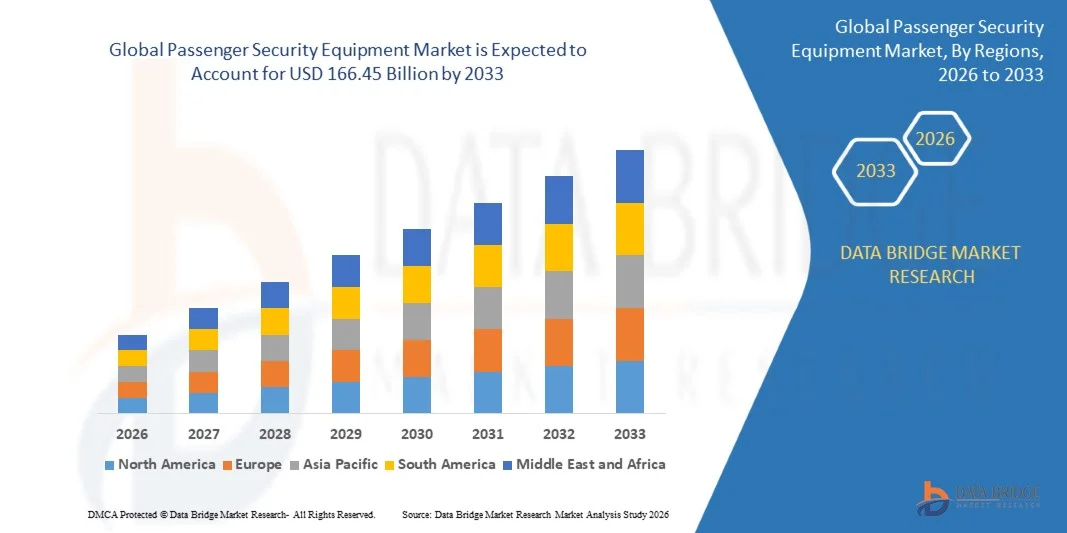
The Passenger Security Equipment Market was valued at USD 83.85 billion in 2025 and is projected to reach USD 166.45 billion by 2033, growing at a CAGR of 8.95% from 2026 to 2033. The market is witnessing substantial growth driven by increasing concerns regarding passenger safety across airports, railways, metros, seaports, and public transportation systems, along with rising investments in advanced surveillance and screening technologies. Governments and transportation authorities worldwide are strengthening security infrastructure to address growing threats related to terrorism, smuggling, cyberattacks, and unauthorized access in high-traffic transit environments.
The growing volume of global air and rail passengers, coupled with expanding urban transportation networks, is accelerating the deployment of modern passenger security equipment such as biometric identification systems, X-ray baggage scanners, explosive detection systems, metal detectors, CCTV surveillance, and AI-powered monitoring solutions. In addition, rapid technological advancements in automated threat detection, facial recognition, and integrated command-and-control systems are enhancing operational efficiency and real-time risk management capabilities. Increasing regulatory compliance requirements and the modernization of aging transportation infrastructure are further supporting long-term market expansion across both developed and emerging economies.
Key Market Trends & Insights
- North America dominated the passenger security equipment market with the largest revenue share of 38.7% in 2025, supported by strong investments in airport modernization programs, widespread deployment of biometric identification systems, and advanced security infrastructure across aviation and public transportation networks. The region also benefits from high adoption of AI-powered surveillance systems, automated baggage screening technologies, and robust homeland security initiatives focused on strengthening passenger safety and operational efficiency.
- Asia-Pacific is expected to be the fastest-growing region, recording a CAGR of 10.1% from 2026 to 2033. Growth is driven by rapid urbanization, expanding metro and high-speed rail networks, increasing air passenger traffic, and large-scale government investments in smart city and transportation infrastructure projects across countries such as China, India, and Japan. Rising adoption of advanced screening systems and cost-effective domestic manufacturing of security equipment are further supporting regional expansion.The Airports segment held the largest market revenue share of approximately 58.6% in 2025 driven by stringent international aviation security regulations, continuously rising global air passenger traffic, and large-scale investments in airport modernization projects. Airports extensively deploy advanced baggage scanners, biometric verification systems, explosive detection equipment, and AI-powered surveillance platforms to strengthen passenger screening efficiency and ensure compliance with global aviation safety standards.
- The Train Stations and Bus Stations segment is projected to register the fastest growth at a CAGR of 9.8% from 2026 to 2033, driven by rapid urbanization, expansion of metro and high-speed rail networks, and increasing government investments in public transportation security infrastructure. Rising deployment of intelligent surveillance systems, contactless passenger screening technologies, and centralized security monitoring solutions across urban transit hubs is accelerating segment expansion.
- The Video Surveillance segment held the largest market revenue share of approximately 31.4% in 2025 driven by increasing adoption of AI-enabled CCTV systems, facial recognition technologies, and real-time threat monitoring solutions across airports, railway terminals, and public transportation facilities. Transportation authorities are increasingly integrating intelligent surveillance platforms with centralized command-and-control systems to improve operational visibility and strengthen public safety management.
- The Explosive Detection System segment is projected to register the fastest growth at a CAGR of 10.4% from 2026 to 2033, driven by growing global concerns regarding terrorism threats, rising cross-border passenger traffic, and stricter international transportation security protocols. Increasing deployment of advanced CT scanners, automated explosive trace detection technologies, and next-generation baggage inspection systems across aviation and border security infrastructure is supporting strong segment growth.
Market Size & Forecast
- Global Market Value (2025): USD 83.85 Billion
- Expected Market Value (2033): USD 166.45 Billion
- Forecast CAGR (2026–2033): 8.95%
- Leading Region in 2025: North America
- Fastest Growing Region: Asia-Pacific
Report Scope and Passenger Security Equipment Market Segmentation
|
Attributes |
Passenger Security Equipment Key Market Insights |
|
Segments Covered |
· By Transport Infrastructure: Airports, Train Stations, and Bus Stations, Seaports · By Type: Baggage Inspection System, Explosive Detection System, Video Surveillance, Intrusion Detection and Prevention System, Fire Safety & Detection System, People Screening Systems, and Others |
|
Countries Covered |
North America · U.S. · Canada · Mexico Europe · Germany · France · U.K. · Netherlands · Switzerland · Belgium · Russia · Italy · Spain · Turkey · Rest of Europe Asia-Pacific · China · Japan · India · South Korea · Singapore · Malaysia · Australia · Thailand · Indonesia · Philippines · Rest of Asia-Pacific Middle East and Africa · Saudi Arabia · U.A.E. · South Africa · Egypt · Israel · Rest of Middle East and Africa South America · Brazil · Argentina · Rest of South America |
|
Key Market Players |
• Honeywell International Inc. (U.S.) |
|
Market Opportunities |
• Expansion Of Smart Airport Infrastructure |
|
Value Added Data Infosets |
In addition to the market insights such as market value, growth rate, market segments, geographical coverage, market players, and market scenario, the market report curated by the Data Bridge Market Research team includes in-depth expert analysis, import/export analysis, pricing analysis, production consumption analysis, and pestle analysis. |
Passenger Security Equipment Market Trends
Trend: Rising Adoption Of AI-Powered Screening And Integrated Smart Surveillance Systems
Increasing global concerns regarding terrorism, cyber threats, illegal trafficking, and public transportation safety are accelerating demand for advanced passenger security technologies across airports, railways, metros, seaports, and border control infrastructure. Conventional security inspection systems often face operational limitations including slower screening processes, higher dependency on manual monitoring, and limited real-time threat identification capabilities, encouraging transportation authorities to adopt AI-enabled and automated security platforms with higher operational accuracy and faster response times.
Modern airports and railway terminals are increasingly integrating biometric authentication systems, AI-powered video analytics, facial recognition technologies, and automated baggage screening equipment to strengthen passenger verification and improve security efficiency. For instance, several international airports including Singapore Changi Airport and Dubai International Airport have expanded deployment of biometric boarding and facial recognition systems to reduce passenger processing times while improving security monitoring accuracy. In urban transit systems, advanced CCTV surveillance integrated with behavioral analytics is being used to identify suspicious activities and unattended baggage in real time, reducing operational risks and enhancing crowd management efficiency.
The growing expansion of smart city infrastructure and rising investments in digital transportation ecosystems are also supporting demand for connected security equipment capable of centralized monitoring and predictive threat analysis. In addition, governments across North America, Europe, and Asia-Pacific continue increasing investments in border security modernization and aviation safety infrastructure to comply with evolving international security regulations. Real-world deployments conducted during 2024 at major European airports integrating AI-assisted CT baggage scanners demonstrated passenger screening throughput improvements of approximately 20–30% while significantly reducing false alarm rates during peak operational periods.
Passenger Security Equipment Market Dynamics
Key Market Driver: Increasing Investments In Transportation Infrastructure Security Modernization
Governments and transportation authorities worldwide are significantly increasing investments in advanced passenger security infrastructure to strengthen national security, improve public safety, and address growing passenger traffic volumes across airports, railway stations, seaports, and metro networks. Rising incidents related to terrorism, smuggling, cyberattacks, and unauthorized access are creating strong demand for highly advanced detection and surveillance technologies capable of delivering rapid and accurate threat identification.
Transportation operators are increasingly deploying advanced X-ray scanners, explosive trace detectors, biometric authentication systems, and AI-enabled surveillance solutions to improve operational efficiency and comply with stringent international aviation and transportation security standards. For instance, airport modernization programs across the U.S., India, and the Middle East are integrating automated passenger screening lanes and contactless identity verification systems to enhance screening speed and reduce congestion.
Similarly, railway and metro operators are strengthening station security infrastructure through integrated command-and-control systems and intelligent video monitoring platforms capable of real-time threat analysis and crowd surveillance. Large-scale airport security modernization projects implemented across Europe and Asia during 2024 reported reductions of nearly 25–35% in average passenger processing times after deploying AI-powered baggage inspection and biometric passenger verification technologies.
Key Restraint/Challenge: High Installation Costs And Complex System Integration Requirements
Advanced passenger security equipment requires substantial capital investment associated with procurement, infrastructure upgrades, software integration, cybersecurity protection, and long-term maintenance, creating affordability challenges for small transportation hubs and developing economies. Large-scale deployment of sophisticated security technologies often involves extensive integration with existing airport, railway, and border management infrastructure, increasing implementation complexity and operational downtime risks.
In addition, rapidly evolving cyber threats and data privacy concerns related to biometric identification and AI surveillance systems are creating regulatory and compliance challenges for transportation authorities and security solution providers. Integration of multiple security technologies including facial recognition, access control systems, and centralized surveillance platforms also requires skilled personnel, continuous software upgrades, and high operational expenditures.
Commercial assessments indicate that deployment costs for fully integrated AI-powered airport security systems, For instance advanced CT baggage scanners combined with biometric identity verification infrastructure, can exceed several million dollars for large international terminals, limiting rapid adoption across budget-constrained transportation facilities and regional transit networks.
Key Market Opportunity: Expansion Of Smart Airports And Contactless Passenger Screening Technologies
Rapid growth in global passenger traffic, smart airport development initiatives, and increasing preference for contactless travel experiences are creating significant opportunities for next-generation passenger security equipment manufacturers. Transportation operators are increasingly prioritizing automated and touchless screening technologies capable of improving passenger convenience while maintaining high security standards and operational efficiency.
Airports and metro networks are actively exploring advanced passenger security systems, For instance biometric e-gates, AI-driven behavioral analytics, remote screening technologies, and cloud-connected surveillance platforms, to support faster passenger movement and reduce dependency on manual inspections. In aviation infrastructure, rising adoption of computed tomography (CT) scanners and facial recognition-based identity management systems is improving baggage inspection accuracy and enabling seamless passenger verification processes.
In addition, increasing integration of IoT-enabled sensors, predictive analytics, and cloud-based command platforms is expanding opportunities across smart transportation ecosystems in Asia-Pacific, Europe, and North America. Large-scale smart airport initiatives launched during 2025 in countries including China, India, and Saudi Arabia reported passenger throughput efficiency improvements of approximately 30–40% after implementing automated biometric screening and AI-enabled security monitoring systems across terminal operations.
Passenger Security Equipment Market Scope
The market is segmented on the basis of transport infrastructure and type.
- By Transport Infrastructure
On the basis of transport infrastructure, the passenger security equipment market is segmented into Airports, Train Stations and Bus Stations, and Seaports. The Airports segment held the largest market revenue share of approximately 58.6% in 2025 driven by stringent international aviation security regulations, continuously rising global air passenger traffic, and large-scale investments in airport modernization projects. Airports extensively deploy advanced baggage scanners, biometric verification systems, explosive detection equipment, and AI-powered surveillance platforms to strengthen passenger screening efficiency and ensure compliance with global aviation safety standards.
The Train Stations and Bus Stations segment is projected to register the fastest growth at a CAGR of 9.8% from 2026 to 2033, driven by rapid urbanization, expansion of metro and high-speed rail networks, and increasing government investments in public transportation security infrastructure. Rising deployment of intelligent surveillance systems, contactless passenger screening technologies, and centralized security monitoring solutions across urban transit hubs is accelerating segment expansion.
- By Type
On the basis of type, the passenger security equipment market is segmented into Baggage Inspection System, Explosive Detection System, Video Surveillance, Intrusion Detection and Prevention System, Fire Safety & Detection System, People Screening Systems, and Others. The Video Surveillance segment held the largest market revenue share of approximately 31.4% in 2025 driven by increasing adoption of AI-enabled CCTV systems, facial recognition technologies, and real-time threat monitoring solutions across airports, railway terminals, and public transportation facilities. Transportation authorities are increasingly integrating intelligent surveillance platforms with centralized command-and-control systems to improve operational visibility and strengthen public safety management.
The Explosive Detection System segment is projected to register the fastest growth at a CAGR of 10.4% from 2026 to 2033, driven by growing global concerns regarding terrorism threats, rising cross-border passenger traffic, and stricter international transportation security protocols. Increasing deployment of advanced CT scanners, automated explosive trace detection technologies, and next-generation baggage inspection systems across aviation and border security infrastructure is supporting strong segment growth.
Passenger Security Equipment Market Regional Analysis
North America Passenger Security Equipment Market Insight
North America dominated the passenger security equipment market with the largest revenue share of 38.7% in 2025, supported by extensive investments in aviation security modernization, advanced border surveillance infrastructure, and increasing deployment of AI-powered passenger screening technologies. The region benefits from strong government focus on public transportation safety, rising cybersecurity concerns, and continuous upgrades across airports, metro systems, and railway stations. Increasing adoption of biometric identification systems, automated baggage scanners, and integrated command-and-control platforms is further strengthening market expansion across both public and private transportation networks.
U.S. Passenger Security Equipment Market Insight
The U.S. passenger security equipment market captured the largest revenue share in 2025 within North America, fueled by rising investments in airport modernization programs, strict homeland security regulations, and growing deployment of advanced passenger screening systems across aviation and urban transit infrastructure. Transportation authorities and airport operators are increasingly prioritizing AI-enabled surveillance systems, biometric authentication technologies, and automated explosive detection solutions to strengthen operational efficiency and improve passenger safety. Moreover, the growing integration of cloud-connected monitoring systems and smart transportation infrastructure is significantly contributing to market growth.
Europe Passenger Security Equipment Market Insight
The Europe passenger security equipment market is expected to witness the fastest growth rate from 2026 to 2033, primarily driven by stringent transportation security regulations, increasing cross-border passenger movement, and rising investments in railway and airport modernization projects. The expansion of smart mobility infrastructure and increasing adoption of intelligent surveillance technologies are fostering deployment of advanced security screening systems across public transportation hubs. European transportation operators are also focusing on contactless passenger verification and AI-assisted monitoring solutions to improve operational efficiency and reduce security risks.
U.K. Passenger Security Equipment Market Insight
The U.K. passenger security equipment market is expected to witness the fastest growth rate from 2026 to 2033, driven by increasing investments in airport expansion projects, modernization of railway security infrastructure, and rising concerns regarding terrorism and cyber threats in public transportation systems. The growing adoption of biometric e-gates, automated baggage inspection systems, and intelligent CCTV surveillance technologies is supporting market growth. In addition, the country’s strong focus on smart transportation ecosystems and connected infrastructure development continues to accelerate demand for advanced passenger security solutions.
Germany Passenger Security Equipment Market Insight
The Germany passenger security equipment market is expected to witness the fastest growth rate from 2026 to 2033, fueled by increasing demand for technologically advanced transportation safety infrastructure and strong government emphasis on public security modernization. Germany’s well-developed railway and airport infrastructure is encouraging deployment of AI-powered surveillance systems, automated screening technologies, and integrated threat detection platforms. The country is also witnessing rising adoption of smart access control systems and predictive analytics solutions designed to improve passenger monitoring efficiency and operational safety standards.
Asia-Pacific Passenger Security Equipment Market Insight
The Asia-Pacific passenger security equipment market is expected to witness the fastest growth rate from 2026 to 2033, supported by rapid urbanization, expanding metro and high-speed rail networks, and increasing government investments in transportation infrastructure security across countries such as China, Japan, and India. Rising passenger traffic volumes and growing smart city development initiatives are accelerating deployment of intelligent screening and surveillance systems across airports, railway stations, and seaports. Furthermore, increasing domestic manufacturing capabilities and technological advancements are improving affordability and accessibility of advanced passenger security solutions throughout the region.
Japan Passenger Security Equipment Market Insight
The Japan passenger security equipment market is expected to witness the fastest growth rate from 2026 to 2033 due to the country’s strong focus on transportation safety, advanced technological infrastructure, and rising investments in smart mobility systems. Japan is increasingly deploying AI-enabled video surveillance, facial recognition systems, and automated passenger verification technologies across airports and railway stations to strengthen operational security and improve passenger flow management. Moreover, growing integration of IoT-enabled monitoring systems and real-time threat detection technologies is contributing significantly to market expansion.
China Passenger Security Equipment Market Insight
The China passenger security equipment market accounted for the largest market revenue share in Asia-Pacific in 2025, attributed to the country’s large-scale airport expansion projects, rapid urban transit development, and increasing investments in smart city security infrastructure. China continues to witness strong demand for advanced baggage inspection systems, biometric access control technologies, and AI-powered surveillance platforms across airports, metro networks, and railway stations. Government-led transportation modernization initiatives, combined with strong domestic manufacturing capabilities and increasing deployment of intelligent security ecosystems, are major factors driving market growth in China.
Passenger Security Equipment Market Share
The Passenger Security Equipment industry is primarily led by well-established companies, including:
• Honeywell International Inc. (U.S.)
• ORBCOMM (U.S.)
• L3Harris Security & Detection Systems (U.S.)
• Siemens (Germany)
• Rapiscan Systems (U.S.)
• Collins Aerospace (U.S.)
• Safran (France)
• Smiths Detection Group Ltd (U.K.)
• O&I Consulting (Italy)
• NUCTECH COMPANY LIMITED (China)
• The Infinova Group (U.S.)
• SITA (Switzerland)
• Mantra Softech (India) Pvt. Ltd. (India)
• Genetec Inc. (Canada)
• Bosch Sicherheitssysteme GmbH (Germany)
Latest Developments in Passenger Security Equipment Market
- In July 2023, Ports of Jersey, a U.K.-based airport authority, launched an advanced security system under a £3 million upgrade project aimed at enhancing passenger screening efficiency and improving airport security infrastructure. The newly installed system enables passengers to carry individual liquid, aerosol, and gel containers of up to two liters in hand luggage, significantly streamlining security checks. This development improves passenger convenience, reduces queue times, and enhances overall airport operational efficiency, thereby supporting the modernization of aviation security systems globally.

- Interactive Data Analysis Dashboard
- Company Analysis Dashboard for high growth potential opportunities
- Research Analyst Access for customization & queries
- Competitor Analysis with Interactive dashboard
- Latest News, Updates & Trend analysis
- Harness the Power of Benchmark Analysis for Comprehensive Competitor Tracking
Data collection and base year analysis are done using data collection modules with large sample sizes. The stage includes obtaining market information or related data through various sources and strategies. It includes examining and planning all the data acquired from the past in advance. It likewise envelops the examination of information inconsistencies seen across different information sources. The market data is analysed and estimated using market statistical and coherent models. Also, market share analysis and key trend analysis are the major success factors in the market report. To know more, please request an analyst call or drop down your inquiry.
The key research methodology used by DBMR research team is data triangulation which involves data mining, analysis of the impact of data variables on the market and primary (industry expert) validation. Data models include Vendor Positioning Grid, Market Time Line Analysis, Market Overview and Guide, Company Positioning Grid, Patent Analysis, Pricing Analysis, Company Market Share Analysis, Standards of Measurement, Global versus Regional and Vendor Share Analysis. To know more about the research methodology, drop in an inquiry to speak to our industry experts.
Data Bridge Market Research is a leader in advanced formative research. We take pride in servicing our existing and new customers with data and analysis that match and suits their goal. The report can be customized to include price trend analysis of target brands understanding the market for additional countries (ask for the list of countries), clinical trial results data, literature review, refurbished market and product base analysis. Market analysis of target competitors can be analyzed from technology-based analysis to market portfolio strategies. We can add as many competitors that you require data about in the format and data style you are looking for. Our team of analysts can also provide you data in crude raw excel files pivot tables (Fact book) or can assist you in creating presentations from the data sets available in the report.













