


Password Based Authentication Market Size
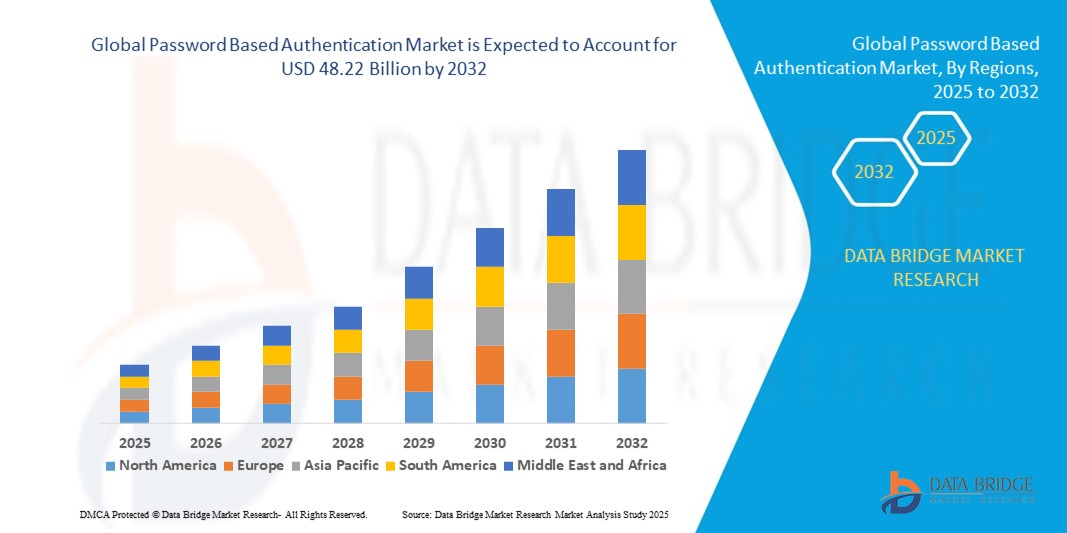
- The global password based authentication market size was valued at USD 7.98 billion in 2024 and is expected to reach USD 48.22 billion by 2032, at a CAGR of 25.20% during the forecast period
- The market growth is largely fueled by increasing cybersecurity threats, rapid digital transformation across industries, and the widespread adoption of biometric technologies, which are driving demand for more secure, scalable, and efficient authentication solutions across both enterprise and consumer applications
Password Based Authentication Market Analysis
- Password based authentication encompasses security mechanisms that use static or biometric passwords for identity verification across digital systems, often incorporating technologies such as fingerprint, face, iris, and voice recognition. These solutions are deployed across government, banking, healthcare, and enterprise platforms to ensure secure user access and protect sensitive data
- The increasing demand for secure access solutions is driven by a combination of rising cybercrime, regulatory compliance mandates, and growing user preference for fast, seamless, and contactless authentication. This has led to accelerated integration of advanced biometric and behavioral technologies into password-based authentication frameworks across global markets
- North America dominated the password based authentication market with a share of 37.5% in 2024, due to the rising adoption of biometric security systems across government, defense, banking, and consumer electronics sectors
- Asia-Pacific is expected to be the fastest growing region in the password based authentication market during the forecast period due to rapid digital transformation, urbanization, and rising smartphone usage across countries such as China, India, and Japan
- Fingerprint recognition segment dominated the market with a market share of 35.1% in 2024, due to its widespread deployment across consumer electronics and enterprise security systems. Its popularity stems from its balance of accuracy, speed, and user convenience. The minimal hardware requirements and growing integration into smartphones, laptops, and access control devices further consolidate its dominance in both commercial and personal authentication environments
Report Scope and Password Based Authentication Market Segmentation
|
Attributes |
Password Based Authentication Key Market Insights |
|
Segments Covered |
|
|
Countries Covered |
North America
Europe
Asia-Pacific
Middle East and Africa
South America
|
|
Key Market Players |
|
|
Market Opportunities |
|
|
Value Added Data Infosets |
In addition to the insights on market scenarios such as market value, growth rate, segmentation, geographical coverage, and major players, the market reports curated by the Data Bridge Market Research also include in-depth expert analysis, geographically represented company-wise production and capacity, network layouts of distributors and partners, detailed and updated price trend analysis and deficit analysis of supply chain and demand. |
Password Based Authentication Market Trends
Rising Need for Robust Security Measures
- The ongoing increase in digital transactions, remote work, and online service expansion is intensifying the demand for effective, accessible security solutions, making password-based authentication a widely adopted method for user identity verification across multiple sectors
- For instance, cybersecurity firms such as Okta and IBM Security continue to enhance traditional password systems with additional safeguards such as password strength meters, breach detection, and alerting functionalities, responding to elevated threat levels and regulatory compliance requirements in industries such as healthcare and financial services
- The proliferation of SaaS applications, e-commerce, and personal data storage platforms accelerates implementation of password-based access controls, driving innovation around salted hashes, multi-step reset mechanisms, and audit trails
- The rise in phishing attacks and credential stuffing campaigns is prompting businesses to introduce periodic forced password changes, user education initiatives, and adaptive rate-limiting in authentication workflows
- Cloud-native authentication tools are offering centralized password management, federation, and integration with single sign-on (SSO), designed for hybrid IT environments and mobile-first use cases
- Regulatory frameworks such as GDPR and PCI DSS raise the bar for password encryption, storage, and lifecycle policies, driving upgrades in enterprise-grade password management protocols
Password Based Authentication Market Dynamics
Driver
Highly Used in Banking Sector
- The banking sector continues to rely heavily on password-based authentication as a frontline mechanism for verifying user identity during online banking logins, mobile app access, and high-risk transactions
- For instance, leading banks such as JPMorgan Chase and HSBC supplement password-based logins with layered defenses, including one-time passwords (OTPs), risk-based authentication, and device fingerprinting, to maintain customer trust and reduce fraud risk
- Core banking systems and payment gateways incorporate password authentication as a default, given its widespread familiarity, ease of deployment, and compatibility with legacy infrastructures
- Financial regulatory requirements for user verification and secure online access drive continued investments in password policy enforcement, mandatory complexity rules, and customer support for password resets
- As digital financial services expand in emerging markets, password-based methods remain the most accessible and cost-effective way to onboard new users and quickly scale service delivery
Restraint/Challenge
Increasing Limitations on Password-Based Authentication Standards
- Despite their ubiquity, passwords face growing scrutiny due to usability problems, vulnerability to cyberattacks, and rising operational costs linked to password resets and helpdesk support
- For instance, enterprises in the finance and healthcare sectors (such as Capital One and UnitedHealth Group) have reported elevated phishing and credential theft incidents resulting from weak or reused passwords, driving interest in alternative authentication models such as biometrics, hardware tokens, or passkeys
- Regulations and cybersecurity best practices now discourage the sole use of passwords for high-value assets or sensitive data protection, encouraging multi-factor authentication (MFA) adoption and conditional access policies
- User fatigue, password reuse across platforms, and sophisticated attack techniques such as brute-force automation limit the long-term effectiveness of password-based controls and erode user experience
- Technology vendors and regulatory bodies are collaborating on standards and messaging that promote passwordless authentication, further challenging the dominance of the password-based model in the digital identity landscape
Password Based Authentication Market Scope
The market is segmented on the basis of type, offering, functionality type, and end user.
- By Type
On the basis of type, the password-based authentication market is segmented into fingerprint recognition, iris recognition, palm print recognition, face recognition, vein recognition, signature recognition, voice recognition, and others. The fingerprint recognition segment dominated the largest market revenue share of 35.1% in 2024, driven by its widespread deployment across consumer electronics and enterprise security systems. Its popularity stems from its balance of accuracy, speed, and user convenience. The minimal hardware requirements and growing integration into smartphones, laptops, and access control devices further consolidate its dominance in both commercial and personal authentication environments.
The face recognition segment is anticipated to witness the fastest growth rate from 2025 to 2032, due to advancements in AI-powered image processing and the rising demand for touchless biometric solutions. The COVID-19 pandemic accelerated contactless authentication adoption, making facial recognition more attractive in sectors such as travel, banking, and healthcare. High user acceptance, enhanced surveillance capabilities, and government investments in facial recognition infrastructure also contribute to this segment's rapid growth.
- By Offering
On the basis of offering, the market is segmented into hardware and software. The hardware segment accounted for the largest revenue share in 2024, owing to the widespread installation of biometric sensors and scanners across access points, ATMs, mobile devices, and surveillance systems. These devices serve as the front line in biometric authentication, capturing and verifying physical traits such as fingerprints, iris patterns, and facial features. The demand for high-performance and tamper-resistant devices, especially in high-security applications, further strengthens this segment’s lead. Hardware advancements have led to faster processing, higher image resolution, and rugged designs for field use. Public and private sector investments in physical access control are driving adoption. As biometrics becomes more embedded in day-to-day infrastructure, hardware remains foundational.
The software segment is expected to register the fastest CAGR from 2025 to 2032, propelled by the increasing reliance on cloud-based identity management solutions and advanced biometric matching algorithms. Software is critical in analyzing, comparing, and securely storing biometric data across platforms. Continuous software updates, integration with multifactor authentication systems, and the rise of AI-based authentication platforms are enhancing software capabilities, making it central to secure digital identities. Scalable solutions are being adopted across banking, healthcare, and government sectors for frictionless verification. The push toward identity-as-a-service (IDaaS) and cross-platform compatibility further boosts this segment’s momentum. As threats evolve, software innovations will be key to resilient biometric ecosystems.
- By Functionality Type
On the basis of functionality type, the market is segmented into contact, noncontact, and combined. The contact segment led the market in 2024, largely driven by its maturity, reliability, and cost-effectiveness. Commonly used in fingerprint and signature recognition systems, contact-based authentication continues to dominate legacy systems across government and financial institutions. These systems offer consistent performance and are supported by well-established infrastructure, making them a practical choice in budget-sensitive deployments. Contact methods are especially prevalent in national ID programs, access control systems, and time attendance tracking. Despite rising competition from newer technologies, their simplicity and proven security maintain demand. Upgrades to existing contact-based installations also help sustain segment revenue.
The noncontact segment is projected to exhibit the fastest growth rate through 2032, as organizations seek more hygienic and user-friendly authentication methods. The growing preference for facial, iris, and voice recognition, especially in healthcare and travel sectors, supports the shift toward noncontact solutions. These systems allow faster processing, seamless integration with mobile platforms, and improved accessibility in high-traffic environments. Enhanced user experience, improved accuracy, and reduced physical wear and tear contribute to the segment’s accelerated adoption. Technological advances in 3D imaging and AI-based recognition further elevate performance standards. As privacy and convenience gain importance, noncontact systems are quickly becoming the new standard in biometric authentication.
- By End User
On the basis of end user, the market is segmented into government, military and defence, healthcare, automotive, banking and finance, consumer electronics, travel & immigration, security, and others. The government segment held the largest share in 2024, driven by large-scale identity verification projects, national ID programs, and secure access requirements for government employees. Biometric authentication is widely deployed in border control, voter registration, and public welfare distribution to ensure identity accuracy and reduce fraud. Deployment of biometric authentication in e-governance and digital service delivery platforms continues to expand across both developed and developing nations. Initiatives such as e-passports, biometric visas, and smart policing further strengthen this segment. The push for secure, inclusive digital identity systems keeps government demand high.
The banking and finance segment is forecasted to grow at the fastest pace during the forecast period, fueled by escalating concerns over financial fraud and digital identity theft. Banks and fintech platforms are increasingly investing in biometrics to enable secure mobile banking, ATM access, and customer onboarding. The technology enhances both security and user convenience, reducing reliance on traditional PINs and passwords. Regulatory compliance with KYC (Know Your Customer) norms and multi-factor authentication standards further propels biometric adoption in this sector. As digital transactions surge, biometric solutions are becoming integral to financial risk mitigation.
Password Based Authentication Market Regional Analysis
- North America dominated the password based authentication market with the largest revenue share of 37.5% in 2024, driven by the rising adoption of biometric security systems across government, defense, banking, and consumer electronics sectors
- Organizations in the region are rapidly integrating fingerprint, facial, and voice recognition systems to bolster security protocols, enhance user convenience, and comply with evolving regulatory standards
- High awareness of data privacy, widespread use of digital services, and early adoption of advanced technologies are accelerating market growth across both public and private sectors
U.S. Password Based Authentication Market Insight
The U.S. held the largest revenue share within the North American market in 2024, driven by heightened focus on secure, frictionless authentication across critical sectors. The growing threat of identity theft and cybercrime has led government agencies, healthcare providers, and financial institutions to adopt biometric systems to protect sensitive data and ensure compliance with standards such as HIPAA, FIDO, and CCPA. In addition, strong investments in artificial intelligence and machine learning are improving the accuracy and responsiveness of authentication systems, driving broader deployment across both consumer and enterprise applications.
Europe Password Based Authentication Market Insight
The Europe password based authentication market is expected to grow steadily over the forecast period, fueled by regulatory mandates and increasing concern over data protection. Initiatives such as GDPR, PSD2, and eIDAS are compelling enterprises and public institutions to strengthen identity verification processes. The integration of biometric authentication into banking, immigration, and public sector services is accelerating across the region. Europe’s focus on privacy-preserving technologies and secure digital ecosystems is fostering demand for advanced, non-contact authentication methods such as face and iris recognition.
U.K. Password Based Authentication Market Insight
The U.K. market is poised for notable growth, driven by the expansion of digital financial services, increased remote access needs, and heightened concerns around cybersecurity. Biometric systems are being integrated into online banking, government platforms, and mobile applications to enable secure, real-time identity verification. The growing preference for seamless, user-friendly, and privacy-compliant solutions is fueling the adoption of contactless authentication methods, particularly in the retail, healthcare, and public service sectors.
Germany Password Based Authentication Market Insight
Germany’s password based authentication market is projected to expand considerably during the forecast period, supported by the country’s strong industrial infrastructure, regulatory focus on data privacy, and demand for advanced security systems. Enterprises across manufacturing, IT, and finance are increasingly deploying biometric access controls to safeguard critical assets and sensitive data. German consumers also show a growing preference for secure, locally processed biometric authentication systems that align with strict privacy standards, further encouraging adoption of on-device technologies.
Asia-Pacific Password Based Authentication Market Insight
Asia-Pacific is projected to register the fastest CAGR between 2025 and 2032 in the password based authentication market, fueled by rapid digital transformation, urbanization, and rising smartphone usage across countries such as China, India, and Japan. Government-led initiatives such as Aadhaar in India and digital ID programs in Southeast Asia are driving mass-scale deployment of biometric systems. Increasing awareness around cybersecurity, growing demand for mobile banking, and the integration of biometrics into consumer electronics are also accelerating market growth across the region.
Japan Password Based Authentication Market Insight
Japan’s market is gaining traction due to its high technological maturity and increasing demand for contactless, secure, and efficient authentication methods. Biometrics such as face and voice recognition are being widely adopted across banking, consumer electronics, and healthcare, where precision and user comfort are critical. Japan’s aging population is also influencing the design of intuitive, non-contact authentication systems that enhance accessibility without compromising security.
China Password Based Authentication Market Insight
China led the Asia-Pacific region in market revenue in 2024, driven by its strong domestic manufacturing base, widespread deployment of biometric technologies, and large-scale digital infrastructure development. The government’s emphasis on smart city development and the implementation of facial recognition in public safety, payments, and citizen services are key contributors to growth. The increasing affordability and technological advancement of biometric systems are expanding their use across residential, commercial, and institutional applications, securing China’s position as a regional leader in password based authentication.
Password Based Authentication Market Share
The password based authentication industry is primarily led by well-established companies, including:
- Safran (France)
- NEC Corporation India Private Limited (India)
- FUJITSU (Japan)
- Aware, Inc. (U.S.)
- Gemalto Cogent, Inc. (U.S.)
- BIO-key International (U.S.)
- Precise Biometrics (Sweden)
- secunet Security Networks AG. (Germany)
- Thales Group (France)
- Cognitec Systems GmbH (Germany)
- Crossmatch. (U.S.)
- Fulcrum Biometrics, LLC. (U.S.)
- Daon (Ireland)
- Facebanx (U.S.)
- HID Global Corporation/ASSA ABLOY AB. (U.S.)
- SUPREMA Inc, (South Korea)
- Iritech, inc. (U.S.)
- M2SYS Technology (U.S.)
Latest Developments in Global Password Based Authentication Market
- In October 2024, SecureAuth launched an advanced adaptive authentication feature powered by machine learning, enabling real-time assessment of user behavior and contextual risk. This innovation enhances the user experience by reducing login friction while maintaining high security standards. The integration of intelligent decision-making into authentication processes marks a significant step toward dynamic, passwordless verification models, strengthening SecureAuth’s position in the enterprise cybersecurity space and contributing to the broader shift toward smarter, risk-aware authentication solutions in the market
- In July 2022, Stytch unveiled a modern upgrade to traditional password systems, aiming to simplify and secure user authentication. By introducing updated infrastructure and user-friendly authentication flows, the company addressed long-standing issues with password fatigue and vulnerability. This move reflected a growing industry trend toward reimagining password-based systems to improve usability without compromising security, influencing both developers and organizations to rethink legacy authentication models in favor of more seamless and secure solutions
- In December 2020, LoginRadius introduced Smart and IoT Authentication designed specifically for input-constrained devices, enabling hassle-free login experiences. This development responded to the rising proliferation of IoT ecosystems, where conventional password input is impractical. By enabling secure and user-friendly access across wearables, smart appliances, and embedded systems, LoginRadius positioned itself at the forefront of IoT-ready authentication solutions, expanding the scope and application of password-based authentication in a rapidly diversifying connected device landscape
- In November 2020, Hitachi ABB Power Grids announced that they had signed a 5-year contract with Dubai Electricity and Water Authority (DEWA) to provide energy solutions. Under this agreement, the company will supply, install, test, and commission 15 new substations and refurbish and upgrade 18 existing substations across Dubai. Thus, the company will supply its MicroSCADA solution helping to protect, control, measure, and supervise power systems

- Interactive Data Analysis Dashboard
- Company Analysis Dashboard for high growth potential opportunities
- Research Analyst Access for customization & queries
- Competitor Analysis with Interactive dashboard
- Latest News, Updates & Trend analysis
- Harness the Power of Benchmark Analysis for Comprehensive Competitor Tracking
Global Password Based Authentication Market, Supply Chain Analysis and Ecosystem Framework
To support market growth and help clients navigate the impact of geopolitical shifts, DBMR has integrated in-depth supply chain analysis into its Global Password Based Authentication Market research reports. This addition empowers clients to respond effectively to global changes affecting their industries. The supply chain analysis section includes detailed insights such as Global Password Based Authentication Market consumption and production by country, price trend analysis, the impact of tariffs and geopolitical developments, and import and export trends by country and HSN code. It also highlights major suppliers with data on production capacity and company profiles, as well as key importers and exporters. In addition to research, DBMR offers specialized supply chain consulting services backed by over a decade of experience, providing solutions like supplier discovery, supplier risk assessment, price trend analysis, impact evaluation of inflation and trade route changes, and comprehensive market trend analysis.
Data collection and base year analysis are done using data collection modules with large sample sizes. The stage includes obtaining market information or related data through various sources and strategies. It includes examining and planning all the data acquired from the past in advance. It likewise envelops the examination of information inconsistencies seen across different information sources. The market data is analysed and estimated using market statistical and coherent models. Also, market share analysis and key trend analysis are the major success factors in the market report. To know more, please request an analyst call or drop down your inquiry.
The key research methodology used by DBMR research team is data triangulation which involves data mining, analysis of the impact of data variables on the market and primary (industry expert) validation. Data models include Vendor Positioning Grid, Market Time Line Analysis, Market Overview and Guide, Company Positioning Grid, Patent Analysis, Pricing Analysis, Company Market Share Analysis, Standards of Measurement, Global versus Regional and Vendor Share Analysis. To know more about the research methodology, drop in an inquiry to speak to our industry experts.
Data Bridge Market Research is a leader in advanced formative research. We take pride in servicing our existing and new customers with data and analysis that match and suits their goal. The report can be customized to include price trend analysis of target brands understanding the market for additional countries (ask for the list of countries), clinical trial results data, literature review, refurbished market and product base analysis. Market analysis of target competitors can be analyzed from technology-based analysis to market portfolio strategies. We can add as many competitors that you require data about in the format and data style you are looking for. Our team of analysts can also provide you data in crude raw excel files pivot tables (Fact book) or can assist you in creating presentations from the data sets available in the report.













