What is the Pasta Sauce Market Size and Growth Rate?
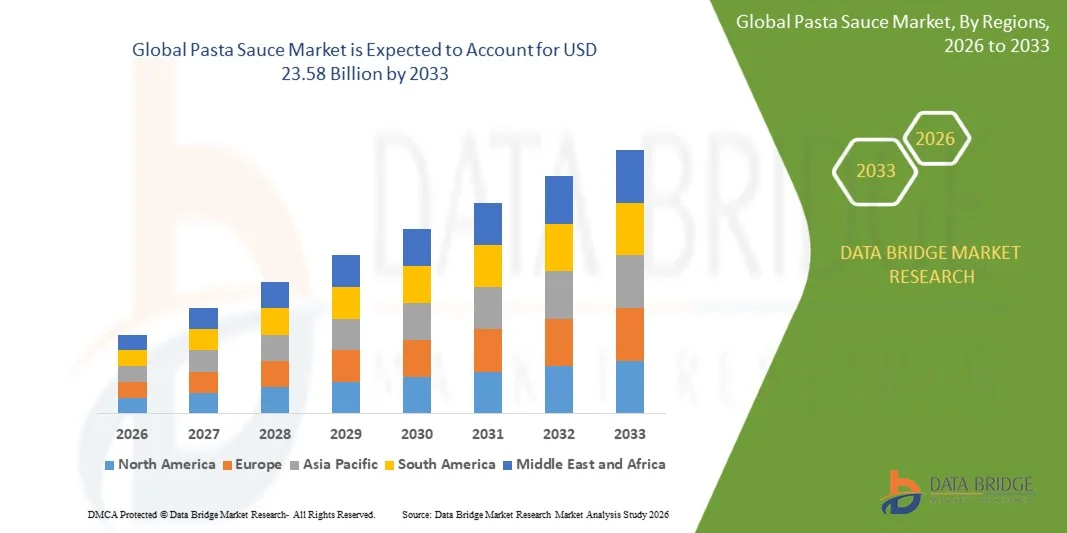
- As per Data Bridge Market Research analysis, the Pasta Sauce market was valued at USD 13.22 billion in 2025 and is projected to reach USD 23.58 billion by 2033, growing at a CAGR of 7.50% from 2026 to 2033.
- The market is expanding due to rising consumer demand for convenient and ready-to-use meal solutions, increasing consumption of pasta and Italian cuisine, changing consumer lifestyles, growing preference for packaged and flavorful food products, increasing health and wellness awareness, rising demand for organic and clean-label products, and expansion of supermarkets, modern retail, and e-commerce food channels.
- Pasta sauces are increasingly being adopted as convenient meal-enhancing products across households and foodservice applications, supported by growing demand for quick meal preparation, diverse flavors, premium and organic formulations, improved packaging, product innovation, and wider availability through supermarkets, hypermarkets, convenience stores, specialty food retailers, and online grocery platforms.
Market Size & Forecast
- Global Market Value (2025): USD 13.22 billion
- Expected Market Value (2033): USD 23.58 billion
- Forecast CAGR (2026–2033): 7.50%
- Leading Region in 2025: Europe
- Fastest Growing Region: Asia-Pacific
What are the Major Takeaways of the Pasta Sauce Market?
- Europe dominated the global pasta sauce market with a share of 38.10% in 2025, supported by strong pasta consumption, established pasta-making traditions, consumer preference for authentic flavors, developed food manufacturing capabilities, and extensive retail distribution networks.
- Asia pacific is expected to be the fastest-growing regional market at a CAGR of 7.42% through 2031, driven by urbanization, rising disposable incomes, expanding middle-class populations, increasing exposure to western cuisines, and growing demand for convenient packaged foods.
- The conventional segment dominated the market by nature with a share of 80.75% in 2025, supported by its wider availability, established distribution networks, competitive pricing, longer shelf life, and strong consumer acceptance.
- The organic segment is expected to register the faster growth, at a CAGR of 8.74% through 2031, driven by increasing demand for clean-label products, natural ingredients, health-oriented foods, and sustainable food choices.
- The tomato-based sauces segment dominated the product type category with a market share of 53.89% in 2025, supported by its broad consumer acceptance, affordability, versatility, and extensive use across household and foodservice applications.
- The glass bottles segment dominated the packaging type category with a share of 38.05% in 2025, supported by product visibility, preservation characteristics, premium positioning, consumer familiarity, and suitability for a wide range of pasta sauce formulations.
- Pouches are expected to be the fastest-growing packaging format at a CAGR of 6.51% through 2031, supported by lightweight construction, convenience, portability, resealability, lower transportation requirements, and increasing adoption in e-commerce and single-serve applications.
Report Scope and Pasta Sauce Market Segmentation
|
Attributes |
Pasta Sauce Key Market Insights |
|
Segments Covered |
|
|
Countries Covered |
North America
Europe
Asia-Pacific
Middle East and Africa
South America
|
|
Key Market Players |
|
|
Market Opportunities |
|
|
Value Added Data Infosets |
In addition to the insights on market scenarios such as market value, growth rate, segmentation, geographical coverage, and major players, the market reports curated by the Data Bridge Market Research also include in-depth expert analysis, pricing analysis, brand share analysis, consumer survey, demography analysis, supply chain analysis, value chain analysis, raw material/consumables overview, vendor selection criteria, PESTLE Analysis, Porter Analysis, and regulatory framework. |
What is the Key Trend in the Pasta Sauce Market?
- Increasing demand for clean-label, natural, and minimally processed Pasta Sauce products is becoming a major trend in the global pasta sauce market, as consumers increasingly seek products with simple ingredients, reduced artificial additives, organic formulations, and transparent ingredient and production information. Growing health and wellness awareness is encouraging brands to reformulate sauces around natural ingredients, low-sugar formulations, plant-based ingredients, and other better-for-you attributes. Mintel's 2026 analysis highlights naturalness and streamlined recipes as important directions in cooking and pasta sauce innovation.
- Integration of convenience, premiumization, and globally inspired flavors is gaining importance as consumers increasingly look for restaurant-style meals that can be prepared quickly at home. Pasta sauce brands are introducing versatile products, premium ingredients, spicy and Asian-influenced flavors, and formulations designed to simplify meal preparation while providing greater flavor variety. Mintel's 2026 outlook identifies convenience, versatility, global flavors, and nutritious formats as important areas of future sauce innovation.
- For instance, in March 2025, Yo Mama's expanded its product portfolio with gluten-free, low-glycemic pastas and reformulated its Vodka Sauce using fresh heavy cream, while emphasizing clean-label positioning and consumer feedback. The company also used direct-to-consumer channels through Amazon and its website to test products and collect consumer feedback before broader retail expansion, demonstrating the increasing integration of product innovation, health-oriented positioning, and digital commerce in the pasta sauce category.
- Overall, the pasta sauce market is increasingly shaped by clean-label formulations, natural and organic ingredients, convenience-oriented products, premium and restaurant-inspired flavors, global taste influences, nutritious formulations, flexible packaging, and omnichannel retail. Pasta sauce companies are therefore moving toward consumer-centric product development that combines simpler ingredients and health-oriented attributes with convenience, versatility, distinctive flavors, and wider digital and modern retail distribution
What are the Key Drivers of the Pasta Sauce Market?
- Increasing demand for premium, clean-label, and healthier pasta sauces is becoming a major growth driver in the global pasta sauce market, as consumers increasingly seek products with recognizable ingredients, organic formulations, lower sodium, no artificial additives, and reduced processing. Premiumization is particularly important as consumers show greater willingness to pay for sauces offering higher-quality ingredients, distinctive flavors, and perceived health benefits.
- Expansion of flavor innovation and product variety is gaining importance as consumers increasingly seek convenient meals with diverse culinary experiences. Pasta sauce manufacturers are introducing pesto, vegetable-rich, tomato-basil, spicy, cheese-based, organic, and other specialty formulations to address changing taste preferences and attract younger consumers. The trend is also supported by growing interest in Mediterranean flavors and premium sauces.
- Overall, the pasta sauce market is increasingly shaped by premiumization, clean-label formulations, organic ingredients, health and wellness preferences, bold flavor innovation, convenience, sustainable packaging, and expansion through modern retail and e-commerce channels. Pasta sauce manufacturers are therefore moving toward consumer-centric product development that combines convenient meal solutions with higher-quality ingredients, differentiated flavors, nutritional benefits, and transparent product positioning
What Factors are Challenging the Growth of the Pasta Sauce Market?
- Volatility in tomato, olive oil, packaging, energy, and logistics costs is becoming a major challenge in the global Pasta Sauce market, as manufacturers remain exposed to agricultural supply fluctuations, climate variability, transportation costs, energy prices, and changes in packaging material costs. Tomatoes are a particularly important input for tomato-based sauces, making crop yields and sourcing conditions important factors affecting production costs and margins.
- Increasing consumer demand for healthier and clean-label pasta sauces is creating formulation and cost pressures for manufacturers, as consumers increasingly scrutinize sodium, sugar, preservatives, artificial additives, and ingredient transparency. Manufacturers are therefore required to develop organic, low-sodium, low-sugar, preservative-free, gluten-free, and plant-based formulations while maintaining taste, texture, shelf stability, and affordability.
- For instance, in January 2025, Bionaturae introduced its first line of certified organic pasta sauces in the U.S., including Marinara, Arrabbiata, and Tomato and Basil variants with gluten-free, glyphosate-free, and non-GMO positioning, reflecting the increasing pressure on manufacturers to differentiate through clean-label and organic formulations.
- Overall, the global Pasta Sauce market is increasingly shaped by raw-material volatility, changing nutritional preferences, clean-label reformulation, sustainable packaging requirements, premiumization, product innovation, and supply-chain resilience. Pasta sauce manufacturers are therefore moving toward diversified sourcing, healthier formulations, recyclable packaging, differentiated flavors, and flexible product portfolios that can address both premium consumer demand and affordability requirements.
How is the Pasta Sauce Market Segmented?
The global pasta sauce market is segmented on the basis of nature, product type, packaging type, distribution channel, and application.
- By Nature
On the basis of nature, the global pasta sauce market is segmented into organic and conventional. The conventional segment dominated the market with a market share of 80.75% in 2025, supported by broad product availability, established consumer preferences, competitive pricing, longer shelf life, and extensive retail distribution.
The organic segment is projected to grow at a CAGR of 7.80% from 2026 to 2033, driven by increasing consumer demand for clean-label products, natural ingredients, organic certification, and healthier food alternatives.
- By Product Type
On the basis of product type, the global pasta sauce market is segmented into tomato-based sauces, pesto-based sauces, alfredo-based sauces, and others. The tomato-based sauces segment dominated the market with a market share of 53.89% in 2025, supported by broad consumer acceptance, affordability, versatility, traditional consumption patterns, and extensive use across household and foodservice applications.
The pesto-based sauces segment is projected to grow at a CAGR of 7.80% from 2026 to 2033, supported by increasing demand for premium sauces, Mediterranean flavors, authentic ingredients, and gourmet meal solutions.
- By Packaging Type
On the basis of packaging type, the global pasta sauce market is segmented into glass bottles, pet, cans, pouches, and cartons. The glass bottles segment dominated the market with a share of 38.05% in 2025, supported by product visibility, perceived quality, preservation characteristics, premium positioning, and consumer familiarity.
The pouches segment is projected to grow at a CAGR of 6.50% from 2026 to 2033, driven by lightweight construction, portability, convenience, resealability, efficient transportation, and growing consumer preference for flexible packaging
- By Distribution Channel
On the basis of distribution channel, the global pasta sauce market is segmented into direct and indirect channels. The indirect segment dominated the market with a share of 85.00% in 2025, supported by the extensive reach of supermarkets, hypermarkets, specialty food retailers, convenience stores, and online grocery platforms.
The direct segment is projected to grow at a CAGR of 6.80% from 2026 to 2033, supported by the expansion of direct-to-consumer websites, subscription-based food services, digital commerce, and brand-owned online platforms.
- By Application
On the basis of application, the global pasta sauce market is segmented into dried pasta, fresh pasta, and others. The dried pasta segment dominated the application category with a market share of 57.00% in 2025, supported by longer shelf life, affordability, ease of storage, widespread availability, and convenience of preparation.
The fresh pasta segment is projected to grow at a CAGR of 6.80% from 2026 to 2033, driven by increasing consumer interest in premium and restaurant-style meals, fresh food products, and authentic Italian cuisine.
Which Region Holds the Largest Share of the Pasta Sauce Market?
- Europe accounted for the largest share of the global pasta sauce market, with a revenue share of 38.10% in 2025, supported by deeply established pasta consumption patterns, strong Italian culinary heritage, high per capita pasta consumption, well-developed food retail infrastructure, and strong consumer preference for traditional and premium pasta sauces. Italy remains a key market within the region, supported by its established pasta and sauce manufacturing ecosystem, while Germany, France, the United Kingdom, and Spain contribute to regional demand through established retail networks and growing interest in authentic, clean-label, premium, and convenient food products.
- The Italy represents a major contributor within Europe, supported by its strong culinary heritage, high pasta consumption, established pasta-sauce manufacturing base, and presence of internationally recognized food companies. Demand for traditional tomato-based sauces, pesto, premium formulations, and authentic Italian flavors continues to support the regional market. Germany and the United Kingdom also represent important markets, driven by established modern retail channels, increasing demand for convenient meal solutions, and consumer interest in premium and authentic food products.
U.S. Pasta Sauce Market Insight
The U.S. pasta sauce market is theoretically expected to maintain steady growth, supported by rising demand for convenient meal solutions, home cooking, premium sauces, and Italian-inspired cuisine. Tomato-based sauces are expected to remain the leading product category, while pesto and Alfredo sauces are anticipated to gain traction. Increasing consumer preference for organic, clean-label, low-sodium, plant-based, and sustainable packaged sauces is also expected to create growth opportunities.
Canada Pasta Sauce Market Insight
The Canada pasta sauce market is supported by strong household consumption, established grocery retail infrastructure, and growing demand for convenient and premium meal solutions. The market is being shaped by increasing interest in clean-label formulations, healthier sauces, diverse global flavors, and home cooking. Supermarkets and hypermarkets remain important distribution channels, while e-commerce is gaining traction. The tomato-based segment is expected to maintain a leading position, supported by its broad consumer acceptance.
Asia-Pacific Pasta Sauce Market Insight
Asia-Pacific is emerging as a promising region in the global pasta sauce market, driven by rapid urbanization, rising disposable incomes, expanding middle-class populations, and growing consumer exposure to Western and Italian cuisines. Increasing retail modernization, expanding e-commerce platforms, and the growth of foodservice outlets are improving the accessibility and availability of pasta sauces across the region. In addition, rising demand for convenient meal solutions, evolving food preferences, and growing interest in international flavors are supporting market expansion. Countries such as China, Japan, India, and Australia are contributing to regional demand through changing dietary habits and increasing adoption of Western-style food products.
China Pasta Sauce Market Insight
The China pasta sauce market is expected to witness steady expansion, Growth is supported by increasing exposure to Western cuisines, rapid urbanization, rising disposable incomes, expansion of modern retail, and growing demand for convenient meal solutions. Increasing penetration of supermarkets, online grocery platforms, and foodservice outlets is further supporting accessibility. Demand for tomato-based, spicy, fusion, and premium pasta sauces is expected to increase as younger consumers adopt diverse international flavors and convenient cooking formats.
Japan Pasta Sauce Market Insight
The Japan pasta sauce market is supported by increasing demand for convenient meal solutions, changing household structures, and growing acceptance of Western-style cuisine. Tomato-based sauces supported by their familiarity and versatility. Demand for microwave-ready pouches, reduced-sodium formulations, natural ingredients, and premium sauces is expected to strengthen adoption. Supermarkets and convenience stores are anticipated to remain key distribution channels, while online retail is projected to gain momentum among younger and urban consumers.
Germany Pasta Sauce Market Insight
The Germany pasta sauce market is supported by strong consumer demand for food and beverages, personal care products, household care products, and healthcare products. Growing consumer preference for premium, convenient, health-oriented, and sustainable products is encouraging manufacturers to expand product portfolios and adopt innovative packaging solutions. Germany’s well-developed retail infrastructure, extensive supermarket networks, discount retailers, and rapidly expanding e-commerce channels are further supporting market accessibility. Increasing private-label penetration, digital shopping adoption, sustainability initiatives, and demand for environmentally responsible packaging are expected to influence market development, while established domestic and international CPG companies continue to strengthen competition.
U.K. Pasta Sauce Market Insight
The U.K. pasta sauce market is supported by increasing demand for convenient meal solutions, premium sauces, authentic Italian flavors, and clean-label formulations. Demand is further supported by expanding supermarket and e-commerce distribution, premium own-label offerings, and consumer interest in healthier, low-sugar, organic, and plant-based formulations. Growing experimentation with pesto, cream-based, spicy, and regional Italian flavors is also expected to support market expansion.
Which are the Top Companies in Pasta Sauce Market?
The pasta sauce industry is primarily led by well-established companies, including:
- Kellogg Co. (U.S.)
- Dun & Bradstreet, Inc (U.S.)
- Conagra Brands, Inc. (U.S.)
- London Dairy Co. Ltd (U.K.)
- Danone S.A. (France)
- ADM (U.S.)
- Daiya Foods Inc. (Canada)
- Grupo Bimbo S.A.B.de C.V. (Mexico)
- Associated British Foods PLC (U.K.)
- General Mills Inc. (U.S.)
- Lantmännen Unibake (Denmark)
- Aryzta AG (Switzerland)
- Vandemoortele NV (Belgium)
- Europastry S.A. (Spain)
- Cole’s Quality Food Inc. (U.S.)
What are Latest Developments in Pasta Sauce Market?
- In January 2025, Bionaturae launched its first-ever line of Certified Organic Pasta Sauces, introducing Marinara, Arrabbiata, and Tomato & Basil varieties. The products were positioned around organic, gluten-free, glyphosate-free, and non-GMO attributes, reflecting growing demand for clean-label and health-oriented pasta sauces.
- In February 2025, Carbone Fine Food expanded its premium pasta sauce portfolio with five new flavors, including Sweet Pepper & Onion, Mediterranean Marinara, Black Truffle Alfredo, Mac & Cheese Alfredo, and Lemon Pepper Alfredo. The launch expanded the company's portfolio to 17 sauce varieties and strengthened its focus on premium and chef-inspired flavor innovation.
- In March 2025, Yo Mama's expanded its better-for-you product portfolio with protein- and fiber-enriched gluten-free pastas designed to complement its existing sauce range. The company also reformulated its Vodka Sauce with fresh heavy cream, while continuing to offer no-added-sugar red sauces, highlighting the market's movement toward health-oriented and clean-label offerings.
- In August 2025, Cravings by Chrissy Teigen entered the pasta sauce category with four varieties, including Spicy Miso Alfredo, Creamy Tomato, Spicy Thai Basil Marinara, and Creamy Corn & Truffle. The launch demonstrated continued consumer interest in globally inspired flavors and differentiated premium sauce formulations.
- In May 2026, The Campbell's Company completed its acquisition of a 49% interest in La Regina, the longtime manufacturer of Rao's Homemade tomato-based pasta sauces. The transaction strengthened Campbell's supply-chain relationship with La Regina and supported the continued expansion of the Rao's Homemade premium sauce business.
- Interactive Data Analysis Dashboard
- Company Analysis Dashboard for high growth potential opportunities
- Research Analyst Access for customization & queries
- Competitor Analysis with Interactive dashboard
- Latest News, Updates & Trend analysis
- Harness the Power of Benchmark Analysis for Comprehensive Competitor Tracking
Global Pasta Sauce Market, Supply Chain Analysis and Ecosystem Framework
To support market growth and help clients navigate the impact of geopolitical shifts, DBMR has integrated in-depth supply chain analysis into its Global Pasta Sauce Market research reports. This addition empowers clients to respond effectively to global changes affecting their industries. The supply chain analysis section includes detailed insights such as Global Pasta Sauce Market consumption and production by country, price trend analysis, the impact of tariffs and geopolitical developments, and import and export trends by country and HSN code. It also highlights major suppliers with data on production capacity and company profiles, as well as key importers and exporters. In addition to research, DBMR offers specialized supply chain consulting services backed by over a decade of experience, providing solutions like supplier discovery, supplier risk assessment, price trend analysis, impact evaluation of inflation and trade route changes, and comprehensive market trend analysis.
Data collection and base year analysis are done using data collection modules with large sample sizes. The stage includes obtaining market information or related data through various sources and strategies. It includes examining and planning all the data acquired from the past in advance. It likewise envelops the examination of information inconsistencies seen across different information sources. The market data is analysed and estimated using market statistical and coherent models. Also, market share analysis and key trend analysis are the major success factors in the market report. To know more, please request an analyst call or drop down your inquiry.
The key research methodology used by DBMR research team is data triangulation which involves data mining, analysis of the impact of data variables on the market and primary (industry expert) validation. Data models include Vendor Positioning Grid, Market Time Line Analysis, Market Overview and Guide, Company Positioning Grid, Patent Analysis, Pricing Analysis, Company Market Share Analysis, Standards of Measurement, Global versus Regional and Vendor Share Analysis. To know more about the research methodology, drop in an inquiry to speak to our industry experts.
Data Bridge Market Research is a leader in advanced formative research. We take pride in servicing our existing and new customers with data and analysis that match and suits their goal. The report can be customized to include price trend analysis of target brands understanding the market for additional countries (ask for the list of countries), clinical trial results data, literature review, refurbished market and product base analysis. Market analysis of target competitors can be analyzed from technology-based analysis to market portfolio strategies. We can add as many competitors that you require data about in the format and data style you are looking for. Our team of analysts can also provide you data in crude raw excel files pivot tables (Fact book) or can assist you in creating presentations from the data sets available in the report.