


Patient Mechanical Lift Handling Equipment Market Overview
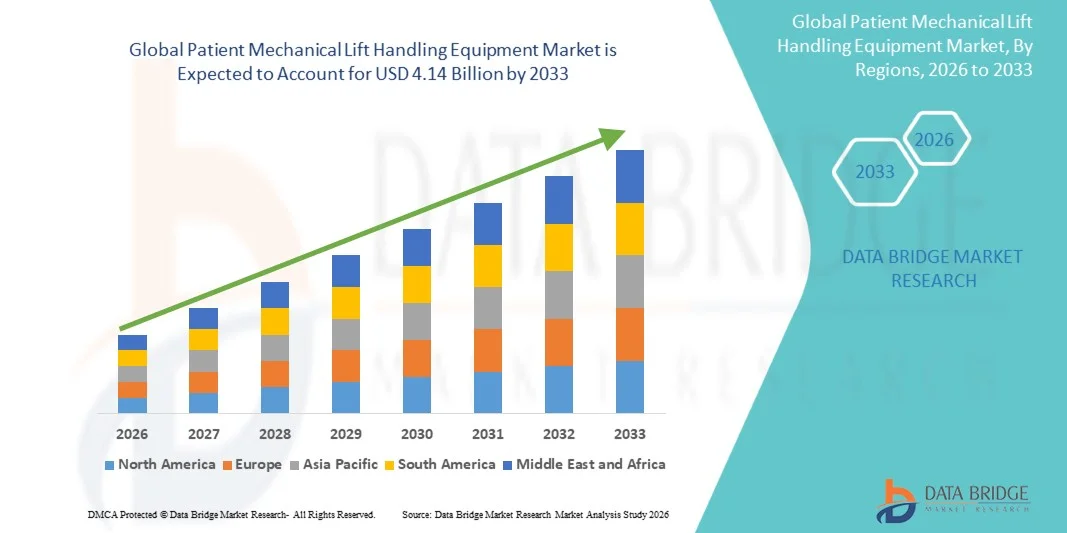
The Patient Mechanical Lift Handling Equipment Market was valued at USD 2.21 billion in 2025 and is projected to reach USD 4.14 billion by 2033, growing at a CAGR of 8.18% from 2026 to 2033. The market is experiencing consistent growth driven by the rising demand for safe patient handling solutions, increasing adoption of mobility assistance equipment across healthcare facilities, and growing advancements in automated lifting and transfer technologies. Expanding elderly populations, rising prevalence of disabilities and musculoskeletal disorders, and increasing focus on caregiver safety are further accelerating demand for patient mechanical lift handling equipment globally.
The increasing incidence of patient handling injuries among healthcare workers, combined with stringent workplace safety regulations and growing emphasis on reducing manual lifting practices, is compelling hospitals, nursing homes, rehabilitation centers, and home healthcare providers to adopt advanced patient lifting systems. Ceiling lifts, mobile lifts, sit-to-stand lifts, and powered transfer devices are increasingly replacing manual patient handling methods in many healthcare settings, offering safer, more efficient, and ergonomic solutions for patient mobility, transfer, and rehabilitation support.
Key Market Trends & Insights
- North America dominated the Patient Mechanical Lift Handling Equipment Market with the largest revenue share of 37.48% in 2025, supported by advanced healthcare infrastructure, high adoption of safe patient handling technologies, and stringent occupational safety regulations aimed at reducing caregiver injuries across hospitals and long-term care facilities.
- The Medical Beds segment led the market with a 29.84% share in 2025, driven by rising hospitalization rates, increasing demand for critical care infrastructure, and widespread adoption of electrically adjustable beds across hospitals, rehabilitation centers, and elderly care facilities.
- Asia-Pacific is expected to be the fastest-growing region at a CAGR of 7.9% from 2026 to 2033, fueled by rapidly expanding healthcare infrastructure, rising geriatric population, increasing healthcare expenditure, and growing adoption of patient mobility and transfer solutions across China, India, and Japan.
- The Overhead/Ceiling Lifts segment is projected to register the fastest growth at a CAGR of 7.4% from 2026 to 2033, reflecting increasing demand for safe, efficient, and ergonomic patient transfer systems in hospitals and long-term care facilities.
- The Long Term Care segment dominates the type of care category with a 34.26% revenue share in 2025, led by increasing elderly population, rising prevalence of mobility-related disorders, and growing demand for continuous patient assistance and rehabilitation support services.
- The Hospital Bed Accessories segment accounted for 31.42% of the accessories market in 2025, supported by growing demand for advanced patient positioning systems, pressure relief mattresses, side rails, and monitoring-integrated bed accessories across acute and critical care settings.
- The Hospitals segment dominated the end user category with a 46.18% revenue share in 2025, driven by increasing patient admissions, rising surgical procedures, and strong adoption of mechanical patient lifting equipment to improve patient safety and caregiver efficiency.
- The Home Care Settings segment is expected to witness the fastest growth at a CAGR of 7.2% from 2026 to 2033, fueled by increasing preference for home-based elderly care, growing adoption of portable lifting systems, and rising focus on reducing long-term hospitalization costs globally.
- The acute and critical care segment dominated the market with a share of 31.74% in 2025 due to the high utilization of patient lifting and repositioning equipment across intensive care units, emergency departments, and surgical recovery facilities
Market Size & Forecast
- Global Market Value (2025): USD 2.21 Billion
- Expected Market Value (2033): USD 4.14 Billion
- Forecast CAGR (2026–2033): 8.18%
- Leading Region in 2025: North America
- Fastest Growing Region: Asia-Pacific
Report Scope and Patient Mechanical Lift Handling Equipment Market Segmentation
|
Attributes |
Patient Mechanical Lift Handling Equipment Key Market Insights |
|
Segments Covered |
|
|
Countries Covered |
North America · U.S. · Canada · Mexico Europe · Germany · France · U.K. · Netherlands · Switzerland · Belgium · Russia · Italy · Spain · Turkey · Rest of Europe Asia-Pacific · China · Japan · India · South Korea · Singapore · Malaysia · Australia · Thailand · Indonesia · Philippines · Rest of Asia-Pacific Middle East and Africa · Saudi Arabia · U.A.E. · South Africa · Egypt · Israel · Rest of Middle East and Africa South America · Brazil · Argentina · Rest of South America |
|
Key Market Players |
• Arjo AB (Sweden) |
|
Market Opportunities |
· Expansion of Home Healthcare and Elderly Care Services · Increasing Adoption of Smart and Automated Patient Handling Solutions · Rising Healthcare Infrastructure Development in Emerging Economies |
|
Value Added Data Infosets |
In addition to the insights on market scenarios such as market value, growth rate, segmentation, geographical coverage, and major players, the market reports curated by the Data Bridge Market Research also include in-depth expert analysis, geographically represented company-wise production and capacity, network layouts of distributors and partners, detailed and updated price trend analysis and deficit analysis of supply chain and demand. |
Patient Mechanical Lift Handling Equipment Market Trends
Trend: Rising Adoption of Smart and Ergonomic Patient Handling Solutions
Healthcare providers and long-term care facilities are increasingly adopting smart patient mechanical lift handling equipment to improve patient safety, reduce caregiver injuries, and enhance operational efficiency. Advanced ceiling lifts, powered sit-to-stand systems, and AI-enabled patient transfer devices are being integrated with pressure sensors, remote monitoring systems, and ergonomic controls to support safe patient mobility and minimize musculoskeletal strain among healthcare workers. In addition, the growing adoption of bariatric care equipment and reusable sling systems is improving patient comfort and reducing manual lifting risks across hospitals and elderly care centers.
For instance, in 2024, Arjo AB expanded its portfolio of intelligent patient transfer and mobility solutions designed to improve caregiver safety and workflow efficiency across acute and long-term care settings. Similarly, Hillrom introduced advanced connected hospital bed and patient mobility technologies integrated with digital monitoring capabilities to enhance patient handling and fall prevention programs. Increasing adoption of ceiling-mounted lifts and automated repositioning systems across North America and Europe is further accelerating the transition toward safer and technology-enabled patient handling environments.
Patient Mechanical Lift Handling Equipment Market Dynamics
Key Market Driver: Rising Geriatric Population and Increasing Need for Safe Patient Handling
The growing elderly population and rising prevalence of chronic diseases, disabilities, and mobility impairments are major factors driving demand for patient mechanical lift handling equipment globally. Increasing hospitalization rates, long-term rehabilitation needs, and demand for home healthcare services are significantly expanding the requirement for safe patient transfer and mobility assistance solutions. According to the World Health Organization (WHO), the global population aged 60 years and above is expected to reach over 2 billion by 2050, substantially increasing demand for elderly care and patient mobility support systems.
Hospitals, nursing homes, rehabilitation centers, and home healthcare providers are increasingly investing in mechanical lifts, transfer aids, and repositioning systems to reduce caregiver injuries and improve patient safety outcomes. In addition, stringent occupational safety regulations regarding manual patient handling across countries such as the United States, Germany, and Japan are accelerating adoption of advanced patient lifting equipment in healthcare facilities globally.
Key Restraint/Challenge: High Equipment Cost and Limited Accessibility in Developing Regions
A significant challenge in the Patient Mechanical Lift Handling Equipment Market is the high cost associated with advanced lifting systems, ceiling-mounted transfer devices, and powered mobility solutions. Installation of overhead lifting infrastructure, specialized bariatric equipment, and automated patient repositioning systems often requires substantial capital investment and ongoing maintenance expenses, limiting adoption among smaller hospitals and resource-constrained healthcare facilities.
In addition, costs related to staff training, equipment servicing, and customized patient handling accessories increase the total cost of ownership for healthcare providers. For instance, installation of ceiling lift systems across multi-bed hospital environments can require major infrastructure modifications and significant financial investment. Furthermore, limited awareness regarding safe patient handling practices and inadequate healthcare infrastructure across rural areas in Asia-Pacific, Africa, and Latin America continue to restrict widespread adoption of advanced patient lift technologies.
Key Market Opportunity: Expansion of Home Healthcare and Digitally Connected Patient Mobility Solutions
The rapid expansion of home healthcare services and remote patient monitoring technologies is creating strong growth opportunities for patient mechanical lift handling equipment manufacturers globally. Increasing demand for portable lifts, compact transfer systems, and home-compatible mobility aids is supporting adoption among elderly patients and individuals requiring long-term rehabilitation support.
The growing integration of IoT-enabled monitoring systems, AI-assisted mobility analytics, and connected patient safety platforms is further improving equipment efficiency and caregiver support. In 2024, Invacare Corporation expanded its home healthcare mobility portfolio featuring advanced patient transfer solutions designed for improved comfort and caregiver convenience. Similarly, several healthcare providers across Europe and North America are increasingly investing in smart patient mobility ecosystems integrated with fall prevention and remote monitoring capabilities. Rising healthcare digitization and increasing preference for aging-in-place care models are expected to further accelerate demand for advanced and connected patient mechanical lift handling equipment globally.
Patient Mechanical Lift Handling Equipment Market Scope
The Patient Mechanical Lift Handling Equipment market is segmented on the basis of product type, type of care, accessories, and end user.
- By Product Type
On the basis of product type, the Patient Mechanical Lift Handling Equipment Market is segmented into medical beds, patient repositioning equipment, mobility aid, bathroom safety and ambulatory aids, bath patient lifters, floor-based lifts, overhead/ceiling lifts, powered sit-to-stand lifts, stand-up and raising lifts, and other products. The medical beds segment dominated the market with a share of 24.68% in 2025 due to its extensive adoption across hospitals, intensive care units, rehabilitation centers, and elderly care facilities for safe patient positioning, mobility support, and long-term care management. Increasing prevalence of chronic diseases, rising hospitalization rates, and growing geriatric population are significantly driving demand for advanced electrically adjustable medical beds integrated with pressure relief systems and smart monitoring technologies. Additionally, healthcare providers are increasingly investing in ergonomic patient handling systems to reduce caregiver injuries and improve patient comfort. The widespread integration of connected monitoring systems, automated positioning controls, and fall prevention technologies further supports segment dominance across developed healthcare markets. Strong demand from acute care settings and long-term care facilities continues to accelerate replacement of conventional hospital beds with technologically advanced patient support systems globally.
The overhead/ceiling lifts segment is expected to witness the fastest CAGR of 7.9% from 2026 to 2033, driven by increasing demand for safe and efficient patient transfer systems that minimize manual lifting risks for caregivers. These systems are increasingly being adopted across hospitals, rehabilitation facilities, and elderly care centers due to their ability to improve patient mobility, reduce musculoskeletal injuries among healthcare workers, and enhance operational efficiency. In addition, rising focus on workplace safety regulations and ergonomic healthcare infrastructure is accelerating adoption of ceiling-mounted lifting solutions. Technological advancements such as motorized lift systems, remote-controlled mobility support, and AI-enabled patient transfer monitoring are further supporting segment growth. Growing investments in bariatric care infrastructure and long-term elderly care facilities are also contributing significantly to the rapid expansion of this segment globally.
- By Type of Care
On the basis of type of care, the Patient Mechanical Lift Handling Equipment Market is segmented into long term care, bariatric care, acute and critical care, wound care, fall prevention, and others. The acute and critical care segment dominated the market with a share of 31.74% in 2025 due to the high utilization of patient lifting and repositioning equipment across intensive care units, emergency departments, and surgical recovery facilities. Rising incidence of chronic illnesses, increasing surgical procedures, and growing patient admissions requiring assisted mobility support are significantly driving demand for advanced patient handling solutions in acute care environments. Additionally, hospitals are increasingly deploying powered lifts, repositioning systems, and pressure injury prevention equipment to improve patient outcomes and reduce caregiver strain. The integration of smart patient mobility systems and digitally monitored lifting equipment is further enhancing efficiency across critical care operations. Increasing investments in hospital infrastructure modernization and patient safety initiatives are reinforcing the dominance of the acute and critical care segment globally.
The bariatric care segment is anticipated to witness the fastest CAGR of 7.6% from 2026 to 2033, driven by the increasing prevalence of obesity and rising demand for specialized patient handling equipment designed for overweight and high-dependency patients. Healthcare facilities are increasingly investing in bariatric lifts, reinforced transfer systems, and heavy-duty mobility support equipment to improve patient safety and reduce manual handling risks. In addition, growing awareness regarding caregiver injury prevention and patient dignity in bariatric treatment settings is accelerating adoption of advanced lifting technologies. Technological innovations including powered bariatric beds, automated repositioning systems, and high-capacity ceiling lifts are further supporting market expansion. Rising obesity-related hospitalization rates across North America and Europe are expected to continue driving rapid growth of the bariatric care segment globally.
- By Accessories
On the basis of accessories, the Patient Mechanical Lift Handling Equipment Market is segmented into hospital bed accessories, medical bed accessories, lifting accessories, transfer accessories, stretcher accessories, and others. The lifting accessories segment dominated the market with a share of 29.43% in 2025 due to its critical role in supporting safe patient transfer, repositioning, and mobility operations across hospitals, rehabilitation centers, and home healthcare environments. High adoption of slings, harnesses, lift straps, and transfer supports is driven by increasing demand for ergonomic patient handling systems and rising focus on caregiver safety. Additionally, healthcare providers are increasingly utilizing specialized lifting accessories designed for bariatric care, fall prevention, and rehabilitation support to improve patient comfort and operational efficiency. Continuous advancements in antimicrobial materials, reusable patient support systems, and lightweight ergonomic designs are further supporting segment growth. Strong demand for customizable and infection-control-compliant patient lifting accessories continues to reinforce the segment’s leading position in the global market.
The transfer accessories segment is expected to witness the fastest CAGR of 7.3% from 2026 to 2033, driven by increasing demand for efficient patient transfer solutions across hospitals, elderly care facilities, and home healthcare settings. Transfer boards, sliding sheets, air-assisted transfer devices, and mobility transfer aids are increasingly being adopted to reduce caregiver injuries and improve patient mobility outcomes. Additionally, growing emphasis on safe patient handling regulations and rehabilitation-focused care models is accelerating the use of advanced transfer accessories globally. Technological improvements in lightweight materials, pressure redistribution systems, and reusable patient transfer products are further enhancing operational convenience and safety. Increasing healthcare investments and rising awareness regarding injury prevention among caregivers are expected to continue supporting rapid segment expansion during the forecast period.
- By End User
On the basis of end user, the Patient Mechanical Lift Handling Equipment Market is segmented into hospitals, home care settings, elderly care facilities, and others. The hospitals segment dominated the market with a share of 46.58% in 2025 due to the high volume of patient admissions, increasing surgical procedures, and growing demand for advanced patient handling systems across acute and critical care departments. Hospitals are extensively adopting medical beds, ceiling lifts, repositioning systems, and mobility support equipment to improve patient safety, operational efficiency, and caregiver ergonomics. In addition, rising focus on reducing patient falls, pressure injuries, and caregiver musculoskeletal disorders is driving significant investments in advanced mechanical lifting infrastructure. Integration of digitally connected patient monitoring systems and automated mobility technologies is further strengthening adoption across modern hospital environments. Growing healthcare expenditure and expansion of multi-specialty hospitals globally continue to reinforce the leading position of this segment in the market.
The home care settings segment is expected to witness the fastest CAGR of 8.1% from 2026 to 2033, driven by rising preference for home-based healthcare services among elderly and chronically ill patients. Increasing adoption of portable patient lifts, powered mobility aids, and compact transfer systems is enabling patients to receive long-term care in home environments while reducing dependency on institutional healthcare facilities. Additionally, growing aging populations, rising healthcare costs, and expanding telehealth infrastructure are accelerating demand for home-compatible patient handling equipment globally. Manufacturers are increasingly introducing lightweight, foldable, and easy-to-operate lifting solutions specifically designed for caregivers and home healthcare providers. The increasing focus on aging-in-place care models and supportive government initiatives for home healthcare reimbursement are expected to further drive rapid growth of the home care settings segment worldwide.
Patient Mechanical Lift Handling Equipment Market Regional Analysis
North America dominated the Patient Mechanical Lift Handling Equipment market with the largest revenue share of 37.48% in 2025, supported by advanced healthcare infrastructure, high adoption of safe patient handling technologies, and stringent occupational safety regulations aimed at reducing caregiver injuries across hospitals and long-term care facilities. The region also benefits from strong reimbursement frameworks, increasing investments in bariatric and elderly patient care, and widespread integration of powered lifting and mobility solutions across acute care settings. Rising focus on caregiver safety, patient comfort, and automation in healthcare environments continues to strengthen North America’s leadership position in the global market.
U.S. Patient Mechanical Lift Handling Equipment Market Insight
The U.S. Patient Mechanical Lift Handling Equipment market is witnessing strong growth due to increasing hospitalization rates, rising prevalence of mobility-related disorders, and growing demand for safe patient handling solutions across hospitals and home care settings. The country’s advanced healthcare ecosystem, combined with high adoption of powered patient lifts, ceiling lifts, and transfer systems, is driving market expansion across acute care, rehabilitation, and elderly care facilities. In addition, stringent workplace safety regulations by OSHA and increasing focus on reducing musculoskeletal injuries among caregivers are accelerating adoption of patient lift handling equipment throughout the U.S. healthcare sector.
Europe Patient Mechanical Lift Handling Equipment Market Insight
The Europe Patient Mechanical Lift Handling Equipment market remains a significant contributor to global revenue, driven by increasing aging population, strong healthcare infrastructure, and rising implementation of patient safety regulations across hospitals and nursing homes. The widespread use of ceiling lifts, medical beds, and mobility assistance equipment in countries such as Germany, France, and the U.K. is supporting regional market expansion. Increasing investments in long-term care facilities, rehabilitation centers, and ergonomic healthcare technologies continue to enhance the adoption of Patient Mechanical Lift Handling Equipment across Europe.
U.K. Patient Mechanical Lift Handling Equipment Market Insight
The U.K. Patient Mechanical Lift Handling Equipment market is experiencing steady growth, supported by rising demand for elderly care services, increasing prevalence of chronic diseases, and growing focus on reducing patient handling injuries among healthcare workers. Hospitals and care homes are increasingly adopting advanced lifting systems, transfer devices, and mobility aids to improve patient safety and operational efficiency. Furthermore, increasing government support for modernizing healthcare facilities and integrating safe patient handling practices is contributing to market growth in the U.K.
Germany Patient Mechanical Lift Handling Equipment Market Insight
The Germany Patient Mechanical Lift Handling Equipment market is expanding steadily due to the country’s advanced healthcare infrastructure, strong focus on patient safety, and increasing adoption of technologically advanced mobility assistance solutions. Hospitals, rehabilitation centers, and elderly care facilities are increasingly utilizing ceiling lifts, powered sit-to-stand lifts, and bariatric handling systems to improve patient mobility and reduce caregiver strain. Continuous advancements in automated lifting technologies, ergonomic medical devices, and smart healthcare systems are further supporting market growth in Germany.
Asia-Pacific Patient Mechanical Lift Handling Equipment Market Insight
The Asia-Pacific Patient Mechanical Lift Handling Equipment market is expected to witness rapid growth, recording a CAGR of 7.9% from 2026 to 2033, driven by expanding healthcare infrastructure, rising geriatric population, and increasing healthcare expenditure across China, India, and Japan. Growing awareness regarding caregiver safety, rising incidence of disability and mobility-related disorders, and increasing adoption of patient transfer and repositioning equipment are supporting regional market expansion. Additionally, rapid development of hospitals, rehabilitation centers, and elderly care facilities is accelerating adoption of Patient Mechanical Lift Handling Equipment across Asia-Pacific.
Japan Patient Mechanical Lift Handling Equipment Market Insight
The Japan Patient Mechanical Lift Handling Equipment market is witnessing consistent growth due to the country’s rapidly aging population and increasing demand for advanced elderly care solutions. Healthcare providers and nursing care facilities are increasingly adopting robotic lifting systems, powered mobility aids, and ceiling-mounted transfer equipment to improve patient handling efficiency and reduce caregiver workload. Moreover, strong government initiatives promoting elderly care innovation and assistive healthcare technologies are further contributing to market growth in Japan.
China Patient Mechanical Lift Handling Equipment Market Insight
The China Patient Mechanical Lift Handling Equipment market is growing rapidly, driven by expanding healthcare infrastructure, rising elderly population, and increasing investments in hospital modernization initiatives. Growing adoption of patient mobility solutions, powered lifting systems, and rehabilitation equipment across hospitals and long-term care facilities is significantly boosting market demand. In addition, increasing awareness regarding patient safety, rising healthcare expenditure, and rapid development of elderly care services are positioning China as one of the fastest-growing markets for Patient Mechanical Lift Handling Equipment globally.
Patient Mechanical Lift Handling Equipment Market Share
The Patient Mechanical Lift Handling Equipment industry is primarily led by well-established companies, including:
- Arjo AB (Sweden)
- Hill-Rom Holdings, Inc. (U.S.)
- Stryker Corporation (U.S.)
- Invacare Corporation (U.S.)
- Getinge AB (Sweden)
- Joerns Healthcare LLC (U.S.)
- GF Health Products, Inc. (U.S.)
- Handicare Group AB (Sweden)
- Etac AB (Sweden)
- Guldmann Inc. (Denmark)
- Savaria Corporation (Canada)
- Mangar Health Ltd. (U.K.)
- Sunrise Medical LLC (U.S.)
- Human Care HC AB (Sweden)
- Prism Medical UK (U.K.)
- Drive DeVilbiss Healthcare (U.S.)
- Liko AB (Sweden)
- V. Guldmann A/S (Denmark)
- Benmor Medical Ltd. (U.K.)
- DJO Global, Inc. (U.S.)
- Medline Industries, LP (U.S.)
- Paramount Bed Holdings Co., Ltd. (Japan)
- LINET Group SE (Netherlands)
- Stiegelmeyer GmbH & Co. KG (Germany)
- Transfer Master Products, Inc. (U.S.)
- HoverTech International (U.S.)
- Apex Medical Corp. (Taiwan)
- Saga Healthcare (U.K.)
- Mac Healthcare (India)
- Airpal, Inc. (U.S.)
- Romedic AB (Sweden)
- Haining Changxiang Medical Industry Co., Ltd. (China)
- Zhangjiagang Medi Medical Equipment Co., Ltd. (China)
- Antano Group Srl (Italy)
- Winncare Group (France)
Latest Developments in Patient Mechanical Lift Handling Equipment Market
- In February 2021, Savaria Corporation, a global provider of accessibility and patient care solutions, completed the acquisition of Handicare Group AB, strengthening its patient handling portfolio with ceiling lifts, transfer aids, and mobility assistance products. The acquisition significantly expanded Savaria’s presence in the Patient Mechanical Lift Handling Equipment Market and enhanced its long-term care and home healthcare capabilities
- In December 2021, Baxter International Inc. completed the acquisition of Hill-Rom Holdings, Inc., enabling Baxter to strengthen its connected care and patient support solutions portfolio, including patient lifting, hospital bed systems, and mobility assistance technologies. The acquisition enhanced Baxter’s position in smart healthcare infrastructure and patient handling equipment across hospitals and acute care settings
- In September 2024, Human Care Group showcased its new Cosmos ceiling lift system at Rehacare 2024 in Germany. The Cosmos ceiling lift, which received the Red Dot Design Award 2024, was developed for both stationary and portable patient transfer applications and featured a quick-connect mechanism, flexible installation capability, and compatibility with wet healthcare environments. The launch highlighted the growing focus on ergonomic, flexible, and caregiver-friendly patient lifting technologies
- In October 2024, researchers introduced an advanced dual-motor actuator system designed for intelligent ceiling-based patient mobility equipment capable of patient lifting, assisted movement, and fall prevention. The technology demonstrated the ability to lift patients weighing up to 318 kg while supporting controlled patient mobility and fall management, reflecting ongoing innovation in smart patient handling systems and robotic-assisted lifting technologies
- In April 2025, Arjo AB announced the launch of the Maxi Move 5 patient floor lift, a next-generation mobile lifting solution designed to reduce caregiver injuries and improve patient transfer efficiency across hospitals and long-term care facilities. The system incorporated touch-sensor motion assist technology, powered dynamic positioning, and ergonomic handling features that significantly reduced physical strain during patient transfers. The launch reinforced Arjo’s focus on advanced safe patient handling and mobility solutions

- Interactive Data Analysis Dashboard
- Company Analysis Dashboard for high growth potential opportunities
- Research Analyst Access for customization & queries
- Competitor Analysis with Interactive dashboard
- Latest News, Updates & Trend analysis
- Harness the Power of Benchmark Analysis for Comprehensive Competitor Tracking
Data collection and base year analysis are done using data collection modules with large sample sizes. The stage includes obtaining market information or related data through various sources and strategies. It includes examining and planning all the data acquired from the past in advance. It likewise envelops the examination of information inconsistencies seen across different information sources. The market data is analysed and estimated using market statistical and coherent models. Also, market share analysis and key trend analysis are the major success factors in the market report. To know more, please request an analyst call or drop down your inquiry.
The key research methodology used by DBMR research team is data triangulation which involves data mining, analysis of the impact of data variables on the market and primary (industry expert) validation. Data models include Vendor Positioning Grid, Market Time Line Analysis, Market Overview and Guide, Company Positioning Grid, Patent Analysis, Pricing Analysis, Company Market Share Analysis, Standards of Measurement, Global versus Regional and Vendor Share Analysis. To know more about the research methodology, drop in an inquiry to speak to our industry experts.
Data Bridge Market Research is a leader in advanced formative research. We take pride in servicing our existing and new customers with data and analysis that match and suits their goal. The report can be customized to include price trend analysis of target brands understanding the market for additional countries (ask for the list of countries), clinical trial results data, literature review, refurbished market and product base analysis. Market analysis of target competitors can be analyzed from technology-based analysis to market portfolio strategies. We can add as many competitors that you require data about in the format and data style you are looking for. Our team of analysts can also provide you data in crude raw excel files pivot tables (Fact book) or can assist you in creating presentations from the data sets available in the report.













