


What is the Patient Monitoring Devices Market Size and Growth Rate?
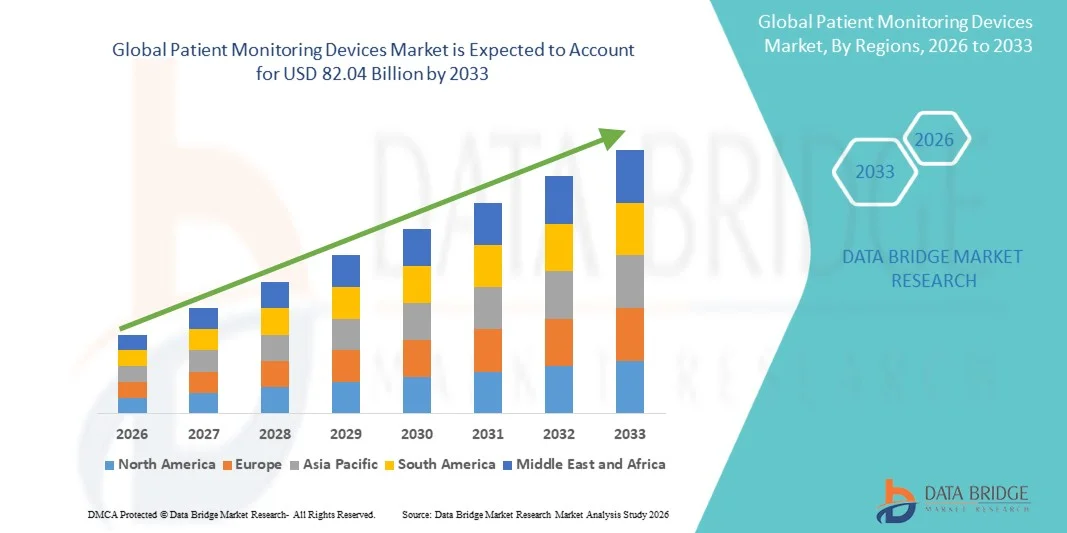
- As per Data Bridge Market Research analysis, the patient monitoring devices market was valued at USD 52.26 billion in 2025 and is projected to reach USD 82.04 billion by 2033, growing at a CAGR of 5.80% from 2026 to 2033.
- The market is experiencing strong growth driven by the rising prevalence of chronic diseases, growing geriatric population, increasing demand for continuous patient monitoring, and expanding adoption of remote patient monitoring and connected healthcare technologies.
- The increasing burden of cardiovascular diseases, diabetes, and respiratory disorders, combined with the shift toward home healthcare and value-based care, is encouraging hospitals and healthcare providers to adopt advanced patient monitoring devices. Wearable monitoring systems, wireless connectivity, and AI-enabled remote monitoring solutions are increasingly complementing conventional bedside monitoring by enabling real-time physiological data collection, early clinical intervention, and improved patient management across hospital and home care settings.
Market Size & Forecast
- Global Market Value (2025): USD 52.26 Billion
- Expected Market Value (2033): USD 82.04 Billion
- Forecast CAGR (2026–2033): 5.80%
- Leading Region in 2025: North America
- Fastest Growing Region: Asia Pacific
What are the Major Takeaways of the Patient Monitoring Devices Market?
- North America dominated the patient monitoring devices market with the largest revenue share of 39.0% in 2025, supported by advanced healthcare infrastructure, high healthcare expenditure, and widespread adoption of connected monitoring technologies.
- Asia-Pacific is expected to be the fastest-growing region at a CAGR of 10.7% from 2026 to 2033, fueled by expanding healthcare infrastructure, increasing prevalence of chronic diseases, growing healthcare investments, and rising adoption of remote patient monitoring solutions across China, India, and Japan
- The continuous glucose monitoring systems & SMBG systems segment led the market with a 34.0% share in 2025, driven by the rising global prevalence of diabetes and increasing demand for continuous glucose tracking.
- EEG monitors are the fastest-growing product type, projected to register a CAGR of 11.8%, reflecting the surge in prevalence of neurological disorders and growing demand for continuous brain activity monitoring.
- The portable segment dominated the modality category with a 62.5% revenue share in 2025, led by the increasing demand for point-of-care monitoring, home healthcare, and remote patient monitoring solutions.
- Adults accounted for 81.0% of the market share in 2025, preferred by the high prevalence of cardiovascular diseases, diabetes, respiratory disorders, and other chronic medical conditions among the adult population
- The pediatrics segment is the fastest-growing age group category, with a CAGR of 10.8%, driven by increasing neonatal and pediatric intensive care admissions and growing awareness regarding early disease detection.
Report Scope and Patient Monitoring Devices Market Segmentation
|
Attributes |
Patient Monitoring Devices Key Market Insights |
|
Segments Covered |
|
|
Countries Covered |
North America
Europe
Asia-Pacific
Middle East and Africa
South America
|
|
Key Market Players |
|
|
Market Opportunities |
|
|
Value Added Data Infosets |
|
What is the Key Trend in the Patient Monitoring Devices Market?
- Connected and AI-enabled patient monitoring platforms are increasingly being adopted to enable continuous physiological monitoring, improve clinical decision-making, and support proactive patient management across hospital and home care settings.
- For instance, in February 2025, Philips and Mass General Brigham announced a collaboration to integrate live AI-powered insights with connected patient monitoring data, enabling clinicians to access near real-time information for improved patient care.
- Real-time monitoring and predictive analytics enable clinicians to detect patient deterioration earlier, reduce alarm fatigue, and improve workflow efficiency across acute and ambulatory care environments.
- Healthcare providers are increasingly deploying wearable and wireless monitoring technologies to support remote patient monitoring, chronic disease management, and decentralized healthcare delivery.
- For instance, in August 2024, Masimo received FDA 510(k) clearance for connectivity of its Masimo W1 Medical Watch with the Masimo SafetyNet telemonitoring platform, expanding continuous remote patient monitoring capabilities.
- As healthcare systems continue to prioritize connected care, early intervention, and value-based healthcare delivery, the adoption of intelligent patient monitoring devices is expected to accelerate, reinforcing continuous monitoring as a core component of modern clinical care.
What are the Key Drivers of the Patient Monitoring Devices Market?
- The rising prevalence of chronic diseases and increasing demand for continuous patient surveillance have significantly accelerated the adoption of advanced patient monitoring devices across healthcare settings.
- For instance, in May 2024, Philips presented clinical studies at the Heart Rhythm Society Annual Meeting demonstrating that its AI-powered cardiac monitoring solutions improved diagnosis, reduced readmissions, and lowered healthcare costs.
- Hospitals, healthcare providers, and digital health companies are integrating connected monitoring systems with artificial intelligence to improve clinical outcomes, enhance operational efficiency, and support personalized patient care.
- For instance, in July 2025, Philips launched its ECG AI Marketplace, enabling healthcare providers to deploy FDA-cleared AI-powered cardiac diagnostic algorithms through its connected ECG ecosystem.
- With healthcare providers increasingly focusing on remote care, predictive analytics, and continuous physiological monitoring, patient monitoring devices will remain essential for improving patient outcomes and supporting the digital transformation of healthcare.
Which Factors are Challenging the Growth of the Patient Monitoring Devices Market?
- Advanced patient monitoring systems require substantial investment owing to sophisticated sensors, wireless connectivity, software integration, cybersecurity infrastructure, and interoperability with hospital information systems.
- For instance, in April 2025, the U.S. FDA highlighted the expanding regulatory oversight of sensor-based digital health technologies and remote patient monitoring devices, reflecting the increasing compliance requirements associated with advanced monitoring solutions.
- These implementation costs and integration complexities limit adoption among smaller hospitals, ambulatory care facilities, and healthcare providers operating under constrained budgets.
- Data privacy concerns, cybersecurity risks, and interoperability challenges between monitoring devices and electronic health record platforms continue to create barriers to large-scale deployment across healthcare systems.
- For instance, in January 2025, the U.S. Food and Drug Administration (FDA) warned that certain Contec and Epsimed patient monitors contained cybersecurity vulnerabilities that could allow unauthorized remote access, device manipulation, and unauthorized export of patient data, highlighting the growing cybersecurity and regulatory challenges associated with connected patient monitoring systems.
- The high implementation costs and regulatory compliance requirements associated with connected patient monitoring technologies continue to restrict broader adoption, particularly in resource-constrained healthcare settings, limiting market penetration despite growing demand for continuous patient monitoring.
How is the Patient Monitoring Devices Market Segmented?
The patient monitoring devices market is segmented on the basis of product type, modality, age group, and end user.
- By Product Type
On the basis of product type, the patient monitoring devices market is segmented into ECG devices, holter monitors, capnography monitors, pulse oximeters, EEG monitors, cerebral oximeters, continuous glucose monitoring systems & SMBG systems, and others. The continuous glucose monitoring systems & SMBG systems segment dominated the market with an estimated share of 34.0% in 2025, driven by the rising global prevalence of diabetes and increasing demand for continuous glucose tracking. Continuous glucose monitoring devices enable real-time glucose measurement, improving glycemic control and reducing the risk of diabetes-related complications. Growing adoption of wearable sensors, smartphone connectivity, and cloud-based data sharing has significantly enhanced patient compliance and disease management. Favorable reimbursement policies and increasing awareness regarding diabetes management have further strengthened market penetration. Continuous technological advancements, including minimally invasive and implantable sensors, are improving patient convenience and monitoring accuracy. The increasing shift toward personalized diabetes care continues to reinforce the segment's market leadership.
The EEG monitors segment is projected to witness the fastest growth at an estimated CAGR of 11.8% from 2026 to 2033, driven by the increasing prevalence of neurological disorders and growing demand for continuous brain activity monitoring. Rising adoption of EEG monitoring in intensive care units, epilepsy diagnosis, sleep disorder assessment, and neurocritical care is supporting market expansion. Technological advancements in wireless EEG systems and AI-enabled brain signal analysis are improving diagnostic efficiency and patient outcomes. Increasing research activities related to neurodegenerative diseases and brain-computer interface technologies are creating additional growth opportunities. Growing healthcare investments in neurological care and expanding availability of portable EEG systems are further accelerating adoption. Continuous innovation in neurodiagnostic technologies is expected to sustain rapid growth throughout the forecast period.
- By Modality
On the basis of modality, the patient monitoring devices market is segmented into portable and tabletop. The portable segment accounted for an estimated market share of 62.5% in 2025, owing to the increasing demand for point-of-care monitoring, home healthcare, and remote patient monitoring solutions. Portable monitoring devices provide greater mobility, ease of use, and continuous physiological monitoring across hospital and non-hospital settings. The growing adoption of wearable technologies and wireless connectivity has significantly expanded their clinical applications. Increasing preference for decentralized healthcare delivery and home-based chronic disease management is further supporting demand. Advances in battery life, miniaturization, and cloud-enabled connectivity continue to improve device performance. Their ability to provide real-time monitoring while enhancing patient comfort makes portable devices the preferred modality.
The tabletop segment is projected to register the fastest growth at an estimated CAGR of 11.2% from 2026 to 2033, driven by increasing demand for advanced multi-parameter monitoring in intensive care units, operating rooms, emergency departments, and specialty care facilities. These systems provide highly accurate, continuous monitoring of multiple physiological parameters, making them essential for managing critically ill patients. Growing investments in hospital infrastructure, rising ICU admissions, and increasing surgical procedures are supporting segment growth. Technological advancements, including touchscreen interfaces, interoperability with hospital information systems, and AI-assisted clinical decision support, are further enhancing their adoption. Expanding critical care capacity in emerging economies is also creating new growth opportunities.
- By Age Group
On the basis of age group, the patient monitoring devices market is segmented into adults and pediatrics. The adults segment held an estimated market share of 81.0% in 2025, driven by the high prevalence of cardiovascular diseases, diabetes, respiratory disorders, and other chronic medical conditions among the adult population. Adults represent the largest patient population requiring continuous physiological monitoring across hospitals, outpatient facilities, and homecare settings. Increasing adoption of wearable monitoring devices and remote patient monitoring solutions is improving disease management and reducing hospital readmissions. Growing aging populations worldwide are further contributing to demand for continuous monitoring technologies. Technological advancements enabling real-time data transmission and predictive analytics continue to enhance patient care. The expanding burden of chronic diseases remains the primary factor supporting segment dominance.
The pediatrics segment is anticipated to witness the fastest growth at an estimated CAGR of 10.8% from 2026 to 2033, owing to increasing neonatal and pediatric intensive care admissions and growing awareness regarding early disease detection. Rising incidence of congenital disorders, respiratory diseases, and pediatric neurological conditions is driving demand for specialized monitoring solutions. Continuous technological improvements in pediatric sensors and non-invasive monitoring devices are improving diagnostic accuracy and patient safety. Increasing investments in neonatal intensive care infrastructure are further supporting adoption. Healthcare providers are increasingly focusing on personalized pediatric care and continuous monitoring technologies. Expanding access to advanced pediatric healthcare services is expected to sustain segment growth.
- By End User
On the basis of end user, the patient monitoring devices market is segmented into hospitals & ASCs, specialty clinics, homecare settings, and others. The hospitals & ASCs segment dominated the market with an estimated share of 58.0% in 2025, due to the high volume of patient admissions requiring continuous physiological monitoring across emergency departments, intensive care units, and surgical settings. Hospitals remain the primary healthcare facilities utilizing advanced multi-parameter monitoring systems for critical care management. Increasing investments in digital healthcare infrastructure and integrated monitoring platforms are supporting widespread adoption. Growing surgical procedures and rising prevalence of chronic diseases continue to increase monitoring requirements. Integration of artificial intelligence and centralized patient monitoring systems is improving clinical workflow efficiency. Strong healthcare infrastructure and favorable reimbursement policies continue to reinforce the segment's leadership.
The homecare settings segment is projected to register the fastest growth at an estimated CAGR of 12.3% from 2026 to 2033, driven by the growing adoption of remote patient monitoring and home-based healthcare services. Increasing preference for decentralized healthcare delivery is encouraging patients to utilize connected monitoring devices outside hospital environments. Rising aging populations and the increasing burden of chronic diseases are further supporting demand. Advancements in wearable sensors, wireless communication technologies, and cloud-based healthcare platforms are enhancing monitoring capabilities. Favorable reimbursement policies and expanding telehealth services are accelerating market penetration. Continuous emphasis on reducing healthcare costs while improving patient outcomes is expected to drive sustained growth in this segment.
Which Region Holds the Largest Share of the Patient Monitoring Devices Market?
- North America dominated the patient monitoring devices market with the largest revenue share of 39.0% in 2025, supported by advanced healthcare infrastructure, high healthcare expenditure, and widespread adoption of connected monitoring technologies.
- The region also benefits from the high prevalence of chronic diseases, favorable reimbursement policies, rapid adoption of remote patient monitoring solutions, and increasing integration of artificial intelligence and digital health platforms across hospitals and homecare settings. Growing investments in healthcare digitalization and expanding use of wearable monitoring devices continue to strengthen North America's leadership position in the global market.
U.S. Patient Monitoring Devices Market Insight
The U.S. patient monitoring devices market is witnessing strong growth due to rising adoption of remote patient monitoring (RPM), increasing prevalence of chronic diseases, and expanding investments in digital healthcare technologies. The country's advanced healthcare infrastructure, favorable reimbursement landscape, and strong presence of leading medical device manufacturers are driving demand across hospitals, ambulatory care centers, and homecare settings. In addition, growing integration of AI-powered monitoring platforms, wearable devices, and connected healthcare ecosystems is accelerating adoption of continuous patient monitoring solutions. In January 2024, the U.S. Centers for Medicare & Medicaid Services (CMS) expanded reimbursement support for remote patient monitoring and digital health services under the 2024 Physician Fee Schedule, further encouraging RPM adoption.
Asia-Pacific Patient Monitoring Devices Market Insight
The Asia-Pacific patient monitoring devices market is expected to witness rapid growth, driven by expanding healthcare infrastructure, rising chronic disease burden, and increasing investments in digital health across countries such as China, India, and Japan. Growing awareness regarding preventive healthcare, rising adoption of wearable monitoring technologies, and increasing government initiatives supporting healthcare modernization are contributing to regional market expansion. In addition, the growing availability of remote patient monitoring solutions and increasing healthcare expenditure are accelerating market growth across both urban and rural healthcare settings. According to the World Health Organization (WHO), the WHO South-East Asia Region is accelerating digital health implementation, including remote monitoring and integrated digital healthcare services through its Regional Digital Health Strategy.
Japan Patient Monitoring Devices Market Insight
The Japan patient monitoring devices market is witnessing consistent growth due to rising healthcare expenditure, rapid population aging, and increasing adoption of connected patient monitoring technologies. Hospitals and healthcare providers are increasingly deploying wearable monitoring devices and AI-assisted clinical monitoring systems to improve chronic disease management and elderly patient care. Moreover, continuous technological innovation and the country's strong focus on digital healthcare transformation are further contributing to market growth. According to the World Bank, approximately 30% of Japan's population is aged 65 years and above, creating substantial demand for long-term patient monitoring and home healthcare technologies.
China Patient Monitoring Devices Market Insight
The China patient monitoring devices market is growing rapidly, driven by expanding healthcare infrastructure, increasing prevalence of chronic diseases, and strong government support for healthcare digitalization. Growing adoption of wearable monitoring devices, remote patient monitoring platforms, and AI-enabled healthcare solutions across hospitals and community healthcare centers is significantly boosting market demand. In addition, rising healthcare investments, increasing elderly population, and continuous technological advancements are positioning China as one of the fastest-growing patient monitoring markets globally. China's Healthy China 2030 initiative prioritizes digital healthcare, telemedicine, and smart hospital development to improve nationwide healthcare delivery
U.K. Patient Monitoring Devices Market Insight
The U.K. patient monitoring devices market is experiencing steady growth, supported by increasing adoption of remote patient monitoring technologies, expanding digital healthcare programs, and rising demand for home-based patient care. Growing investments in connected healthcare infrastructure and increasing utilization of wearable monitoring devices are contributing to market growth. Furthermore, integration of artificial intelligence, cloud connectivity, and virtual care platforms is improving clinical decision-making and patient outcomes, positioning the U.K. as a key digital health market in Europe. NHS England continues expanding virtual wards, enabling eligible patients to receive acute care at home using remote monitoring technologies
Germany Patient Monitoring Devices Market Insight
The Germany patient monitoring devices market is expanding steadily due to the country's advanced healthcare infrastructure, strong medical technology industry, and increasing adoption of digital patient monitoring solutions. Healthcare providers are increasingly utilizing wearable devices, continuous monitoring systems, and AI-enabled clinical platforms to improve patient outcomes and hospital efficiency. Continuous investments in healthcare digitalization, together with favorable regulatory support for digital health innovation, are further driving market growth in Germany. Germany's Digital Healthcare Act (Digitale-Versorgung-Gesetz, DVG) supports the adoption and reimbursement of approved digital health applications, encouraging broader implementation of connected patient monitoring technologies.
Which are the Top Companies in Patient Monitoring Devices Market?
The patient monitoring devices industry is primarily led by well-established companies, including:
- Koninklijke Philips N.V. (Netherlands)
- GE HealthCare (U.S.)
- Medtronic (Ireland)
- Masimo Corporation (U.S.)
- NIHON KOHDEN CORPORATION (Japan)
- Omron Healthcare Co., Ltd. (Japan)
- Baxter (U.S.)
- Edwards Lifesciences Corporation (U.S.)
- OSI Systems, Inc. (U.S.)
- CONTEC MEDICAL SYSTEMS CO., LTD. (China)
- Shenzhen Mindray Bio-Medical Electronics Co., Ltd. (China)
- Schiller AG (Switzerland)
- Drägerwerk AG & Co. KGaA (Germany)
- Spacelabs Healthcare (U.S.)
- ICU Medical, Inc. (U.S.)
- Nonin Medical, Inc. (U.S.)
- BPL Medical Technologies Private Limited (India)
- Biolight Co., Ltd. (China)
- Lepu Medical Technology (Beijing) Co., Ltd. (China)
- Infinium Medical, Inc. (U.S.)
What are Latest Developments in Patient Monitoring Devices Market?
- In July 2025, Royal Philips launched the Philips ECG AI Marketplace, a cloud-enabled platform that allows hospitals to seamlessly integrate multiple FDA-cleared artificial intelligence algorithms into their existing Philips ECG workflow through a single interface. The marketplace eliminates the need for separate software integrations while enabling clinicians to access AI-powered diagnostic tools during routine ECG interpretation.
- In August 2024, Masimo announced FDA 510(k) clearance for connectivity between its Masimo W1 Medical Watch and the Masimo SafetyNet remote patient monitoring platform. The wearable device continuously measures physiological parameters such as pulse rate, oxygen saturation, and respiration-related metrics while securely transmitting patient data to clinicians for remote assessment. The launch supports hospital-at-home programs, post-discharge monitoring, and chronic disease management
- In May 2024, Sempulse announced the U.S. FDA 510(k) clearance and commercial launch of the Halo Vital Signs Monitoring System, a wearable, non-invasive patient monitoring solution designed for continuous measurement of SpO₂, pulse rate, respiratory rate, core body temperature, and skin temperature. The Halo platform also includes LiveCharts and Command Cloud, enabling clinicians to remotely monitor
- In May 2024, Masimo received FDA clearance for its Stork Over-the-Counter Baby Monitoring System, a home monitoring solution designed for continuous infant surveillance without requiring a prescription. The system includes a wearable sensor that continuously monitors oxygen saturation, pulse rate, and skin temperature while transmitting real-time information to caregivers through a mobile application. The launch expands patient monitoring beyond hospitals by providing parents with clinically validated physiological monitoring for infants in home environments.
- In June 2023, Royal Philips introduced new advanced monitoring capabilities for its IntelliVue MX750 and MX850 patient monitors by integrating Masimo SedLine Brain Function Monitoring, O3 Regional Oximetry, and CO₂ monitoring technologies following FDA clearance. The enhancement enables clinicians to simultaneously monitor neurological status, cerebral oxygenation, ventilation, and vital signs from a single bedside monitoring platform.

- Interactive Data Analysis Dashboard
- Company Analysis Dashboard for high growth potential opportunities
- Research Analyst Access for customization & queries
- Competitor Analysis with Interactive dashboard
- Latest News, Updates & Trend analysis
- Harness the Power of Benchmark Analysis for Comprehensive Competitor Tracking
Data collection and base year analysis are done using data collection modules with large sample sizes. The stage includes obtaining market information or related data through various sources and strategies. It includes examining and planning all the data acquired from the past in advance. It likewise envelops the examination of information inconsistencies seen across different information sources. The market data is analysed and estimated using market statistical and coherent models. Also, market share analysis and key trend analysis are the major success factors in the market report. To know more, please request an analyst call or drop down your inquiry.
The key research methodology used by DBMR research team is data triangulation which involves data mining, analysis of the impact of data variables on the market and primary (industry expert) validation. Data models include Vendor Positioning Grid, Market Time Line Analysis, Market Overview and Guide, Company Positioning Grid, Patent Analysis, Pricing Analysis, Company Market Share Analysis, Standards of Measurement, Global versus Regional and Vendor Share Analysis. To know more about the research methodology, drop in an inquiry to speak to our industry experts.
Data Bridge Market Research is a leader in advanced formative research. We take pride in servicing our existing and new customers with data and analysis that match and suits their goal. The report can be customized to include price trend analysis of target brands understanding the market for additional countries (ask for the list of countries), clinical trial results data, literature review, refurbished market and product base analysis. Market analysis of target competitors can be analyzed from technology-based analysis to market portfolio strategies. We can add as many competitors that you require data about in the format and data style you are looking for. Our team of analysts can also provide you data in crude raw excel files pivot tables (Fact book) or can assist you in creating presentations from the data sets available in the report.













