


What is the Patient Positioning Devices Market Size and Growth Rate?
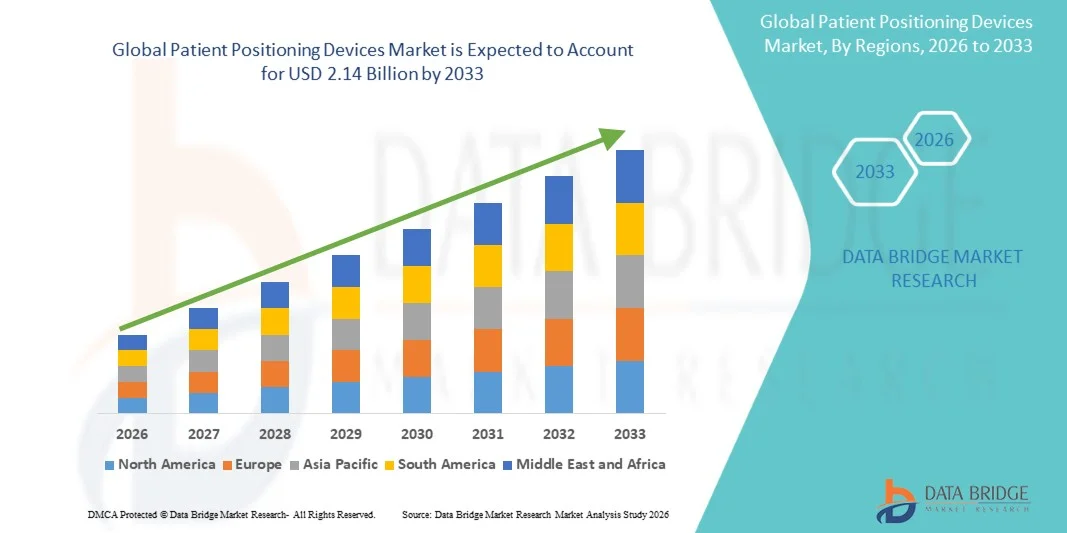
- As per Data Bridge Market Research analysis, the patient positioning devices market was valued at USD 1.43 billion in 2025 and is projected to reach USD 2.14 billion by 2033, growing at a CAGR of 5.20% from 2026 to 2033.
- The market is experiencing consistent growth driven by the rising prevalence of chronic diseases, increasing number of surgeries, and expanding healthcare infrastructure globally, which are increasing the demand for patient positioning solutions across healthcare settings.
- The increasing number of surgical procedures, combined with the need to ensure patient safety and comfort, optimize surgical outcomes, and reduce the risks associated with improper positioning, is supporting the adoption of patient positioning devices. These devices are increasingly used across surgeries, diagnostics, and therapeutics, including hospitals, diagnostic laboratories, and ambulatory surgical centers.
Market Size & Forecast
- Global Market Value (2025): USD 1.43 Billion
- Expected Market Value (2033): USD 2.14 Billion
- Forecast CAGR (2026–2033): 5.20%
- Leading Region in 2025: North America
- Fastest Growing Region: Asia Pacific
What are the Major Takeaways of the Patient Positioning Devices Market?
- North America dominated the patient positioning devices market with a 40.2% share in 2025, supported by strong hospital infrastructure, high surgical volumes, and rapid adoption of advanced operating room technologies such as motorized and imaging-compatible positioning systems
- Asia-Pacific is expected to be the fastest-growing region at a CAGR of 7.0% from 2026 to 2033, fueled by expanding healthcare infrastructure, rising prevalence of chronic diseases, and increasing investments in advanced surgical and diagnostic technologies.
- The operating room tables segment led the market with a 40% share in 2025, driven by their extensive use across surgical procedures requiring stable, precise, and adjustable patient positioning
- Mattress overlays are the fastest-growing device type, projected to register a CAGR of 6%, reflecting the surge in demand for immersive, interactive driver training environments.
- The surgery support segment dominated the application category with a 45% revenue share in 2025, led by the essential role of positioning devices in maintaining patient stability and providing appropriate access to surgical sites.
- Metal accounted for 35% of the market share in 2025, preferred by the extensive use of metal in structural components of operating tables and positioning equipment
- The gel segment is the fastest-growing material category, with a CAGR of 6.5%, driven by increasing demand for cushioning materials that enhance patient comfort and pressure distribution.
Report Scope and Patient Positioning Devices Market Segmentation
Attributes |
Patient Positioning Devices Key Market Insights |
|
Segments Covered |
|
|
Countries Covered |
North America
Europe
Asia-Pacific
Middle East and Africa
South America
|
|
Key Market Players |
|
|
Market Opportunities |
|
|
Value Added Data Infosets |
In addition to the insights on market scenarios such as market value, growth rate, segmentation, geographical coverage, and major players, the market reports curated by the Data Bridge Market Research also include in-depth expert analysis, patient epidemiology, pipeline analysis, pricing analysis, and regulatory framework. |
What is the Key Trend in the Patient Positioning Devices Market?
- Healthcare providers are increasingly adopting advanced patient positioning systems with ergonomic designs, imaging compatibility, and automated adjustment capabilities to improve patient safety, procedural accuracy, and operating-room efficiency.
- Radiolucent and imaging-compatible positioning systems are increasingly important as healthcare facilities expand minimally invasive surgery and advanced diagnostic imaging, requiring accurate positioning without interfering with imaging procedures.
- Pressure-management and immobilization technologies are gaining importance as hospitals seek to reduce pressure points, nerve damage, and other complications associated with prolonged or improper patient positioning.
- For instance, in April 2025, a randomized controlled trial evaluated curvilinear positioning and micromovement as strategies for preventing intraoperative pressure injuries, highlighting the growing focus on advanced positioning techniques to improve patient safety during surgery.
- As hospitals and ambulatory surgical centers continue to prioritize patient safety, comfort, precision, and procedural efficiency, adoption of technologically advanced positioning tables, accessories, and immobilization systems is expected to accelerate across surgical and diagnostic applications.
What are the Key Drivers of the Patient Positioning Devices Market?
- The increasing prevalence of chronic diseases and the rising number of surgical procedures are significantly increasing demand for patient positioning devices that provide stable and accurate positioning during complex medical interventions.
- For instance, in January 2024, an article published in the Journal of Advanced Nursing analyzed 22 studies and found that improper intraoperative positioning was associated with peripheral nerve injuries, perioperative pressure ulcers, vascular injuries, postoperative pain, and eye injuries, reinforcing the need for effective patient positioning during surgery.
- The growing geriatric population and increasing prevalence of cancer are further increasing demand for precise positioning systems used during surgery, advanced imaging, radiation therapy, and other prolonged clinical procedures.
- Increasing focus on patient safety and comfort is also supporting adoption, as proper positioning helps healthcare professionals provide access to the surgical site while reducing risks such as pressure ulcers, nerve damage, and unnecessary tissue exposure.
- With healthcare systems increasingly investing in surgical procedures, diagnostic imaging, minimally invasive interventions, and advanced healthcare infrastructure, patient positioning devices will remain essential for improving procedural safety, accuracy, reproducibility, and patient outcomes.
Which Factors are Challenging the Growth of the Patient Positioning Devices Market?
- High costs associated with advanced patient positioning devices remain a major challenge, particularly for healthcare facilities that require sophisticated systems incorporating smart technologies, ergonomic features, and advanced positioning capabilities.
- For instance, in June 2023, a randomized controlled trial published in the International Wound Journal evaluated a specialized turning and positioning system for ICU patients, highlighting the additional clinical and economic considerations associated with advanced positioning technologies.
- These high costs can limit adoption among smaller hospitals, clinics, and healthcare facilities in emerging markets, where budgets for advanced medical equipment and ongoing maintenance are often constrained.
- Complexity of advanced positioning equipment and the requirement for trained healthcare personnel can further increase implementation and operating costs, particularly when facilities transition from conventional positioning equipment to technologically advanced systems.
- For instance, in April 2021, an economic evaluation found that a wearable patient-positioning sensor could reduce hospital-acquired pressure injuries by 77% and generate estimated savings of USD 6,621 per patient over one year, demonstrating the economic importance of evaluating the cost of advanced positioning technologies.
- The high capital expenditure and maintenance requirements therefore continue to restrict adoption among smaller and underfunded healthcare facilities, slowing penetration of advanced positioning solutions despite increasing demand for safer and more precise patient positioning.
How is the Patient Positioning Devices Market Segmented?
The patient positioning devices market is segmented on the basis of device type, application, material, and end user.
- By Device Type
On the basis of device type, the patient positioning devices market is segmented into operating room tables, wheelchair positioning aids, head positioners, limb holders, and mattress overlays. The operating room tables segment dominated the market with an estimated share of 40% in 2025, owing to their extensive use across surgical procedures requiring stable, precise, and adjustable patient positioning. These tables provide appropriate access to the surgical site while maintaining patient stability throughout procedures. Increasing adoption of minimally invasive and complex surgical procedures is further strengthening demand. Technological advancements in electrically powered adjustment, radiolucent surfaces, and specialized surgical configurations are enhancing their functionality. Growing investments in hospital operating rooms and surgical infrastructure are also supporting segment expansion. Their broad applicability across multiple surgical specialties continues to make operating room tables the leading device category.
The mattress overlays segment is estimated to be the fastest-growing device type at a CAGR of 6% during the forecast period, driven by increasing emphasis on patient comfort and pressure-ulcer prevention. These overlays provide cushioning and support for patients who remain in fixed positions for prolonged periods. Growing awareness regarding pressure injuries among elderly, critically ill, and immobile patients is increasing their adoption. Advancements in foam, gel, and other pressure-distribution materials are improving product performance and comfort. Their increasing use across hospitals, rehabilitation centers, nursing homes, and homecare settings is further expanding the addressable market. The shift toward preventive patient care and improved clinical outcomes is also supporting demand for mattress overlays.
- By Application
On the basis of application, the patient positioning devices market is segmented into surgery support, patient comfort, neurology procedures, orthopedic treatments, and pressure ulcer prevention. The surgery support segment dominated the market with an estimated share of 45% in 2025, owing to the essential role of positioning devices in maintaining patient stability and providing appropriate access to surgical sites. The growing volume of surgical procedures worldwide is increasing demand for reliable positioning systems. Complex and minimally invasive surgeries require precise alignment to support procedural accuracy and patient safety. Increasing adoption of robotic-assisted and image-guided procedures is further strengthening the need for advanced positioning technologies. Hospitals are increasingly investing in positioning tables and accessories that improve surgical workflow and stability. The broad use of positioning devices across surgical specialties continues to support the dominance of surgery support applications.
The pressure ulcer prevention segment is estimated to register the fastest growth at a CAGR of 6.5% during the forecast period, driven by increasing awareness of pressure-related injuries associated with prolonged immobility and improper patient positioning. Positioning aids, cushions, mattress overlays, and specialized support surfaces help redistribute pressure and improve patient comfort. Growing numbers of elderly and critically ill patients are increasing the need for effective preventive positioning solutions. Healthcare providers are increasingly focusing on preventing pressure injuries rather than treating complications after they occur. Technological advancements in pressure-management surfaces are further improving the effectiveness of these solutions. Rising adoption across hospitals, nursing homes, rehabilitation centers, and homecare environments is expanding application opportunities.
- By Material
On the basis of material, the patient positioning devices market is segmented into metal, plastic, foam, silicone, and gel. The metal segment dominated the market with an estimated share of 35% in 2025, owing to the extensive use of metal in structural components of operating tables and positioning equipment. Metal provides the strength, durability, and load-bearing capability required for supporting patients during surgical procedures. Its ability to withstand repeated adjustment, cleaning, and sterilization makes it suitable for demanding healthcare environments. Increasing adoption of advanced operating room tables is supporting continued demand for durable structural materials. Manufacturers are also combining metal structures with cushioning and polymer-based components to improve patient comfort. The material's mechanical strength and long service life continue to support its widespread application in positioning equipment.
The gel segment is estimated to witness the fastest growth at a CAGR of 6.8% during the forecast period, driven by increasing demand for cushioning materials that enhance patient comfort and pressure distribution. Gel is increasingly used in head positioners, support pads, cushions, and other positioning accessories. Its ability to provide softer contact surfaces makes it suitable for patients requiring prolonged positioning. Growing awareness of pressure-related complications is encouraging healthcare providers to adopt advanced cushioning solutions. Product innovations combining pressure redistribution, comfort, durability, and hygiene are further supporting adoption. Increasing use of specialized positioning accessories in surgical and long-term-care environments is expanding opportunities for gel-based solutions. The growing emphasis on patient-centric positioning solutions is expected to accelerate segment growth.
- By End User
On the basis of end user, the patient positioning devices market is segmented into hospitals, clinics, rehabilitation centers, homecare, and nursing homes. The hospitals segment dominated the market with an estimated share of 50% in 2025, owing to the high volume of surgeries, diagnostic procedures, and therapeutic interventions performed in hospital settings. Hospitals require positioning devices across operating rooms, imaging departments, intensive-care units, and other clinical environments. Increasing numbers of complex and minimally invasive surgical procedures are further strengthening demand. Hospitals also have greater requirements for advanced operating tables, positioning aids, and pressure-management equipment. Growing investments in healthcare infrastructure and surgical facilities are supporting procurement of advanced positioning systems. The broad range of clinical applications makes hospitals the largest end-user environment for patient positioning devices.
The homecare segment is estimated to witness the fastest growth at a CAGR of 7% during the forecast period, driven by the increasing shift toward home-based care and rising demand for patient positioning solutions outside traditional healthcare facilities. Patients with limited mobility and chronic conditions often require positioning support to maintain comfort and appropriate body alignment. The growing elderly population is further increasing demand for long-term positioning assistance. Portable and easy-to-use positioning aids are becoming increasingly relevant for caregivers and homecare providers. Expansion of healthcare-at-home models is encouraging manufacturers to develop products suitable for residential environments. Increasing focus on patient-centered and decentralized care is creating additional opportunities for homecare positioning solutions.
Which Region Holds the Largest Share of the Patient Positioning Devices Market?
- North America dominated the patient positioning devices market with a 40.2% share in 2025, supported by strong hospital infrastructure, high surgical volumes, and rapid adoption of advanced operating room technologies such as motorized and imaging-compatible positioning systems
- The region also benefits from the increasing number of surgical procedures associated with chronic diseases and age-related conditions, alongside continued investments in advanced healthcare infrastructure and surgical technologies. The growing elderly population and increasing use of minimally invasive, robotic-assisted, and image-guided procedures are further strengthening demand for precise and ergonomic patient positioning solutions across North America.
U.S. Patient Positioning Devices Market Insight
The U.S. patient positioning devices market is witnessing strong growth due to high healthcare expenditure, large surgical volumes, and continued investment in advanced hospital infrastructure. The country’s healthcare system spent USD 5.3 trillion in 2024, equivalent to 18.0% of GDP, while hospital expenditure reached USD 1.63 trillion, supporting demand for sophisticated medical equipment and positioning systems. In addition, increasing demand for surgical, diagnostic, and minimally invasive procedures is creating opportunities for operating room tables, positioning aids, and pressure-management solutions. The growing focus on patient safety, procedural precision, and efficient operating-room workflows is further supporting adoption across U.S. healthcare facilities.
Asia-Pacific Patient Positioning Devices Market Insight
The Asia-Pacific patient positioning devices market is expected to witness rapid growth, driven by expanding healthcare infrastructure, rising healthcare utilization, and increasing investments in modern surgical and diagnostic facilities across the region. China recorded 6.88 billion healthcare visits during January–November 2024, up 7.3% year over year, while hospital discharges increased 4.6%, demonstrating substantial and expanding healthcare activity. Increasing demand for surgical care, growing hospital capacity, and rising adoption of advanced medical technologies are supporting regional demand for patient positioning devices. In addition, the region’s expanding healthcare infrastructure and growing emphasis on patient safety and quality of care are creating further opportunities for positioning tables, aids, and pressure-management solutions.
Japan Patient Positioning Devices Market Insight
The Japan patient positioning devices market is witnessing consistent growth due to its established healthcare infrastructure, high healthcare utilization, and demand for advanced medical equipment. Japan’s Ministry of Health, Labour and Welfare reported comprehensive 2024 medical-facility and hospital statistics, covering hospital numbers, bed capacity, average inpatient and outpatient volumes, and bed utilization. The country’s established hospital network and aging-oriented healthcare requirements support demand for positioning systems used during surgical, diagnostic, rehabilitation, and long-duration care procedures. Furthermore, increasing emphasis on patient safety, comfort, and efficient clinical workflows is encouraging healthcare providers to adopt advanced positioning solutions. These factors are supporting continued demand for operating tables, positioning aids, and pressure-management products in Japan.
China Patient Positioning Devices Market Insight
The China patient positioning devices market is growing rapidly, driven by expanding healthcare utilization, increasing hospital activity, and continued development of medical infrastructure. China recorded 68.8 billion healthcare visits during January–November 2024, representing a 7.3% increase year over year, while hospitals recorded 41.0 billion visits, up 6.2%. Growing healthcare activity is increasing the need for reliable patient positioning equipment across hospitals and other medical facilities. In addition, continued modernization of healthcare services and rising demand for advanced clinical technologies are supporting adoption of positioning tables, supports, and pressure-management solutions.
U.K. Patient Positioning Devices Market Insight
The U.K. patient positioning devices market is experiencing steady growth, supported by high elective-care activity, expansion of surgical capacity, and continued investment in NHS healthcare infrastructure. NHS England reported that staff delivered a record 18 million treatments in 2024, 4% more than in 2023 and 5% above 2019 levels, demonstrating strong demand for healthcare procedures. Furthermore, 116 elective surgical hubs were operational across England by April 2025, increasing dedicated surgical capacity. This expansion supports demand for operating-room equipment and positioning systems required for safe and efficient surgical workflows. Growing emphasis on reducing waiting lists, increasing theatre capacity, and improving procedural efficiency is expected to further support adoption of patient positioning devices across the U.K.
Germany Patient Positioning Devices Market Insight
The high hospital activity, and substantial healthcare expenditure. Germany recorded approximately 17.5 million inpatient hospital cases in 2024, an increase of 2.0% from 2023, indicating continued demand for hospital-based medical procedures and equipment. In addition, Germany’s total healthcare expenditure reached USD 581.3 billion in 2024, equivalent to 12.4% of GDP, while hospitals accounted for USD 142.1 billion of healthcare expenditure. Strong hospital infrastructure, substantial healthcare spending, and continuing demand for surgical and inpatient care are supporting the need for patient positioning systems. Increasing focus on modern clinical equipment, patient safety, and efficient surgical workflows is further contributing to market development
Which are the Top Companies in Patient Positioning Devices Market?
The patient positioning devices industry is primarily led by well-established companies, including:
- Stryker (U.S.)
- Getinge AB (Sweden)
- Baxter (U.S.)
- Medline Industries, LP (U.S.)
- AliMed (U.S.)
- SchureMed (U.S.)
- MIZUHO Corporation (Japan)
- Skytron, LLC (U.S.)
- STERIS Corporation (U.S.)
- B. Braun SE (Germany)
- Arjo AB (Sweden)
- Mölnlycke AB (Sweden)
- CQ Medical (U.S.)
- SCHMITZ medical GmbH (Germany)
- GF Health Products, Inc. (U.S.)
- Drive DeVilbiss Healthcare (U.S.)
- FAMED Łódź S.A. (Poland)
- ALVO Medical Sp. z o.o. (Poland)
- Mediland Enterprise Corporation (Taiwan)
What are Latest Developments in Patient Positioning Devices Market?
- In May 2024, Michelin Inflatable Solutions introduced its MICHELIN AirSurgery positioning cushions at the 39th UNAIBODE National Study and Training Days in France. The inflatable modules were developed for operating-theatre patient positioning and can be customized for supine and lateral-decubitus positions, while providing access to the surgical area and improving patient comfort.
- In March 2024, Getinge announced the U.S. launch of its Corin OR table, a smart mobile surgical table designed with advanced feedback lighting, intuitive controls, collision and overload detection, and tipping prevention. The table also provides customizable user sequences and preset surgical positions to improve flexibility, workflow efficiency, and patient positioning during surgical procedures.
- In May 2022, Inspital launched its OT80.20 NOVUS operating table, developed in response to challenges faced by physicians, nurses, and operating-room teams in achieving precise patient positioning. The company designed the table to provide improved adjustability and integration into surgical workflows, reflecting continued development of operating tables focused on positioning flexibility and surgical requirements.

- Interactive Data Analysis Dashboard
- Company Analysis Dashboard for high growth potential opportunities
- Research Analyst Access for customization & queries
- Competitor Analysis with Interactive dashboard
- Latest News, Updates & Trend analysis
- Harness the Power of Benchmark Analysis for Comprehensive Competitor Tracking
Data collection and base year analysis are done using data collection modules with large sample sizes. The stage includes obtaining market information or related data through various sources and strategies. It includes examining and planning all the data acquired from the past in advance. It likewise envelops the examination of information inconsistencies seen across different information sources. The market data is analysed and estimated using market statistical and coherent models. Also, market share analysis and key trend analysis are the major success factors in the market report. To know more, please request an analyst call or drop down your inquiry.
The key research methodology used by DBMR research team is data triangulation which involves data mining, analysis of the impact of data variables on the market and primary (industry expert) validation. Data models include Vendor Positioning Grid, Market Time Line Analysis, Market Overview and Guide, Company Positioning Grid, Patent Analysis, Pricing Analysis, Company Market Share Analysis, Standards of Measurement, Global versus Regional and Vendor Share Analysis. To know more about the research methodology, drop in an inquiry to speak to our industry experts.
Data Bridge Market Research is a leader in advanced formative research. We take pride in servicing our existing and new customers with data and analysis that match and suits their goal. The report can be customized to include price trend analysis of target brands understanding the market for additional countries (ask for the list of countries), clinical trial results data, literature review, refurbished market and product base analysis. Market analysis of target competitors can be analyzed from technology-based analysis to market portfolio strategies. We can add as many competitors that you require data about in the format and data style you are looking for. Our team of analysts can also provide you data in crude raw excel files pivot tables (Fact book) or can assist you in creating presentations from the data sets available in the report.













