


What is the Patient Simulators Market Size and Overview?
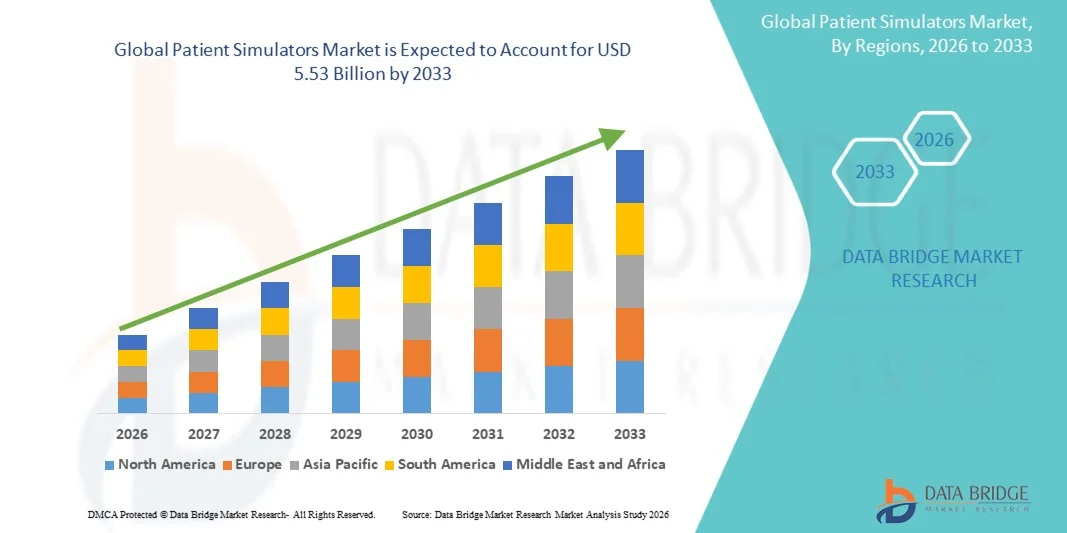
As per Data Bridge Market Research Analysis the Patient Simulators Market was valued at USD 2.51 billion in 2025 and is projected to reach USD 5.53 billion by 2033, growing at a CAGR of 10.40% from 2026 to 2033. The Patient Simulators Market is experiencing steady growth driven by increasing demand for advanced medical training solutions, rising focus on patient safety, and rapid advancements in high-fidelity simulation technologies. Growing adoption of simulation-based medical education across hospitals, nursing schools, and academic institutions is enabling healthcare professionals to practice clinical procedures in a risk-free environment, improving diagnostic accuracy and treatment outcomes.
The increasing prevalence of chronic diseases, rising complexity of surgical procedures, and growing emphasis on minimizing medical errors are compelling healthcare providers, medical universities, and training centers to adopt patient simulation systems. High-fidelity manikins and virtual patient simulators are increasingly replacing traditional lecture-based learning, offering immersive, hands-on training for emergency care, anesthesia, surgery, and critical care scenarios.
Key Market Trends & Insights
- North America dominated the Patient Simulators Market with the largest revenue share of 36.42% in 2025, supported by strong adoption of advanced medical training technologies, high healthcare expenditure, and the presence of leading simulation manufacturers and medical training institutions. The region benefits from well-established simulation-based education programs across hospitals, academic institutes, and military medical training centers, along with increasing focus on patient safety and reduction of clinical errors. Growing integration of high-fidelity manikins, VR/AR-based training tools, and AI-enabled simulation platforms continues to reinforce regional leadership.
- The Adult Patient Simulator segment dominated the market with a 52.18% share in 2025, owing to its extensive use in emergency care training, surgical simulation, anesthesia practice, and critical care education.
- Asia-Pacific is expected to be the fastest-growing region at a CAGR of 8.34% from 2026 to 2033, driven by rapid expansion of healthcare infrastructure, increasing investments in medical education, and rising adoption of simulation-based training across emerging economies such as China, India, Japan, and South Korea. Growing government initiatives to improve clinical training standards and reduce medical errors are further accelerating market growth in the region.
- The Hospitals segment dominated the End User category with a 48.73% revenue share in 2025, owing to high patient inflow, strong clinical training requirements, and widespread adoption of simulation-based learning for improving healthcare outcomes. Hospitals increasingly utilize patient simulators for resident training, emergency preparedness, and surgical skill development. Rising focus on reducing medical errors and improving patient safety is further accelerating adoption across hospital settings.
Market Size & Forecast
- Global Market Value (2025): USD 2.51 Billion
- Expected Market Value (2033): USD 5.53 Billion
- Forecast CAGR (2026–2033): 10.40%
- Leading Region in 2025: North America
- Fastest Growing Region: Asia-Pacific
Report Scope and Patient Simulators Market Segmentation
|
Attributes |
Patient Simulators Key Market Insights |
|
Segments Covered |
|
|
Countries Covered |
North America
Europe
Asia-Pacific
Middle East and Africa
South America
|
|
Key Market Players |
• Laerdal Medical (Norway) |
|
Market Opportunities |
|
|
Value Added Data Infosets |
In addition to the insights on market scenarios such as market value, growth rate, segmentation, geographical coverage, and major players, the market reports curated by the Data Bridge Market Research also include in-depth expert analysis, geographically represented company-wise production and capacity, network layouts of distributors and partners, detailed and updated price trend analysis and deficit analysis of supply chain and demand. |
What is the Key Trend in the Patient Simulators Market?
Trend: Growth in Simulation-Based Medical Training & Clinical Skill Development
The Patient Simulators Market is witnessing strong growth driven by increasing adoption of simulation-based medical education across hospitals, academic institutes, and military medical training centers. Healthcare institutions are increasingly using high-fidelity patient simulators to train clinicians in critical care, emergency response, anesthesia management, and surgical procedures without risk to real patients. The integration of real-time physiological feedback systems enables precise assessment of clinical decision-making and procedural accuracy. Medical schools and nursing colleges are also leveraging simulation labs to deliver standardized, competency-based training programs, while VR and AR technologies are creating highly immersive clinical environments that closely replicate ICUs, operating rooms, and emergency departments.
Patient Simulators Market Dynamics
Key Market Driver: Rising Focus on Patient Safety and Reduction of Medical Errors
The increasing global emphasis on patient safety and reduction of clinical errors is a major driver of the patient simulators market. According to healthcare safety reports, medical errors contribute to a significant percentage of preventable hospital complications globally, pushing healthcare systems to adopt advanced training solutions. Patient simulators enable repetitive, risk-free practice of high-stakes procedures such as cardiopulmonary resuscitation (CPR), airway management, and trauma care. For example, simulation-based training programs have been widely adopted in accredited medical institutions such as the American College of Surgeons (ACS) simulation programs, which require hands-on competency validation before real-world procedures. Additionally, growing investment in healthcare education infrastructure across North America, Europe, and Asia-Pacific is accelerating adoption of advanced simulation technologies.
Key Restraint/Challenge: High Cost of Advanced Simulation Systems and Maintenance Complexity
A major challenge in the Patient Simulators Market is the high initial cost associated with advanced simulation systems, along with ongoing maintenance and operational expenses. High-fidelity manikins integrated with physiological modeling, haptic feedback systems, and AI-based response engines require substantial capital investment, often ranging from tens of thousands to hundreds of thousands of dollars per unit depending on complexity. This limits adoption in smaller hospitals, nursing schools, and developing healthcare systems. In addition, frequent software updates, calibration requirements, and technical support needs increase the total cost of ownership. Despite increasing funding initiatives in medical education, cost barriers continue to restrict widespread deployment, particularly in low- and middle-income countries.
The growing reliance on advanced simulation infrastructure, such as hospital-based simulation centers in leading teaching hospitals (e.g., Harvard Medical School affiliated simulation labs and European Society for Simulation in Healthcare-accredited centers), highlights both the technological progress and the high investment threshold required for adoption.
Key Market Opportunity: Integration of AI-Driven Adaptive Learning and Immersive Technologies in Healthcare Simulation
The integration of artificial intelligence, VR/AR, and data-driven analytics is creating a significant growth opportunity in the patient simulators market. AI-enabled simulators can dynamically adjust patient vital signs based on trainee actions, enabling realistic clinical progression scenarios such as sepsis development, cardiac arrest escalation, or respiratory failure management. For instance, advanced simulation platforms used in leading medical universities now provide real-time performance scoring and personalized feedback for trainees. The expansion of cloud-based simulation platforms is further enabling remote training and multi-institutional collaboration. Increasing investment in digital healthcare education, combined with rising demand for competency-based training frameworks, is expected to drive strong long-term market expansion globally.
How is the Patient Simulators Market Segmented?
The Patient Simulators market is segmented on the basis of product and end user.
- By Product
On the basis of product, the Patient Simulators Market is segmented into Adult Patient Simulator, Infant Simulator, Childbirth Simulator, and Others. The Adult Patient Simulator segment dominated the market with a 52.18% share in 2025, owing to its extensive use in emergency care training, surgical simulation, anesthesia practice, and critical care education. These simulators replicate complex physiological responses, enabling healthcare professionals to train for real-world clinical scenarios in a controlled, risk-free environment. High adoption across hospitals, medical universities, and simulation centers, along with increasing demand for competency-based medical education, continues to strengthen segment dominance. Additionally, rising focus on patient safety and reduction of clinical errors is further accelerating usage across developed and emerging healthcare systems.
The Childbirth Simulator segment is expected to witness the fastest growth at a CAGR of 8.12% from 2026 to 2033, driven by rising emphasis on maternal healthcare training and obstetric emergency preparedness. Increasing institutional deliveries and government initiatives to reduce maternal and neonatal mortality are encouraging the adoption of advanced birthing simulators. Medical schools and nursing institutions are increasingly integrating high-fidelity childbirth simulators to train students in labor management, delivery complications, and neonatal care. Growing investments in women’s healthcare infrastructure across Asia-Pacific and Latin America are further boosting segment expansion.
- By End User
On the basis of end user, the Patient Simulators Market is segmented into Hospitals, Military Organizations, Academic Institutes, and Others. The Hospitals segment dominated the market with a 48.73% share in 2025, supported by high patient inflow, strong demand for clinical training, and widespread use of simulation-based education for improving patient safety. Hospitals increasingly utilize patient simulators for emergency response training, ICU preparedness, surgical skill development, and resident physician education. The presence of advanced simulation labs in teaching hospitals and strong reimbursement frameworks in developed regions further reinforce segment leadership. Additionally, rising focus on reducing medical errors and improving healthcare outcomes continues to drive adoption across hospital systems.
The Military Organizations segment is expected to witness the fastest growth at a CAGR of 7.95% from 2026 to 2033, driven by increasing investments in combat casualty care training and battlefield medical preparedness. Defense forces are adopting advanced patient simulators to replicate trauma injuries, mass casualty events, and emergency surgical scenarios. Military medical training centers in North America, Europe, and Asia-Pacific are expanding simulation-based programs to enhance frontline response efficiency. Growing geopolitical tensions and rising defense healthcare budgets are further accelerating adoption of high-fidelity medical simulation systems globally.
Which Region Holds the Largest Share of the Patient Simulators Market?
North America dominated the Patient Simulators Market and accounted for the largest revenue share of 36.42% in 2025, supported by strong adoption of advanced medical training technologies, high healthcare expenditure, and the presence of leading simulation manufacturers and medical training institutions. The region benefits from well-established simulation-based education programs across hospitals, academic institutes, and military medical training centers, along with increasing focus on patient safety and reduction of clinical errors. Growing integration of high-fidelity manikins, VR/AR-based training tools, and AI-enabled simulation platforms continues to reinforce regional leadership in the global market.
U.S. Patient Simulators Market Insight
The U.S. Patient Simulators market is witnessing robust growth due to rising investments in medical education infrastructure, simulation-based training programs, and competency-based clinical learning. The country’s advanced healthcare system, combined with strong presence of simulation technology providers and medical universities, is driving widespread adoption of high-fidelity patient simulators. Increasing emphasis on reducing medical errors, improving surgical outcomes, and enhancing emergency response training is further accelerating demand across hospitals, academic institutes, and defense medical training facilities.
Europe Patient Simulators Market Insight
The Europe Patient Simulators market remains a key contributor to global revenue, supported by strong regulatory focus on clinical training standards, patient safety initiatives, and continuous medical education programs. Widespread use of simulation-based learning in nursing schools, hospitals, and emergency care training centers is driving adoption across the region. In addition, increasing investments in immersive simulation technologies, combined with government-backed healthcare training reforms and rising demand for skilled healthcare professionals, are strengthening market expansion across Europe.
U.K. Patient Simulators Market Insight
The U.K. Patient Simulators market is experiencing steady growth, driven by increasing adoption of simulation-based medical education in NHS-affiliated hospitals, universities, and emergency training programs. Rising focus on improving clinical competency, reducing procedural errors, and enhancing patient safety outcomes is supporting market expansion. Furthermore, integration of VR/AR technologies and advanced manikin-based simulation systems is improving training realism and efficiency, positioning the U.K. as a leading hub for medical simulation innovation.
Germany Patient Simulators Market Insight
The Germany Patient Simulators market is expanding steadily due to strong healthcare infrastructure, high investment in medical research, and growing emphasis on structured clinical training programs. Medical universities, teaching hospitals, and simulation centers are increasingly adopting high-fidelity patient simulators for surgical training, emergency care preparation, and interdisciplinary clinical education. Continuous technological advancements in AI-enabled simulation systems and government support for healthcare innovation are further driving market growth in Germany.
Asia-Pacific Patient Simulators Market Insight
The Asia-Pacific Patient Simulators market is expected to witness the fastest growth, driven by rapid expansion of healthcare infrastructure, increasing investments in medical education, and rising demand for skilled healthcare professionals. Countries such as China, India, Japan, and South Korea are significantly enhancing simulation-based training adoption to improve clinical competency and reduce medical errors. Growing government initiatives to modernize healthcare education systems, along with increasing penetration of affordable simulation solutions, are further accelerating regional market expansion.
Japan Patient Simulators Market Insight
The Japan Patient Simulators market is witnessing consistent growth due to strong focus on advanced medical training, aging population-driven healthcare demand, and continuous improvement in clinical education systems. Hospitals, universities, and specialized training centers are increasingly adopting high-fidelity simulators for surgical practice, emergency response training, and nursing education. Integration of robotics, VR/AR, and AI-based simulation technologies is further enhancing training precision and effectiveness across the country.
China Patient Simulators Market Insight
The China Patient Simulators market is growing rapidly, driven by large-scale healthcare system expansion, rising investments in medical universities and teaching hospitals, and increasing government focus on improving clinical training standards. Adoption of advanced simulation technologies is expanding across urban hospitals, military medical institutions, and academic centers. In addition, growing awareness regarding patient safety, coupled with rapid technological advancements and localization of medical simulation manufacturing, is positioning China as one of the fastest-growing markets globally.
Which are the Top Companies in Patient Simulators Market?
The Patient Simulators industry is primarily led by well-established companies, including:
- Laerdal Medical (Norway)
- Gaumard Scientific (U.S.)
- CAE Healthcare (Canada)
- 3B Scientific (Germany)
- Simulaids (U.S.)
- Simulab Corporation (U.S.)
- METI (Japan)
- KGS Medical (South Korea)
- Erasmus MC Simulation Center (Netherlands)
- Virginia Simulation Alliance (U.S.)
- Innovative Simulation Solutions (U.S.)
- Educational Management Solutions (U.S.)
- IngMar Medical (U.S.)
- SimX (U.S.)
- MedVision Group (Russia)
- Surgical Science Sweden AB (Sweden)
- BT Inc. (U.S.)
- Holox (U.S.)
- Cardionics (U.S.)
- EccElearning (Spain)
- Adam Rouilly (U.K.)
- Koken Co., Ltd. (Japan)
- Shanghai Honglian Medical Tech (China)
- Shandong Shinva Medical Instrument Co., Ltd. (China)
- TrandoMed (China)
- Beijing Xishan Institute of Simulation Technology (China)
- Simulab Asia (India)
- Medical-X (Netherlands)
- Anesoft Corporation (U.S.)
- Epistemix (U.S.)
What are Latest Developments in Patient Simulators Market?
- In May 2021, CAE Healthcare, a global leader in medical simulation solutions, announced the launch of CAE Vimedix 3.2, an advanced high-fidelity ultrasound simulation platform designed to enhance point-of-care ultrasound training. The upgraded system introduced improved 3D and 4D imaging capabilities, expanded clinical case libraries, and enhanced AI-driven assessment tools, enabling more realistic diagnostic training for healthcare professionals. This development strengthened CAE’s position in delivering immersive, competency-based medical education solutions across hospitals and academic institutions worldwide
- In November 2021, global medical simulation manufacturers including Laerdal Medical, CAE, 3D Systems, Limbs & Things, Mentice, and Gaumard Scientific were highlighted as key players driving innovation in the patient simulation market, with increased focus on high-fidelity manikins, VR-based training systems, and integrated clinical education platforms. These companies expanded global distribution networks and strengthened partnerships with hospitals and universities to support competency-based medical training and patient safety initiatives. This reflects the consolidation and innovation wave shaping the post-pandemic simulation ecosystem
- In October 2022, MarketsandMarkets reported the expansion of the global healthcare simulation market, highlighting that the industry is increasingly driven by adoption of high-fidelity patient simulators, VR/AR-based training systems, and simulation-based clinical education programs across medical schools and hospitals. The report emphasized growing demand for realistic training environments due to rising focus on patient safety, reduced clinical errors, and standardized competency-based medical education. This development reflects accelerating institutional adoption of simulation technologies globally
- In February 2025, Transparency Market Research reported that the global medical simulation market is projected to exceed USD 13.1 billion by 2034, driven by rapid adoption of AI-powered simulators, VR/AR-based training environments, and advanced patient safety-focused education models. The report highlighted increasing integration of intelligent simulation platforms in clinical training, enabling real-time performance feedback and enhanced surgical preparedness. This underscores the strong long-term investment trend in simulation-based healthcare education worldwide
- In June 2025, industry analysis of the global healthcare simulation market highlighted that leading companies such as CAE Inc., Laerdal Medical, and Gaumard Scientific continue to dominate the patient simulator landscape through continuous innovation in high-fidelity manikins, digital simulation platforms, and AI-enabled learning systems. The report also emphasized rapid growth in Asia-Pacific adoption, driven by increasing healthcare infrastructure investments and expanding medical education programs. This reflects strong competitive consolidation and regional expansion trends in the market

- Interactive Data Analysis Dashboard
- Company Analysis Dashboard for high growth potential opportunities
- Research Analyst Access for customization & queries
- Competitor Analysis with Interactive dashboard
- Latest News, Updates & Trend analysis
- Harness the Power of Benchmark Analysis for Comprehensive Competitor Tracking
Data collection and base year analysis are done using data collection modules with large sample sizes. The stage includes obtaining market information or related data through various sources and strategies. It includes examining and planning all the data acquired from the past in advance. It likewise envelops the examination of information inconsistencies seen across different information sources. The market data is analysed and estimated using market statistical and coherent models. Also, market share analysis and key trend analysis are the major success factors in the market report. To know more, please request an analyst call or drop down your inquiry.
The key research methodology used by DBMR research team is data triangulation which involves data mining, analysis of the impact of data variables on the market and primary (industry expert) validation. Data models include Vendor Positioning Grid, Market Time Line Analysis, Market Overview and Guide, Company Positioning Grid, Patent Analysis, Pricing Analysis, Company Market Share Analysis, Standards of Measurement, Global versus Regional and Vendor Share Analysis. To know more about the research methodology, drop in an inquiry to speak to our industry experts.
Data Bridge Market Research is a leader in advanced formative research. We take pride in servicing our existing and new customers with data and analysis that match and suits their goal. The report can be customized to include price trend analysis of target brands understanding the market for additional countries (ask for the list of countries), clinical trial results data, literature review, refurbished market and product base analysis. Market analysis of target competitors can be analyzed from technology-based analysis to market portfolio strategies. We can add as many competitors that you require data about in the format and data style you are looking for. Our team of analysts can also provide you data in crude raw excel files pivot tables (Fact book) or can assist you in creating presentations from the data sets available in the report.













