


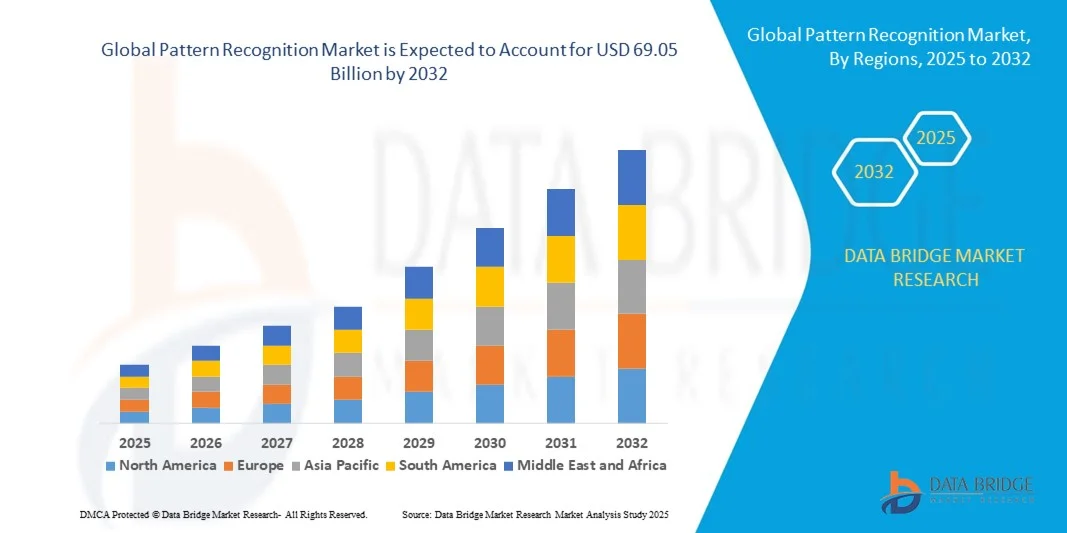
Pattern Recognition Market Size
- The global pattern recognition market size was valued at USD 5.1 billion in 2024 and is expected to reach USD 69.05 billion by 2032, at a CAGR of 38.50% during the forecast period
- The market growth is largely fueled by the expanding adoption of artificial intelligence (AI), machine learning (ML), and data analytics across industries, driving the demand for intelligent systems capable of recognizing patterns, trends, and anomalies in large data sets. Businesses increasingly rely on pattern recognition to automate processes, enhance decision-making, and improve operational efficiency in sectors such as healthcare, finance, and manufacturing
- Furthermore, rising investment in AI-based research and technological innovation is accelerating the deployment of advanced pattern recognition solutions. For instance, companies such as IBM and Microsoft are integrating deep learning algorithms and neural networks into their analytics platforms to enhance predictive accuracy and automate complex recognition tasks across multiple domains, fueling market expansion
Pattern Recognition Market Analysis
- Pattern recognition, which involves the identification and classification of patterns in data using AI and machine learning algorithms, is becoming a cornerstone technology in digital transformation strategies. It is widely used for image and speech recognition, fraud detection, predictive maintenance, and data security enhancement across industries, driving strong market penetration
- The escalating demand for automation, real-time analytics, and intelligent decision-making systems is propelling the market forward. Enterprises are increasingly adopting pattern recognition technologies to process unstructured data efficiently and derive actionable insights, positioning it as a critical enabler of innovation and competitiveness in the global AI ecosystem
- North America dominated the pattern recognition market with a share of 35.73% in 2024, due to extensive adoption of AI, machine learning, and data analytics across industries
- Asia-Pacific is expected to be the fastest growing region in the pattern recognition market during the forecast period due to rapid digitalization, expanding AI adoption, and favorable government initiatives in countries such as China, Japan, and India
- Cloud segment dominated the market with a market share of 57.9% in 2024, due to its scalability, cost efficiency, and ease of integration with AI-based analytics platforms. Cloud-based pattern recognition systems allow real-time data processing and model training, enabling businesses to handle large datasets efficiently. Enterprises prefer cloud deployment for its accessibility, minimal hardware requirements, and faster software updates, which enhance operational agility
Report Scope and Pattern Recognition Market Segmentation
|
Attributes |
Pattern Recognition Key Market Insights |
|
Segments Covered |
|
|
Countries Covered |
North America
Europe
Asia-Pacific
Middle East and Africa
South America
|
|
Key Market Players |
|
|
Market Opportunities |
|
|
Value Added Data Infosets |
In addition to the insights on market scenarios such as market value, growth rate, segmentation, geographical coverage, and major players, the market reports curated by the Data Bridge Market Research also include in-depth expert analysis, geographically represented company-wise production and capacity, network layouts of distributors and partners, detailed and updated price trend analysis and deficit analysis of supply chain and demand. |
Pattern Recognition Market Trends
Integration of Deep Learning and Neural Networks in Pattern Recognition
- The pattern recognition market is witnessing a profound transformation through the integration of deep learning and advanced neural network architectures, which are enabling systems to identify complex data patterns with enhanced precision and speed. This development is significantly improving object detection, image classification, and speech recognition capabilities across diverse sectors such as healthcare, automotive, and finance
- For instance, IBM Corporation has implemented deep neural networks in its Watson platform to deliver advanced pattern recognition for medical diagnostics and financial risk assessments. By leveraging deep learning algorithms, the system can detect intricate correlations within large datasets, improving prediction accuracy and decision-making efficiency
- The growing application of convolutional and recurrent neural networks is enabling faster processing of unstructured data such as images, audio, and natural language. Neural architectures can autonomously learn multi-layered representations from vast datasets, thus allowing systems to generalize and perform at high accuracy levels in recognition and classification tasks
- Cloud-based AI training environments are further optimizing deployment in pattern recognition systems by offering scalable computational resources. Service providers are increasingly focusing on integrating neural models into platform-as-a-service (PaaS) solutions to enhance accessibility and operational agility for enterprises expanding their AI infrastructure
- Ongoing research and innovation by technology firms are driving improvements in self-learning AI models, which require less supervision and more adaptive pattern adjustment. For instance, Google’s TensorFlow ecosystem has expanded to include pre-trained deep learning models that support computer vision and speech-based pattern recognition workloads with reduced training time and high scalability
- The integration of deep learning and neural networks is reshaping the overall landscape of pattern recognition by enabling machines to derive insights from complex datasets autonomously. As industries continue to leverage automation and intelligent analytics, this trend is expected to accelerate, driving innovation, accuracy, and efficiency across various data-intensive operations globally
Pattern Recognition Market Dynamics
Driver
Rising Adoption of AI-Powered Analytics Across Industries
- The increasing need for efficient decision-making and predictive insights across industries is driving the adoption of AI-powered analytics integrated with pattern recognition technologies. These solutions enable organizations to detect anomalies, forecast trends, and optimize processes with higher speed and accuracy, improving competitiveness and operational outcomes
- For instance, Siemens AG utilizes AI-enabled pattern recognition in its industrial automation platforms to analyze sensor data and improve equipment reliability through predictive maintenance. Such applications reduce downtime and operational costs while enhancing production quality, demonstrating the growing role of pattern recognition in industrial analytics
- The expansion of AI and machine learning frameworks across verticals such as healthcare, retail, manufacturing, and banking is reinforcing the importance of pattern recognition systems. These tools aid in identifying customer behavior patterns, fraud detection, and real-time diagnostics, contributing to improved business intelligence capabilities
- With the rapid generation of structured and unstructured data, companies are prioritizing analytical tools that can automate insights discovery. Pattern recognition models embedded with AI are supporting businesses in understanding hidden correlations and generating actionable outcomes critical for strategic decision-making
- The growing integration of AI-driven recognition technologies across enterprises signifies a long-term shift toward data-centric operations. As industries continue to invest in intelligent automation systems and predictive analytics, the increased adoption of pattern recognition platforms will remain a major driver for market expansion globally
Restraint/Challenge
High Computational Cost and Data Processing Complexity
- The pattern recognition market faces a significant challenge due to the high computational and processing resources required to train and deploy deep learning algorithms efficiently. The complexity of these models demands robust hardware infrastructure and specialized software design, which can elevate operational costs and limit adoption among smaller enterprises
- For instance, developing and maintaining deep neural networks involves heavy reliance on high-performance GPUs and cloud-based computational frameworks from companies such as NVIDIA Corporation and Amazon Web Services. While these technologies enable faster model training, they also substantially increase infrastructure expenses for end users, particularly during large-scale deployment
- As datasets become increasingly complex and voluminous, data preprocessing, labeling, and normalization processes add further computational strain. Organizations must manage extensive data pipelines that require optimized memory allocation and real-time processing capabilities to achieve reliable recognition outcomes
- The requirement for specialized technical expertise in managing deep learning frameworks poses another barrier, as many enterprises face skill shortages in advanced AI development and system optimization. This gap often leads to higher project costs and delayed implementation timelines across industries adopting AI-driven recognition
- To mitigate these challenges, companies are leveraging cloud-based AI infrastructure, distributed computing frameworks, and model compression techniques to optimize performance and reduce hardware dependency. Overcoming computational cost and data complexity barriers will be crucial for expanding accessibility and achieving sustainable scalability in the pattern recognition market
Pattern Recognition Market Scope
The market is segmented on the basis of type, component, deployment, application, and industry vertical.
- By Type
On the basis of type, the pattern recognition market is segmented into speech recognition, speaker identification, multimedia document recognition (MDR), and automatic medical diagnosis. The speech recognition segment dominated the market with the largest revenue share in 2024, owing to its extensive adoption in virtual assistants, customer service automation, and voice-enabled devices. Enterprises increasingly integrate speech recognition systems for real-time transcription, language translation, and human-computer interaction enhancement. The growing incorporation of AI-driven voice technologies in consumer electronics and enterprise applications continues to strengthen the market presence of this segment globally.
The automatic medical diagnosis segment is projected to witness the fastest growth rate from 2025 to 2032, driven by rising demand for AI-assisted healthcare solutions. These systems utilize pattern recognition algorithms to detect diseases and interpret medical imaging, leading to faster and more accurate diagnostics. Increased investments in digital health technologies and machine learning tools are fueling innovation in medical diagnostics. The push toward precision medicine and efficient patient data management further accelerates this segment’s growth potential.
- By Component
On the basis of component, the pattern recognition market is segmented into hardware, software, and service. The software segment held the largest market share in 2024, supported by its central role in algorithm development and data processing capabilities. Software platforms enable automation, data classification, and decision-making across industries through AI and machine learning models. The increasing availability of scalable software solutions integrated with cloud platforms is driving widespread enterprise adoption, ensuring flexibility and continuous system updates.
The service segment is anticipated to witness the fastest CAGR from 2025 to 2032, owing to growing demand for professional support, consulting, and managed services in implementing pattern recognition solutions. As enterprises deploy AI models for diverse applications, service providers play a vital role in customization, integration, and maintenance. Continuous support services ensure optimal performance, data accuracy, and scalability, making this segment an essential contributor to overall market expansion.
- By Deployment
On the basis of deployment, the pattern recognition market is divided into cloud and on-premises. The cloud segment dominated the market with a share of 57.9% in 2024, attributed to its scalability, cost efficiency, and ease of integration with AI-based analytics platforms. Cloud-based pattern recognition systems allow real-time data processing and model training, enabling businesses to handle large datasets efficiently. Enterprises prefer cloud deployment for its accessibility, minimal hardware requirements, and faster software updates, which enhance operational agility.
The on-premises segment is expected to register the fastest growth rate from 2025 to 2032 due to increasing data privacy concerns and the need for secure, controlled environments in sensitive sectors such as healthcare and BFSI. Organizations opting for on-premises solutions benefit from direct control over infrastructure and compliance management. As regulatory mandates tighten across regions, demand for secure, locally managed systems continues to rise, supporting the growth of this deployment model.
- By Application
On the basis of application, the pattern recognition market is segmented into image processing and segmentation, analysis, computer vision, seismic analysis, radar signal classification/analysis, speech recognition, and fingerprint identification. The image processing and segmentation segment held the largest revenue share in 2024, driven by growing use in medical imaging, security surveillance, and autonomous systems. Pattern recognition in image processing enables high-precision detection, classification, and feature extraction across multiple industries, enhancing automation and decision-making accuracy.
The computer vision segment is projected to grow at the fastest rate from 2025 to 2032, propelled by advancements in AI algorithms and deep learning techniques. Its applications in self-driving vehicles, robotics, and industrial automation are expanding rapidly. Increasing use of visual data analytics for object detection, motion tracking, and quality control further fuels demand. Continuous innovation in neural networks and edge AI processing strengthens this segment’s future outlook.
- By Industry Vertical
On the basis of industry vertical, the pattern recognition market is categorized into retail and e-commerce, media and entertainment, BFSI, automobile and transportation, IT & telecom, government, healthcare, and others. The IT & telecom segment dominated the market in 2024 due to the rising use of AI-enabled analytics for fraud detection, network optimization, and predictive maintenance. Telecom providers employ pattern recognition algorithms to manage massive data flows and enhance customer experience through intelligent automation. The digital transformation of IT infrastructure and 5G implementation further boosts demand for advanced recognition systems.
The healthcare segment is forecasted to exhibit the fastest growth from 2025 to 2032, fueled by increasing reliance on pattern recognition for disease prediction, diagnostics, and personalized treatment planning. AI-driven tools in medical imaging, genomic analysis, and patient monitoring improve clinical accuracy and operational efficiency. As healthcare organizations focus on digitalization and data-driven care delivery, the adoption of pattern recognition technologies is accelerating significantly.
Pattern Recognition Market Regional Analysis
- North America dominated the pattern recognition market with the largest revenue share of 35.73% in 2024, driven by extensive adoption of AI, machine learning, and data analytics across industries
- The region’s well-established technology infrastructure and high investment in automation and cybersecurity strengthen its leadership position
- Enterprises increasingly utilize pattern recognition for fraud detection, predictive analytics, and speech processing, enhancing operational efficiency and data security. Favorable government initiatives supporting digital transformation and AI innovation further stimulate market growth across the U.S. and Canada
U.S. Pattern Recognition Market Insight
The U.S. pattern recognition market captured the largest revenue share in 2024 within North America, fueled by the strong presence of tech giants such as IBM, Microsoft, and Google. The nation’s expanding demand for AI-driven solutions in finance, healthcare, and e-commerce continues to accelerate adoption. Widespread integration of pattern recognition in voice assistants, image analysis, and fraud management systems underscores the U.S.’s leadership in the sector. Furthermore, high R&D expenditure and strategic collaborations between technology providers and enterprises are fostering rapid innovation and deployment.
Europe Pattern Recognition Market Insight
The Europe pattern recognition market is projected to grow at a substantial CAGR throughout the forecast period, propelled by rising investments in AI infrastructure and regulatory emphasis on secure data processing. Countries in the region are adopting pattern recognition technologies for industrial automation, smart manufacturing, and digital security. The growing implementation of computer vision and biometric authentication systems in government and enterprise applications enhances market prospects. Increasing collaboration between research institutions and private organizations further drives innovation across the European market.
U.K. Pattern Recognition Market Insight
The U.K. pattern recognition market is anticipated to expand at a noteworthy CAGR during the forecast period, driven by strong advancements in AI research and a growing focus on digital transformation across industries. Enterprises in finance, retail, and healthcare are actively deploying pattern recognition systems for risk mitigation and customer insights. Supportive government initiatives promoting AI adoption and data ethics frameworks bolster market growth. The U.K.’s thriving technology ecosystem and increasing integration of intelligent automation solutions contribute to the segment’s robust expansion.
Germany Pattern Recognition Market Insight
The Germany pattern recognition market is expected to grow at a considerable CAGR during the forecast period, driven by its focus on Industry 4.0 and advanced manufacturing. German industries leverage pattern recognition for quality control, predictive maintenance, and process optimization. The country’s emphasis on research, engineering precision, and adoption of AI-based analytics solutions is fostering significant growth. Moreover, Germany’s regulatory commitment to data security and privacy aligns well with the expanding use of pattern recognition in industrial and enterprise environments.
Asia-Pacific Pattern Recognition Market Insight
The Asia-Pacific pattern recognition market is expected to grow at the fastest CAGR from 2025 to 2032, supported by rapid digitalization, expanding AI adoption, and favorable government initiatives in countries such as China, Japan, and India. Growing investments in smart city projects and the increasing application of computer vision and speech analytics in consumer and industrial sectors propel regional demand. The region’s thriving manufacturing base, coupled with affordable AI software development, positions Asia-Pacific as a major growth hub for pattern recognition technologies.
China Pattern Recognition Market Insight
The China pattern recognition market accounted for the largest revenue share in Asia-Pacific in 2024, driven by rapid technological advancements and high government support for AI innovation. Local enterprises are actively investing in facial recognition, automated surveillance, and image-based diagnostics. The integration of AI with IoT and big data solutions enhances China’s position as a global leader in digital intelligence. In addition, the presence of key domestic technology firms and cost-effective AI development continues to bolster market expansion across the nation.
Japan Pattern Recognition Market Insight
The Japan pattern recognition market is witnessing steady growth, supported by increasing automation in healthcare, automotive, and industrial robotics. Japan’s commitment to developing intelligent systems and leveraging pattern recognition for predictive analytics drives adoption across multiple sectors. Integration with IoT platforms and robotics enhances operational precision and safety. The nation’s strong innovation ecosystem, along with growing demand for AI-based diagnostic tools and voice-enabled solutions, supports its rising influence in the regional market.
Pattern Recognition Market Share
The pattern recognition industry is primarily led by well-established companies, including:
- Attrasoft, Inc. (U.S.)
- Catchoom Technologies S.L. (Spain)
- Google (U.S.)
- Hitachi, Ltd. (Japan)
- Honeywell International Inc. (U.S.)
- LTUTech (China)
- NEC Corporation (Japan)
- Qualcomm Technologies, Inc. (U.S.)
- Slyce (Canada)
- Wikitude GmbH (Austria)
- Amazon Web Services, Inc. (U.S.)
- Microsoft (U.S.)
- IBM Corporation (U.S.)
- Blippar (U.K.)
- Ricoh Innovations (Japan)
- TRAX IMAGE RECOGNITION (Singapore)
- Planorama (France)
- PRC (China)
- Intelligence Retail (Russia)
- Snap2Insight Inc. (U.S.)
Latest Developments in Global Pattern Recognition Market
- In July 2025, Pattern Computer Inc. announced a major partnership with Phenome Health and the Buck Institute for Research on Aging to apply its advanced pattern recognition engine, ProSpectral, for multi-disease diagnostics and drug discovery. This collaboration significantly enhances the company’s influence in the healthcare AI domain by expanding the application of pattern recognition to complex biomedical data, improving early disease detection accuracy, and accelerating research efficiency across genomics and clinical diagnostics
- In July 2025, Pattern Computer Inc. also launched its breakthrough PatternDE (Pattern Discovery Engine) platform, an online AI tool designed to identify high-dimensional patterns across vast datasets. The launch strengthens the company’s technological footprint in data analytics, allowing researchers and enterprises to uncover hidden correlations in industrial, healthcare, and scientific data. This innovation is expected to drive greater market adoption of AI-powered pattern discovery solutions
- In June 2025, Pattern Group Inc. unveiled a suite of AI-driven e-commerce products, including Chessboard, GEO Scorecard, TrendVision, and The Portal, all leveraging pattern recognition for real-time consumer behavior insights. This strategic product expansion enhances data-driven marketing and personalization capabilities, positioning the company as a leader in applying pattern recognition to optimize retail conversions and improve customer engagement across digital marketplaces
- In July 2025, Mycronic AB’s Pattern Generators division completed the acquisition of Cowin DST in South Korea, a specialist in inspection and photomask repair technology utilizing pattern recognition algorithms. This acquisition strengthens Mycronic’s semiconductor manufacturing portfolio by integrating AI-based defect detection and precision inspection tools, boosting production accuracy and efficiency in advanced microelectronics
- In May 2025, Permira Advisers LLP expanded its investment strategy by targeting professional service firms specializing in pattern recognition and digital transformation technologies. This move underscores the growing investor confidence in AI-enabled analytics and pattern recognition startups, promoting increased innovation, funding accessibility, and M&A activity within the global AI ecosystem

- Interactive Data Analysis Dashboard
- Company Analysis Dashboard for high growth potential opportunities
- Research Analyst Access for customization & queries
- Competitor Analysis with Interactive dashboard
- Latest News, Updates & Trend analysis
- Harness the Power of Benchmark Analysis for Comprehensive Competitor Tracking
Global Pattern Recognition Market, Supply Chain Analysis and Ecosystem Framework
To support market growth and help clients navigate the impact of geopolitical shifts, DBMR has integrated in-depth supply chain analysis into its Global Pattern Recognition Market research reports. This addition empowers clients to respond effectively to global changes affecting their industries. The supply chain analysis section includes detailed insights such as Global Pattern Recognition Market consumption and production by country, price trend analysis, the impact of tariffs and geopolitical developments, and import and export trends by country and HSN code. It also highlights major suppliers with data on production capacity and company profiles, as well as key importers and exporters. In addition to research, DBMR offers specialized supply chain consulting services backed by over a decade of experience, providing solutions like supplier discovery, supplier risk assessment, price trend analysis, impact evaluation of inflation and trade route changes, and comprehensive market trend analysis.
Data collection and base year analysis are done using data collection modules with large sample sizes. The stage includes obtaining market information or related data through various sources and strategies. It includes examining and planning all the data acquired from the past in advance. It likewise envelops the examination of information inconsistencies seen across different information sources. The market data is analysed and estimated using market statistical and coherent models. Also, market share analysis and key trend analysis are the major success factors in the market report. To know more, please request an analyst call or drop down your inquiry.
The key research methodology used by DBMR research team is data triangulation which involves data mining, analysis of the impact of data variables on the market and primary (industry expert) validation. Data models include Vendor Positioning Grid, Market Time Line Analysis, Market Overview and Guide, Company Positioning Grid, Patent Analysis, Pricing Analysis, Company Market Share Analysis, Standards of Measurement, Global versus Regional and Vendor Share Analysis. To know more about the research methodology, drop in an inquiry to speak to our industry experts.
Data Bridge Market Research is a leader in advanced formative research. We take pride in servicing our existing and new customers with data and analysis that match and suits their goal. The report can be customized to include price trend analysis of target brands understanding the market for additional countries (ask for the list of countries), clinical trial results data, literature review, refurbished market and product base analysis. Market analysis of target competitors can be analyzed from technology-based analysis to market portfolio strategies. We can add as many competitors that you require data about in the format and data style you are looking for. Our team of analysts can also provide you data in crude raw excel files pivot tables (Fact book) or can assist you in creating presentations from the data sets available in the report.













