


What is the Pay TV Market Size & Overview?
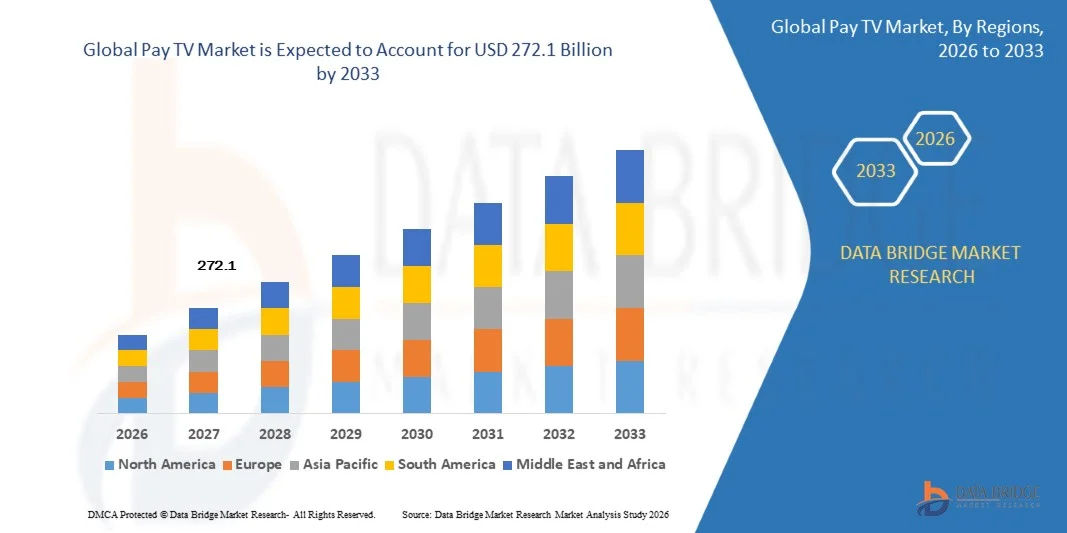
The pay TV market was valued at USD 225.1 billion in 2025 and is projected to reach USD 272.1 billion by 2033, growing at a CAGR of 2.40% from 2026 to 2033. The market is undergoing a structural transition as legacy cable and direct-to-home (DTH) subscriptions continue to erode in mature markets, even as broadband-bundled IPTV services expand rapidly across telecom-led distribution channels. Pay television continues to anchor household entertainment through premium sports rights, live news, and bundled broadband-mobile-television packages, helping operators offset cord-cutting pressure from over-the-top (OTT) streaming platforms.
The market comprises a wide range of delivery formats, including cable television, satellite (DTH) services, IPTV, and digital terrestrial television, supported by set-top boxes, hybrid Android TV devices, and cloud-based content management platforms. Technological innovations such as broadband-bundled IPTV, hybrid set-top boxes combining linear TV with OTT applications, Ultra HD/4K content delivery, and targeted advertising technologies are transforming the Pay TV distribution landscape, while large-scale consolidation among cable, broadband, and satellite operators is reshaping the competitive structure.
Market Size & Forecast
- Market Value (2025): USD 225.1 Billion
- Expected Market Value (2033): USD 272.1 Billion
- Forecast CAGR (2026–2033): 2.40%
- Leading Region in 2025: North America
- Fastest Growing Region: Asia-Pacific
Key Market Trends & Insights
- North America dominated the Pay TV market with the largest revenue share of 33.86% in 2025, supported by high broadband penetration, widespread bundling of broadband-television-mobile packages, a well-established base of cable and satellite operators, and continued large-scale industry consolidation.
- The cable TV segment led the market with a 38.42% share in 2025, driven by its large installed subscriber base, long-standing bundling relationships with broadband and telephony services, and continued reliance on cable infrastructure in mature markets.
- Asia-Pacific is expected to be the fastest-growing region at a CAGR of 4.9% from 2026 to 2033, fueled by rapid broadband expansion, rising middle-class disposable income, and an accelerating shift from cable and satellite television toward telecom-led IPTV services in China, India, and Southeast Asia.
- IPTV is the fastest-growing service type, projected to register a CAGR of 5.8%, reflecting rising broadband penetration, telecom operators bundling television with fiber and mobile services, and growing consumer preference for hybrid linear-plus-streaming devices.
- The subscription-based revenue model segment dominates with a 71.65% share in 2025, supported by the continued preference among consumers for fixed monthly bundles offering predictable access to premium sports, entertainment, and news content.
- The High Definition (HD) content type segment accounts for 47.86% of the market, led by widespread consumer upgrades from Standard Definition service and broad availability of HD channel packages across cable, satellite, and IPTV platforms.
- The residential end-user segment is the largest, with a CAGR of 4.2% expected for the commercial segment, driven by rising demand for Pay TV services across hospitality, healthcare, and institutional establishments.
Report Scope and Pay TV Market Segmentation
|
Attributes |
Pay TV Key Market Insights |
|
Segments Covered |
|
|
Countries Covered |
North America
Europe
Asia-Pacific
Middle East and Africa
South America
|
|
Key Market Players |
|
|
Market Opportunities |
|
|
Value Added Data Infosets |
In addition to the market insights such as market value, growth rate, market segments, geographical coverage, market players, and market scenario, the market report curated by the Data Bridge Market Research team includes in-depth expert analysis, import/export analysis, pricing analysis, production consumption analysis, and pestle analysis. |
What are the Pay TV Market Trends?
Trend: Growing Adoption of Broadband-Bundled IPTV Services
The increasing adoption of broadband-bundled IPTV services is reshaping the global television distribution landscape as telecom operators combine live TV, on-demand content, and OTT applications with broadband and mobile connectivity. Expanding fiber networks, rising smart TV adoption, and growing consumer demand for integrated entertainment solutions with simplified billing are accelerating the transition from traditional cable and satellite services toward IPTV-based platforms.
Operators are increasingly introducing hybrid Android TV-based set-top boxes, expanding localized content offerings, and integrating third-party streaming applications to provide seamless access to both traditional Pay TV and digital streaming services through a single platform.
For instance,
- According to TRAI performance data reported in June 2026, India’s Bharti Airtel-led IPTV subscriber base more than doubled over a six-month period through March 2026, while private pay-DTH subscribers declined by nearly 13.8% year-on-year, highlighting the growing shift toward broadband-based television services.
The transition toward IPTV and broadband-integrated entertainment platforms is expected to remain a key market trend as consumers increasingly prioritize flexible, connected, and multi-service viewing experiences.
What are the Pay TV Market Dynamics?
Key Market Driver: Rising Demand for Bundled Broadband, Mobile, and Pay TV Services
Growing demand for bundled connectivity and entertainment services is driving the evolution of the Pay TV market. Consumers are increasingly preferring packages that combine broadband internet, mobile services, and television subscriptions with unified billing, customer support, and improved value.
Telecom and media operators are expanding converged service offerings while integrating streaming platforms and ad-supported content options into traditional Pay TV packages. These strategies help operators improve customer retention, reduce subscriber churn, and compete more effectively with standalone streaming platforms.
For instance,
- In February 2026, the U.S. Federal Communications Commission approved Charter Communications’ USD 34.5 billion acquisition of Cox Communications, creating a major broadband and Pay TV provider with an expanded bundled service footprint across the U.S.
The increasing preference for all-in-one connectivity and entertainment packages is strengthening the role of bundled services as a major growth driver for Pay TV providers worldwide.
Key Restraint/Challenge: Growing Competition from OTT and Streaming Platforms
The rapid expansion of OTT and streaming platforms continues to challenge traditional Pay TV operators as consumers increasingly prefer flexible, on-demand, and cost-effective entertainment options. Improved broadband availability, smart TV penetration, and expanding digital content libraries are accelerating cord-cutting trends, particularly among younger consumers and price-sensitive households.
To address subscriber losses, Pay TV providers are adopting hybrid strategies by integrating OTT applications into set-top boxes, offering streaming bundles, and investing in premium content such as live sports and exclusive programming.
For instance,
- According to Pew Research Center findings published in July 2025, only 36% of U.S. adults reported subscribing to cable or satellite television, reflecting the continued shift toward streaming-based entertainment consumption.
Although OTT platforms pose significant competition, Pay TV operators that adopt hybrid models and enhance digital offerings are better positioned to maintain subscriber engagement and market relevance.
Key Market Opportunity: Strategic Consolidation and M&A Expansion in the Pay TV Industry
Strategic mergers and acquisitions are creating new opportunities for Pay TV operators to expand market reach, strengthen infrastructure capabilities, and improve competitiveness against streaming platforms. Consolidation enables companies to combine content portfolios, geographic presence, and distribution networks while improving operational efficiency and investment capacity.
Large-scale transactions are supporting the development of integrated broadband, television, and streaming ecosystems that allow operators to compete in an increasingly converged media environment.
For instance,
- In July 2026, Canal+ completed its USD 3.17 billion acquisition of MultiChoice Group, creating a combined Pay TV and streaming organization operating across approximately 70 countries.
- In May 2025, Charter Communications and Cox Communications announced a USD 34.5 billion merger agreement, which received FCC approval in February 2026 to expand bundled broadband, mobile, and Pay TV services across the U.S.
Increasing consolidation within the Pay TV industry is expected to support market expansion by enabling operators to achieve greater scale, strengthen content capabilities, and develop competitive multi-service entertainment ecosystems.
What is Pay TV Market Scope?
The Pay TV market is segmented on the basis of service type, revenue model, content type, end user, and distribution channel.
- By Service Type
On the basis of service type, the market is segmented into cable TV, satellite TV (DTH), IPTV, and digital terrestrial television (DTT). In 2026, the cable TV segment is expected to dominate the market with a market share of 38.09%, owing to its large existing installed base, established bundling relationships with broadband and telephony services, and continued reliance on cable infrastructure across mature markets in North America and Europe.
The IPTV segment is projected to register the fastest growth at a CAGR of 5.8% from 2026 to 2033, driven by rapid fiber broadband expansion, aggressive bundling strategies by telecom operators, and rising consumer preference for hybrid devices that combine linear television with OTT applications.
- By Revenue Model
On the basis of revenue model, the market is segmented into subscription-based, advertising-based, and pay-per-view & transactional. In 2026, the subscription-based segment is expected to dominate the market with a market share of 71.30%, supported by consumer preference for predictable monthly bundles offering consistent access to premium sports, entertainment, and news programming.
The pay-per-view & transactional segment is expected to experience the fastest growth at a CAGR of 4.9% from 2026 to 2033, driven by rising demand for one-off access to premium live sporting events, boxing and combat sports pay-per-view broadcasts, and exclusive entertainment specials.
- By Content Type
On the basis of content type, the market is segmented into standard definition (SD), high definition (HD), and Ultra HD/4K. In 2026, the HD segment is expected to dominate the market with a market share of 47.62%, due to widespread consumer upgrades from SD service and broad availability of HD channel packages across cable, satellite, and IPTV platforms.
The Ultra HD/4K segment is anticipated to witness the fastest CAGR of 6.1% from 2026 to 2033, driven by rising adoption of large-screen 4K-enabled televisions, growing availability of Ultra HD live sports broadcasts, and continued investment by operators in next-generation content delivery infrastructure.
- By End User
On the basis of end user, the market is segmented into residential and commercial. In 2026, the residential segment is expected to dominate the market with a market share of 80.02%, due to Pay TV's continued role as a primary source of household entertainment, live news, and sports viewing.
The commercial segment is expected to witness the fastest CAGR of 4.2% from 2026 to 2033, driven by rising demand for Pay TV subscriptions across hotels, bars, restaurants, healthcare facilities, and other institutional establishments seeking premium sports and entertainment programming for guests and patrons.
- By Distribution Channel
On the basis of the distribution channel, the market is segmented into direct and indirect. In 2026, the indirect segment is expected to dominate the market with a market share of 57.74%, due to the continued prevalence of third-party retailers, telecom bundling partners, and regional distribution agents in expanding subscriber reach.
The direct segment is expected to witness the fastest CAGR of 4.5% from 2026 to 2033, driven by growing operator investment in direct-to-consumer digital sales channels, stronger customer relationships, and greater control over pricing and bundling strategies.
Which Region Holds the Largest Share of the Pay TV Market?
North America dominated the Pay TV market with the largest revenue share of 33.86% in 2025, supported by high broadband penetration, widespread adoption of bundled broadband-television-mobile packages, a well-established base of leading cable and satellite operators, and continued large-scale consolidation activity across the region.
U.S. Pay TV Market Insight
The U.S. Pay TV market is undergoing a significant structural shift as traditional cable and satellite subscribers continue to migrate toward broadband-bundled and hybrid entertainment packages. Large-scale consolidation among cable and broadband operators, expanding fiber footprints, and the integration of ad-supported streaming tiers into legacy Pay TV bundles are reshaping competitive dynamics. Despite steady subscriber attrition in legacy DTH and cable segments, sustained demand for premium sports, live events, and news content continues to anchor the market.
Europe Pay TV Market Insight
The Europe Pay TV market remains a substantial contributor to revenue, supported by well-established cable and satellite infrastructure, strong regional broadcasting groups, and growing consumer preference for bundled broadband-television-mobile packages. Increasing consolidation among regional pay television operators, expansion of pan-regional content platforms, and rising investment in HD and Ultra HD content delivery are further reinforcing market growth across the region.
U.K. Pay TV Market Insight
The U.K. Pay TV market continues to be shaped by strong satellite and IPTV penetration, the presence of established broadcasting groups, and rising consumer demand for integrated broadband-television bundles. Growing adoption of hybrid set-top boxes that combine linear television with on-demand streaming, along with continued investment in premium sports and entertainment content rights, is supporting sustained market activity.
Germany Pay TV Market Insight
The Germany Pay TV market is expanding steadily, supported by the country's advanced telecommunications infrastructure, high broadband penetration, and rising demand for technologically advanced entertainment bundles. Growing adoption of IPTV services delivered over fiber networks, along with strong investment from national telecom operators in content partnerships and hybrid television platforms, continues to drive market growth.
Asia-Pacific Pay TV Market Insight
The Asia-Pacific Pay TV market is expected to witness the fastest growth ly, driven by rising broadband penetration, expanding middle-class populations, and rapid migration from traditional satellite and cable television toward IPTV services delivered by telecom operators. Countries such as China, India, and Japan are experiencing substantial shifts in distribution mix as broadband-led operators expand aggressively, while a large under-penetrated population base across Southeast Asia presents significant long-term growth opportunities.
Japan Pay TV Market Insight
The Japan Pay TV market is witnessing steady growth, supported by a mature telecommunications ecosystem, high household broadband penetration, and continued consumer preference for premium and Ultra HD content. Growing integration of Pay TV services with fiber-based broadband bundles and increasing demand for localized sports and entertainment programming are further supporting adoption.
China Pay TV Market Insight
The China Pay TV market continues to evolve rapidly as IPTV services delivered by major state-owned telecom operators steadily displace legacy cable television subscriptions. Expanding fiber broadband infrastructure, government-backed digitalization initiatives, and rising consumer demand for bundled broadband-television-mobile packages are significantly boosting IPTV adoption, positioning China as one of the largest and fastest-transitioning Pay TV markets ly.
What are Top Companies in Pay TV Market?
The Pay TV industry is primarily led by well-established companies, including:
- Comcast Corporation (U.S.)
- Charter Communications, Inc. (U.S.)
- Cox Communications, Inc. (U.S.)
- DIRECTV (U.S.)
- DISH Network Corporation (U.S.)
- AT&T Inc. (U.S.)
- Altice USA, Inc. (U.S.)
- Sky Group (U.K.)
- Vodafone Group Plc (U.K.)
- Liberty plc (U.K.)
- Deutsche Telekom AG (Germany)
- Vivendi SE / Canal+ Group (France)
- Orange S.A. (France)
- Telefónica, S.A. (Spain)
- Tata Play Limited (India)
- Bharti Airtel Limited (India)
- Dish TV India Limited (India)
- Sun Direct (India)
- China Telecom Corporation Limited (China)
- China Unicom (Hong Kong) Limited (China)
- China Mobile Limited (China)
- SK Broadband Co., Ltd. (South Korea)
- KT Corporation (South Korea)
- StarHub Ltd. (Singapore)
- Astro Malaysia Holdings Berhad (Malaysia)
- Foxtel Group (Australia)
- Telstra Corporation Limited (Australia)
- MultiChoice Group (South Africa)
- América Móvil, S.A.B. de C.V. (México)
- Grupo Televisa, S.A.B. (México)
- Sky Brasil (Brazil)
Which are the Latest Developments in Pay TV Market?
- In February 2026, the U.S. Federal Communications Commission approved Charter Communications' USD 34.5 billion acquisition of Cox Communications, creating the largest combined cable, broadband, and Pay TV provider in the United States, with the transaction expected to close in mid-2026.
- In July 2026, Canal+ completed its USD 3.17 billion acquisition of MultiChoice Group, bringing the operator of DStv, GOtv, and Showmax fully under Canal+ ownership and forming a combined Pay TV and streaming group operating across roughly 70 countries.
- In January 2020, Tata Play launched its Binge+ hybrid Android TV set-top box in India, integrating fiber broadband, live DTH-style television channels, and OTT streaming applications into a single connected device.
- In June 2026, TRAI performance data showed Bharti Airtel-led IPTV subscriptions in India more than doubling over the preceding six months, while the country's private pay-DTH subscriber base continued to contract, reflecting the accelerating shift toward broadband-delivered television services.

- Interactive Data Analysis Dashboard
- Company Analysis Dashboard for high growth potential opportunities
- Research Analyst Access for customization & queries
- Competitor Analysis with Interactive dashboard
- Latest News, Updates & Trend analysis
- Harness the Power of Benchmark Analysis for Comprehensive Competitor Tracking
Data collection and base year analysis are done using data collection modules with large sample sizes. The stage includes obtaining market information or related data through various sources and strategies. It includes examining and planning all the data acquired from the past in advance. It likewise envelops the examination of information inconsistencies seen across different information sources. The market data is analysed and estimated using market statistical and coherent models. Also, market share analysis and key trend analysis are the major success factors in the market report. To know more, please request an analyst call or drop down your inquiry.
The key research methodology used by DBMR research team is data triangulation which involves data mining, analysis of the impact of data variables on the market and primary (industry expert) validation. Data models include Vendor Positioning Grid, Market Time Line Analysis, Market Overview and Guide, Company Positioning Grid, Patent Analysis, Pricing Analysis, Company Market Share Analysis, Standards of Measurement, Global versus Regional and Vendor Share Analysis. To know more about the research methodology, drop in an inquiry to speak to our industry experts.
Data Bridge Market Research is a leader in advanced formative research. We take pride in servicing our existing and new customers with data and analysis that match and suits their goal. The report can be customized to include price trend analysis of target brands understanding the market for additional countries (ask for the list of countries), clinical trial results data, literature review, refurbished market and product base analysis. Market analysis of target competitors can be analyzed from technology-based analysis to market portfolio strategies. We can add as many competitors that you require data about in the format and data style you are looking for. Our team of analysts can also provide you data in crude raw excel files pivot tables (Fact book) or can assist you in creating presentations from the data sets available in the report.













