


What is the PCR Stretch Hood Film Market Size and Growth Rate?
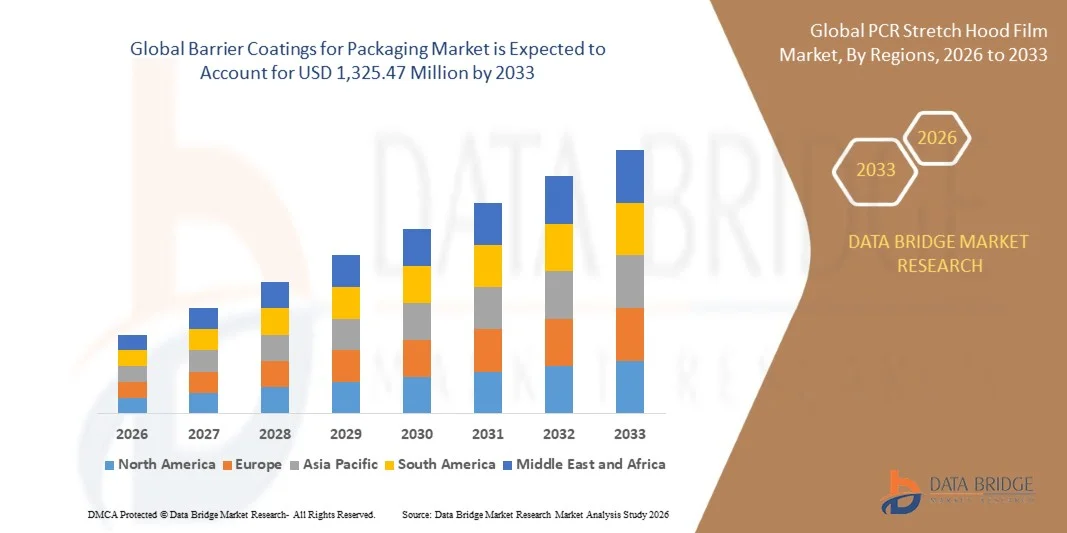
- As per Data Bridge Market Research analysis, the PCR stretch hood film market was valued at USD 760.00 million in 2025 and is projected to reach USD 1,325.47 million by 2033, growing at a CAGR of 7.20% from 2026 to 2033.
- The market is experiencing consistent growth driven by rising demand for sustainable packaging solutions, increasing adoption of post-consumer recycled materials, advancements in recycling technologies, and expanding applications across palletizing, transportation, storage, and logistics.
- The increasing focus on reducing virgin plastic consumption, combined with stricter packaging sustainability regulations and growing corporate commitments to circular economy practices, is encouraging manufacturers and logistics providers to adopt PCR stretch hood films. Automated palletizing systems and improvements in PCR resin quality are further supporting the adoption of high-performance recycled-content films across global packaging applications
Market Size & Forecast
- Global Market Value (2025): USD 760.00 Million
- Expected Market Value (2033): USD 1,325.47 Million
- Forecast CAGR (2026–2033): 7.20%
- Leading Region in 2025: North America
- Fastest Growing Region: Asia Pacific
What are the Major Takeaways of the PCR Stretch Hood Film Market?
- North America dominated the PCR stretch hood film market with the largest revenue share of 38.4% in 2025, supported by strong demand from the food & beverage, logistics, pharmaceutical, and industrial sectors, along with increasing adoption of recycled-content packaging solutions.
- Asia-Pacific is expected to be the fastest-growing region at a CAGR of 8.3% from 2026 to 2033, fueled by rapid industrialization, urbanization, expanding retail and logistics sectors, and increasing government initiatives promoting recycling and sustainable packaging solutions across China, India, Japan, and South Korea.
- The standard film segment led the market with a 35% share in 2025, driven by its broad application across palletizing, transportation, and general industrial packaging.
- High-performance film are the fastest-growing film type, projected to register a CAGR of 9%, reflecting the surge in requirements for high load retention, puncture resistance, tear resistance, and high-speed automated application.
- The polyethylene segment dominated the material type category with a 68% revenue share in 2025, led by its established use in stretch hood film manufacturing and strong mechanical performance
- Palletizing deployment accounted for 32% of the market share in 2025, preferred by manufacturers and logistics operators handling high-volume palletized loads, particularly in food & beverages, building materials, chemicals, and consumer goods,
- The transportation segment is the fastest-growing application category, with a CAGR of 9%, driven by increasing movement of palletized goods through complex global supply chains
Report Scope and PCR Stretch Hood Film Market Segmentation
|
Attributes |
PCR Stretch Hood Film Key Market Insights |
|
Segments Covered |
|
|
Countries Covered |
North America
Europe
Asia-Pacific
Middle East and Africa
South America
|
|
Key Market Players |
|
|
Market Opportunities |
|
|
Value Added Data Infosets |
In addition to the insights on market scenarios such as market value, growth rate, segmentation, geographical coverage, and major players, the market reports curated by the Data Bridge Market Research also include import export analysis, production capacity overview, production consumption analysis, price trend analysis, climate change scenario, supply chain analysis, value chain analysis, raw material/consumables overview, vendor selection criteria, PESTLE Analysis, Porter Analysis, and regulatory framework. |
What is the Key Trend in the PCR Stretch Hood Film Market?
- Packaging manufacturers are increasingly developing high-PCR-content stretch hood films that maintain the strength, stretchability, puncture resistance, and load stability required for demanding palletized applications, supporting the transition toward circular packaging.
- For instance, in February 2024, Charter Next Generation introduced Titanium 5P, a stretch hood film containing 20% post-consumer recycled (PCR) content, designed to reduce virgin resin use while maintaining load containment, UV protection, all-weather protection, and condensation control.
- Advanced extrusion and multi-layer film technologies are enabling manufacturers to increase PCR content without substantially compromising mechanical and processing performance.
- Rising recycled-content requirements and circular-economy initiatives are accelerating investment in PCR stretch hood formulations that reduce dependence on virgin polyethylene while supporting packaging recyclability.
- For instance, in March 2025, Borealis launched Borcycle M CWT120CL, an rLLDPE grade containing 85% post-consumer recycled (PCR) content, with stretch hood identified as a key application; the material was developed to provide stretchability and toughness while supporting circular packaging goals.
- As packaging producers increasingly balance recycled-content targets with high-performance requirements, advances in PCR processing, film-layer engineering, and material compatibility are expected to accelerate adoption of PCR stretch hood films across industrial packaging applications.
What are the Key Drivers of the PCR Stretch Hood Film Market?
- The increasing regulatory pressure and corporate sustainability commitments are driving packaging manufacturers and brand owners to incorporate post-consumer recycled content into plastic packaging, creating stronger demand for PCR-based stretch hood films.
- For instance, in February 2023, Berry Global launched a stretch hood film containing a minimum of 30% recycled plastic, enabling customers in beverage, building, and glass applications to meet sustainability and forthcoming UK and European recycled-content requirements; Berry reported an approximately 18% reduction in carbon emissions versus virgin-material film.
- Growing demand for sustainable pallet protection is encouraging logistics, food and beverage, construction, and consumer-goods companies to replace conventional virgin-polyethylene films with recycled-content alternatives while maintaining load containment and transportation protection.
- For instance, in December 2024, Berry Global reported a 36% year-on-year increase in PCR polyethylene use across its European flexible-film products, with recycled material being incorporated into stretch wrap and stretch hood pallet-protection films for logistics and transportation, demonstrating increasing demand for recycled-content solutions.
- With manufacturers increasingly seeking to reduce virgin plastic consumption without sacrificing packaging performance, continued advances in PCR resin quality, extrusion technology, and film engineering will remain important drivers of PCR stretch hood film adoption.
Which Factors are Challenging the Growth of the PCR Stretch Hood Film Market?
- Maintaining consistent mechanical strength, elasticity, tear resistance, and load containment remains a major challenge because PCR feedstocks can contain impurities and exhibit greater variability than virgin polyethylene.
- For instance, in August 2023, a Trioworld patent application disclosed that previous attempts to incorporate recycled polyethylene into stretch hood films had resulted in inferior tear resistance, crack-propagation resistance, elastic recovery, holding force, and elongation at break, with defective films potentially causing machine stoppages during automated application.
- These material-quality limitations can increase film breakage, processing difficulties, and performance variability, particularly when PCR content is increased for high-speed automated palletizing and demanding transportation applications.
- The technical complexity of processing variable PCR feedstocks while maintaining film consistency can increase formulation, quality-control, and manufacturing requirements, potentially limiting adoption among smaller converters and price-sensitive packaging users.
- For instance, in August 2025, ExxonMobil Signature Polymers and XL Recycling developed a 90-micron, three-layer stretch hood film containing 35% PCR polyethylene; the partners reported that achieving comparable mechanical and optical performance to virgin formulations required combining recycled LLDPE with performance polymers, highlighting the technical complexity of maintaining puncture resistance and pallet stability with PCR content.
- As PCR availability, quality consistency, processing requirements, and performance specifications remain challenging, manufacturers must continue investing in advanced compounding, extrusion, and multi-layer film technologies to achieve higher recycled-content levels without compromising operational performance.
How is the PCR Stretch Hood Film Market Segmented?
The PCR stretch hood film market is segmented on the basis of film type, material type, PCR content, application, and end user.
- By Film Type
On the basis of film type, the PCR stretch hood film market is segmented into standard, high-performance, UV-stabilized, weather-resistant, downgauged, and printed films. The standard film segment is expected to dominated the market with an estimated share of 35% in 2025, owing to its broad application across palletizing, transportation, and general industrial packaging. Standard films provide the basic combination of stretchability, load containment, and protection required for routine palletized shipments. Their relatively straightforward formulation also allows converters to manufacture PCR-based films at competitive costs. Demand is particularly strong among users transitioning from conventional virgin stretch hood films toward recycled-content alternatives without requiring specialized performance characteristics.
The high-performance film segment is projected to be the fastest-growing segment at an estimated CAGR of 9% during forecast period, driven by increasing requirements for high load retention, puncture resistance, tear resistance, and high-speed automated application. High-performance formulations allow converters to incorporate PCR material while compensating for variations in recycled resin quality. ExxonMobil and Reifenhäuser have demonstrated a five-layer stretch hood film containing 35% household-sourced PCR while maintaining load retention, tear resistance, and friction control. Such formulations are particularly important for heavy pallet loads and demanding transportation conditions. Growing automation of end-of-line packaging is also increasing demand for films capable of withstanding rapid hooding operations without premature breakage.
- By Material Type
On the basis of material type, the market is segmented into polyethylene, polypropylene, and others. The polyethylene segment dominated the market with an estimated share of 68% in 2025, owing to its established use in stretch hood film manufacturing and strong mechanical performance. PE provides an effective balance of flexibility, stretchability, puncture resistance, elastic recovery, and load stability. PCR polyethylene is also well suited to recycling streams because post-consumer film waste contains substantial polyethylene content. The established availability of PE grades specifically engineered for stretch hood applications further supports its leading position. Polyethylene's compatibility with automated stretch hood equipment makes it particularly attractive to large-volume industrial users.
The polypropylene segment is projected to be the fastest-growing at an estimated CAGR of 8% during forecast period, although it represents a smaller base than polyethylene. Growth is supported by demand for materials offering high tensile strength, rigidity, moisture resistance, and chemical resistance. PP can provide advantages in applications where greater dimensional stability is required. Increasing development of recycled polypropylene grades is also improving the material's suitability for sustainable packaging. Demand from chemical, pharmaceutical, and industrial users could particularly support PP adoption where enhanced resistance is required. However, PP continues to face the established processing infrastructure and performance advantages of PE
- By PCR Content
On the basis of PCR content, the market is segmented into up to 20%, 21%–30%, 31%–50%, and above 50%. The 21%–30% PCR content segment is expected to dominated with an estimated share of 38% in 2025, because this range provides a practical balance between recycled-content targets and the mechanical performance required for stretch hood applications. Commercial developments have demonstrated stretch hood films incorporating around 30% PCR while maintaining load stability and tear resistance. ExxonMobil has demonstrated a 90-micron stretch hood film containing 30% PCR that achieved comparable hooding performance and tear resistance to a virgin reference film. This makes the range attractive to converters seeking meaningful virgin-resin reduction without substantially changing existing processing conditions.
The 31%–50% PCR content segment is projected to register the fastest growth at an estimated CAGR of 10% during forecast period, supported by increasingly ambitious recycled-content requirements and technological improvements in PCR processing. ExxonMobil and Reifenhäuser have demonstrated a stretch hood film containing 35% household-sourced PCR while retaining critical performance characteristics. Higher-PCR formulations are becoming more commercially viable as manufacturers improve compatibilization, multilayer structures, and PCR purification. These technologies help control film defects and maintain consistent mechanical properties at higher recycled-content levels. Corporate sustainability targets are also encouraging packaging producers to move beyond low-PCR formulations.
- By Application
On the basis of application, the market is segmented into palletizing, transportation, storage, load stabilization, weather & dust protection, and others. The palletizing segment is expected to dominated with an estimated share of 32% in 2025, because stretch hood film is principally designed to secure and protect palletized loads during handling and movement. Stretch hood systems provide load containment while protecting goods from dust, moisture, and external contamination. The technology is increasingly used in automated end-of-line packaging because it can wrap pallet loads rapidly and consistently. Stretch hood films are widely used for industrial logistics and pallet stabilization across manufacturing and distribution operations. Increasing replacement of virgin films with PCR alternatives will further support demand within this core application.
The transportation segment is projected to be the fastest-growing at an estimated CAGR of 9% during forecast period, driven by increasing movement of palletized goods through complex global supply chains. PCR stretch hood films provide load stability while reducing virgin plastic consumption associated with transportation packaging. Their ability to retain pallet integrity during handling, loading, unloading, and long-distance movement makes them attractive to logistics-intensive industries. The growth of automated warehouses and distribution centers is further increasing demand for films capable of maintaining containment forces during high-speed operations. Stretch hood films also provide protection against moisture and environmental exposure during transportation and outdoor storage.
- By End User
On the basis of end user, the market is segmented into food & beverages, chemicals, building & construction, pharmaceuticals, logistics & warehousing, agriculture, consumer goods, retail & e-commerce, and others. The logistics & warehousing segment is expected to dominated with an estimated share of 34.7% in 2025, supported by extensive use of palletized loads and increasing automation of distribution operations. Warehouses and logistics providers require films that provide reliable load containment, protection, and consistent machine performance. PCR stretch hood films allow these users to reduce virgin plastic consumption while maintaining the functional requirements of pallet protection. Growing warehouse automation and organized distribution networks are strengthening demand for automated stretch hood solutions. The combination of high pallet volumes and sustainability requirements makes logistics and warehousing a major demand center.
The retail & e-commerce segment is projected to be the fastest-growing at an estimated CAGR of 10.4% during forecast period, supported by expanding fulfillment networks, increasing shipment volumes, and growing pressure to reduce packaging waste. E-commerce supply chains require stable palletized loads for movement between manufacturers, distribution centers, fulfillment facilities, and retail locations. PCR stretch hood films can help retailers and logistics partners reduce virgin plastic consumption while maintaining protection during repeated handling. Increasing sustainability targets among retailers and consumer brands are encouraging suppliers to introduce recycled-content pallet packaging. Lightweight and downgauged PCR films can further reduce material consumption per pallet, strengthening their appeal to high-volume distribution operations.
Which Region Holds the Largest Share of the PCR Stretch Hood Film Market?
- North America dominated the PCR stretch hood film market with the largest revenue share of 38.4% in 2025, supported by strong demand from the food & beverage, logistics, pharmaceutical, and industrial sectors, along with increasing adoption of recycled-content packaging solutions
- The region also benefits from stringent packaging sustainability requirements, expanding e-commerce fulfillment networks, advanced logistics infrastructure, and growing adoption of PCR materials by packaging manufacturers. Increasing emphasis on recycled-content packaging, plastic reduction, and circular economy initiatives continues to strengthen North America's leadership position in the global PCR stretch hood film market.
U.S. PCR Stretch Hood Film Market Insight
The U.S. PCR stretch hood film market is witnessing strong growth due to rising demand for sustainable pallet packaging, increasing adoption of recycled-content films, and expanding logistics and warehousing activities. The country’s mature packaging industry, along with growing investments in recycling infrastructure and circular packaging solutions, is driving demand across food and beverages, consumer goods, chemicals, and industrial applications. In addition, increasing emphasis on reducing virgin plastic consumption and improving load protection is accelerating the adoption of PCR stretch hood films.
Asia-Pacific PCR Stretch Hood Film Market Insight
The Asia-Pacific PCR stretch hood film market is expected to witness rapid growth, driven by expanding manufacturing activity, increasing logistics operations, and rising demand for sustainable packaging solutions across countries such as China, India, and Japan. Growing awareness regarding recycled-content packaging, investments in recycling infrastructure, and increasing adoption of efficient pallet protection solutions are supporting regional market expansion. In addition, the growing e-commerce sector and expansion of food, beverage, construction, and consumer goods industries are accelerating the use of PCR stretch hood films across the region.
Japan PCR Stretch Hood Film Market Insight
The Japan PCR stretch hood film market is witnessing consistent growth due to rising investments in sustainable packaging technologies, recycling initiatives, and efficient logistics operations. Packaging manufacturers and industrial users are increasingly adopting recycled-content films to reduce dependence on virgin plastics while maintaining load stability and product protection. Moreover, increasing integration of recycled materials into stretch film products and the country’s focus on resource efficiency and circular packaging solutions are further contributing to market growth.
China PCR Stretch Hood Film Market Insight
The China PCR stretch hood film market is growing rapidly, driven by expanding manufacturing and logistics industries, increasing palletized transportation, and rising emphasis on sustainable packaging. Growing adoption of recycled polyethylene materials, advancements in film manufacturing technologies, and increasing demand for cost-efficient load stabilization solutions are significantly boosting market demand. In addition, rapid growth in e-commerce, food and beverage production, and industrial packaging is positioning China as one of the fastest-growing markets for PCR stretch hood films across the Asia-Pacific region.
U.K. PCR Stretch Hood Film Market Insight
The U.K. PCR stretch hood film market is experiencing steady growth, supported by increasing adoption of recycled-content packaging, sustainability initiatives, and demand for efficient pallet protection solutions. Growing investments in circular packaging systems and increasing pressure to reduce virgin plastic consumption are contributing to market expansion. Furthermore, the availability of stretch hood films with recycled content and increasing focus on compliance with plastic packaging sustainability requirements are strengthening the adoption of PCR-based solutions in the U.K.
Germany PCR Stretch Hood Film Market Insight
The Germany PCR stretch hood film market is expanding steadily due to the country’s strong packaging manufacturing base, advanced recycling infrastructure, and increasing emphasis on circular economy practices. Packaging manufacturers, retailers, and industrial users are increasingly utilizing PCR stretch hoods for pallet stabilization, transportation protection, and sustainable packaging applications. Continuous advancements in recycled-material processing and collaborative development of household-PCR stretch hoods, along with strong sustainability initiatives, are further driving market growth in Germany.
Which are the Top Companies in PCR Stretch Hood Film Market?
The PCR stretch hood film industry is primarily led by well-established companies, including:
- Trioworld (Sweden)
- Charter Next Generation, Inc. (U.S.)
- Coveris GmbH (Austria)
- Exxon Mobil Corporation (U.S.)
- DUO PLAST AG (Germany)
- RKW SE (Germany)
- POLIFILM EXTRUSION GmbH (Germany)
- Ab Rani Plast Oy (Finland)
- Crocco S.p.A. SB (Italy)
- Viplastic S.r.l. (Italy)
- Gelplast S.A. (Greece)
- Bocedi S.r.l. (Italy)
- Nolanplastica S.p.A. (Italy)
- Kablonex Sp. z o.o. (Poland)
- JSC Umaras (Lithuania)
- PETRIO, a.s. (Slovakia)
- Bischof+Klein SE & Co. KG (Germany)
- Innova Group (Spain)
- Manupackaging GmbH (Germany)
- Signode Industrial Group LLC (U.S.)
What are Latest Developments in PCR Stretch Hood Film Market?
- In March 2025, Borealis launched Borcycle M CWT120CL, an 85% post-consumer recycled linear low-density polyethylene grade designed for non-food flexible packaging applications, including stretch film and stretch hood films. The new material was developed to provide high stretchability, low gel content, and a strong toughness-to-stiffness balance while enabling packaging manufacturers to increase recycled content without compromising demanding film-performance requirements. The launch represented a significant advancement in high-PCR-content materials for sustainable stretch hood applications.
- In September 2024, Trioworld introduced Stretch Hood Loop70, a stretch hood solution incorporating 70% recycled content, at FACHPACK 2024. The development demonstrated the company’s efforts to increase recycled content in transport packaging while maintaining the stretchability and load-containment properties required for palletized goods. The solution highlighted the growing shift toward high-recycled-content stretch hood films for more circular packaging systems.
- In February 2024, Charter Next Generation introduced Titanium 5P, a stretch hood film containing 20% post-consumer recycled content. The new film was designed to provide load containment, UV protection, all-weather protection, and condensation control while reducing reliance on virgin resin. The launch demonstrated continued industry efforts to integrate PCR materials into stretch hood films while maintaining the performance expected from conventional solutions.
- In February 2022, Coveris increased production capacity for stretch and shrink hoods made with recycled materials by modernizing its Montfaucon facility in France. The company installed a new five-layer co-extrusion system capable of producing industrial stretch hoods containing recycled PCR and PIR materials. The investment enabled Coveris to offer thinner stretch hoods with recycled content while expanding its manufacturing capabilities for more sustainable industrial packaging.
- In February 2022, Coveris launched a new generation of lightweight stretch films containing a minimum of 30% recycled content. The films were developed using recycled polyethylene recovered from post-consumer waste streams and Coveris’ own circular manufacturing process, while maintaining packing and transportation efficiencies comparable with virgin materials. The development supported the increasing use of recycled materials in palletized transportation packaging and helped customers address emerging plastic-packaging sustainability requirements.

- Interactive Data Analysis Dashboard
- Company Analysis Dashboard for high growth potential opportunities
- Research Analyst Access for customization & queries
- Competitor Analysis with Interactive dashboard
- Latest News, Updates & Trend analysis
- Harness the Power of Benchmark Analysis for Comprehensive Competitor Tracking
Global Pcr Stretch Hood Film Market, Supply Chain Analysis and Ecosystem Framework
To support market growth and help clients navigate the impact of geopolitical shifts, DBMR has integrated in-depth supply chain analysis into its Global Pcr Stretch Hood Film Market research reports. This addition empowers clients to respond effectively to global changes affecting their industries. The supply chain analysis section includes detailed insights such as Global Pcr Stretch Hood Film Market consumption and production by country, price trend analysis, the impact of tariffs and geopolitical developments, and import and export trends by country and HSN code. It also highlights major suppliers with data on production capacity and company profiles, as well as key importers and exporters. In addition to research, DBMR offers specialized supply chain consulting services backed by over a decade of experience, providing solutions like supplier discovery, supplier risk assessment, price trend analysis, impact evaluation of inflation and trade route changes, and comprehensive market trend analysis.
Data collection and base year analysis are done using data collection modules with large sample sizes. The stage includes obtaining market information or related data through various sources and strategies. It includes examining and planning all the data acquired from the past in advance. It likewise envelops the examination of information inconsistencies seen across different information sources. The market data is analysed and estimated using market statistical and coherent models. Also, market share analysis and key trend analysis are the major success factors in the market report. To know more, please request an analyst call or drop down your inquiry.
The key research methodology used by DBMR research team is data triangulation which involves data mining, analysis of the impact of data variables on the market and primary (industry expert) validation. Data models include Vendor Positioning Grid, Market Time Line Analysis, Market Overview and Guide, Company Positioning Grid, Patent Analysis, Pricing Analysis, Company Market Share Analysis, Standards of Measurement, Global versus Regional and Vendor Share Analysis. To know more about the research methodology, drop in an inquiry to speak to our industry experts.
Data Bridge Market Research is a leader in advanced formative research. We take pride in servicing our existing and new customers with data and analysis that match and suits their goal. The report can be customized to include price trend analysis of target brands understanding the market for additional countries (ask for the list of countries), clinical trial results data, literature review, refurbished market and product base analysis. Market analysis of target competitors can be analyzed from technology-based analysis to market portfolio strategies. We can add as many competitors that you require data about in the format and data style you are looking for. Our team of analysts can also provide you data in crude raw excel files pivot tables (Fact book) or can assist you in creating presentations from the data sets available in the report.













