


What is the PDLC (Polymer Dispersed Liquid Crystal) for Smart Window Market Size and Growth Rate?
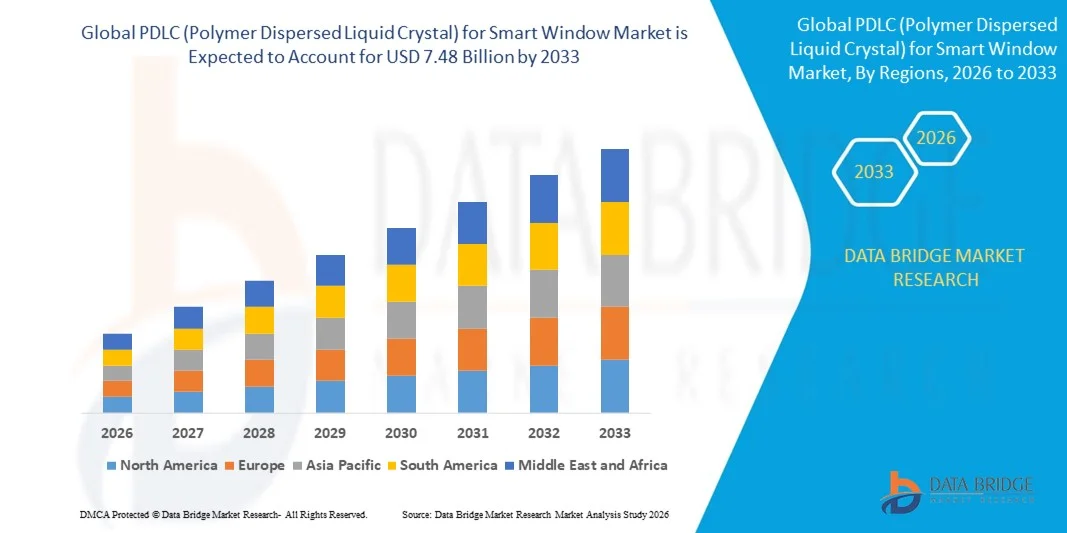
- As per Data Bridge Market Research Analysis the global PDLC (Polymer Dispersed Liquid Crystal) for smart window market size was valued at USD 2.08 billion in 2025 and is expected to reach USD 7.48 billion by 2033, at a CAGR of 17.30% during the forecast period
- The market growth is largely fueled by the increasing adoption of energy-efficient and smart building technologies, leading to enhanced demand for dynamic light control and privacy solutions in both residential and commercial constructions
- Furthermore, rising consumer and corporate demand for customizable, user-friendly, and integrated window solutions that provide privacy, glare reduction, and thermal insulation is establishing PDLC smart windows as a preferred choice in modern architecture. These converging factors are accelerating the adoption of PDLC technology, thereby significantly boosting the industry's growth
Market Size & Forecast
- Global Market Value (2025): USD 2.08 Billion
- Expected Market Value (2033): USD 7.48 Billion
- Forecast CAGR (2026–2033): 17.30%
PDLC (Polymer Dispersed Liquid Crystal) for Smart Window Market Analysis
- PDLC smart windows, offering electronically switchable opacity for glass surfaces, are becoming vital components in modern buildings, vehicles, and commercial spaces due to their ability to enhance privacy, control natural light, reduce glare, and improve energy efficiency
- The escalating demand for PDLC smart windows is primarily driven by the widespread adoption of smart building and IoT technologies, increasing focus on energy conservation, and the growing preference for flexible, privacy-enhancing, and visually appealing window solutions in both residential and commercial settings
- North America dominated the PDLC (Polymer Dispersed Liquid Crystal) for smart window market with a share of over 32% in 2025, due to rising adoption of energy-efficient buildings, smart home integration, and growing awareness of sustainable construction practices
- Asia-Pacific is expected to be the fastest growing region in the PDLC (Polymer Dispersed Liquid Crystal) for smart window market during the forecast period due to rapid urbanization, rising disposable incomes, and increasing adoption of smart buildings in countries such as China, Japan, and India
- Self-dimming window segment dominated the market with a market share of 47.3% in 2025, due to its ability to provide adjustable opacity, effective glare control, and energy efficiency in residential and commercial buildings. Homeowners and businesses often prefer self-dimming windows for their capability to modulate natural light while maintaining privacy, thereby reducing reliance on blinds and curtains. The widespread adoption is also fueled by compatibility with modern building automation systems and integration with smart lighting and HVAC solutions. Manufacturers continue to innovate in self-dimming technologies, offering faster response times, improved optical clarity, and enhanced durability, which strengthens its market dominance. In addition, growing awareness of energy conservation and green building initiatives has reinforced the preference for self-dimming PDLC windows
Report Scope and PDLC (Polymer Dispersed Liquid Crystal) for Smart Window Market Segmentation
|
Attributes |
PDLC (Polymer Dispersed Liquid Crystal) for Smart Window Key Market Insights |
|
Segments Covered |
|
|
Countries Covered |
North America
Europe
Asia-Pacific
Middle East and Africa
South America
|
|
Key Market Players |
|
|
Market Opportunities |
|
|
Value Added Data Infosets |
In addition to the insights on market scenarios such as market value, growth rate, segmentation, geographical coverage, and major players, the market reports curated by the Data Bridge Market Research also include in-depth expert analysis, geographically represented company-wise production and capacity, network layouts of distributors and partners, detailed and updated price trend analysis and deficit analysis of supply chain and demand. |
What is the Key Trend in the PDLC (Polymer Dispersed Liquid Crystal) for Smart Window Market?
Growth of Smart and Energy-Efficient Buildings
- The PDLC smart window market is growing strongly due to increased demand for energy-efficient building solutions that regulate natural light and optimize thermal insulation. PDLC technology’s ability to switch between transparent and opaque states supports dynamic control of daylight and heat ingress, reducing reliance on artificial lighting and HVAC systems and enhancing building ergonomics
- For instance, companies such as Gauzy Ltd. and Saint-Gobain are innovating advanced PDLC films integrated with IoT and smart building management systems to provide real-time control and customization. Such products enable users to tailor window transparency for privacy, glare reduction, and energy savings, meeting modern architectural and sustainability demands
- The surge in smart commercial and residential construction projects, driven by rising energy costs and environmental regulations, is propelling the adoption of PDLC smart windows. This trend aligns with greener building certifications and government incentives promoting smart glazing products
- In addition, ongoing research focuses on improving PDLC film durability, switching speeds, and optical clarity while enhancing UV protection. These improvements expand potential applications beyond buildings into automotive, healthcare, and consumer electronics sectors, widening market reach
- The growing urbanization and smart city initiatives, particularly in Asia-Pacific regions such as China and India, contribute to accelerated PDLC market growth by stimulating demand for smart infrastructure and automotive glazing solutions
- Overall, the rise of smart, energy-efficient buildings and infrastructure is a critical growth driver for PDLC smart windows, positioning them as essential components of sustainable urban development
PDLC (Polymer Dispersed Liquid Crystal) for Smart Window Market Dynamics
Driver
Rising Demand for Privacy and Glare Control
- The increasing need for privacy and glare control in commercial and residential buildings is fueling demand for PDLC smart windows. These windows allow instant switching between opaque and transparent states, providing dynamic user control over privacy without compromising natural light availability
- For instance, luxury office spaces and healthcare facilities leverage PDLC smart glass to create flexible environments that balance openness and discretion. Companies such as Madico and Research Frontiers supply PDLC films enabling rapid light modulation to enhance occupant comfort and productivity
- Heightened awareness of occupant well-being and productivity contributes to growing adoption, as controlling glare and UV exposure can reduce eye strain and improve mood. This trend accompanies evolving architectural designs seeking adaptable and multipurpose interior spaces
- In addition, the expansion of the remote work culture and mixed-use real estate developments drives demand for dynamic glazing solutions that enable privacy on demand. PDLC technology supports these applications by eliminating the need for blinds or curtains while offering aesthetically appealing solutions
- The combination of functional benefits and design flexibility offered by PDLC smart windows is leading to sustained market growth, especially in sectors valuing occupant experience and space versatility
Restraint/Challenge
High Cost and Installation Complexity
- The relatively high cost of PDLC films and associated installation complexity remain barriers to widespread adoption. Premium pricing compared to traditional glazing solutions and the need for specialized electrical systems and controls increase initial investment and project timelines
- For instance, small and medium-sized commercial developers often face budget constraints when integrating PDLC smart windows, opting instead for conventional glass or shading systems. The complexity of retrofitting PDLC films into existing structures adds logistical challenges and increases installation costs
- Moreover, the electrical wiring and power supply requirements for switching the PDLC films necessitate careful design and skilled labor, which can further complicate integration, especially in older buildings lacking modern infrastructure
- In addition, maintenance considerations such as film lifespan and replacement costs add to the total cost of ownership, deterring some buyers. Educating stakeholders on long-term energy savings and functional advantages is essential to justify premium expenditures
- Addressing these cost and technical challenges through innovation in film manufacturing, modular products, and streamlined installation practices will be vital to expand PDLC smart window market reach and competitiveness across varied building segments
PDLC (Polymer Dispersed Liquid Crystal) for Smart Window Market Scope
The market is segmented on the basis of type and application.
- By Type
On the basis of type, the PDLC smart window market is segmented into OLED glass, self-dimming window, and self-repairing. The self-dimming window segment dominated the market with the largest market revenue share of 47.3% in 2025, driven by its ability to provide adjustable opacity, effective glare control, and energy efficiency in residential and commercial buildings. Homeowners and businesses often prefer self-dimming windows for their capability to modulate natural light while maintaining privacy, thereby reducing reliance on blinds and curtains. The widespread adoption is also fueled by compatibility with modern building automation systems and integration with smart lighting and HVAC solutions. Manufacturers continue to innovate in self-dimming technologies, offering faster response times, improved optical clarity, and enhanced durability, which strengthens its market dominance. In addition, growing awareness of energy conservation and green building initiatives has reinforced the preference for self-dimming PDLC windows.
The OLED glass segment is anticipated to witness the fastest growth rate from 2026 to 2033, driven by its advanced display integration capabilities and aesthetic appeal. OLED glass windows provide privacy on demand and also can function as interactive displays, offering applications in smart homes, offices, and high-end architectural designs. The increasing use of OLED technology in luxury and futuristic buildings, along with continuous reductions in production costs, further accelerates its adoption. Its capability to combine transparency control with lighting and visual effects presents opportunities for designers and architects to create highly customizable environments. The integration of OLED glass with IoT platforms enhances user convenience, enabling remote control and automation, which contributes to rapid market growth in the coming years.
- By Application
On the basis of application, the PDLC smart window market is segmented into architectural and construction, transportation, automotive, aircraft, marine, consumer goods, and power generation. The architectural and construction segment dominated the market in 2025, driven by high demand for energy-efficient buildings, smart home integration, and sustainable construction practices. Architects and developers increasingly prefer PDLC smart windows for commercial and residential projects due to their ability to provide dynamic privacy, natural light management, and aesthetic enhancement. Integration with building management systems allows for automated light and heat control, reducing energy consumption and operational costs. For instance, major real estate developers such as Gensler and Skidmore, Owings & Merrill incorporate PDLC smart windows into modern office towers and luxury apartments to achieve smart building certifications. The segment also benefits from growing regulatory support for green buildings and rising awareness of occupant comfort and productivity enhancements.
The automotive segment is expected to witness the fastest CAGR from 2026 to 2033, fueled by rising demand for passenger comfort, privacy, and energy-efficient vehicles. PDLC smart windows in cars allow passengers to control light transmission, reduce glare, and enhance thermal insulation, improving overall driving and riding experiences. For instance, luxury car manufacturers such as BMW and Tesla are increasingly integrating PDLC windows in high-end models to provide privacy on demand and reduce cabin heat, contributing to faster adoption. Continuous innovations in flexible and lightweight PDLC films further facilitate implementation in automotive applications. The growing trend toward electric vehicles also drives interest in energy-saving features, making PDLC smart windows an attractive option for vehicle designers.
PDLC (Polymer Dispersed Liquid Crystal) for Smart Window Market Regional Analysis
- North America dominated the PDLC (Polymer Dispersed Liquid Crystal) for smart window market with the largest revenue share of over 32% in 2025, driven by rising adoption of energy-efficient buildings, smart home integration, and growing awareness of sustainable construction practices
- Consumers in the region highly value the ability of PDLC smart windows to provide adjustable opacity, glare reduction, and thermal insulation, while seamlessly integrating with building automation systems and IoT devices
- This widespread adoption is further supported by high disposable incomes, strong technological infrastructure, and the increasing preference for energy-efficient and privacy-enhancing solutions in both residential and commercial properties
U.S. PDLC (Polymer Dispersed Liquid Crystal) Smart Window Market Insight
The U.S. PDLC smart window market captured the largest revenue share in 2025 within North America, fueled by increasing adoption of smart building technologies and growing focus on energy-efficient construction. Consumers prioritize dynamic privacy control, natural light management, and integration with smart home and office automation systems, driving market demand. Government incentives for green buildings, rising awareness of energy savings, and availability of advanced PDLC solutions with faster response times, improved optical clarity, and enhanced durability further propel market growth.
Europe PDLC (Polymer Dispersed Liquid Crystal) Smart Window Market Insight
The Europe PDLC smart window market is projected to expand at a substantial CAGR during the forecast period, primarily driven by stringent energy efficiency regulations and the need for sustainable construction solutions. Adoption is rising in residential, commercial, and office buildings due to PDLC windows’ ability to provide privacy on demand, reduce energy consumption, and enhance occupant comfort. Countries such as Germany and France are witnessing significant interest in integrating PDLC windows into both new projects and renovation initiatives, supported by strong government policies promoting green buildings.
U.K. PDLC (Polymer Dispersed Liquid Crystal) Smart Window Market Insight
The U.K. PDLC smart window market is anticipated to grow at a noteworthy CAGR during the forecast period, driven by increasing awareness of energy efficiency and sustainable architecture. Rising demand for smart building technologies and aesthetically appealing window solutions is encouraging adoption in residential and commercial projects. The region’s advanced construction infrastructure, supportive government initiatives, and focus on occupant comfort and privacy are expected to continue fueling market growth.
Germany PDLC (Polymer Dispersed Liquid Crystal) Smart Window Market Insight
The Germany PDLC smart window market is expected to expand at a considerable CAGR during the forecast period, supported by growing emphasis on energy-efficient buildings and digitalized infrastructure. Awareness of environmental sustainability and demand for technologically advanced building solutions are driving adoption in residential and commercial properties. Integration of PDLC windows with smart lighting, HVAC systems, and building management platforms is increasing, with a strong preference for solutions that offer privacy, comfort, and energy savings.
Asia-Pacific PDLC (Polymer Dispersed Liquid Crystal) Smart Window Market Insight
The Asia-Pacific PDLC smart window market is poised to grow at the fastest CAGR of 23% during the forecast period of 2026 to 2033, driven by rapid urbanization, rising disposable incomes, and increasing adoption of smart buildings in countries such as China, Japan, and India. Government initiatives promoting energy-efficient and smart construction, along with rising awareness of sustainable technologies, are boosting demand across residential and commercial sectors. APAC’s role as a manufacturing hub for smart window components enhances affordability and accessibility, expanding the consumer base for PDLC smart windows.
Japan PDLC (Polymer Dispersed Liquid Crystal) Smart Window Market Insight
The Japan PDLC smart window market is gaining momentum due to the country’s focus on high-tech infrastructure, smart building integration, and energy efficiency. Rising demand for convenient, user-controlled privacy solutions and natural light management is driving adoption in residential, commercial, and institutional buildings. Integration with IoT-based building automation systems and smart home platforms, coupled with an aging population seeking ease of use, is further supporting market growth.
China PDLC (Polymer Dispersed Liquid Crystal) Smart Window Market Insight
The China PDLC smart window market accounted for the largest market revenue share in Asia-Pacific in 2025, fueled by rapid urbanization, a growing middle class, and increased adoption of smart building technologies. The push for smart cities, availability of cost-effective PDLC solutions, and strong domestic manufacturing capabilities are driving adoption in residential, commercial, and public infrastructure projects. Regulatory focus on energy-efficient construction and rising awareness of occupant comfort and sustainability are additional factors propelling market growth.
Which are the Top Companies in PDLC (Polymer Dispersed Liquid Crystal) for Smart Window Market?
The PDLC (Polymer Dispersed Liquid Crystal) for smart window industry is primarily led by well-established companies, including:
- Pleotint LLC (U.S.)
- SAGE Electrochromics, Inc. (U.S.)
- Research Frontiers (U.S.)
- Polytronix, Inc. (U.S.)
- GENTEX CORPORATION (U.S.)
- ChromoGenics (Sweden)
- Innovative Glass Corp (U.S.)
- Smart Windows Colorado (U.S.)
- View, Inc. (U.S.)
- RavenWindow (U.S.)
- PPG Industries, Inc. (U.S.)
- Kinestral Technologies, Inc. (U.S.)
- Merck KGaA (Germany)
- e-Chromic Technologies, Inc. (Australia)
- AGC Inc. (Japan)
- Nippon Sheet Glass Co., Ltd (Japan)
- Heliotrope Technologies (U.S.)
- Scienstry (U.S.)
- VISTA LIMITED (U.K.)
- Diamond Glass (U.S.)
Latest Developments in Global PDLC (Polymer Dispersed Liquid Crystal) for Smart Window Market
- In March 2025, Gauzy Ltd. completed the acquisition of Perspecta Glass, creating a vertically integrated platform combining PDLC film manufacturing with smart glass system integration. This development strengthens supply‑chain control, improves production efficiency, and accelerates the deployment of large‑scale commercial and architectural smart window projects. The acquisition allows Gauzy to offer end-to-end solutions, positioning the company as a more dominant player in both residential and commercial applications while driving market consolidation
- In January 2025, a strategic partnership was established between View, Inc. and Saint‑Gobain S.A. to co-develop and deploy PDLC switchable glass solutions internationally. This collaboration expands the global reach of both companies, accelerates innovation in smart window technologies, and enhances product offerings tailored to smart building projects. The partnership also enables faster integration of PDLC windows into high-rise constructions, office spaces, and luxury residential developments, boosting adoption rates in key regions
- In 2025, multiple manufacturers launched self-adhesive “peel-and-stick” PDLC film retrofit solutions that allow existing glass installations to be upgraded with switchable privacy and light control. This innovation reduces installation complexity and cost, broadening market access to retrofitting projects and older buildings. It also creates new revenue streams in the commercial and residential sectors, as building owners and tenants can implement energy-efficient and privacy-enhancing solutions without replacing entire glass panels
- In early 2025, industry trends indicated increasing tariffs and regulatory changes on certain smart glass imports in major markets, prompting manufacturers and system integrators to reassess their supply chains and production strategies. This development is driving regional manufacturing shifts, encouraging local production, and influencing cost structures. As a result, companies are investing in more efficient PDLC film production technologies and exploring partnerships to mitigate tariff impacts, which could reshape competitive dynamics in the market
- In January 2025, market forecasts revealed that the PDLC smart film segment in the automotive sector is expected to reach $136 million in revenue in 2025 with a projected CAGR of approximately 23.3%. This highlights growing interest in integrating PDLC technology into vehicles for privacy, glare reduction, and thermal insulation. The trend reflects the diversification of the market beyond architectural and construction applications, expanding adoption in transportation and premium automotive segments, thereby increasing overall market size and growth potential

- Interactive Data Analysis Dashboard
- Company Analysis Dashboard for high growth potential opportunities
- Research Analyst Access for customization & queries
- Competitor Analysis with Interactive dashboard
- Latest News, Updates & Trend analysis
- Harness the Power of Benchmark Analysis for Comprehensive Competitor Tracking
Global Pdlc Polymer Dispersed Liquid Crystal For Smart Window Market, Supply Chain Analysis and Ecosystem Framework
To support market growth and help clients navigate the impact of geopolitical shifts, DBMR has integrated in-depth supply chain analysis into its Global Pdlc Polymer Dispersed Liquid Crystal For Smart Window Market research reports. This addition empowers clients to respond effectively to global changes affecting their industries. The supply chain analysis section includes detailed insights such as Global Pdlc Polymer Dispersed Liquid Crystal For Smart Window Market consumption and production by country, price trend analysis, the impact of tariffs and geopolitical developments, and import and export trends by country and HSN code. It also highlights major suppliers with data on production capacity and company profiles, as well as key importers and exporters. In addition to research, DBMR offers specialized supply chain consulting services backed by over a decade of experience, providing solutions like supplier discovery, supplier risk assessment, price trend analysis, impact evaluation of inflation and trade route changes, and comprehensive market trend analysis.
Data collection and base year analysis are done using data collection modules with large sample sizes. The stage includes obtaining market information or related data through various sources and strategies. It includes examining and planning all the data acquired from the past in advance. It likewise envelops the examination of information inconsistencies seen across different information sources. The market data is analysed and estimated using market statistical and coherent models. Also, market share analysis and key trend analysis are the major success factors in the market report. To know more, please request an analyst call or drop down your inquiry.
The key research methodology used by DBMR research team is data triangulation which involves data mining, analysis of the impact of data variables on the market and primary (industry expert) validation. Data models include Vendor Positioning Grid, Market Time Line Analysis, Market Overview and Guide, Company Positioning Grid, Patent Analysis, Pricing Analysis, Company Market Share Analysis, Standards of Measurement, Global versus Regional and Vendor Share Analysis. To know more about the research methodology, drop in an inquiry to speak to our industry experts.
Data Bridge Market Research is a leader in advanced formative research. We take pride in servicing our existing and new customers with data and analysis that match and suits their goal. The report can be customized to include price trend analysis of target brands understanding the market for additional countries (ask for the list of countries), clinical trial results data, literature review, refurbished market and product base analysis. Market analysis of target competitors can be analyzed from technology-based analysis to market portfolio strategies. We can add as many competitors that you require data about in the format and data style you are looking for. Our team of analysts can also provide you data in crude raw excel files pivot tables (Fact book) or can assist you in creating presentations from the data sets available in the report.













