


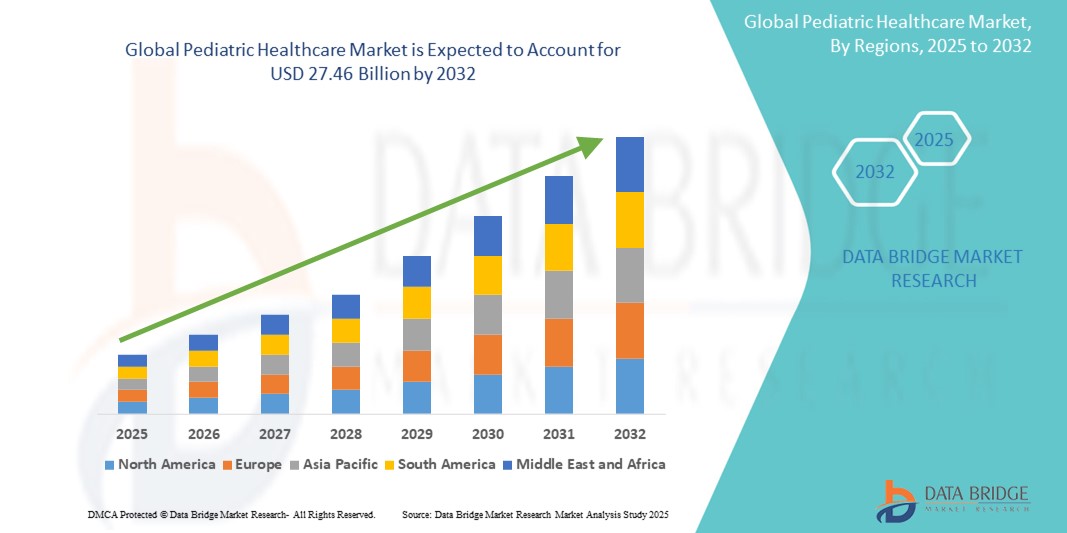
Pediatric Healthcare Market Size
- The global pediatric healthcare market size was valued at USD 14.51 billion in 2024 and is expected to reach USD 27.46 billion by 2032, at a CAGR of 8.3% during the forecast period
- This growth is driven by factors such as the rising birth rates, pediatric population growth and rising prevalence of pediatric chronic conditions
Pediatric Healthcare Market Analysis
- Pediatric healthcare covers a wide range of medical services aimed at promoting the health and well-being of children, including preventive care, diagnosis, and treatment of diseases and disorders from infancy through adolescence
- The demand for pediatric healthcare services is significantly driven by the rising global birth rate, increasing prevalence of chronic pediatric diseases, and growing awareness of early childhood health
- North America is expected to dominate the pediatric healthcare Market, accounting for 40.3% of the global market share, driven by advanced healthcare infrastructure, a strong focus on pediatric care, and the presence of leading healthcare providers and pharmaceutical companies
- Asia-Pacific is expected to be the fastest growing region in the pediatric healthcare market, accounting for 30.2% of the global market share, driven by rapid healthcare infrastructure expansion, rising awareness about child health, and increasing healthcare spending
- Chronic illness segment is expected to dominate the market with a market share of 63.65% due to the high prevalence of long-term conditions such as asthma, diabetes, and epilepsy. These illnesses require continuous medical management, regular monitoring, and specialized pediatric care, which drives market growth. Advancements in diagnostic technologies and therapeutic approaches, along with a growing focus on personalized care for pediatric patients, further contribute to the dominance of this segment
Report Scope and Pediatric Healthcare Market Segmentation
|
Attributes |
Pediatric Healthcare Key Market Insights |
|
Segments Covered |
|
|
Countries Covered |
North America
Europe
Asia-Pacific
Middle East and Africa
South America
|
|
Key Market Players |
|
|
Market Opportunities |
|
|
Value Added Data Infosets |
In addition to the insights on market scenarios such as market value, growth rate, segmentation, geographical coverage, and major players, the market reports curated by the Data Bridge Market Research also include import export analysis, production capacity overview, production consumption analysis, price trend analysis, climate change scenario, supply chain analysis, value chain analysis, raw material/consumables overview, vendor selection criteria, PESTLE Analysis, Porter Analysis, and regulatory framework. |
Pediatric Healthcare Market Trends
“Technological Advancements in Pediatric Healthcare Devices”
- One prominent trend in the pediatric healthcare market is the rapid development and adoption of advanced medical devices specifically designed for children
- These innovations include child-friendly diagnostic tools, wearable monitors, and minimally invasive surgical instruments that cater to the unique physiological needs of pediatric patients, enhancing the quality of care
- For instance, the use of pediatric-specific imaging technologies, such as low-dose CT scans and MRI machines with faster scanning times, helps reduce radiation exposure and improve diagnostic accuracy in children. In addition, smart wearables for continuous glucose monitoring (CGM) and respiratory tracking are gaining popularity for managing chronic conditions such as asthma and diabetes
- These advancements are transforming pediatric care, improving patient outcomes, reducing hospital stays, and driving demand for next-generation medical devices that offer precision, safety, and comfort for young patients
Pediatric Healthcare Market Dynamics
Driver
“Rising Prevalence of Pediatric Chronic Conditions”
- The increasing prevalence of chronic conditions in children, such as asthma, diabetes, congenital heart defects, and neurological disorders, is significantly driving the demand for pediatric healthcare services and devices
- With the growing global awareness about child health and early diagnosis, healthcare systems are increasingly focusing on specialized pediatric care to improve long-term outcomes and reduce hospitalization rates
- As the number of children diagnosed with chronic illnesses rises, the need for advanced medical devices, continuous monitoring systems, and personalized treatment plans is also growing, supporting the expansion of the pediatric healthcare market
For instance,
- In 2024, according to a report by the World Health Organization (WHO), the global prevalence of asthma among children aged 5 to 14 years has increased significantly, with approximately 11-13% of children in this age group affected. This rising burden is driving the demand for pediatric respiratory devices, including inhalers, nebulizers, and wearable monitoring systems
- As a result, the pediatric healthcare market is experiencing robust growth, driven by the increasing need for specialized treatment solutions for children with chronic conditions
Opportunity
“Integration of Digital Health Technologies in Pediatric Care”
- Digital health technologies, including telehealth platforms, wearable devices, and mobile health apps, are transforming pediatric healthcare by enabling remote monitoring, early diagnosis, and personalized treatment
- These technologies are particularly beneficial for managing chronic conditions, monitoring growth and development, and ensuring timely interventions, improving overall patient outcomes
- In addition, digital platforms offer valuable data for healthcare professionals, allowing for proactive management of pediatric health and reducing the need for frequent hospital visits
For instance,
- In January 2025, according to a report published by the American Academy of Pediatrics, the use of digital health tools, including wearable heart monitors, glucose sensors, and remote consultation platforms, has significantly improved the management of chronic pediatric conditions, reducing emergency room visits by up to 30%
- The integration of digital health technologies in pediatric care is expected to drive market growth, offering improved patient outcomes, reduced healthcare costs, and enhanced quality of life for children and their families
Restraint/Challenge
“High Costs of Specialized Pediatric Healthcare”
- The high cost of specialized pediatric healthcare, including advanced diagnostic tools, surgical procedures, and long-term treatment plans, poses a significant challenge for the market, particularly in low- and middle-income countries
- Pediatric healthcare often requires specialized equipment and highly trained medical professionals, which can significantly increase the overall cost of care
- This financial burden can limit access to high-quality pediatric care, affecting patient outcomes and overall market growth
For instance,
- In 2024, according to a report by the National Institute for Health Research (NIHR), the cost of managing complex pediatric conditions, such as congenital heart disease and cystic fibrosis, is significantly higher than standard medical care, leading to disparities in healthcare access and outcomes
- As a result, the high costs associated with pediatric healthcare remain a critical barrier to market growth, particularly in regions with limited healthcare budgets and infrastructure
Pediatric Healthcare Market Scope
The market is segmented on the basis of type, treatment and indication.
|
Segmentation |
Sub-Segmentation |
|
By Type |
|
|
By Indication |
|
|
By Treatment |
|
In 2025, the chronic illness is projected to dominate the market with a largest share in type segment
The chronic illness segment is expected to dominate the pediatric healthcare market with the largest share of approximately 63.65% due to the high prevalence of long-term conditions such as asthma, diabetes, and epilepsy. These illnesses require continuous medical management, regular monitoring, and specialized pediatric care, which drives market growth. Advancements in diagnostic technologies and therapeutic approaches, along with a growing focus on personalized care for pediatric patients, further contribute to the dominance of this segment.
The asthma and allergies is expected to account for the largest share during the forecast period in indication market
In 2025, the asthma and allergies segment is expected to dominate the pediatric healthcare market with the largest share of approximately 41.45% due to its high prevalence among children. As one of the most common chronic conditions in pediatric populations, asthma significantly impacts the quality of life for millions of young patients globally. The increasing incidence of respiratory disorders, rising pollution levels, and heightened awareness about early diagnosis and treatment further contribute to the dominance of this segment.
Pediatric Healthcare Market Regional Analysis
“North America Holds the Largest Share in the Pediatric Healthcare Market”
- North America dominates the pediatric healthcare market, accounting for approximately 40.3% of the global market share, driven by advanced healthcare infrastructure, a strong focus on pediatric care, and the presence of leading healthcare providers and pharmaceutical companies
- U.S. accounts for around 35.7% of the global market share, primarily due to high healthcare spending, well-established healthcare facilities, and a proactive approach to child health and disease prevention
- In addition, the U.S. leads in technological advancements, including the development of specialized pediatric medical devices and innovative treatment solutions for chronic childhood illnesses such as asthma, diabetes, and congenital heart diseases
- The availability of comprehensive insurance coverage, robust R&D investments, and a strong focus on early childhood health programs are also key factors driving market growth in this region
“Asia-Pacific is Projected to Register the Highest CAGR in the Pediatric Healthcare Market”
- Asia-Pacific is expected to witness the highest growth rate in the pediatric healthcare market, accounting for approximately 30.2% of the global market share, driven by rapid healthcare infrastructure expansion, rising awareness about child health, and increasing healthcare spending
- Countries such as China, India, and Japan are emerging as key markets due to their large pediatric populations, improving healthcare access, and increasing focus on reducing child mortality rates through early diagnosis and advanced treatment options
- Japan, known for its advanced medical technology, remains a crucial market for pediatric healthcare, with high adoption rates for innovative diagnostic tools and treatment solutions. The country continues to lead in the development of cutting-edge pediatric medical devices and personalized treatment approaches
- India is projected to register the highest CAGR of 9.4% in the region, driven by expanding healthcare infrastructure, increasing awareness about child health, and rising demand for preventive and specialized pediatric care
Pediatric Healthcare Market Share
The market competitive landscape provides details by competitor. Details included are company overview, company financials, revenue generated, market potential, investment in research and development, new market initiatives, global presence, production sites and facilities, production capacities, company strengths and weaknesses, product launch, product width and breadth, application dominance. The above data points provided are only related to the companies' focus related to market.
The Major Market Leaders Operating in the Market Are:
- Johnson & Johnson Services, Inc. (U.S.)
- Abbott (U.S.)
- Medtronic (Ireland)
- Boston Scientific Corporation (U.S.)
- GE Healthcare (U.S.)
- F. Hoffmann-La Roche Ltd (Switzerland)
- Siemens Healthineers AG (Germany)
- Philips Healthcare (Netherlands)
- Novartis AG (Switzerland)
- Baxter International Inc. (U.S.)
- CURE International (U.S.)
- Artsana S.p.A. (Italy)
- OrthoPediatrics Corp. (U.S.)
- Sanford Health (U.S.)
- Sanofi (France)
Latest Developments in Global Pediatric Healthcare Market
- In January 2025, Pfizer Inc., a global leader in pediatric healthcare, announced the launch of its Breztri Aerosphere for the management of pediatric asthma in the European Union, following approval from the European Medicines Agency (EMA). The Breztri Aerosphere inhaler is designed to provide effective control of asthma symptoms with a combination of two powerful corticosteroid and long-acting beta-agonist drugs. The launch aims to help improve asthma management in children with moderate to severe persistent asthma by offering a convenient, once-daily inhalation therapy
- In October 2024, Sanofi introduced its new Dupixent injection for the treatment of pediatric atopic dermatitis in children aged six years and older. This medication is designed to help manage severe eczema in pediatric patients, offering a biologic solution for reducing inflammation and preventing flare-ups. The launch of Dupixent aims to improve the quality of life for children with this chronic skin condition and further expand the treatment options available to pediatric dermatology specialists
- In September 2024, Novartis announced the successful completion of Phase 3 trials for its Kymriah pediatric cancer treatment. The treatment, based on CAR T-cell therapy, is now approved for pediatric patients with acute lymphoblastic leukemia (ALL). This breakthrough therapy is expected to provide a life-saving option for children who have failed other treatment modalities and presents a new frontier in pediatric oncology
- In December 2024, Johnson & Johnson introduced its innovative pediatric vaccination solution, Janssen's RSV vaccine for infants, at a global health conference. The vaccine is expected to reduce the incidence of respiratory syncytial virus (RSV) infections, a common cause of severe respiratory illness in children. The vaccine has shown promising results in early clinical trials and is anticipated to be widely available in the upcoming years, significantly contributing to the prevention of respiratory diseases in children

- Interactive Data Analysis Dashboard
- Company Analysis Dashboard for high growth potential opportunities
- Research Analyst Access for customization & queries
- Competitor Analysis with Interactive dashboard
- Latest News, Updates & Trend analysis
- Harness the Power of Benchmark Analysis for Comprehensive Competitor Tracking
Data collection and base year analysis are done using data collection modules with large sample sizes. The stage includes obtaining market information or related data through various sources and strategies. It includes examining and planning all the data acquired from the past in advance. It likewise envelops the examination of information inconsistencies seen across different information sources. The market data is analysed and estimated using market statistical and coherent models. Also, market share analysis and key trend analysis are the major success factors in the market report. To know more, please request an analyst call or drop down your inquiry.
The key research methodology used by DBMR research team is data triangulation which involves data mining, analysis of the impact of data variables on the market and primary (industry expert) validation. Data models include Vendor Positioning Grid, Market Time Line Analysis, Market Overview and Guide, Company Positioning Grid, Patent Analysis, Pricing Analysis, Company Market Share Analysis, Standards of Measurement, Global versus Regional and Vendor Share Analysis. To know more about the research methodology, drop in an inquiry to speak to our industry experts.
Data Bridge Market Research is a leader in advanced formative research. We take pride in servicing our existing and new customers with data and analysis that match and suits their goal. The report can be customized to include price trend analysis of target brands understanding the market for additional countries (ask for the list of countries), clinical trial results data, literature review, refurbished market and product base analysis. Market analysis of target competitors can be analyzed from technology-based analysis to market portfolio strategies. We can add as many competitors that you require data about in the format and data style you are looking for. Our team of analysts can also provide you data in crude raw excel files pivot tables (Fact book) or can assist you in creating presentations from the data sets available in the report.













