Penoxsulam Market Overview
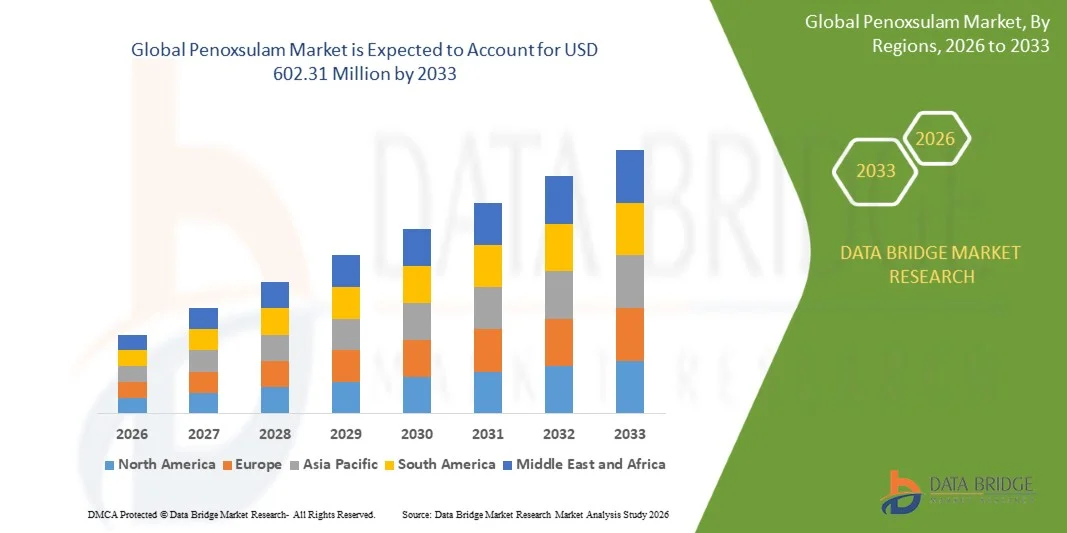
As per Data Bridge Market Research analysis, the penoxsulam market was valued at USD 396.96 million in 2025 and is projected to reach USD 602.31 million by 2033, growing at a CAGR of 5.35% from 2026 to 2033. The market is experiencing consistent growth driven by increasing adoption of selective herbicides in rice cultivation, rising demand for effective weed management solutions, and growing emphasis on improving agricultural productivity through advanced crop protection products.
The increasing need for sustainable weed control practices, combined with the expansion of rice farming and the challenges associated with herbicide-resistant weeds, is encouraging farmers and agricultural organizations to adopt penoxsulam-based herbicides. Penoxsulam provides broad-spectrum control of problematic weeds, including grasses, sedges, and broadleaf weeds, making it a preferred solution for rice fields and other agricultural applications. The development of advanced formulations and increasing focus on integrated weed management practices are further supporting market growth.
Market Size & Forecast
- Global Market Value (2025): USD 396.96 Million
- Expected Market Value (2033): USD 602.31 Million
- Forecast CAGR (2026–2033): 5.35%
- Leading Region in 2025: North America
- Fastest Growing Region: Asia Pacific
Key Market Trends & Insights
- North America dominated the penoxsulam market with the largest revenue share of 37.4% in 2025, supported by strong demand for herbicides, advanced agricultural practices, and increasing adoption of selective weed management solutions
- The rice segment led the market with a 55.0% share in 2025, driven by the extensive use of penoxsulam in paddy cultivation for controlling grasses, sedges, and broadleaf weeds.
- Asia-Pacific is expected to be the fastest-growing region from 2026 to 2033 at a CAGR of 5.8%, fueled by expanding rice cultivation, rising agricultural productivity requirements, increasing adoption of modern crop protection solutions, and growing herbicide usage in countries such as China, India, and Southeast Asian countries
- Turf is the fastest-growing crop type, projected to register a CAGR of 6.1%, reflecting the surge in maintenance of golf courses, sports grounds, recreational facilities, and commercial landscapes.
- The concentrated liquid segment dominated the product type category with a 60.0% revenue share in 2025, led by ease of application, superior field coverage, and compatibility with modern spraying systems.
- Grains and cereals accounted for 70.0% of the market, preferred by extensive use of penoxsulam in rice cultivation. Effective control of annual grasses, sedges, and broadleaf weeds makes penoxsulam an important crop protection solution within cereal production systems.
- The fruits and vegetables segment is the fastest-growing application category, with a CAGR of 5.8%, driven by increasing adoption of advanced weed management practices in high-value crop cultivation
Report Scope and Penoxsulam Market Segmentation
|
Attributes |
Penoxsulam Key Market Insights |
|
Segments Covered |
|
|
Countries Covered |
North America
Europe
Asia-Pacific
Middle East and Africa
South America
|
|
Key Market Players |
|
|
Market Opportunities |
|
|
Value Added Data Infosets |
In addition to the insights on market scenarios such as market value, growth rate, segmentation, geographical coverage, and major players, the market reports curated by the Data Bridge Market Research also include import export analysis, production capacity overview, production consumption analysis, price trend analysis, climate change scenario, supply chain analysis, value chain analysis, raw material/consumables overview, vendor selection criteria, PESTLE Analysis, Porter Analysis, and regulatory framework. |
Penoxsulam Market Trends
Trend: Rising Adoption of Integrated Weed Management in Rice Cultivation
Rice growers are increasingly adopting penoxsulam-based herbicides as part of integrated weed management programs to improve weed control efficiency, delay herbicide resistance, and enhance crop productivity while reducing overall dependence on repeated herbicide applications. The combination of selective herbicides with cultural and rotational weed management practices is becoming a preferred approach across major rice-producing regions, supported by advances in precision agriculture and sustainable farming initiatives. For instance, a March 2021 study published in Weed Technology (Cambridge University Press) reported the increasing prevalence of penoxsulam-resistant barnyardgrass in Chinese rice fields, highlighting the importance of integrated weed management strategies to maintain effective weed control.
The growing emphasis on integrated weed management is strengthening long-term demand for penoxsulam-based herbicides while supporting sustainable agricultural productivity.
Penoxsulam Market Dynamics
Key Market Driver: Increasing Demand for Selective Herbicides to Improve Rice Productivity
The increasing need to maximize rice yields while effectively controlling grasses, sedges, and broadleaf weeds is driving widespread adoption of penoxsulam across global rice-growing regions. Farmers are increasingly utilizing selective herbicides that deliver broad-spectrum weed control with favorable crop safety, enabling higher productivity, improved operational efficiency, and better economic returns under modern crop protection programs. For instance, a April 2025 study published in the Indian Journal of Weed Science reported that penoxsulam + pendimethalin (625 g/ha) increased direct-seeded rice grain yield by 187% (6.6 t/ha vs. 2.3 t/ha in the untreated control) while providing effective control of grasses and sedges, demonstrating the growing role of integrated weed management in improving rice productivity.
Rising demand for higher crop productivity and effective weed management continues to accelerate adoption of penoxsulam in commercial rice cultivation.
Key Restraint/Challenge: Rising Herbicide Resistance Among Major Rice Weeds
A significant challenge for the penoxsulam market is the increasing development of herbicide-resistant weed species caused by repeated use of acetolactate synthase (ALS)-inhibiting herbicides. Resistance reduces long-term field performance, increases weed management costs, and encourages growers to adopt herbicide rotation and integrated weed management practices instead of relying solely on single-mode-of-action products. For instance, a November 2023 study published in the Journal of Agricultural and Food Chemistry (American Chemical Society) found that late watergrass (Echinochloa phyllopogon) populations in Northeast China developed both target-site and metabolic resistance to penoxsulam, highlighting the growing challenge of herbicide resistance in rice production systems
Managing herbicide resistance through diversified weed control strategies will remain essential for sustaining long-term growth of the penoxsulam market.
Key Market Opportunity: Expansion of Precision Agriculture and Sustainable Crop Protection
The expansion of precision agriculture technologies presents a significant opportunity for penoxsulam by enabling targeted herbicide application, optimizing dosage, reducing chemical inputs, and improving weed management efficiency. Increasing investments in sustainable farming practices and digital agriculture platforms are supporting wider adoption of precision crop protection solutions across major agricultural markets. For instance, a March 2024 study published in Crop Protection (Elsevier) reported that camera-based smart sprayers for site-specific herbicide application can achieve weed control comparable to broadcast spraying while significantly reducing herbicide use, demonstrating the potential of precision agriculture to improve application efficiency and sustainability.
The integration of precision agriculture with selective herbicide programs is expected to create new long-term growth opportunities for the global penoxsulam market.
Penoxsulam Market Scope
The penoxsulam market is segmented on the basis of crop type, product type, application, and end users.
- By Crop Type
On the basis of crop type, the penoxsulam market is segmented into rice, aquatics, and turf. The rice segment dominated the market with an estimated 55.0% share in 2025, owing to the extensive use of penoxsulam in paddy cultivation for controlling grasses, sedges, and broadleaf weeds. Rice remains the primary application area for penoxsulam due to its high efficacy and crop selectivity. Growing rice consumption and the need to improve productivity are supporting herbicide demand across Asia-Pacific and other rice-producing regions. The segment benefits from increasing adoption of modern weed management practices and rising agricultural mechanization. Penoxsulam's low use rate and broad-spectrum performance further strengthen its market position. Continued expansion of rice cultivation is expected to sustain segment dominance throughout the forecast period.
The turf segment is projected to witness the fastest growth at an estimated CAGR of 6.1% from 2026 to 2033, driven by increasing maintenance of golf courses, sports grounds, recreational facilities, and commercial landscapes. Turf managers are increasingly adopting selective herbicides to improve aesthetic quality and weed control efficiency. Rising investments in sports infrastructure and urban landscaping projects are supporting demand growth. The segment also benefits from increasing awareness regarding professional turf management practices. Expansion of non-crop herbicide applications is creating additional opportunities. Growing demand for efficient vegetation management solutions is expected to accelerate segment growth.
- By Product Type
On the basis of product type, the penoxsulam market is segmented into concentrated liquid and granules. The concentrated liquid segment dominated the market with an estimated 60.0% share in 2025, owing to ease of application, superior field coverage, and compatibility with modern spraying systems. Liquid formulations enable uniform herbicide distribution and provide effective weed control performance. Farmers increasingly prefer concentrated liquid products because of operational convenience and lower preparation requirements. The segment benefits from widespread commercial availability and established distribution networks. Compatibility with precision spraying technologies further supports adoption. Strong demand from commercial agriculture continues to reinforce segment leadership.
The granules segment is expected to register the fastest growth at an estimated CAGR of 5.9% from 2026 to 2033, supported by increasing demand for controlled-release herbicide formulations and improved application flexibility. Granular products offer reduced drift potential and improved handling characteristics compared with some liquid formulations. Adoption is increasing in specialized agricultural and aquatic weed management applications. Continuous advancements in formulation technologies are improving effectiveness and environmental performance. Rising focus on sustainable herbicide application practices is also contributing to growth. The segment is expected to benefit from increasing demand for precision crop protection products.
- By Application
On the basis of application, the penoxsulam market is segmented into grains and cereals, pulses and oilseeds, fruits and vegetables, and others. The grains and cereals segment dominated the market with an estimated 70.0% share in 2025, primarily driven by extensive use of penoxsulam in rice cultivation. Effective control of annual grasses, sedges, and broadleaf weeds makes penoxsulam an important crop protection solution within cereal production systems. Rising global food demand and increasing pressure to improve agricultural productivity are supporting adoption. The segment benefits from strong demand across major rice-producing countries. Government initiatives focused on crop yield enhancement further support growth. The strategic importance of cereal crops in food security continues to reinforce segment dominance.
The fruits and vegetables segment is anticipated to witness the fastest growth at an estimated CAGR of 5.8% from 2026 to 2033, supported by increasing adoption of advanced weed management practices in high-value crop cultivation. Growers are increasingly seeking selective herbicide solutions that improve crop quality and reduce labor-intensive weed control activities. Rising demand for fresh produce is encouraging investment in productivity-enhancing technologies. Expanding commercial horticulture operations are creating additional opportunities. Greater emphasis on efficient land utilization and sustainable farming practices is contributing to growth. Increasing awareness regarding integrated crop protection strategies is expected to support future demand.
- By End Users
On the basis of end users, the penoxsulam market is segmented into industries, agriculture, and others. The agriculture segment dominated the market with an estimated 72.0% share in 2025, driven by extensive herbicide use in commercial crop production systems. Increasing pressure to improve agricultural productivity and reduce crop losses caused by weed infestation is supporting widespread adoption. Penoxsulam is widely used in rice cultivation because of its broad-spectrum weed control capabilities and favorable crop safety profile. Growing global food demand is encouraging farmers to invest in effective crop protection solutions. Government support for modern farming practices is also contributing to market expansion. The segment remains the primary revenue contributor due to the essential role of herbicides in agriculture.
The industries segment is projected to witness the fastest growth at an estimated CAGR of 5.6% from 2026 to 2033, driven by increasing use of herbicides for vegetation management across industrial facilities, transportation corridors, and utility infrastructure. Effective weed control is becoming increasingly important for operational safety and maintenance efficiency. Growing infrastructure development activities are creating additional demand for vegetation management solutions. Adoption is increasing among organizations seeking cost-effective and long-lasting weed control methods. Increasing regulatory focus on land management practices is supporting market growth. Continued expansion of industrial and utility assets is expected to further accelerate segment development.
Penoxsulam Market Regional Analysis
North America dominated the penoxsulam market with the largest revenue share of 37.4% in 2025, supported by strong demand for herbicides, advanced agricultural practices, and increasing adoption of selective weed management solutions. The region also benefits from extensive cultivation of major crops, established crop protection distribution networks, and the presence of leading agrochemical manufacturers. Growing adoption of precision agriculture technologies, integrated weed management programs, and sustainable farming practices is accelerating market development. Increasing focus on improving crop productivity, reducing yield losses from weed infestation, and optimizing herbicide application efficiency continues to strengthen North America's leadership position in the global market.
U.S. Penoxsulam Market Insight
The U.S. penoxsulam market is witnessing steady growth due to increasing adoption of advanced herbicide technologies, rising focus on crop productivity, and growing demand for effective weed management solutions across commercial agriculture. The country’s highly mechanized farming sector, extensive crop protection infrastructure, and increasing implementation of precision agriculture practices are driving market demand. In addition, growing concerns regarding herbicide-resistant weeds and the need for sustainable crop protection programs are accelerating adoption of selective herbicides such as penoxsulam. The United States harvested approximately 2.86 million acres of rice in 2024, reinforcing the importance of effective weed management solutions in rice production systems.
Europe Penoxsulam Market Insight
The Europe penoxsulam market remains an important contributor to global revenue, driven by increasing emphasis on sustainable agriculture, integrated weed management practices, and efficient crop protection technologies. The widespread adoption of advanced farming techniques and growing focus on reducing environmental impact are supporting market expansion across the region. Increasing investments in agricultural innovation and precision farming technologies continue to strengthen herbicide utilization. The European Commission's Farm to Fork Strategy sets a target to reduce the use and risk of chemical pesticides by 50% by 2030 while promoting sustainable crop protection and precision farming practices, encouraging adoption of targeted weed management solutions across European farming systems.
U.K. Penoxsulam Market Insight
The U.K. penoxsulam market is experiencing steady growth, supported by increasing adoption of precision farming technologies and growing demand for efficient weed management practices. Rising investments in agricultural productivity enhancement and sustainable crop production methods are contributing to market development. Furthermore, increasing utilization of digital farming tools and integrated crop protection programs is improving herbicide application efficiency. The U.K. Government's Environmental Land Management (ELM) schemes encourage sustainable land management by rewarding farmers for improving soil health, protecting biodiversity, reducing agricultural emissions, and enhancing water quality, supporting more efficient and environmentally responsible farming practices.
Germany Penoxsulam Market Insight
The Germany penoxsulam market is expanding steadily due to the country's advanced agricultural sector, strong focus on sustainable farming, and increasing adoption of precision agriculture technologies. Agricultural producers are increasingly utilizing modern crop protection solutions to improve productivity while maintaining environmental compliance. Continuous innovation in agricultural technology and digital farm management systems is further supporting market growth. Germany remains one of Europe's largest agricultural producers, with over 16.6 million hectares of agricultural land supporting significant demand for crop protection products and weed management solutions.
Asia-Pacific Penoxsulam Market Insight
The Asia-Pacific penoxsulam market is expected to witness rapid growth, driven by expanding rice cultivation, increasing food demand, and rising adoption of modern crop protection technologies across countries such as China, India, Japan, Vietnam, and Thailand. Growing awareness regarding crop yield optimization and sustainable weed management practices is supporting regional market expansion. In addition, increasing government support for agricultural modernization and precision farming initiatives is accelerating herbicide adoption. Asia accounts for more than 90% of global rice production and consumption, making the region the world's largest market for rice cultivation and, consequently, a major consumer of rice herbicides such as penoxsulam
Japan Penoxsulam Market Insight
The Japan penoxsulam market is witnessing consistent growth due to increasing adoption of advanced agricultural technologies, rising focus on labor-saving farming practices, and strong emphasis on crop productivity. Agricultural producers are increasingly implementing precision application technologies and integrated weed management programs to optimize production efficiency. Moreover, government support for smart agriculture initiatives is contributing to market development. Japan's Ministry of Agriculture, Forestry and Fisheries (MAFF) is promoting Smart Agriculture through the adoption of robotics, artificial intelligence (AI), Internet of Things (IoT), drones, and agricultural data platforms to improve productivity, address labor shortages, and accelerate precision farming across the country.
China Penoxsulam Market Insight
The China penoxsulam market is growing rapidly, driven by extensive rice cultivation, increasing agricultural modernization, and rising adoption of advanced herbicide solutions. Growing implementation of precision agriculture technologies and integrated weed management strategies is significantly boosting market demand. In addition, increasing investments in agricultural innovation, food security initiatives, and sustainable farming practices are positioning China as one of the fastest-growing markets for penoxsulam globally. According to the USDA Foreign Agricultural Service, China produced approximately 206.6 million metric tons of rough rice in the 2023/24 marketing year, maintaining its position as the world's largest rice-producing country and supporting strong demand for rice herbicides such as penoxsulam.
Penoxsulam Market Share
The penoxsulam industry is primarily led by well-established companies, including:
- Corteva (U.S.)
- BASF (Germany)
- Syngenta (Switzerland)
- FMC Corporation (U.S.)
- UPL (India)
- Nufarm (Australia)
- ADAMA (Israel)
- Sumitomo Chemical Co., Ltd. (Japan)
- Nissan Chemical Corporation (Japan)
- Albaugh, LLC (U.S.)
- Best Agro Group (India)
- Bharat Group (India)
- Yangnong Chemical Co., Ltd. (China)
- Zhejiang Xin'an Chemical Group Co., Ltd. (China)
- ISK Biosciences Corporation (U.S.)
- Nichino India Private Limited (India)
- Rainbow Agro. (China)
- HEBEI ENGE BIOTECH CO., LTD. (China)
Latest Developments in Penoxsulam Market
- In February 2025, FMC Corporation announced that it successfully manufactured the first commercial batch of its Dodhylex active herbicide (tetflupyrolimet), the first new herbicide mode of action for rice in more than three decades. The innovation is designed to help rice growers manage herbicide-resistant weeds and complements existing ALS-inhibitor herbicides such as penoxsulam by providing an alternative resistance-management tool for rice production systems
- In February 2025, BASF announced the regulatory submission of Prexio Active, a novel rice insecticide, across key Asia-Pacific markets including India. The development strengthens BASF's rice crop protection portfolio and demonstrates continued investment in integrated rice protection solutions that complement herbicide programs such as penoxsulam for sustainable rice production
- In September 2024, FMC Corporation launched Vayobel Herbicide and Ambriva Herbicide in India as part of its new crop protection portfolio for paddy farmers. The launches strengthen FMC's herbicide offerings for rice cultivation by providing advanced weed management solutions that support higher productivity and sustainable farming practices
- In May 2023, BASF launched Facet herbicide for rice growers in India to help control problematic weeds affecting rice production. The launch expanded BASF's rice herbicide portfolio by providing growers with an effective weed management solution that supports higher crop productivity and complements integrated weed management programs
- In December 2022, Corteva Agriscience announced the launch of Novixid herbicide in India for rice growers. The product combines Rinskor active and penoxsulam to provide broad-spectrum post-emergence control of grasses, sedges, broadleaf weeds, and aquatic weeds in rice fields. The launch expanded Corteva's rice herbicide portfolio and provides growers with an additional tool for managing herbicide-resistant weeds while improving crop productivity and profitability

- Interactive Data Analysis Dashboard
- Company Analysis Dashboard for high growth potential opportunities
- Research Analyst Access for customization & queries
- Competitor Analysis with Interactive dashboard
- Latest News, Updates & Trend analysis
- Harness the Power of Benchmark Analysis for Comprehensive Competitor Tracking
Data collection and base year analysis are done using data collection modules with large sample sizes. The stage includes obtaining market information or related data through various sources and strategies. It includes examining and planning all the data acquired from the past in advance. It likewise envelops the examination of information inconsistencies seen across different information sources. The market data is analysed and estimated using market statistical and coherent models. Also, market share analysis and key trend analysis are the major success factors in the market report. To know more, please request an analyst call or drop down your inquiry.
The key research methodology used by DBMR research team is data triangulation which involves data mining, analysis of the impact of data variables on the market and primary (industry expert) validation. Data models include Vendor Positioning Grid, Market Time Line Analysis, Market Overview and Guide, Company Positioning Grid, Patent Analysis, Pricing Analysis, Company Market Share Analysis, Standards of Measurement, Global versus Regional and Vendor Share Analysis. To know more about the research methodology, drop in an inquiry to speak to our industry experts.
Data Bridge Market Research is a leader in advanced formative research. We take pride in servicing our existing and new customers with data and analysis that match and suits their goal. The report can be customized to include price trend analysis of target brands understanding the market for additional countries (ask for the list of countries), clinical trial results data, literature review, refurbished market and product base analysis. Market analysis of target competitors can be analyzed from technology-based analysis to market portfolio strategies. We can add as many competitors that you require data about in the format and data style you are looking for. Our team of analysts can also provide you data in crude raw excel files pivot tables (Fact book) or can assist you in creating presentations from the data sets available in the report.