


Peppermint Essential Oil Market Overview
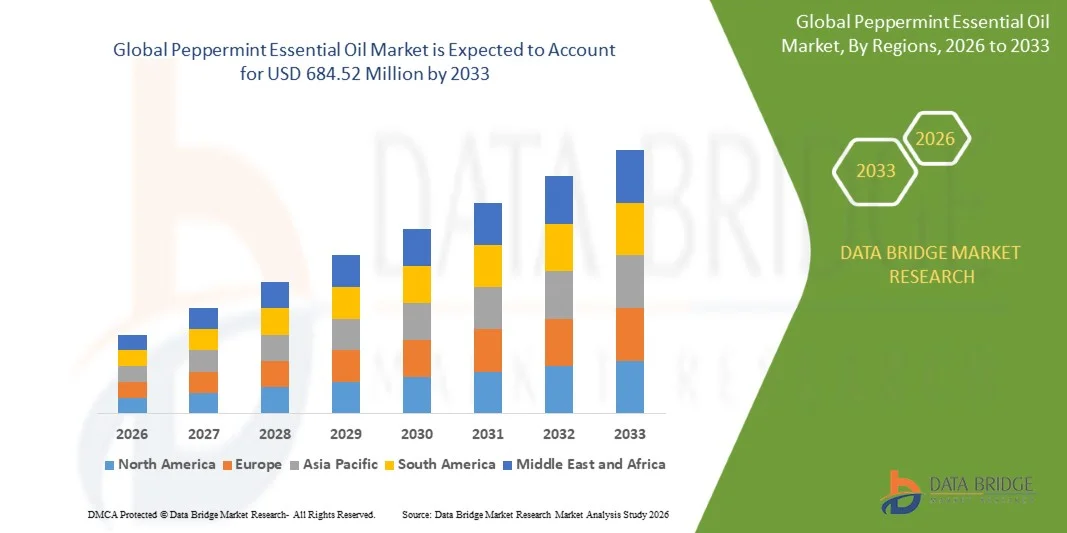
As per Data Bridge Market Research analysis, the peppermint essential oil market was valued at USD 333.62 million in 2025 and is projected to reach USD 684.52 million by 2033, growing at a CAGR of 9.40% from 2026 to 2033. The market is experiencing consistent growth driven by increasing consumer preference for natural and plant-based ingredients, rising demand for essential oils in personal care and cosmetic formulations, and expanding applications across pharmaceuticals, food and beverages, aromatherapy, and wellness products.
The growing awareness regarding the therapeutic properties of peppermint essential oil, including its cooling, refreshing, and digestive health benefits, is encouraging adoption among consumers and manufacturers. In addition, the shift toward clean-label products, increasing utilization of natural fragrances and flavors, and rising demand for organic essential oils are supporting market expansion. The use of peppermint oil in products such as oral care formulations, dietary supplements, skincare products, and aromatherapy solutions is further strengthening its global market presence.
Market Size & Forecast
- Global Market Value (2025): USD 333.62 Million
- Expected Market Value (2033): USD 684.52 Million
- Forecast CAGR (2026–2033): 9.40%
- Leading Region in 2025: North America
- Fastest Growing Region: Asia-Pacific
Key Market Trends & Insights
- North America dominated the peppermint essential oil market with the largest revenue share of 34.43% in 2025, supported by increasing consumer demand for natural and organic products, growing adoption of aromatherapy and wellness solutions, and strong utilization of peppermint oil in food, supplements, personal care, and pharmaceutical application
- The natural peppermint essential oil segment led the market with a 78.3% share in 2025, driven by increasing preference for plant-derived ingredients across food & beverages, personal care, pharmaceuticals, and wellness applications
- Asia-Pacific is projected to be the fastest-growing region in the peppermint essential oil market with a CAGR of 7.5% during the forecast period, fueled by rising disposable income, increasing consumer preference for natural wellness products, expanding personal care industries, and growing adoption of essential oils in China, India, Japan, and Southeast Asian countries
- Synthetic peppermint essential oil are the fastest-growing product type, projected to register a CAGR of 9.6%, reflecting the surge in applications requiring consistent aroma profiles, cost efficiency, and stable supply availability
- The distillation segment dominated the method of extraction category with a 70.75% revenue share in 2025, led by its widespread adoption as the conventional commercial extraction method for peppermint oil production
- Pharmaceutical products accounted for 30.35% of the market, preferred by increasing utilization of peppermint oil in digestive health products, topical formulations, and herbal medicines
- The fragrance products segment is the fastest-growing application category, with a CAGR of 7.0%, driven by increasing demand for natural fragrances in cosmetics, personal care, and household products
Report Scope and Peppermint Essential Oil Market Segmentation
|
Attributes |
Peppermint Essential Oil Key Market Insights |
|
Segments Covered |
|
|
Countries Covered |
North America
Europe
Asia-Pacific
Middle East and Africa
South America
|
|
Key Market Players |
|
|
Market Opportunities |
|
|
Value Added Data Infosets |
In addition to the insights on market scenarios such as market value, growth rate, segmentation, geographical coverage, and major players, the market reports curated by the Data Bridge Market Research also include in-depth expert analysis, pricing analysis, brand share analysis, consumer survey, demography analysis, supply chain analysis, value chain analysis, raw material/consumables overview, vendor selection criteria, PESTLE Analysis, Porter Analysis, and regulatory framework. |
Peppermint Essential Oil Market Trends
Trend: Rising Demand for Natural and Clean-Label Ingredients
Essential oil manufacturers are increasingly focusing on sustainable cultivation, transparent sourcing, and traceability of peppermint oil to address rising demand for ethically produced and naturally derived ingredients. Companies across the flavor, fragrance, personal care, and wellness industries are strengthening supplier partnerships and implementing responsible sourcing practices to ensure consistent quality and meet consumer preference for sustainable products. The shift toward traceable peppermint oil supply chains is encouraging manufacturers to develop premium natural formulations while improving supply security across global markets. For instance, in April 2025, Symrise AG’s “Bridging the Gap” initiative was recognized by Unilever through the Partner to Win Award for transforming India’s mint supply chain, engaging 25,000 farmers in Uttar Pradesh and implementing sustainable agricultural practices to improve supply chain resilience and traceability for mint-based ingredients.
Sustainable sourcing initiatives and traceable supply chains are becoming important competitive factors in the peppermint essential oil market, supporting long-term growth and premium product development.
Peppermint Essential Oil Market Dynamics
Key Market Driver: Growing Pharmaceutical and Therapeutic Applications of Peppermint Oil
The increasing utilization of peppermint essential oil in pharmaceutical and healthcare applications is driving market expansion, supported by its recognized therapeutic properties and use in digestive health, topical formulations, oral care, and herbal medicines. Regulatory acceptance of peppermint oil-based medicinal products and rising consumer preference for natural healthcare solutions are encouraging pharmaceutical manufacturers to incorporate peppermint oil into clinically evaluated formulations. The expanding demand for herbal remedies and plant-based healthcare products is further strengthening adoption across global pharmaceutical markets. For instance, in February 2024, a clinical study published in BioPsychoSocial Medicine evaluated the efficacy and safety of peppermint oil (ZO-Y60) in Japanese patients with irritable bowel syndrome (IBS). The Phase 3 clinical study demonstrated improvements in IBS symptoms following peppermint oil treatment, supporting the continued development and adoption of peppermint oil-based pharmaceutical therapies for gastrointestinal disorders.
Increasing recognition of peppermint oil as a functional botanical ingredient in healthcare applications is creating sustained demand from pharmaceutical and wellness product manufacturers.
Key Restraint/Challenge: Dependence on Agricultural Production and Crop-Related Supply Fluctuations
A significant restraint in the peppermint essential oil market is the dependence on agricultural cultivation, where factors such as climate conditions, irrigation availability, pests, diseases, and soil conditions can influence peppermint crop yield and oil production. Since peppermint oil is extracted from harvested mint crops, supply consistency depends on geographically concentrated farming regions and effective crop management practices. Production challenges can affect raw material availability, increase cultivation costs, and create pricing uncertainty for essential oil manufacturers and downstream users. For instance, in November 2024, Essex Laboratories reported that U.S. peppermint acreage continued to decline due to lower grower returns, shifting crop economics, irrigation limitations, and challenges in finding suitable disease-free fields for crop rotation. The report also highlighted that rising input costs, labor expenses, and agricultural conditions continued to pressure mint production, creating supply uncertainties for peppermint oil manufacturers dependent on consistent crop availability.
The geographic concentration of peppermint cultivation and sensitivity of mint crops to environmental and agricultural factors remain key challenges for market participants, increasing the importance of sustainable farming practices, crop protection strategies, and diversified sourcing networks.
Key Market Opportunity: Expansion of Peppermint Oil in Natural Personal Care and Wellness Products
The increasing consumer preference for natural, plant-based, and wellness-oriented products is creating significant opportunities for peppermint essential oil manufacturers. Cosmetic, personal care, aromatherapy, and wellness companies are increasingly incorporating peppermint oil into products such as skincare formulations, oral care products, massage oils, and relaxation solutions due to its refreshing aroma and functional properties. The growing clean beauty movement and rising adoption of essential oils in holistic wellness applications are encouraging companies to develop innovative peppermint oil-based products and expand into premium natural product categories. For instance, in January 2024, Givaudan Active Beauty launched PrimalHyal 50 Life, a sustainably produced cosmetic ingredient developed using precision fermentation technology for skincare applications. The launch reflects the growing demand for sustainable and natural-origin ingredients in the beauty industry, creating broader opportunities for botanical ingredients such as peppermint oil in personal care, fragrance, and wellness formulations.
The expanding use of peppermint essential oil in wellness, aromatherapy, and natural personal care products provides market participants with opportunities to introduce innovative formulations, premium products, and application-specific solutions targeting health-conscious consumers.
Peppermint Essential Oil Market Scope
The peppermint essential oil market is segmented on the basis of product type, method of extraction, application, and end use.
- By Product Type
On the basis of product type, the peppermint essential oil market is segmented into natural peppermint essential oil and synthetic peppermint essential oil. The natural peppermint essential oil segment dominated the market with 78.3% share in 2025, owing to increasing preference for plant-derived ingredients across food & beverages, personal care, pharmaceuticals, and wellness applications. Natural peppermint oil is widely preferred due to its high menthol content, refreshing aroma, and compatibility with clean-label product formulations. The increasing shift toward organic and naturally sourced ingredients is encouraging manufacturers to replace synthetic alternatives with botanical oils. Growing adoption in aromatherapy, therapeutic formulations, and premium personal care products is further supporting segment expansion. The segment benefits from strong consumer acceptance and regulatory preference for naturally derived ingredients. Increasing demand for sustainable and traceable essential oils is expected to maintain its dominance throughout the forecast period.
The synthetic peppermint essential oil segment is projected to be the fastest-growing product segment with a CAGR of 9.6% during the forecast period. Synthetic peppermint oil is preferred in applications requiring consistent aroma profiles, cost efficiency, and stable supply availability. The segment finds usage in industrial flavoring, fragrances, and selected personal care formulations. Lower production costs compared with natural peppermint oil provide advantages for price-sensitive manufacturers. However, increasing consumer preference for natural ingredients may limit faster expansion. The segment continues to maintain demand in applications where standardized performance and affordability are primary considerations.
- By Method of Extraction
On the basis of method of extraction, the peppermint essential oil market is segmented into distillation, carbon dioxide extraction, cold press extraction, solvent extraction, and others. The distillation segment dominated the market with an estimated 70.75% share in 2025, owing to its widespread adoption as the conventional commercial extraction method for peppermint oil production. Steam distillation is extensively used because it efficiently extracts volatile compounds while maintaining the characteristic aroma and menthol profile of peppermint oil. The method provides scalability, lower processing complexity, and suitability for large-scale manufacturing. Most commercial peppermint oil producers rely on distillation due to established infrastructure and operational efficiency. Increasing demand from pharmaceutical, food, and fragrance industries continues to support adoption. The segment remains dominant because of its cost-effectiveness and proven industrial application.
The carbon dioxide extraction segment is projected to be the fastest-growing extraction segment with a CAGR of 7.8% during the forecast period, driven by rising demand for premium-quality essential oils. Supercritical CO₂ extraction enables higher purity, better preservation of bioactive compounds, and reduced solvent contamination. Increasing adoption in pharmaceutical, cosmetic, and high-value wellness applications is supporting market growth. Manufacturers are increasingly investing in advanced extraction technologies to develop specialty-grade peppermint oil products. The segment benefits from growing demand for innovative extraction processes and premium natural ingredients.
- By Application
On the basis of application, the peppermint essential oil market is segmented into oral products, confectionery products, pharmaceutical products, tobacco products, and fragrance products. The pharmaceutical products segment dominated the market with an estimated share of 30.35% in 2025, supported by increasing utilization of peppermint oil in digestive health products, topical formulations, and herbal medicines. Peppermint oil is widely used due to its cooling properties, menthol content, and therapeutic applications. Growing consumer preference for natural healthcare products is increasing demand for peppermint-based pharmaceutical formulations. Regulatory recognition of peppermint oil as a herbal medicinal ingredient is supporting adoption in healthcare applications. Increasing research on botanical therapies is further strengthening demand. The segment remains a major revenue contributor due to expanding pharmaceutical and nutraceutical applications.
The fragrance products segment is estimated to grow at the fastest CAGR of 7% during the forecast period, driven by increasing demand for natural fragrances in cosmetics, personal care, and household products. Peppermint oil is increasingly incorporated into perfumes, soaps, shampoos, and aromatherapy products due to its refreshing scent characteristics. The clean beauty movement is encouraging brands to adopt botanical fragrance ingredients. Rising consumer preference for sustainable personal care products is creating opportunities for essential oil suppliers. Expansion of premium wellness and lifestyle products is further supporting segment growth.
- By End Use
On the basis of end use, the peppermint essential oil market is segmented into cosmetics, drugs and food & beverages, aromatherapy, home care, health care, and others. The drugs and food & beverages segment dominated the market with 34.7% share in 2025, owing to extensive usage of peppermint oil as a natural flavoring agent and functional ingredient. Peppermint oil is widely used in confectionery, chewing gums, beverages, bakery products, and herbal formulations. The pharmaceutical industry also utilizes peppermint oil in digestive health products and therapeutic applications. Increasing demand for clean-label flavors and botanical ingredients is strengthening adoption. The segment benefits from large-scale consumption and broad industrial applications. Continued growth of functional foods and herbal supplements is expected to support segment dominance.
The aromatherapy segment is projected to be the fastest-growing end-use segment with a CAGR of 7.47% during forecast period, driven by increasing consumer focus on wellness, relaxation, and holistic healthcare solutions. Peppermint oil is widely used in diffusers, massage oils, and wellness formulations due to its refreshing aroma and perceived therapeutic benefits. Growing adoption of home-based aromatherapy practices is increasing demand. Expansion of wellness centers and premium essential oil products is further supporting growth. Rising awareness regarding natural stress-management solutions is accelerating consumer adoption. The segment is expected to witness strong expansion during the forecast period.
Peppermint Essential Oil Market Regional Analysis
North America dominated the peppermint essential oil market with the largest revenue share of 34.43% in 2025, supported by increasing consumer demand for natural and organic products, growing adoption of aromatherapy and wellness solutions, and strong utilization of peppermint oil in food, supplements, personal care, and pharmaceutical application. The region benefits from increasing preference for clean-label products, expanding natural beauty trends, and growing utilization of peppermint oil in functional foods, dietary supplements, and healthcare formulations. Rising investments in botanical ingredient innovation, sustainable sourcing practices, and premium wellness products are accelerating market development. Increasing consumer awareness regarding herbal solutions, therapeutic essential oils, and plant-based alternatives continues to strengthen North America's leading position in the global peppermint essential oil market.
U.S. Peppermint Essential Oil Market Insight
The U.S. peppermint essential oil market is witnessing strong growth due to rising consumer preference for natural wellness products, increasing demand for clean-label ingredients, and expanding applications across food & beverages, pharmaceuticals, cosmetics, and aromatherapy. The country’s strong position in peppermint cultivation, particularly in the Pacific Northwest region, along with the presence of established essential oil manufacturers and wellness brands, is driving market demand. In addition, growing adoption of peppermint oil in functional foods, dietary supplements, oral care, and personal care formulations is accelerating market expansion. The U.S. Department of Agriculture (USDA) identifies Idaho, Oregon, and Washington as major U.S. mint-producing states, with these regions accounting for a significant share of domestic mint-for-oil production, supporting the availability of peppermint oil raw materials for downstream industries.
Europe Peppermint Essential Oil Market Insight
The Europe peppermint essential oil market remains a major contributor to global revenue, driven by strong demand for herbal medicines, natural cosmetics, and plant-based wellness products. The region benefits from established regulatory frameworks for herbal medicinal products, increasing consumer preference for organic ingredients, and high adoption of essential oils in aromatherapy and personal care applications. Growing investments in sustainable botanical sourcing and clean beauty formulations are supporting market expansion across European countries. The European Medicines Agency (EMA) recognizes peppermint oil (Menthae piperitae aetheroleum) as a traditional herbal medicinal product, supporting its acceptance in regulated healthcare applications across Europe and strengthening pharmaceutical demand.
U.K. Peppermint Essential Oil Market Insight
The U.K. peppermint essential oil market is experiencing steady growth, supported by increasing consumer adoption of natural health products, aromatherapy solutions, and botanical-based personal care formulations. The country’s expanding wellness industry and rising demand for sustainable and organic ingredients are contributing to peppermint oil adoption across cosmetics, healthcare, and lifestyle applications. Increasing awareness regarding essential oil benefits and growth of premium natural product categories are further supporting market development. The U.K., the National Institute for Health and Care Excellence (NICE) recognizes peppermint oil as an option used in the management of irritable bowel syndrome (IBS) symptoms, supporting awareness and acceptance of peppermint oil-based healthcare applications.
Germany Peppermint Essential Oil Market Insight
The Germany peppermint essential oil market is expanding steadily due to the country’s strong pharmaceutical industry, advanced natural ingredient sector, and increasing demand for herbal healthcare products. Pharmaceutical companies and natural product manufacturers are increasingly utilizing peppermint oil in digestive health products, topical formulations, and wellness applications. Continuous innovation in plant-based formulations, along with strong consumer preference for scientifically supported herbal products, is further driving market growth in Germany. The German Federal Institute for Drugs and Medical Devices (BfArM) provides monographs for herbal medicinal substances, supporting the regulatory acceptance of botanical ingredients such as peppermint oil in healthcare applications.
Asia-Pacific Peppermint Essential Oil Market Insight
The Asia-Pacific peppermint essential oil market is expected to witness rapid growth, driven by increasing disposable income, rising consumer awareness regarding natural wellness products, and expanding applications in cosmetics, food & beverages, and aromatherapy. Growing demand for organic personal care products, herbal healthcare solutions, and natural flavors is supporting regional market expansion across China, India, Japan, and Southeast Asia. In addition, increasing investments in essential oil production and botanical ingredient manufacturing are accelerating market development. India’s Ministry of AYUSH, through the National Medicinal Plants Board (NMPB), promotes the cultivation, conservation, and sustainable utilization of medicinal plants and supports the development of herbal product value chains, creating a favorable environment for plant-based ingredients and wellness products such as essential oils.
Japan Peppermint Essential Oil Market Insight
The Japan peppermint essential oil market is witnessing consistent growth due to increasing demand for aromatherapy, natural healthcare products, and premium personal care formulations. Japanese consumers show strong interest in wellness-oriented products, functional ingredients, and high-quality botanical extracts. Cosmetic and healthcare companies are increasingly incorporating essential oils into products targeting relaxation, skincare, and lifestyle wellness. Japanese consumer brands continue incorporating peppermint oil as a botanical ingredient in cosmetics, aromatherapy, and personal care products, supported by Japan’s established regulatory framework for cosmetics and quasi-drugs.
China Peppermint Essential Oil Market Insight
The China peppermint essential oil market is growing rapidly, driven by expanding cosmetic and personal care industries, increasing demand for natural ingredients, and rising consumer interest in aromatherapy and wellness products. Growing manufacturing capabilities in essential oils, increasing adoption of botanical ingredients, and expanding applications in food, beverages, and healthcare products are significantly boosting market demand. In addition, China’s growing herbal medicine and natural product industry is creating opportunities for peppermint oil suppliers. China’s National Medical Products Administration (NMPA) regulates cosmetics through the Cosmetic Supervision and Administration Regulation (CSAR), establishing safety and compliance requirements for cosmetic products containing natural and botanical ingredients, which supports the commercialization of plant-based personal care formulations in China.
Peppermint Essential Oil Market Share
The peppermint essential oil industry is primarily led by well-established companies, including:
- doTERRA (U.S.)
- Mountain Rose Herbs (U.S.)
- NOW Health Group, Inc. (U.S.)
- Plant Therapy (U.S.)
- Eden Botanicals (U.S.)
- New Directions Aromatics Inc. (Canada)
- Florihana (France)
- Pranarôm International (Belgium)
- Symrise (Germany)
- Givaudan (Switzerland)
- dsm-firmenich (Switzerland)
- Sensient Technologies (U.S.)
- Takasago International Corporation (Japan)
- Mane SA (France)
- Robertet SA (France)
- Berje Inc. (U.S.)
- Ernesto Ventós, S.A. (Spain)
- Lebermuth, Inc. (U.S.)
Latest Developments in Peppermint Essential Oil Market
- In August 2025, UNIFI, makers of REPREVE®, launched A.M.Y.® Peppermint, a naturally deodorizing yarn technology that uses sustainably sourced peppermint oil to provide built-in odor control. The innovation expands the application of peppermint oil beyond traditional fragrance and wellness uses into textiles, apparel, footwear, home textiles, and transportation applications. This development highlights the growing adoption of peppermint oil as a natural functional ingredient across non-traditional consumer product categories.
- In November 2024, Essex Laboratories released its Fall 2024 Domestic Mint Market Report, highlighting continued changes in the U.S. peppermint oil supply chain, including declining peppermint acreage, shifting crop economics, and ongoing efforts by growers and suppliers to maintain production stability. The report reflects the importance of agricultural supply management and raw material availability for the global peppermint essential oil industry
- In September 2023, dōTERRA announced the launch of new essential oil products and blends at its Global Convention, expanding its essential oil portfolio with sustainably sourced ingredients. The company’s continued product expansion reflects increasing consumer demand for essential oil-based wellness products and supports growth in aromatherapy and natural health applications
- In May 2023, Young Living introduced new essential oil blends, including products containing peppermint oil, as part of its wellness product portfolio. The launch expanded the company’s essential oil offerings across aromatherapy and lifestyle applications, reflecting continued consumer interest in peppermint oil-based wellness solutions
- In April 2022, Schwabe Pharma Italia launched Gaspan®, a herbal medicinal product combining peppermint oil and caraway oil for gastrointestinal complaints such as abdominal discomfort, cramps, and bloating. The product launch expanded the pharmaceutical application of peppermint oil by introducing a regulated peppermint oil-based formulation in the European healthcare market, highlighting continued demand for botanical-based digestive health solutions

- Interactive Data Analysis Dashboard
- Company Analysis Dashboard for high growth potential opportunities
- Research Analyst Access for customization & queries
- Competitor Analysis with Interactive dashboard
- Latest News, Updates & Trend analysis
- Harness the Power of Benchmark Analysis for Comprehensive Competitor Tracking
Global Peppermint Essential Oil Market, Supply Chain Analysis and Ecosystem Framework
To support market growth and help clients navigate the impact of geopolitical shifts, DBMR has integrated in-depth supply chain analysis into its Global Peppermint Essential Oil Market research reports. This addition empowers clients to respond effectively to global changes affecting their industries. The supply chain analysis section includes detailed insights such as Global Peppermint Essential Oil Market consumption and production by country, price trend analysis, the impact of tariffs and geopolitical developments, and import and export trends by country and HSN code. It also highlights major suppliers with data on production capacity and company profiles, as well as key importers and exporters. In addition to research, DBMR offers specialized supply chain consulting services backed by over a decade of experience, providing solutions like supplier discovery, supplier risk assessment, price trend analysis, impact evaluation of inflation and trade route changes, and comprehensive market trend analysis.
Data collection and base year analysis are done using data collection modules with large sample sizes. The stage includes obtaining market information or related data through various sources and strategies. It includes examining and planning all the data acquired from the past in advance. It likewise envelops the examination of information inconsistencies seen across different information sources. The market data is analysed and estimated using market statistical and coherent models. Also, market share analysis and key trend analysis are the major success factors in the market report. To know more, please request an analyst call or drop down your inquiry.
The key research methodology used by DBMR research team is data triangulation which involves data mining, analysis of the impact of data variables on the market and primary (industry expert) validation. Data models include Vendor Positioning Grid, Market Time Line Analysis, Market Overview and Guide, Company Positioning Grid, Patent Analysis, Pricing Analysis, Company Market Share Analysis, Standards of Measurement, Global versus Regional and Vendor Share Analysis. To know more about the research methodology, drop in an inquiry to speak to our industry experts.
Data Bridge Market Research is a leader in advanced formative research. We take pride in servicing our existing and new customers with data and analysis that match and suits their goal. The report can be customized to include price trend analysis of target brands understanding the market for additional countries (ask for the list of countries), clinical trial results data, literature review, refurbished market and product base analysis. Market analysis of target competitors can be analyzed from technology-based analysis to market portfolio strategies. We can add as many competitors that you require data about in the format and data style you are looking for. Our team of analysts can also provide you data in crude raw excel files pivot tables (Fact book) or can assist you in creating presentations from the data sets available in the report.













