


What is the Percutaneous Coronary Intervention Guidance Devices Market Size and Growth Rate?
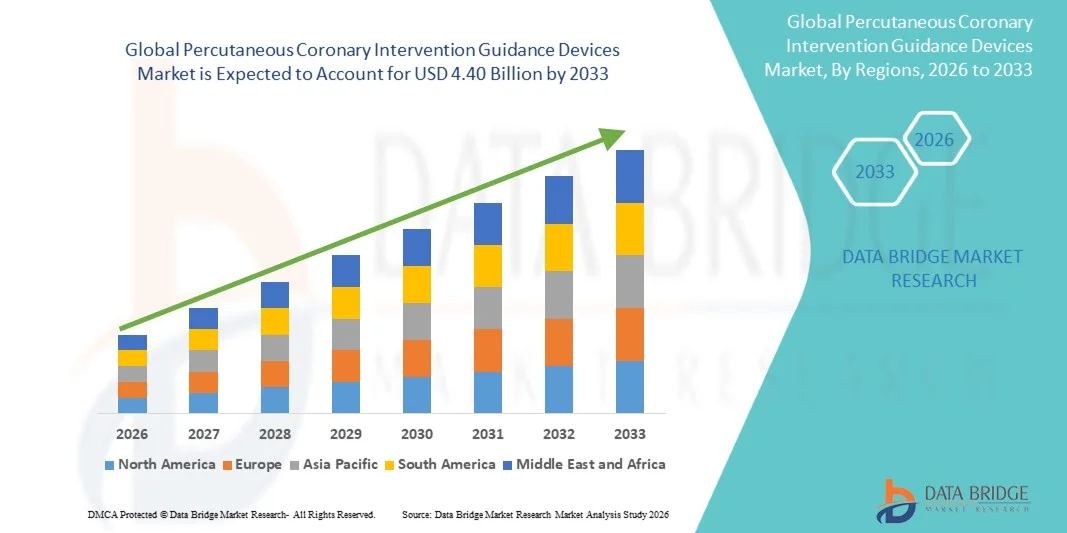
- As per Data Bridge Market Research analysis, the percutaneous coronary intervention guidance devices market was valued at USD 2.10 billion in 2025 and is projected to reach USD 4.40 billion by 2033, growing at a CAGR of 9.70% from 2026 to 2033.
- The market is experiencing consistent growth driven by the rising prevalence of coronary artery disease (CAD), increasing adoption of minimally invasive cardiovascular procedures, and rapid advancements in intravascular imaging and physiological assessment technologies.
- The increasing burden of cardiovascular diseases and aging populations globally, combined with growing clinical evidence supporting image-guided and physiology-guided PCI, is encouraging hospitals and cardiac catheterization laboratories to adopt advanced guidance devices. Real-time imaging, AI-assisted procedural planning, and precision-guided coronary interventions are improving procedural accuracy, reducing complications, and enhancing long-term patient outcomes, thereby accelerating market growth.
Market Size & Forecast
- Global Market Value (2025): USD 2.10 Billion
- Expected Market Value (2033): USD 4.40 Billion
- Forecast CAGR (2026–2033): 9.70%
- Leading Region in 2025: North America
- Fastest Growing Region: Asia Pacific
What are the Major Takeaways of the Percutaneous Coronary Intervention Guidance Devices Market?
- North America dominated the percutaneous coronary intervention guidance devices market with the largest revenue share of 38.7% in 2025, supported by advanced cardiovascular care infrastructure, favorable reimbursement policies, and widespread adoption of intravascular imaging technologies.
- Asia-Pacific is expected to be the fastest-growing region at a CAGR of 9.3% from 2026 to 2033, fueled by the rising burden of cardiovascular diseases, expanding healthcare infrastructure, increasing healthcare expenditure, and growing adoption of advanced PCI guidance technologies across China, India, and Japan.
- The guidewires segment led the market with a 39.8% share in 2025, driven by their indispensable role in virtually every percutaneous coronary intervention procedure.
- Balloon catheters are the fastest-growing device type, projected to register a CAGR of 9.2%, reflecting the surge in adoption of specialty balloons such as drug-coated balloons, scoring balloons, and cutting balloons for complex coronary lesions.
- The coronary artery disease (CAD) segment dominated the application category with a 52.3% revenue share in 2025, led by the high global prevalence of atherosclerotic coronary artery disease and the increasing number of PCI procedures
- Metal accounted for 84.6% of the market share in 2025, preferred by its superior mechanical strength, flexibility, durability, and established clinical performance in coronary intervention devices.
- The needle clipping mechanism segment is the fastest-growing safety mechanism category, with a CAGR of 8.6%, driven by increasing demand for cost-effective sharps safety solutions across healthcare facilities.
Report Scope and Percutaneous Coronary Intervention Guidance Devices Market Segmentation
|
Attributes |
Percutaneous Coronary Intervention Guidance Devices Key Market Insights |
|
Segments Covered |
|
|
Countries Covered |
North America
Europe
Asia-Pacific
Middle East and Africa
South America
|
|
Key Market Players |
|
|
Market Opportunities |
|
|
Value Added Data Infosets |
In addition to the insights on market scenarios such as market value, growth rate, segmentation, geographical coverage, and major players, the market reports curated by the Data Bridge Market Research also include in-depth expert analysis, patient epidemiology, pipeline analysis, pricing analysis, and regulatory framework. |
What is the Key Trend in the Percutaneous Coronary Intervention Guidance Devices Market?
- Interventional cardiologists are increasingly adopting intravascular imaging and physiological guidance technologies to improve lesion assessment, optimize stent placement, and enhance procedural outcomes during complex percutaneous coronary interventions.
- For instance, in October 2025, Philips introduced an integration of pre-operative coronary CT data with its Azurion cath-lab platform, automatically synchronizing the 3D CT reconstruction with C-arm movement to provide additional anatomical guidance during PCI and support the development of CT-guided PCI workflows.
- Real-time IVUS and OCT imaging enables physicians to evaluate plaque morphology, vessel dimensions, lesion characteristics, stent expansion, and stent apposition with greater precision than angiography alone.
- The integration of intravascular imaging with physiological assessment is emerging as an important trend, allowing clinicians to combine anatomical information with ischemia assessment for more personalized PCI decision-making.
- Healthcare providers are increasingly seeking integrated cath-lab platforms that combine imaging, physiology, co-registration, and procedural guidance to simplify workflows and reduce the number of separate technologies required during PCI procedures.
- For instance, in December 2025, Philips announced an agreement to acquire SpectraWAVE, adding AI-supported HyperVue intravascular imaging and AI-enabled X1-FFR technology to its coronary intervention portfolio, combining intravascular imaging, coronary physiology, and AI-based guidance.
- As hospitals increasingly prioritize precision, workflow efficiency, and evidence-based PCI, the integration of advanced imaging, physiology, AI, and multimodal guidance technologies is expected to accelerate adoption of next-generation coronary intervention guidance devices.
What are the Key Drivers of the Percutaneous Coronary Intervention Guidance Devices Market?
- The rising global burden of coronary artery disease and increasing complexity of PCI procedures are significantly increasing demand for advanced guidance devices capable of providing detailed anatomical and physiological information during interventions.
- For instance, in August 2025, the European Society of Cardiology highlighted that intracoronary imaging had progressed to a Class IA recommendation in the 2024 ESC Guidelines for complex PCI, supported by evidence from 21 trials involving more than 18,000 patients, strengthening clinical demand for IVUS and OCT-guided coronary interventions.
- Cardiologists, hospitals, and cardiac catheterization laboratories are increasingly integrating IVUS, OCT, FFR, and iFR technologies into PCI workflows to improve stent sizing, optimize deployment, identify residual disease, and support evidence-based treatment decisions.
- For instance, in May 2025, Philips announced completion of enrollment in the DEFINE GPS trial, with 2,182 patients across 85 hospitals in 18 countries, evaluating angiography combined with iFR co-registration to improve PCI guidance and treatment outcomes, demonstrating increasing clinical adoption and validation of physiology-guided intervention.
- With clinical guidelines increasingly supporting image-guided PCI and technological advances improving workflow integration, coronary intervention guidance devices are expected to remain essential for improving procedural precision, patient outcomes, and treatment optimization.
What Factors are Challenging the Growth of the Percutaneous Coronary Intervention Guidance Devices Market?
- Advanced PCI guidance devices require additional capital expenditure, disposable imaging catheters, specialized equipment, and trained personnel, increasing procedural costs and limiting adoption among hospitals with constrained healthcare budgets.
- For instance, in February 2025, an Irish micro-costing study published in Open Heart found that intracoronary imaging increased average PCI procedure time from 45 to 60 minutes and added USD 841 for IVUS and USD 989 for OCT, highlighting the additional procedural and equipment costs associated with advanced guidance technologies.
- These financial and operational barriers particularly affect smaller hospitals and cardiac centers, where limited access to specialized cath-lab infrastructure and experienced operators can restrict routine use of IVUS, OCT, and physiological guidance technologies.
- For instance, in August 2026, a prospective multicenter OCT2ACT study published in JACC: Advances found that 53.0% of 908 patients who met Class IA criteria for intracoronary imaging underwent PCI without imaging, while imaging uptake varied from 16.7% to 100% across centers, highlighting persistent adoption and practice-variation barriers
- The combination of device costs, reimbursement limitations, additional procedural time, equipment availability, and operator training requirements continues to constrain widespread adoption, particularly in cost-sensitive healthcare systems and lower-resource cardiac centers.
How is the Percutaneous Coronary Intervention Guidance Devices Market Segmented?
The percutaneous coronary intervention guidance devices market is segmented on the basis of device type, application, material type, safety mechanism, and end user.
- By Device Type
On the basis of device type, the percutaneous coronary intervention guidance devices market is segmented into percutaneous sheath introducers, guide catheters, guidewires, and balloon catheters. The guidewires segment dominated the market with a 39.8% share in 2025, owing to their indispensable role in virtually every percutaneous coronary intervention procedure. Guidewires provide the primary pathway for delivering balloons, stents, imaging catheters, and other interventional devices across coronary lesions. Continuous advancements in steerability, torque control, hydrophilic coatings, and lesion-crossing capabilities are improving procedural performance. They are extensively used in both routine and complex interventions, including chronic total occlusions and bifurcation lesions. The increasing volume of PCI procedures and availability of specialized guidewires for different lesion characteristics continue to strengthen segment dominance.
The balloon catheters segment is projected to register the fastest growth at a CAGR of 9.2% from 2026 to 2033, driven by increasing adoption of specialty balloons such as drug-coated balloons, scoring balloons, and cutting balloons for complex coronary lesions. These devices support lesion preparation and improve vessel expansion during PCI. Continuous advancements in balloon materials, flexibility, coating technologies, and deliverability are enhancing procedural performance. Rising treatment of calcified and complex coronary lesions is further supporting demand for advanced balloon technologies. Growing clinical evidence for drug-coated balloon therapy in selected indications is also encouraging adoption.
- By Application
On the basis of application, the percutaneous coronary intervention guidance devices market is segmented into coronary artery disease (CAD), acute coronary syndrome (ACS), myocardial infarction, and others. The coronary artery disease (CAD) segment dominated the market with a 52.3% share in 2025, driven by the high global prevalence of atherosclerotic coronary artery disease and the increasing number of PCI procedures. CAD remains a major indication for coronary angioplasty and stent implantation. The continued burden of coronary disease is generating sustained demand for devices used to navigate, assess, and treat coronary lesions. Increasing access to cardiovascular diagnosis and interventional treatment is further supporting adoption. Advanced guidance devices help physicians improve lesion assessment and procedural precision during CAD interventions.
The acute coronary syndrome (ACS) segment is projected to register the fastest growth at an CAGR of 9.0% from 2026 to 2033, supported by increasing demand for rapid and precise coronary intervention in emergency cardiovascular care. ACS requires timely restoration of coronary blood flow, creating demand for efficient PCI procedures. Advanced guidewires, guide catheters, and balloon systems enable physicians to access and treat affected coronary vessels. Increasing availability of specialized cardiac centers and catheterization laboratories is improving access to emergency intervention. Technological advances are also supporting faster lesion assessment and procedural guidance. Expanding cardiovascular infrastructure in emerging economies is further improving access to ACS treatment.
- By Material Type
On the basis of material type, the percutaneous coronary intervention guidance devices market is segmented into metal and biodegradable polymers. The metal segment dominated the market with an 84.6% share in 2025, owing to its superior mechanical strength, flexibility, durability, and established clinical performance in coronary intervention devices. Stainless steel, nitinol, and cobalt-chromium alloys are widely used in guidewires, guide catheters, and sheath introducers. These materials provide strong pushability, torque transmission, and structural stability during complex coronary interventions. Established manufacturing processes and extensive physician familiarity continue to support widespread adoption. Metal materials are also compatible with sophisticated device designs used for challenging coronary anatomies.
The biodegradable polymers segment is projected to register the fastest growth at a CAGR of 10.4% from 2026 to 2033, driven by increasing research and development of next-generation cardiovascular devices using advanced biomaterials. Biodegradable polymers offer potential advantages related to biocompatibility and controlled degradation. Manufacturers are exploring polymer technologies to improve device performance while reducing long-term material persistence. Advances in polymer composition and mechanical properties are expanding their potential use in cardiovascular applications. Increasing emphasis on patient safety and vascular healing is encouraging innovation in biodegradable materials. Research and development investments are supporting the development of improved polymer-based interventional technologies.
- By Safety Mechanism
On the basis of safety mechanism, the percutaneous coronary intervention guidance devices market is segmented into needle clipping mechanism and needle shielding mechanism. The needle shielding mechanism dominated the market with 61.5% share in 2025, owing to its ability to reduce accidental needlestick injuries and improve healthcare worker safety during vascular access procedures. Shielding systems provide protection around exposed needles following use. Hospitals increasingly prioritize mechanisms that reduce occupational exposure to bloodborne pathogens. Passive and automatic shielding designs can also simplify handling after procedures. Growing awareness of healthcare worker safety is supporting adoption of safer vascular-access technologies. Increasing emphasis on infection prevention and occupational safety continues to strengthen demand for needle shielding mechanisms.
The needle clipping mechanism segment is projected to register the fastest growth at a CAGR of 8.6% from 2026 to 2033, driven by increasing demand for cost-effective sharps safety solutions across healthcare facilities. These mechanisms help secure or disable used needles following vascular access procedures. Increasing regulatory emphasis on healthcare worker protection is encouraging healthcare facilities to strengthen sharps-management practices. Manufacturers are developing simplified mechanisms designed to improve usability without adding substantial procedural complexity. Expanding healthcare infrastructure is creating additional demand for affordable safety technologies. Growing focus on occupational safety and infection prevention is further supporting adoption.
- By End User
On the basis of end user, the percutaneous coronary intervention guidance devices market is segmented into hospitals, ambulatory surgical centers (ASCs), cardiac catheterization laboratories, and others. The hospitals segment dominated the market with 67.2% share in 2025, driven by the high volume of PCI procedures performed in tertiary-care and multispecialty hospitals. Hospitals generally possess comprehensive catheterization infrastructure and specialized cardiovascular teams required for coronary interventions. Emergency cardiac-care capabilities further increase the number of PCI procedures conducted in hospital settings. Increasing investment in cardiovascular infrastructure is supporting the deployment of advanced guidance technologies. The availability of interventional cardiologists and multidisciplinary clinical teams also strengthens hospital-based adoption.
The cardiac catheterization laboratories segment is projected to register the fastest growth at a CAGR of 9.5% from 2026 to 2033, driven by increasing establishment of specialized cardiovascular intervention facilities. These laboratories provide dedicated environments for angiography, PCI, intravascular imaging, and physiological assessment. Growing adoption of image-guided and physiology-guided procedures is increasing demand for sophisticated guidance devices in these facilities. Investments in modern cath-lab infrastructure and advanced imaging platforms are improving procedural efficiency. The rising burden of cardiovascular disease is increasing demand for specialized interventional cardiac services. Greater concentration of advanced technologies within dedicated laboratories is further supporting segment expansion.
Which Region Holds the Largest Share of the Percutaneous Coronary Intervention Guidance Devices Market?
- North America dominated the percutaneous coronary intervention guidance devices market with the largest revenue share of 38.7% in 2025, supported by advanced cardiovascular care infrastructure, favorable reimbursement policies, and widespread adoption of intravascular imaging technologies.
- The region also benefits from the widespread adoption of intravascular imaging and physiological assessment technologies, increasing prevalence of coronary artery disease, growing preference for minimally invasive coronary interventions, and continuous investments in cardiac catheterization laboratories and interventional cardiology innovation. These factors continue to strengthen North America’s leadership position in the global market.
U.S. Percutaneous Coronary Intervention Guidance Devices Market Insight
The U.S. percutaneous coronary intervention guidance devices market is witnessing strong growth due to the country’s well-established healthcare system, favorable reimbursement framework, and strong presence of leading cardiovascular device manufacturers. Increasing physician preference for IVUS-, OCT-, and physiology-guided PCI is supporting demand across hospitals and cardiac catheterization laboratories. In addition, growing clinical evidence for image-guided and physiology-guided coronary interventions, along with continuous investments in advanced cardiovascular technologies, is accelerating adoption of PCI guidance devices.
Asia-Pacific Percutaneous Coronary Intervention Guidance Devices Market Insight
The Asia-Pacific percutaneous coronary intervention guidance devices market is expected to witness rapid growth, driven by increasing cardiovascular disease prevalence, expanding healthcare infrastructure, and rising investments in advanced cardiac care across countries such as China, India, and Japan. Growing healthcare expenditure, increasing adoption of minimally invasive coronary interventions, and rising awareness of advanced PCI guidance technologies are supporting regional market expansion. In addition, the increasing availability of cardiac catheterization facilities and growing adoption of intravascular imaging and physiological assessment technologies are accelerating market growth across the region.
Japan Percutaneous Coronary Intervention Guidance Devices Market Insight
The Japan percutaneous coronary intervention guidance devices market is witnessing consistent growth due to rising demand for advanced cardiovascular care, an aging population, and increasing adoption of precision-guided coronary interventions. Hospitals and cardiac catheterization laboratories are increasingly utilizing guidewires, catheters, intravascular imaging, and physiological assessment technologies to improve procedural accuracy and patient outcomes. Moreover, Japan’s established medical device industry, strong presence of cardiovascular device manufacturers, and focus on advanced interventional cardiology are further contributing to market growth.
China Percutaneous Coronary Intervention Guidance Devices Market Insight
The China percutaneous coronary intervention guidance devices market is growing rapidly, driven by increasing cardiovascular disease burden, expanding healthcare infrastructure, and rising demand for minimally invasive coronary procedures. Growing investments in cardiac catheterization laboratories and increasing adoption of advanced guidewires, catheters, balloon technologies, and intravascular imaging systems are significantly supporting market demand. In addition, expansion of interventional cardiology services and increasing availability of advanced PCI technologies are positioning China as an important growth market for coronary intervention guidance devices.
U.K. Percutaneous Coronary Intervention Guidance Devices Market Insight
The U.K. percutaneous coronary intervention guidance devices market is experiencing steady growth, supported by increasing adoption of advanced cardiovascular procedures and growing emphasis on image-guided and physiology-guided PCI. Hospitals and cardiac centers are increasingly utilizing intravascular imaging and physiological assessment technologies to improve lesion evaluation, procedural precision, and clinical outcomes. Furthermore, growing clinical evidence supporting advanced PCI guidance, along with continued investment in cardiovascular care and catheterization laboratory capabilities, is contributing to market growth in the U.K.
Germany Percutaneous Coronary Intervention Guidance Devices Market Insight
The Germany percutaneous coronary intervention guidance devices market is expanding steadily due to the country’s advanced healthcare infrastructure, strong cardiovascular care capabilities, and increasing adoption of sophisticated interventional cardiology technologies. Hospitals and cardiac catheterization laboratories are increasingly adopting advanced guidewires, catheters, intravascular imaging, and physiological assessment systems for complex coronary interventions. Continuous technological advancements, strong medical device manufacturing capabilities, and increasing emphasis on precise and minimally invasive cardiovascular treatment are further driving market growth in Germany.
Which are the Top Companies in Percutaneous Coronary Intervention Guidance Devices Market?
The percutaneous coronary intervention guidance devices industry is primarily led by well-established companies, including:
- Abbott (U.S.)
- Boston Scientific Corporation (U.S.)
- Medtronic (Ireland)
- Terumo Corporation (Japan)
- Koninklijke Philips N.V. (Netherlands)
- Siemens Healthineers AG (Germany)
- GE HealthCare (U.S.)
- Merit Medical Systems, Inc. (U.S.)
- Teleflex Incorporated (U.S.)
- Cordis (U.S.)
- ASAHI INTECC CO., LTD. (Japan)
- NIPRO CORPORATION (Japan)
- OrbusNeich (Hong Kong)
- AngioDynamics, Inc. (U.S.)
- B. Braun Melsungen AG (Germany)
- Cook Medical (U.S.)
- MicroPort Scientific Corporation (China)
- Sahajanand Medical Technologies Pvt. Ltd. (India)
- Lepu Medical Technology (Beijing) Co., Ltd. (China)
- Biosensors International Group, Ltd. (Singapore)
What are Latest Developments in Percutaneous Coronary Intervention Guidance Devices Market?
- In December 2025, Philips announced an agreement to acquire SpectraWAVE Inc., adding its HyperVue Imaging System with enhanced vascular imaging and AI-supported coronary imaging capabilities, along with X1-FFR for angiography-based physiological assessment. The acquisition is intended to expand Philips’ portfolio of intravascular imaging and coronary physiology technologies and strengthen the integration of AI into image-guided PCI procedures.
- In October 2025, Terumo Interventional Systems announced FDA 510(k) clearance for its OPUSWAVE Dual Sensor Imaging System and DualView Imaging Catheter, combining optical frequency domain imaging and intravascular ultrasound within a single catheter. The system was developed to provide simultaneous complementary views of coronary anatomy and support more comprehensive assessment of coronary artery disease during image-guided PCI.
- In October 2023, Abbott launched its Ultreon 1.0 Software-powered vascular imaging platform in India, integrating optical coherence tomography with artificial intelligence to provide automated assessment of coronary blockages, vessel dimensions, and calcium characteristics. The technology also provides step-by-step guidance intended to support precise stent placement, expansion, and apposition during coronary interventions.
- In May 2024, Abbott launched the XIENCE Sierra Everolimus Eluting Coronary Stent System in India, expanding its coronary intervention portfolio with a next-generation stent designed to provide improved deliverability and precision in complex coronary lesions. Abbott also highlighted the use of AI-enabled imaging and diagnostic technologies alongside coronary intervention devices to support physicians performing complex PCI procedures.
- In July 2021, Philips launched IntraSight Mobile, a mobile interventional platform integrating intravascular imaging, physiological measurements, and co-registration for coronary and peripheral vascular procedures. The development was intended to provide hospitals and office-based laboratories with greater flexibility in using advanced image-guided therapy technologies and to support more streamlined interventional workflows

- Interactive Data Analysis Dashboard
- Company Analysis Dashboard for high growth potential opportunities
- Research Analyst Access for customization & queries
- Competitor Analysis with Interactive dashboard
- Latest News, Updates & Trend analysis
- Harness the Power of Benchmark Analysis for Comprehensive Competitor Tracking
Data collection and base year analysis are done using data collection modules with large sample sizes. The stage includes obtaining market information or related data through various sources and strategies. It includes examining and planning all the data acquired from the past in advance. It likewise envelops the examination of information inconsistencies seen across different information sources. The market data is analysed and estimated using market statistical and coherent models. Also, market share analysis and key trend analysis are the major success factors in the market report. To know more, please request an analyst call or drop down your inquiry.
The key research methodology used by DBMR research team is data triangulation which involves data mining, analysis of the impact of data variables on the market and primary (industry expert) validation. Data models include Vendor Positioning Grid, Market Time Line Analysis, Market Overview and Guide, Company Positioning Grid, Patent Analysis, Pricing Analysis, Company Market Share Analysis, Standards of Measurement, Global versus Regional and Vendor Share Analysis. To know more about the research methodology, drop in an inquiry to speak to our industry experts.
Data Bridge Market Research is a leader in advanced formative research. We take pride in servicing our existing and new customers with data and analysis that match and suits their goal. The report can be customized to include price trend analysis of target brands understanding the market for additional countries (ask for the list of countries), clinical trial results data, literature review, refurbished market and product base analysis. Market analysis of target competitors can be analyzed from technology-based analysis to market portfolio strategies. We can add as many competitors that you require data about in the format and data style you are looking for. Our team of analysts can also provide you data in crude raw excel files pivot tables (Fact book) or can assist you in creating presentations from the data sets available in the report.













