


What is the Perforated Packaging Film Size and Growth Rate?
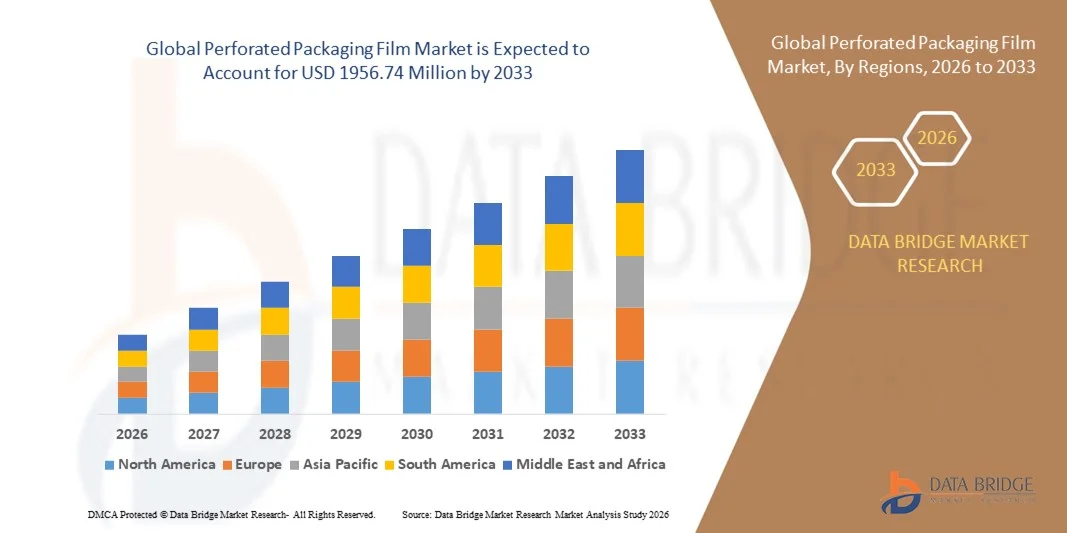
- As per Data Bridge Market Research Analysis the global Perforated Packaging Film Market size was valued at USD 913.50 million in 2025 and is projected to reach USD 1956.74 million by 2033, growing at a CAGR of 9.99% during the forecast period.
- The market expansion is primarily driven by increasing demand for efficient, sustainable, and consumer-friendly packaging solutions across food, pharmaceuticals, and industrial sectors.
- Additionally, advancements in material technology, including biodegradable and recyclable films, alongside the rising need for extended product shelf life and improved freshness, are further propelling the adoption of perforated packaging films, significantly enhancing market growth.
Market Size & Forecast
- Global Market Value (2025): USD 913.50 million in 2025
- Expected Market Value (2033): USD 1956.74 million by 2033
- Forecast CAGR (2026–2033): 9.99%
Global Perforated Packaging Film Market Analysis
- Perforated packaging films, designed with micro-perforations to allow controlled gas exchange, are increasingly essential in preserving freshness, extending shelf life, and maintaining the quality of perishable goods across food, pharmaceutical, and industrial applications.
- The growing demand for perforated packaging films is primarily driven by the rising need for sustainable packaging solutions, consumer preference for fresh and longer-lasting products, and regulatory pressures to reduce food waste.
- North America dominated the Global Perforated Packaging Film Market with the largest revenue share of 33.8% in 2025, supported by high consumer awareness, advanced food processing industries, and the presence of leading packaging manufacturers, with the U.S. witnessing significant adoption in fresh produce, bakery, and snack packaging segments due to innovations in biodegradable and recyclable films.
- Asia-Pacific is expected to be the fastest-growing region in the Global Perforated Packaging Film Market during the forecast period, fueled by rapid urbanization, expanding retail and e-commerce sectors, and increasing disposable incomes driving demand for packaged food products.
- The laser perforation segment dominated the market with the largest revenue share of 45.3% in 2025, owing to its precision, consistency, and ability to customize perforation patterns for various packaging applications.
Report Scope and Global Perforated Packaging Film Market Segmentation
|
Attributes |
Perforated Packaging Film Key Market Insights |
|
Segments Covered |
|
|
Countries Covered |
North America
Europe
Asia-Pacific
Middle East and Africa
South America
|
|
Key Market Players |
|
|
Market Opportunities |
|
|
Value Added Data Infosets |
In addition to the insights on market scenarios such as market value, growth rate, segmentation, geographical coverage, and major players, the market reports curated by the Data Bridge Market Research also include import export analysis, production capacity overview, production consumption analysis, price trend analysis, climate change scenario, supply chain analysis, value chain analysis, raw material/consumables overview, vendor selection criteria, PESTLE Analysis, Porter Analysis, and regulatory framework. |
What is the Key Trend in the Perforated Packaging Film?
Advancements in Functional and Sustainable Packaging
- A significant and accelerating trend in the Global Perforated Packaging Film Market is the increasing adoption of functional and sustainable film technologies, including biodegradable, recyclable, and compostable materials. These innovations are enhancing product freshness, shelf life, and overall environmental friendliness.
- For instance, certain perforated films for fresh produce are designed with micro-perforations that optimize respiration rates, maintaining freshness while reducing spoilage. Similarly, biodegradable films in bakery and snack packaging provide eco-friendly alternatives without compromising product quality or durability.
- Advanced perforated films are also being engineered with antimicrobial coatings and barrier enhancements, which help prevent microbial growth and extend shelf life. Some films now incorporate smart indicators that signal product freshness or exposure to oxygen, providing additional value to both consumers and retailers.
- The seamless integration of these functional and sustainable packaging solutions into existing food and pharmaceutical supply chains facilitates centralized quality control, inventory management, and waste reduction. Through a single packaging solution, producers can maintain product integrity while adhering to sustainability goals and regulatory requirements.
- This trend towards more intelligent, eco-friendly, and high-performance packaging is fundamentally reshaping consumer expectations for packaged goods. Consequently, companies such as Amcor, Sealed Air, and Mondi are developing perforated films with enhanced freshness retention, biodegradability, and tailored gas-permeable properties.
- The demand for perforated packaging films that offer both functional performance and environmental sustainability is growing rapidly across food, pharmaceutical, and industrial sectors, as businesses increasingly prioritize product quality, consumer safety, and eco-conscious solutions.
Global Perforated Packaging Film Market Dynamics
Driver
Growing Need Due to Demand for Freshness and Reduced Food Waste
- The increasing consumer demand for fresh, high-quality products, coupled with stricter regulations on food safety and waste reduction, is a significant driver for the heightened adoption of perforated packaging films.
- For instance, in 2025, Sealed Air Corporation introduced new micro-perforated films designed specifically for fresh produce, aiming to optimize respiration rates and reduce spoilage across the supply chain. Such innovations by leading companies are expected to drive the perforated packaging film market growth during the forecast period.
- As retailers and consumers become more aware of the importance of product freshness and shelf life, perforated films offer advanced features such as controlled gas exchange, moisture regulation, and visibility indicators, providing a compelling advantage over conventional packaging.
- Furthermore, the growing popularity of ready-to-eat and packaged fresh foods is making perforated films an essential component of modern packaging systems, allowing seamless integration with automated packaging lines and smart labeling solutions.
- The convenience of extending product shelf life, reducing waste, and improving overall product quality are key factors propelling the adoption of perforated films in both food and pharmaceutical sectors. The trend towards eco-friendly and consumer-centric packaging solutions further contributes to market growth.
Restraint/Challenge
Concerns Regarding Cost and Material Limitations
- Concerns surrounding the relatively higher cost of advanced perforated films and limitations in material performance pose significant challenges to broader market adoption. While these films provide enhanced freshness and reduced spoilage, the premium pricing compared to conventional films can deter price-sensitive manufacturers and small-scale businesses.
- For instance, some biodegradable or multilayer perforated films with antimicrobial properties are more expensive to produce, making adoption slower in emerging markets.
- Addressing these cost and material limitations through optimized production techniques, scalable manufacturing, and development of cost-effective sustainable films is crucial for expanding market penetration. Companies such as Amcor and Mondi are investing in R&D to improve material efficiency while maintaining performance.
- Additionally, certain films may have limitations in strength, sealing performance, or compatibility with automated packaging machinery, which can restrict their use in specific applications.
- Overcoming these challenges through innovations in film composition, increased availability of sustainable alternatives, and education on the long-term cost benefits of reduced spoilage and waste will be vital for sustained market growth.
Global Perforated Packaging Film Market Scope
Perforated packaging film market is segmented on the basis of product, application, material type, perforation size.
- By Product
On the basis of product, the Global Perforated Packaging Film Market is segmented into laser perforation, punched hole, and needle perforation. The laser perforation segment dominated the market with the largest revenue share of 45.3% in 2025, owing to its precision, consistency, and ability to customize perforation patterns for various packaging applications. Laser perforation ensures optimal gas exchange and moisture control, making it ideal for perishable food products such as fresh produce, bakery items, and dairy. It also allows for high-speed automated processing, which enhances production efficiency for large-scale packaging manufacturers.
The punched hole segment is expected to witness the fastest CAGR of 22.1% from 2026 to 2033, driven by its cost-effectiveness, ease of implementation, and compatibility with different film materials. Punched holes are widely used in mid-range packaging applications, including snack foods and ready-to-eat products, where moderate breathability and ventilation are required.
- By Application
On the basis of application, the Global Perforated Packaging Film Market is segmented into meat, cheese, fruits and vegetables, seafood, and confectionery. The fruits and vegetables segment accounted for the largest market revenue share of 42.7% in 2025, primarily due to the widespread use of perforated films in fresh produce packaging to maintain optimal respiration rates and extend shelf life. These films help reduce spoilage, retain visual quality, and facilitate transport and retail display.
The seafood segment is expected to witness the fastest CAGR of 23.4% from 2026 to 2033, driven by increasing demand for fresh and frozen seafood products in domestic and international markets. The segment benefits from perforated films that allow controlled gas exchange to prevent moisture accumulation, reduce microbial growth, and maintain product integrity during cold storage and transportation.
- By Material Type
On the basis of material type, the Global Perforated Packaging Film Market is segmented into polypropylene (PP), polyethylene (PE), and polyethylene terephthalate (PET). The PP segment dominated the market with the largest revenue share of 44.1% in 2025, due to its excellent clarity, chemical resistance, and suitability for a wide range of packaging applications, including fresh produce and bakery items. PP films are preferred for their strength, lightweight properties, and ability to accommodate precise perforation patterns for optimal product freshness.
The PET segment is expected to witness the fastest CAGR of 21.9% from 2026 to 2033, fueled by increasing demand for premium and high-barrier packaging solutions in the food and pharmaceutical sectors. PET films provide superior gas and moisture barrier properties, enhanced durability, and excellent printability, making them ideal for high-value products that require extended shelf life.
- By Perforation Size
On the basis of perforation size, the Global Perforated Packaging Film Market is segmented into micro perforation and macro perforation. The micro perforation segment dominated the market with a revenue share of 46.5% in 2025, driven by its ability to provide precise control over gas and moisture exchange, which is critical for fruits, vegetables, and other perishable foods. Micro perforations help maintain product freshness while reducing spoilage and enhancing shelf life.
The macro perforation segment is expected to witness the fastest CAGR of 22.8% from 2026 to 2033, supported by its suitability for high-respiration produce and bulk packaging applications where rapid ventilation is necessary. Macro perforated films are commonly used for leafy greens, mushrooms, and other vegetables that require high airflow to prevent condensation and microbial growth during storage and transport.
Global Perforated Packaging Film Market Regional Analysis
- North America dominated the Global Perforated Packaging Film Market with the largest revenue share of 33.8% in 2025, driven by the region’s advanced food processing industry, high consumer awareness regarding product freshness, and stringent regulations on food safety and waste reduction.
- Manufacturers and retailers in the region prioritize perforated packaging films for their ability to extend the shelf life of perishable goods, maintain product quality, and reduce spoilage in fruits, vegetables, meat, and dairy products.
- This widespread adoption is further supported by high disposable incomes, a technologically advanced packaging sector, and the increasing demand for sustainable and eco-friendly packaging solutions. The presence of leading packaging companies and robust supply chains also strengthens North America’s market position, making perforated packaging films a preferred choice for both commercial and retail applications.
U.S. Perforated Packaging Film Market Insight
The U.S. perforated packaging film market captured the largest revenue share of 38% in 2025 within North America, driven by the country’s advanced food processing industry, high consumer awareness about food freshness, and stringent food safety regulations. Manufacturers and retailers increasingly adopt perforated films to extend the shelf life of fresh produce, meat, seafood, and dairy products. The growing preference for sustainable and eco-friendly packaging solutions, combined with the rise of automated packaging lines, further fuels market growth. Additionally, integration of perforated films into modern retail and cold-chain logistics enhances product quality and reduces food waste, strengthening the market’s expansion across both commercial and retail applications.
Europe Perforated Packaging Film Market Insight
The Europe perforated packaging film market is projected to expand at a steady CAGR throughout the forecast period, primarily driven by strict food safety regulations, rising demand for fresh and minimally processed products, and increasing consumer focus on reducing food waste. Countries such as Germany, France, and Italy are seeing growing adoption of perforated films in fresh produce, dairy, and bakery sectors. The trend toward sustainable and recyclable packaging materials is also promoting the use of advanced perforated films. European manufacturers are integrating perforated films with automated packaging systems to improve efficiency, maintain product quality, and enhance supply chain sustainability.
U.K. Perforated Packaging Film Market Insight
The U.K. perforated packaging film market is anticipated to grow at a notable CAGR during the forecast period, fueled by increasing demand for fresh and ready-to-eat products and the adoption of sustainable packaging solutions. Consumer awareness regarding food safety, shelf life, and reduced food waste is driving adoption across retail and commercial sectors. The country’s modern food processing infrastructure, along with the presence of leading packaging companies, supports innovation and implementation of micro- and macro-perforated films. Additionally, the U.K.’s robust cold-chain logistics and retail ecosystem facilitate widespread use of perforated films in fruits, vegetables, meat, and bakery packaging.
Germany Perforated Packaging Film Market Insight
The Germany perforated packaging film market is expected to expand at a considerable CAGR during the forecast period, driven by the country’s strong focus on food safety, sustainable packaging practices, and technologically advanced food processing industry. German manufacturers prioritize high-quality perforated films to maintain freshness and extend shelf life of perishable products such as fruits, vegetables, dairy, and meat. The trend toward eco-friendly and recyclable films further supports market growth. Integration of perforated packaging with automated production lines and cold-chain systems enhances operational efficiency and product quality, making Germany a leading market in Europe.
Asia-Pacific Perforated Packaging Film Market Insight
The Asia-Pacific perforated packaging film market is poised to grow at the fastest CAGR of 23% during the forecast period of 2026 to 2033, driven by rapid urbanization, rising disposable incomes, and increasing demand for fresh and packaged foods in countries such as China, Japan, and India. The growth of modern retail formats, e-commerce grocery delivery, and organized food processing industries is accelerating adoption. Additionally, the increasing emphasis on reducing food waste and improving product shelf life is promoting the use of advanced perforated films. The region’s manufacturing capabilities and cost-effective production further enhance accessibility of high-quality films for domestic and export markets.
Japan Perforated Packaging Film Market Insight
The Japan perforated packaging film market is gaining momentum due to the country’s focus on fresh food quality, technological innovation in packaging, and growing adoption of ready-to-eat and packaged products. Japanese consumers prioritize freshness, leading manufacturers to increasingly use micro- and laser-perforated films for fruits, vegetables, and seafood. Integration of perforated films into automated packaging lines and advanced cold-chain logistics enhances product shelf life and reduces spoilage. The trend toward sustainable, recyclable packaging further supports market growth in both residential and commercial sectors.
China Perforated Packaging Film Market Insight
The China perforated packaging film market accounted for the largest market revenue share in Asia-Pacific in 2025, attributed to the country’s large population, rising disposable incomes, and rapid growth in the processed food and fresh produce sectors. The increasing demand for high-quality, fresh, and safe packaged foods is driving adoption of perforated films across retail, commercial, and e-commerce channels. Government initiatives promoting food safety, urbanization, and modern cold-chain infrastructure are further propelling the market. The presence of domestic film manufacturers and cost-effective production methods enhances the availability and affordability of perforated packaging films, making China a key growth market in the region.
Which are the Top Companies in Perforated Packaging Film?
The Perforated Packaging Film industry is primarily led by well-established companies, including:
• Berry Global, Inc. (U.S.)
• Amcor plc (Australia)
• Sealed Air Corporation (U.S.)
• Uflex Ltd. (India)
• Mondi Group (U.K.)
• Covestro AG (Germany)
• Dupont de Nemours, Inc. (U.S.)
• Toyo Seikan Group Holdings, Ltd. (Japan)
• Kuraray Co., Ltd. (Japan)
• SK Chemicals Co., Ltd. (South Korea)
• Constantia Flexibles Group GmbH (Austria)
• Wisepack Industries (China)
• Huhtamaki Oyj (Finland)
• ProAmpac (U.S.)
• TCI Co., Ltd. (Japan)
• Polyplex Corporation Ltd. (India)
• Jindal Poly Films Ltd. (India)
• Inteplast Group (U.S.)
• Clondalkin Group Holdings B.V. (Netherlands)
• Winpak Ltd. (Canada)
What are the Recent Developments in Global Perforated Packaging Film Market?
- In April 2024, Berry Global, Inc., a global leader in packaging solutions, launched a strategic initiative in South Africa aimed at enhancing food safety and extending the shelf life of fresh produce through its advanced perforated packaging films. This initiative highlights the company’s commitment to delivering innovative, reliable packaging solutions tailored to the specific needs of regional food supply chains. By leveraging its global expertise and high-performance film technologies, Berry Global is addressing local market challenges while reinforcing its presence in the rapidly growing Global Perforated Packaging Film Market.
- In March 2024, Amcor plc, a global packaging company, introduced a new line of micro-perforated films designed specifically for fresh fruits and vegetables in commercial retail environments. The advanced film solutions improve product ventilation and reduce spoilage, ensuring longer shelf life and higher product quality. This development underscores Amcor’s focus on sustainable, efficient packaging technologies that meet the evolving demands of food retailers and consumers.
- In March 2024, Sealed Air Corporation successfully deployed its innovative perforated MAP (Modified Atmosphere Packaging) films for seafood distribution in India, enhancing product freshness and reducing waste across the cold chain. This initiative demonstrates Sealed Air’s commitment to leveraging cutting-edge packaging technologies to address urban food supply challenges while supporting safer and more efficient distribution networks.
- In February 2024, Uflex Ltd., a leading global flexible packaging provider, announced a strategic partnership with major fruit and vegetable exporters in Europe to create an optimized perforated packaging film solution. This collaboration aims to improve ventilation, prevent condensation, and extend shelf life, facilitating more efficient international trade. The initiative highlights Uflex’s focus on innovation and operational excellence in the food packaging sector.
- In January 2024, Mondi Group, a global packaging and paper solutions company, unveiled its latest laser-perforated films at the ProPak Asia 2024 exhibition. The advanced films, designed for fresh produce and meat applications, enable precise gas exchange and moisture control, enhancing product quality and reducing waste. Mondi’s launch emphasizes the company’s dedication to integrating advanced technologies into sustainable packaging solutions, providing both commercial and environmental benefits to customers.

- Interactive Data Analysis Dashboard
- Company Analysis Dashboard for high growth potential opportunities
- Research Analyst Access for customization & queries
- Competitor Analysis with Interactive dashboard
- Latest News, Updates & Trend analysis
- Harness the Power of Benchmark Analysis for Comprehensive Competitor Tracking
Global Perforated Packaging Film Market, Supply Chain Analysis and Ecosystem Framework
To support market growth and help clients navigate the impact of geopolitical shifts, DBMR has integrated in-depth supply chain analysis into its Global Perforated Packaging Film Market research reports. This addition empowers clients to respond effectively to global changes affecting their industries. The supply chain analysis section includes detailed insights such as Global Perforated Packaging Film Market consumption and production by country, price trend analysis, the impact of tariffs and geopolitical developments, and import and export trends by country and HSN code. It also highlights major suppliers with data on production capacity and company profiles, as well as key importers and exporters. In addition to research, DBMR offers specialized supply chain consulting services backed by over a decade of experience, providing solutions like supplier discovery, supplier risk assessment, price trend analysis, impact evaluation of inflation and trade route changes, and comprehensive market trend analysis.
Data collection and base year analysis are done using data collection modules with large sample sizes. The stage includes obtaining market information or related data through various sources and strategies. It includes examining and planning all the data acquired from the past in advance. It likewise envelops the examination of information inconsistencies seen across different information sources. The market data is analysed and estimated using market statistical and coherent models. Also, market share analysis and key trend analysis are the major success factors in the market report. To know more, please request an analyst call or drop down your inquiry.
The key research methodology used by DBMR research team is data triangulation which involves data mining, analysis of the impact of data variables on the market and primary (industry expert) validation. Data models include Vendor Positioning Grid, Market Time Line Analysis, Market Overview and Guide, Company Positioning Grid, Patent Analysis, Pricing Analysis, Company Market Share Analysis, Standards of Measurement, Global versus Regional and Vendor Share Analysis. To know more about the research methodology, drop in an inquiry to speak to our industry experts.
Data Bridge Market Research is a leader in advanced formative research. We take pride in servicing our existing and new customers with data and analysis that match and suits their goal. The report can be customized to include price trend analysis of target brands understanding the market for additional countries (ask for the list of countries), clinical trial results data, literature review, refurbished market and product base analysis. Market analysis of target competitors can be analyzed from technology-based analysis to market portfolio strategies. We can add as many competitors that you require data about in the format and data style you are looking for. Our team of analysts can also provide you data in crude raw excel files pivot tables (Fact book) or can assist you in creating presentations from the data sets available in the report.













