


Perfume and Fragrance Packaging Market Size and Growth Rate
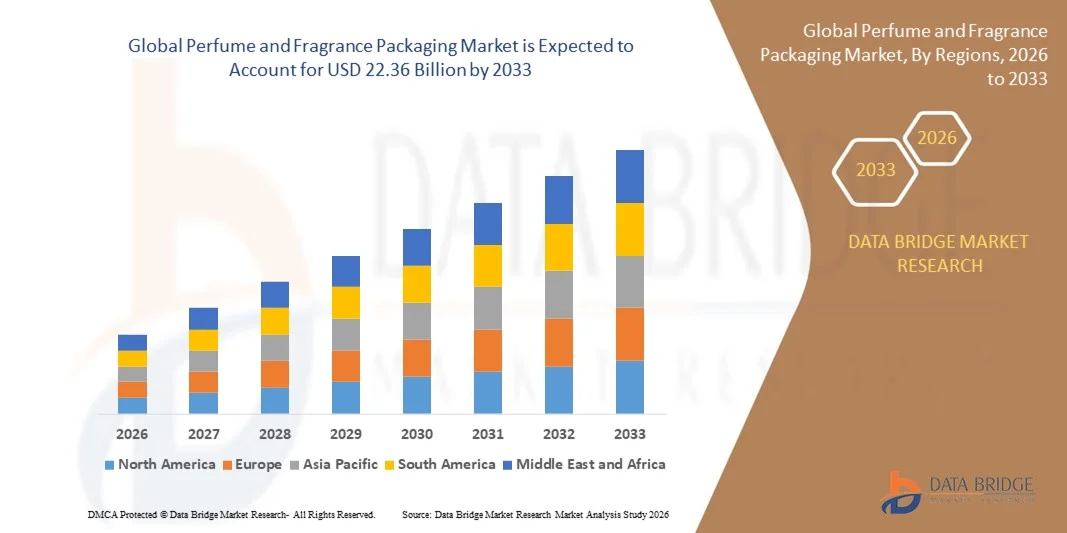
- As per Data Bridge Market Research Analysis the global perfume and fragrance packaging market size was valued at USD 14.13 billion in 2025 and is expected to reach USD 22.36 billion by 2033, at a CAGR of 5.90% during the forecast period
- The market growth is largely fueled by the increasing demand for premium and luxury fragrances, which is driving innovation in aesthetically appealing, functional, and sustainable packaging solutions across both perfumes and deodorants
- Furthermore, rising consumer preference for eco-friendly, travel-friendly, and refillable packaging options is encouraging brands to adopt innovative materials and designs, thereby significantly boosting the adoption of advanced perfume and fragrance packaging solutions
Market Size and Forecast:
- Global Market Value (2025): USD 14.13 billion
- Expected Market Value (2033): USD 22.36 billion
- Forecast CAGR (2026–2033): 5.90%
Perfume and Fragrance Packaging Market Analysis
- Perfume and fragrance packaging, including bottles, cans, pumps, and refillable systems, is increasingly vital in enhancing brand appeal, preserving fragrance quality, and delivering convenience to consumers across both retail and e-commerce channels
- The escalating demand for innovative packaging is primarily fueled by growing consumer expectations for luxury, personalization, and sustainability, combined with the increasing popularity of gifting solutions and travel-size products
- North America dominated the perfume and fragrance packaging market with a share of 37.4% in 2025, due to the region’s well-established personal care industry and high consumer demand for premium and innovative fragrance products
- Asia-Pacific is expected to be the fastest growing region in the perfume and fragrance packaging market during the forecast period due to rapid urbanization, rising disposable incomes, and growing demand for premium and luxury fragrances in countries such as China, Japan, and India
- Bottles segment dominated the market with a market share of 44% in 2025, due to its established use in the fragrance industry and ability to preserve the product’s aroma and quality. Bottles provide versatile design options, allowing brands to create premium, visually appealing packaging that attracts consumers. The segment also benefits from compatibility with various closure systems, sprays, and atomizers, enhancing usability and convenience. Glass and high-quality plastic bottles often serve as collectibles or luxury items, further supporting strong demand. Bottles are widely adopted across both perfumes and deodorants due to their durability and premium perception. The market continues to see innovation in decorative and functional designs, strengthening their domina
Report Scope and Perfume and Fragrance Packaging Market Segmentation
|
Attributes |
Perfume and Fragrance Packaging Key Market Insights |
|
Segments Covered |
|
|
Countries Covered |
North America
Europe
Asia-Pacific
Middle East and Africa
South America
|
|
Key Market Players |
|
|
Market Opportunities |
|
|
Value Added Data Infosets |
In addition to the insights on market scenarios such as market value, growth rate, segmentation, geographical coverage, and major players, the market reports curated by the Data Bridge Market Research also include import export analysis, production capacity overview, production consumption analysis, price trend analysis, climate change scenario, supply chain analysis, value chain analysis, raw material/consumables overview, vendor selection criteria, PESTLE Analysis, Porter Analysis, and regulatory framework. |
Perfume and Fragrance Packaging Market Trends
Rising Demand for Sustainable and Refillable Fragrance Packaging
- A significant trend in the perfume and fragrance packaging market is the growing adoption of sustainable and refillable packaging solutions, driven by increasing consumer awareness of environmental impact and the need to reduce single-use plastics and packaging waste. This trend is elevating the role of eco-friendly materials and innovative dispensing systems as essential elements for luxury and mass-market fragrances
- For instance, Aptar Beauty has introduced refillable fragrance packaging systems that enable consumers to reuse perfume bottles, reducing waste and promoting sustainability initiatives across the industry. Such innovations are helping brands meet regulatory requirements and align with global sustainability goals while maintaining premium appeal
- Leading fragrance manufacturers and brands, including L’Oréal and LVMH, are increasingly integrating recyclable materials, biodegradable plastics, and glass alternatives into their packaging solutions. This adoption is positioning sustainable packaging as a critical differentiator for consumer choice, especially in the luxury and prestige segments
- The market is also witnessing strong growth in modular and refillable designs, allowing consumers to refill or reuse perfume bottles multiple times. These systems contribute to brand loyalty and encourage repeat purchases, while offering practical solutions for on-the-go lifestyles and gifting applications
- Premium and niche fragrance brands are focusing on sustainability to enhance brand image, incorporating refillable sprays, recyclable glass bottles, and innovative closures. This trend is further accelerating investment in research and development for sustainable packaging materials and processes
- Packaging companies are expanding production capabilities for sustainable materials, responding to rising demand from global fragrance brands. The shift toward environmentally conscious products is influencing design, material selection, and supply chain strategies, shaping the overall growth trajectory of the perfume and fragrance packaging market
Perfume and Fragrance Packaging Market Dynamics
Driver
Growing Consumer Preference for Premium and Luxury Fragrances
- The growing consumer demand for premium and luxury fragrances is driving the adoption of sophisticated and aesthetically appealing packaging solutions, as packaging plays a crucial role in brand positioning, consumer perception, and gifting appeal
- For instance, Chanel continues to invest in intricately designed glass bottles and decorative packaging for its luxury perfumes, enhancing both shelf appeal and consumer experience. Such high-quality packaging reinforces brand prestige, attracts new consumers, and supports higher price points
- The increasing popularity of personalized and limited-edition fragrances is further propelling demand for premium packaging solutions that combine functionality, durability, and visual appeal. Consumers are willing to pay a premium for packaging that enhances the perceived value and quality of the fragrance product
- Luxury packaging also enables brands to differentiate their products in a crowded market, leveraging unique materials, finishes, and designs to convey exclusivity and craftsmanship. This creates opportunities for packaging manufacturers to collaborate with leading brands on bespoke solutions
- The growing trend of gifting and seasonal launches in perfumes is stimulating investments in premium and decorative packaging that enhances unboxing experiences and consumer satisfaction. Brands are increasingly prioritizing packaging innovation as an integral part of their marketing and product development strategies
Restraint/Challenge
High Production Costs for Innovative and Eco-Friendly Packaging
- The perfume and fragrance packaging market faces challenges due to high production costs associated with premium, sustainable, and refillable materials, which require specialized manufacturing processes, advanced machinery, and skilled labor
- For instance, LVMH’s partnership with Eastman to produce sustainable resin components demonstrates the financial and technical investments required to implement eco-friendly packaging at scale. Such initiatives involve higher material costs, precise engineering, and rigorous quality standards to ensure product safety and brand compliance
- Producing high-quality glass bottles, refillable sprays, and decorative closures demands meticulous design, specialized raw materials, and stringent quality control, all of which increase operational expenses for packaging manufacturers
- The reliance on recyclable, biodegradable, or premium materials adds complexity to supply chains, affecting cost stability and production timelines. Maintaining both sustainability and luxury appeal often requires balancing innovation with economic feasibility
- Scaling these solutions across multiple markets while preserving design quality and meeting regulatory requirements continues to be a constraint. Manufacturers must optimize production efficiency and cost structures without compromising the premium perception and functionality of the packaging, posing ongoing challenges for the industry
Perfume and Fragrance Packaging Market Scope
The market is segmented on the basis of product type, material type, packaging type, capacity, size, and application.
- By Product Type
On the basis of product type, the perfume and fragrance packaging market is segmented into cans, bottles, and others. The bottles segment dominated the market with the largest revenue share of 44% in 2025, driven by its established use in the fragrance industry and ability to preserve the product’s aroma and quality. Bottles provide versatile design options, allowing brands to create premium, visually appealing packaging that attracts consumers. The segment also benefits from compatibility with various closure systems, sprays, and atomizers, enhancing usability and convenience. Glass and high-quality plastic bottles often serve as collectibles or luxury items, further supporting strong demand. Bottles are widely adopted across both perfumes and deodorants due to their durability and premium perception. The market continues to see innovation in decorative and functional designs, strengthening their dominance.
The cans segment is anticipated to witness the fastest growth rate from 2026 to 2033, fueled by rising demand for aerosol deodorants and travel-friendly fragrance products. For instance, brands such as Procter & Gamble are expanding their use of cans for deodorants to improve portability and user convenience. Cans offer lightweight, durable, and cost-effective solutions, particularly for mass-market products. Increasing awareness of hygienic dispensing and controlled release further drives their adoption. In addition, marketing trends focusing on vibrant and eye-catching can designs enhance consumer appeal in retail settings.
- By Material Type
On the basis of material type, the market is segmented into glass, plastic, metal, and paperboard. The glass segment dominated the market with the largest revenue share in 2025, supported by its premium appeal and ability to preserve fragrance integrity over time. Glass provides a luxurious look and feel, often preferred by high-end perfume brands for gifting and limited-edition releases. The material’s transparency enables creative design and branding opportunities, while its inert nature ensures chemical stability with fragrance oils. Glass packaging is also recyclable, which resonates with environmentally conscious consumers, strengthening its market presence. High-quality glass bottles continue to be associated with authenticity and elegance, reinforcing strong consumer trust. The segment benefits from innovations in colored, frosted, and textured glass for enhanced visual appeal.
The plastic segment is expected to witness the fastest CAGR from 2026 to 2033, driven by its lightweight nature, cost efficiency, and adaptability across various product types. For instance, Coty Inc. increasingly uses high-grade plastic bottles for travel-size perfumes and deodorants, catering to growing on-the-go lifestyles. Plastic packaging also allows for flexible shapes and vibrant colors, attracting younger consumer segments. The durability and shatter-resistant properties make it ideal for mass-market distribution and shipping. In addition, advancements in biodegradable and recyclable plastics enhance its adoption among sustainability-focused brands.
- By Packaging Type
On the basis of packaging type, the market is segmented into primary and secondary packaging. The primary packaging segment dominated the market with the largest revenue share in 2025, as it directly protects and dispenses the fragrance product while defining the brand’s visual identity. Primary packaging, such as bottles and cans, ensures product safety, prevents leakage, and maintains aroma stability. Luxury brands emphasize innovative primary packaging to differentiate their products in a crowded market. In addition, functional designs in primary packaging improve ease of use and consumer experience. Retailers and consumers alike value aesthetically appealing primary packaging, reinforcing its dominance. The market continues to see customization and personalization trends in primary packaging, further driving demand.
The secondary packaging segment is anticipated to witness the fastest growth rate from 2026 to 2033, fueled by increasing emphasis on gifting solutions and brand storytelling. For instance, L’Oréal invests in high-quality boxes and decorative wraps for perfumes to enhance shelf appeal and customer experience. Secondary packaging provides additional protection during shipping and improves visual merchandising. It also offers opportunities for creative designs, sustainable materials, and premium finishes, influencing purchase decisions. In addition, growing e-commerce sales highlight the importance of robust secondary packaging to prevent damage during transit.
- By Capacity
On the basis of capacity, the market is segmented into less than 100ml, 100-250ml, 250-500ml, and above 500ml. The 100-250ml segment dominated the market with the largest revenue share in 2025, driven by its suitability for daily use, affordability, and convenience for most consumers. This capacity balances product longevity and portability, making it a preferred choice across both perfumes and deodorants. The segment also allows brands to price products competitively while maintaining a premium perception. In addition, 100-250ml bottles are commonly used for gifting and limited-edition products, boosting consumer appeal. Retailers favor this capacity for stocking and display due to standardized sizing. Continued popularity in personal care routines ensures sustained demand for this segment.
The less than 100ml segment is expected to witness the fastest CAGR from 2026 to 2033, fueled by rising demand for travel-sized and sample products. For instance, Estée Lauder promotes mini perfumes to attract new consumers and support trial-based marketing. Smaller capacities are convenient for portability, gifting, and subscription boxes. They also reduce waste and appeal to consumers experimenting with multiple fragrances. In addition, the trend of on-the-go lifestyles and frequent travel enhances demand for compact packaging options.
- By Size
On the basis of size, the market is segmented into small, medium, and large. The medium-sized segment dominated the market with the largest revenue share in 2025, driven by its optimal balance between product quantity and affordability. Medium-sized packaging provides sufficient supply for regular users while remaining convenient for storage and display. Consumers perceive medium-sized bottles as value-for-money purchases, encouraging repeated purchases. The segment also aligns well with brand strategies for standard retail offerings across different markets. In addition, medium sizes facilitate design flexibility and premium finishes, enhancing visual appeal. Established fragrance brands continue to prioritize medium sizes to cater to mainstream consumer demand.
The small-sized segment is anticipated to witness the fastest growth rate from 2026 to 2033, fueled by the rising popularity of travel-friendly and sample perfumes. For instance, Chanel has expanded its mini collection to target frequent travelers and trial users. Small-sized packaging enables experimentation with different fragrances at lower costs. In addition, compact sizes support e-commerce and subscription box trends, enhancing accessibility and convenience. Marketing initiatives often leverage small sizes for promotional campaigns and gifting purposes, driving adoption.
- By Application
On the basis of application, the market is segmented into perfumes and deodorants. The perfumes segment dominated the market with the largest revenue share in 2025, driven by higher value per unit, luxury branding, and extensive use of premium packaging designs. Perfume packaging often incorporates glass, decorative elements, and intricate detailing to appeal to high-end consumers. The segment benefits from gift-driven purchases, seasonal launches, and brand loyalty initiatives. In addition, innovative packaging trends, such as personalization and limited editions, strengthen consumer engagement. Perfumes continue to set industry standards for aesthetics, quality, and brand storytelling, maintaining market dominance.
The deodorants segment is expected to witness the fastest CAGR from 2026 to 2033, fueled by growing hygiene awareness, expanding personal care markets, and demand for convenient, easy-to-use packaging. For instance, Unilever has introduced innovative aerosol and stick deodorant packaging to enhance portability and application ease. Deodorants often use cans or plastic bottles, providing lightweight, durable, and cost-effective solutions. In addition, increasing focus on functional benefits, on-the-go usage, and sustainable packaging boosts adoption. The segment continues to attract younger consumers through innovative and visually appealing packaging designs.
Perfume and Fragrance Packaging Market Regional Analysis
- North America dominated the perfume and fragrance packaging market with the largest revenue share of 37.4% in 2025, driven by the region’s well-established personal care industry and high consumer demand for premium and innovative fragrance products
- Consumers in the region highly value aesthetically appealing, sustainable, and functional packaging, which enhances brand perception and user experience
- This widespread adoption is further supported by high disposable incomes, strong retail and e-commerce infrastructure, and growing preference for personalized and luxury fragrances, establishing bottles and glass packaging as favored solutions for both perfumes and deodorants
U.S. Perfume and Fragrance Packaging Market Insight
The U.S. perfume and fragrance packaging market captured the largest revenue share in 2025 within North America, fueled by increasing consumer demand for premium fragrances and gifting solutions. Brands are prioritizing innovative packaging designs, sustainable materials, and travel-friendly formats to enhance consumer appeal. The growing trend of online fragrance purchases, combined with marketing initiatives focusing on luxury and personalization, is further propelling the market, while integration of sustainable materials, decorative elements, and user-friendly closures significantly contributes to expansion.
Europe Perfume and Fragrance Packaging Market Insight
The Europe perfume and fragrance packaging market is projected to expand at a substantial CAGR during the forecast period, driven by the presence of leading fragrance brands and strong consumer preference for premium and luxury packaging. Increasing urbanization and awareness of sustainable packaging are fostering adoption. European consumers are drawn to aesthetically appealing packaging that enhances brand value and gifting potential, with strong growth seen across perfumes and deodorants. Innovative designs, reusable or recyclable materials, and functional packaging that preserves fragrance quality continue to strengthen market demand.
U.K. Perfume and Fragrance Packaging Market Insight
The U.K. perfume and fragrance packaging market is anticipated to grow at a noteworthy CAGR during the forecast period, driven by high consumer demand for luxury fragrances and visually appealing packaging. Rising preference for gifting solutions and personalized packaging encourages both domestic and international brands to innovate, while well-developed retail and e-commerce channels support distribution of premium and travel-friendly packaging. Sustainability trends, including recyclable and eco-conscious materials, are further stimulating market growth.
Germany Perfume and Fragrance Packaging Market Insight
The Germany perfume and fragrance packaging market is expected to expand at a considerable CAGR during the forecast period, fueled by growing awareness of premium fragrances and sustainable packaging solutions. Germany’s strong presence of fragrance manufacturers and high consumer preference for innovative and eco-friendly packaging support adoption. Glass bottles and decorative packaging are particularly popular, and functional designs that preserve fragrance quality, alongside sustainable materials, further strengthen demand across both perfumes and deodorants.
Asia-Pacific Perfume and Fragrance Packaging Market Insight
The Asia-Pacific perfume and fragrance packaging market is poised to grow at the fastest CAGR during the forecast period of 2026 to 2033, driven by rapid urbanization, rising disposable incomes, and growing demand for premium and luxury fragrances in countries such as China, Japan, and India. Increasing adoption of e-commerce and modern retail channels is enhancing accessibility to diverse packaging formats, while government initiatives promoting sustainability and eco-friendly manufacturing practices encourage innovation in packaging materials. Growing interest in gifting, travel-friendly, and visually attractive perfume packaging is further boosting market growth.
Japan Perfume and Fragrance Packaging Market Insight
The Japan perfume and fragrance packaging market is gaining momentum due to high demand for premium fragrances and innovative, compact packaging. Japanese consumers value functional and aesthetically appealing designs that enhance usability and brand perception, while trends in travel-friendly formats and limited-edition packaging support growth in both perfumes and deodorants. Increasing focus on eco-friendly and recyclable materials is influencing product development and market adoption.
China Perfume and Fragrance Packaging Market Insight
The China perfume and fragrance packaging market accounted for the largest revenue share in Asia Pacific in 2025, attributed to rapid urbanization, rising middle-class incomes, and strong demand for luxury and premium fragrances. Increased adoption of glass bottles, travel-size packaging, and decorative designs is enhancing visual appeal and user experience. Growth of e-commerce and modern retail channels, along with strong domestic manufacturers, is driving market expansion, while government initiatives supporting sustainable packaging and innovation in materials further contribute to market growth.
Top Companies in Perfume and Fragrance Packaging Market
The perfume and fragrance packaging industry is primarily led by well-established companies, including:
- Gerresheimer AG (Germany)
- Saverglass SAS (France)
- Piramal Glass Private Limited (India)
- CCL Container (Canada)
- Estée Lauder Inc. (U.S.)
- Chanel (France)
- SGB Packaging Group (U.K.)
- Coverpla (Spain)
- Exal Corporation (U.S.)
- Premi Beauty Industries (India)
- AptarGroup, Inc. (U.S.)
- Brimar Packaging USA (U.S.)
- HCP Packaging (U.K.)
- Rieke (Germany)
Latest Developments in Global Perfume and Fragrance Packaging Market
- In 2025, Gerresheimer expanded its presence in the Asia-Pacific perfume packaging market by opening a new manufacturing facility in India, aimed at increasing production of high-end glass perfume bottles. This expansion addresses the growing regional demand for luxury fragrance packaging and strengthens Gerresheimer’s supply capabilities, enhancing its competitiveness in the rapidly growing Asia-Pacific market. The facility also allows faster delivery and localized production, supporting both international brands and domestic customers seeking premium packaging solutions
- In 2024, Aptar Beauty launched a new refillable fragrance packaging solution designed to reduce waste and support sustainability initiatives in the perfume industry. This innovation enables brands to offer eco-friendly and cost-efficient options to consumers, aligning with the growing global demand for sustainable packaging. By promoting refillable systems, Aptar Beauty is helping to decrease single-use packaging, enhance brand loyalty, and set a precedent for environmentally conscious practices in the fragrance packaging market
- In 2024, LVMH formed a strategic partnership with Eastman to leverage molecular recycling technology for producing sustainable resin components in perfume and cosmetics packaging. This collaboration reflects the industry’s shift toward eco-friendly solutions and reinforces LVMH’s commitment to sustainability. By integrating recycled and recyclable materials into its packaging, the partnership is set to reduce environmental impact while maintaining luxury standards, influencing broader adoption of sustainable practices across the fragrance packaging sector
- In 2024, Verescence inaugurated a new production line at its Mers-les-Bains facility in France, increasing its capacity for high-end glass bottles used in luxury perfume packaging. This expansion enables the company to meet rising global demand for premium fragrance bottles and strengthens its leadership position in the high-end segment. The added capacity also allows Verescence to serve a wider portfolio of luxury brands, supporting innovation in bottle design and customization
- In 2024, Albéa completed the sale of its fragrance pump business to Silgan Holdings, enhancing Silgan’s footprint in the global fragrance packaging market. This acquisition allows Silgan to expand its product portfolio, increase manufacturing capabilities, and better serve international perfume and deodorant brands. The move consolidates Silgan’s market presence and enables it to capitalize on the growing demand for functional and innovative dispensing solutions in fragrance packaging

- Interactive Data Analysis Dashboard
- Company Analysis Dashboard for high growth potential opportunities
- Research Analyst Access for customization & queries
- Competitor Analysis with Interactive dashboard
- Latest News, Updates & Trend analysis
- Harness the Power of Benchmark Analysis for Comprehensive Competitor Tracking
Global Perfume And Fragrance Packaging Market, Supply Chain Analysis and Ecosystem Framework
To support market growth and help clients navigate the impact of geopolitical shifts, DBMR has integrated in-depth supply chain analysis into its Global Perfume And Fragrance Packaging Market research reports. This addition empowers clients to respond effectively to global changes affecting their industries. The supply chain analysis section includes detailed insights such as Global Perfume And Fragrance Packaging Market consumption and production by country, price trend analysis, the impact of tariffs and geopolitical developments, and import and export trends by country and HSN code. It also highlights major suppliers with data on production capacity and company profiles, as well as key importers and exporters. In addition to research, DBMR offers specialized supply chain consulting services backed by over a decade of experience, providing solutions like supplier discovery, supplier risk assessment, price trend analysis, impact evaluation of inflation and trade route changes, and comprehensive market trend analysis.
Data collection and base year analysis are done using data collection modules with large sample sizes. The stage includes obtaining market information or related data through various sources and strategies. It includes examining and planning all the data acquired from the past in advance. It likewise envelops the examination of information inconsistencies seen across different information sources. The market data is analysed and estimated using market statistical and coherent models. Also, market share analysis and key trend analysis are the major success factors in the market report. To know more, please request an analyst call or drop down your inquiry.
The key research methodology used by DBMR research team is data triangulation which involves data mining, analysis of the impact of data variables on the market and primary (industry expert) validation. Data models include Vendor Positioning Grid, Market Time Line Analysis, Market Overview and Guide, Company Positioning Grid, Patent Analysis, Pricing Analysis, Company Market Share Analysis, Standards of Measurement, Global versus Regional and Vendor Share Analysis. To know more about the research methodology, drop in an inquiry to speak to our industry experts.
Data Bridge Market Research is a leader in advanced formative research. We take pride in servicing our existing and new customers with data and analysis that match and suits their goal. The report can be customized to include price trend analysis of target brands understanding the market for additional countries (ask for the list of countries), clinical trial results data, literature review, refurbished market and product base analysis. Market analysis of target competitors can be analyzed from technology-based analysis to market portfolio strategies. We can add as many competitors that you require data about in the format and data style you are looking for. Our team of analysts can also provide you data in crude raw excel files pivot tables (Fact book) or can assist you in creating presentations from the data sets available in the report.













