


Perfusion-Based Biomanufacturing Systems Market Overview
As per Data Bridge Market Research analysis The Perfusion-Based Biomanufacturing Systems Market was valued at USD 1.74 billion in 2025 and is projected to reach USD 6.19 billion by 2033, growing at a CAGR of 17.20% from 2026 to 2033. The market is experiencing steady growth driven by increasing demand for high-yield biologics production, growing adoption of continuous bioprocessing technologies, and rising investments in biopharmaceutical manufacturing infrastructure.
The expanding pipeline of monoclonal antibodies, recombinant proteins, vaccines, and advanced cell and gene therapies, combined with the industry's focus on improving production efficiency and reducing manufacturing costs, is encouraging biopharmaceutical companies and CDMOs to implement perfusion-based manufacturing platforms. Advanced cell retention technologies, single-use bioreactor systems, and integrated process automation solutions are increasingly replacing conventional fed-batch processes in many facilities, offering enhanced productivity, improved product quality, and scalable manufacturing capabilities for next-generation biologics production.
Key Market Trends & Insights
- North America dominated the Perfusion-Based Biomanufacturing Systems Market with the largest revenue share of 38.46% in 2025, supported by a strong biopharmaceutical manufacturing base, extensive biologics R&D activities, and significant investments in continuous bioprocessing technologies.
- The Perfusion Bioreactors segment led the market with a 42.86% share in 2025, driven by their critical role in enabling continuous cell culture processes and high-density cell growth for biologics manufacturing.
- Asia-Pacific is expected to be the fastest-growing region at a CAGR of 9.1% from 2026 to 2033, fueled by expanding biomanufacturing capacity, growing biotechnology investments, and increasing demand for biologics across China, India, South Korea, and Japan.
- Sensors, Monitoring & Control Systems are the fastest-growing product type, projected to register a CAGR of 10.4%, reflecting the surge in the industry's increasing focus on automation, process optimization, and real-time quality assurance.
- The Alternating Tangential Flow segment dominated the cell retention technology category with a 39.74% revenue share in 2025, led by its superior cell retention efficiency, scalability, and compatibility with high-cell-density perfusion cultures.
- Monoclonal Antibody Production accounted for 44.13% of the market, preferred by the growing global demand for antibody-based therapeutics across oncology, autoimmune diseases, and infectious disease treatment
- The Cell & Gene Therapy Manufacturing segment is the fastest-growing application category, with a CAGR of 10.8%, driven by the rapid expansion of advanced therapy pipelines worldwide.
Market Size & Forecast
- Global Market Value (2025): USD 1.74 Billion
- Expected Market Value (2033): USD 6.19 Billion
- Forecast CAGR (2026–2033): 17.20%
- Leading Region in 2025: North America
- Fastest Growing Region: Asia Pacific
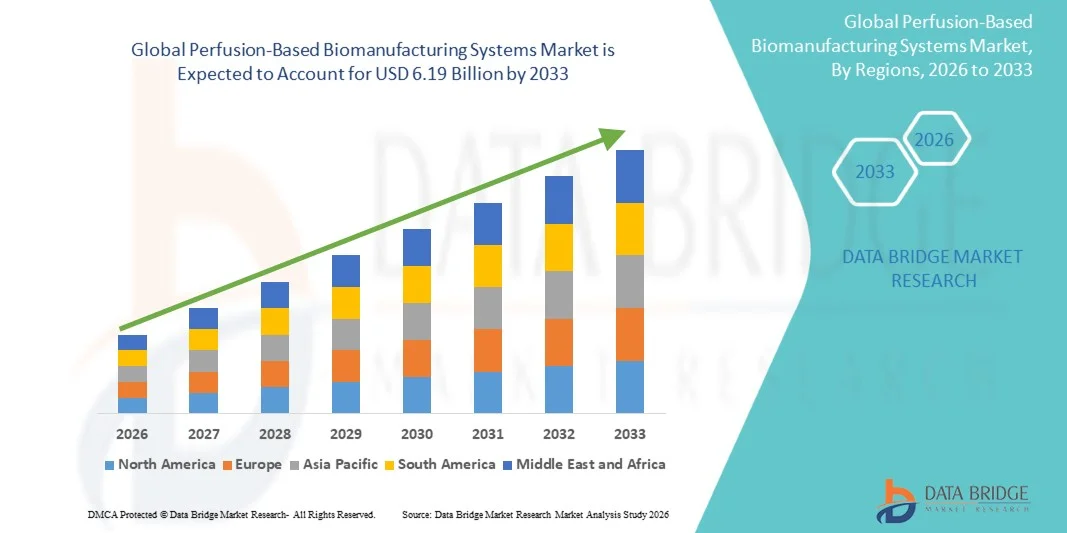
Report Scope and Perfusion-Based Biomanufacturing Systems Market Segmentation
|
Attributes |
Perfusion-Based Biomanufacturing Systems Key Market Insights |
|
Segments Covered |
|
|
Countries Covered |
North America · U.S. · Canada · Mexico Europe · Germany · France · U.K. · Netherlands · Switzerland · Belgium · Russia · Italy · Spain · Turkey · Rest of Europe Asia-Pacific · China · Japan · India · South Korea · Singapore · Malaysia · Australia · Thailand · Indonesia · Philippines · Rest of Asia-Pacific Middle East and Africa · Saudi Arabia · U.A.E. · South Africa · Egypt · Israel · Rest of Middle East and Africa South America · Brazil · Argentina · Rest of South America |
|
Key Market Players |
· Sartorius AG (Germany) · Repligen Corporation (U.S.) · Danaher (U.S.) · Merck KGaA (Germany) · Thermo Fisher Scientific Inc. (U.S.) · Eppendorf SE (Germany) · Getinge AB (Sweden) · GEA Group Aktiengesellschaft (Germany) · Corning Incorporated (U.S.) · PBS Biotech, Inc. (U.S.) · ABEC, Inc. (U.S.) · Meissner Filtration Products, Inc. (U.S.) · Entegris, Inc. (U.S.) · Solaris Biotechnology Srl (Italy) · INFORS HT (Switzerland) · Bionet Servicios Técnicos, S.L. (Spain) · CerCell ApS (Denmark) · Distek, Inc. (U.S.) · Broadley-James Corporation (U.S.) · Esco Lifesciences Group Ltd. (Singapore) |
|
Market Opportunities |
· Growing commercialization of cell and gene therapies · Increasing adoption of single-use perfusion bioreactors · Expansion of biopharmaceutical manufacturing capacity in emerging markets |
|
Value Added Data Infosets |
In addition to the insights on market scenarios such as market value, growth rate, segmentation, geographical coverage, and major players, the market reports curated by the Data Bridge Market Research also include in-depth expert analysis, patient epidemiology, pipeline analysis, pricing analysis, and regulatory framework. |
Perfusion-Based Biomanufacturing Systems Market Trends
Trend: Rising Adoption of Continuous Bioprocessing for High-Yield Biologics Manufacturing
Biopharmaceutical manufacturers are increasingly adopting perfusion-based biomanufacturing systems to enhance production efficiency, maintain consistent product quality, and achieve higher cell densities compared to traditional fed-batch processes. The integration of single-use technologies, advanced cell retention devices, and automated process control platforms enables continuous operation while reducing contamination risks and facility downtime. Contract development and manufacturing organizations are similarly implementing perfusion platforms to support growing demand for monoclonal antibodies, recombinant proteins, and next-generation therapies, while digital monitoring technologies create optimized environments that closely support scalable commercial biologics production.
For instance, in June 2024, Sartorius expanded its advanced bioprocessing solutions portfolio with enhanced perfusion technologies designed to improve continuous biologics manufacturing efficiency and productivity.
Perfusion-Based Biomanufacturing Systems Market Dynamics
Key Market Driver: Growing Demand for Monoclonal Antibodies and Advanced Cell Therapies
The rapid expansion of monoclonal antibody pipelines and advanced cell and gene therapy development has created substantial demand for perfusion-based biomanufacturing systems that can support high-density cell cultures, continuous harvesting, and consistent product quality across extended production cycles. Biopharmaceutical companies, CDMOs, and research organizations are deploying perfusion platforms as a core component of their manufacturing strategies, improving process productivity, accelerating commercialization timelines, and optimizing facility utilization. These capabilities are becoming increasingly important as manufacturers seek scalable solutions for complex biologics and personalized therapeutic products.
For instance, in February 2024, Cytiva highlighted expanded adoption of its perfusion bioprocessing technologies to support growing global demand for biologics and advanced therapy manufacturing.
Key Restraint/Challenge: High Implementation Complexity and Capital Investment Requirements
A significant restraint in the Perfusion-Based Biomanufacturing Systems Market is the high capital investment required for advanced continuous manufacturing infrastructure. Modern platforms integrate sophisticated bioreactors, cell retention technologies, automation systems, and real-time monitoring solutions, demanding substantial expenditure for procurement, validation, workforce training, and ongoing process optimization. The total cost of ownership extends to specialized consumables, system upgrades, and regulatory compliance activities, making adoption challenging for smaller biotechnology companies, academic facilities, and emerging-market manufacturers. These operational and financial barriers can delay deployment despite the long-term productivity benefits offered by perfusion technologies.
For instance, in 2024, several large-scale biopharmaceutical expansion projects across North America and Europe incorporated substantial investments in perfusion-enabled manufacturing facilities, underscoring the significant capital commitment required for advanced continuous bioprocessing infrastructure.
Key Market Opportunity: Expansion of Single-Use Perfusion Platforms in Emerging Biomanufacturing Hubs
The expansion of single-use perfusion technologies presents a significant market opportunity. Single-use platforms can improve manufacturing flexibility, reduce cleaning and validation requirements, and support faster facility deployment while maintaining high productivity levels. The development of integrated automation systems and scalable perfusion workflows is further increasing accessibility to advanced biomanufacturing, opening growth opportunities across rapidly developing biotechnology markets in Asia-Pacific, Latin America, and the Middle East.
For instance, in September 2024, Thermo Fisher Scientific continued expanding its single-use bioprocessing capabilities to support flexible biologics manufacturing and growing demand for continuous production technologies.
Perfusion-Based Biomanufacturing Systems Market Scope
The perfusion-based biomanufacturing systems market is segmented on the basis of product, cell retention technology, application, and end user.
- By Product
On the basis of product, the Perfusion-Based Biomanufacturing Systems Market is segmented into perfusion bioreactors, cell retention devices, perfusion media & reagents, sensors, monitoring & control systems, and consumables & accessories. The Perfusion Bioreactors segment dominated the market with a 42.86% share in 2025, driven by their critical role in enabling continuous cell culture processes and high-density cell growth for biologics manufacturing. These systems provide superior productivity compared to conventional fed-batch bioreactors, making them highly preferred for large-scale monoclonal antibody and recombinant protein production. Increasing demand for continuous bioprocessing and higher manufacturing efficiency is accelerating adoption across biopharmaceutical facilities. The segment also benefits from advancements in single-use bioreactor technologies that reduce contamination risks and operational costs. Growing investments in biologics production capacity expansion are further strengthening demand. Their ability to support consistent product quality and scalable manufacturing continues to maintain market leadership.
The Sensors, Monitoring & Control Systems segment is projected to register the fastest growth at a CAGR of 10.4% from 2026 to 2033, driven by the industry's increasing focus on automation, process optimization, and real-time quality assurance. These systems enable continuous monitoring of critical process parameters such as pH, dissolved oxygen, temperature, and nutrient levels. Regulatory emphasis on process analytical technology (PAT) and quality-by-design approaches is encouraging broader deployment. Advances in digital biomanufacturing, artificial intelligence, and predictive analytics are further enhancing system capabilities. Manufacturers are increasingly adopting smart monitoring solutions to minimize process variability and improve production efficiency. The growing trend toward fully integrated continuous manufacturing facilities is expected to accelerate segment growth.
- By Cell Retention Technology
On the basis of cell retention technology, the Perfusion-Based Biomanufacturing Systems Market is segmented into alternating tangential flow, tangential flow filtration, acoustic cell retention, spin filters, and centrifugal cell retention. The Alternating Tangential Flow (ATF) segment dominated the market with a 39.74% share in 2025 due to its superior cell retention efficiency, scalability, and compatibility with high-cell-density perfusion cultures. ATF systems are extensively utilized in commercial biologics manufacturing because they minimize cell damage while maintaining high product recovery rates. Their ability to support long-duration continuous processing makes them particularly suitable for monoclonal antibody and recombinant protein production. Biopharmaceutical manufacturers favor ATF technology for its operational reliability and proven performance across multiple commercial applications. Increasing adoption of intensified bioprocessing strategies is further supporting segment expansion. Strong validation history and regulatory acceptance continue to reinforce its dominant market position.
The Acoustic Cell Retention segment is expected to witness the fastest growth at a CAGR of 11.2% from 2026 to 2033, driven by technological advancements and increasing demand for gentle cell handling solutions. Acoustic systems use ultrasonic waves to separate and retain cells without physical filtration, reducing the risk of fouling and product loss. These technologies are gaining attention in cell and gene therapy manufacturing where cell viability is critical. Their ability to support continuous processing while minimizing shear stress is attracting significant industry interest. Ongoing innovation is improving scalability and operational performance. As advanced therapy production expands globally, adoption of acoustic retention technologies is expected to accelerate rapidly.
- By Application
On the basis of application, the Perfusion-Based Biomanufacturing Systems Market is segmented into monoclonal antibody production, recombinant protein production, vaccine manufacturing, cell & gene therapy manufacturing, viral vector production, stem cell expansion, and others. The Monoclonal Antibody Production segment dominated the market with a 44.13% revenue share in 2025, driven by the growing global demand for antibody-based therapeutics across oncology, autoimmune diseases, and infectious disease treatment. Perfusion-based systems enable higher cell densities and greater productivity, making them highly effective for large-scale antibody manufacturing. Biopharmaceutical companies are increasingly utilizing continuous processing approaches to improve yields and reduce production costs. The expanding pipeline of monoclonal antibody products is creating sustained demand for advanced manufacturing platforms. Regulatory approvals of new biologics continue to strengthen production requirements. The segment remains the primary revenue contributor due to its large commercial manufacturing volumes.
The Cell & Gene Therapy Manufacturing segment is projected to register the fastest growth at a CAGR of 10.8% from 2026 to 2033, driven by the rapid expansion of advanced therapy pipelines worldwide. Perfusion technologies support efficient cell expansion and consistent production environments required for complex therapeutic products. Growing investment in regenerative medicine and personalized therapies is increasing demand for scalable manufacturing solutions. Manufacturers are adopting perfusion systems to improve product quality and process control. Rising clinical trial activity and commercialization of gene therapies are creating additional opportunities. The need for flexible and high-performance production platforms is expected to fuel strong segment growth over the coming years.
- By End User
On the basis of end user, the Perfusion-Based Biomanufacturing Systems Market is segmented into biopharmaceutical companies, biotechnology companies, contract development and manufacturing organizations (CDMOs), contract research organizations (CROs), and academic & research institutes. The Biopharmaceutical Companies segment dominated the market with a 57.84% share in 2025, supported by extensive biologics manufacturing operations and significant investments in continuous bioprocessing technologies. These organizations represent the largest consumers of perfusion-based systems due to their high-volume production requirements for monoclonal antibodies, vaccines, and recombinant proteins. Increasing focus on manufacturing efficiency, product quality, and facility utilization is encouraging adoption of advanced perfusion platforms. Large-scale commercialization of biologics further strengthens demand from this segment. Continuous expansion of production capacities across major pharmaceutical companies is supporting market growth. Their strong financial resources and technological capabilities contribute significantly to segment leadership.
The Contract Development and Manufacturing Organizations (CDMOs) segment is expected to witness the fastest growth at a CAGR of 9.9% from 2026 to 2033, driven by increasing outsourcing of biologics development and manufacturing activities. Biopharmaceutical companies are relying on CDMOs to reduce capital expenditure and accelerate product commercialization timelines. Perfusion-based systems enable CDMOs to offer high-efficiency manufacturing services for diverse biologic products. Growing demand for flexible production capacity and specialized expertise is supporting segment expansion. Investments in advanced bioprocessing infrastructure are increasing across leading contract manufacturers. The rising complexity of biologics and advanced therapies is expected to further accelerate adoption of perfusion technologies within the CDMO sector.
Perfusion-Based Biomanufacturing Systems Market Regional Analysis
North America dominated the Perfusion-Based Biomanufacturing Systems Market with the largest revenue share of 38.46% in 2025, supported by a strong biopharmaceutical manufacturing base, extensive biologics R&D activities, and significant investments in continuous bioprocessing technologies. The region also benefits from strong adoption of continuous bioprocessing technologies, advanced research infrastructure, and increasing demand for monoclonal antibodies, vaccines, and cell and gene therapies. Growing implementation of single-use systems, process automation solutions, and high-density cell culture platforms across commercial manufacturing facilities continues to drive market expansion. Increasing focus on manufacturing efficiency, product quality, and next-generation biologics development continues to strengthen North America's leadership position in the global market.
U.S. Perfusion-Based Biomanufacturing Systems Market Insight
The U.S. perfusion-based biomanufacturing systems market is witnessing strong growth due to rising investments in biologics manufacturing capacity, continuous bioprocessing technologies, and advanced therapy development programs. The country’s mature biopharmaceutical ecosystem, along with increasing adoption of single-use bioreactors, automated process control systems, and high-density cell culture platforms, is driving demand across commercial manufacturing and research applications. In addition, growing emphasis on improving production efficiency, reducing manufacturing costs, and accelerating biologics commercialization is supporting wider adoption of perfusion-based manufacturing systems across biopharmaceutical companies and CDMOs.
Europe Perfusion-Based Biomanufacturing Systems Market Insight
The Europe perfusion-based biomanufacturing systems market remains a major contributor to global revenue, driven by strong regulatory support, technological innovation, and high demand for advanced biologics manufacturing solutions. The widespread adoption of continuous bioprocessing platforms across biopharmaceutical companies, contract manufacturers, and research institutions is supporting market expansion throughout the region. Increasing investments in single-use technologies, process automation, and next-generation therapeutic production, coupled with a highly skilled workforce and robust biotechnology sector, continue to enhance the adoption of perfusion-based systems across Europe.
U.K. Perfusion-Based Biomanufacturing Systems Market Insight
The U.K. perfusion-based biomanufacturing systems market is experiencing steady growth, supported by rising adoption of continuous manufacturing technologies, increasing biologics development activities, and expanding investment in life sciences infrastructure. Growing demand for efficient and scalable production solutions for monoclonal antibodies, vaccines, and advanced therapies is contributing to market growth. Furthermore, integration of digital bioprocessing platforms, real-time monitoring systems, and automated process controls is improving manufacturing performance and operational efficiency, positioning the U.K. as a key innovation hub in the perfusion-based biomanufacturing industry.
Germany Perfusion-Based Biomanufacturing Systems Market Insight
The Germany perfusion-based biomanufacturing systems market is expanding steadily due to the country’s strong biopharmaceutical manufacturing base, advanced research capabilities, and increasing adoption of next-generation bioprocessing technologies. Pharmaceutical companies, biotechnology firms, and research organizations are increasingly utilizing perfusion systems for biologics production, process optimization, and manufacturing scale-up activities. Continuous advancements in automation, cell retention technologies, and process analytical tools, along with strong government support for biotechnology innovation, are further driving market growth in Germany.
Asia-Pacific Perfusion-Based Biomanufacturing Systems Market Insight
The Asia-Pacific perfusion-based biomanufacturing systems market is expected to witness rapid growth, driven by expanding biopharmaceutical manufacturing capacity, increasing biotechnology investments, and rising demand for biologics across countries such as China, India, Japan, and South Korea. Growing awareness regarding continuous bioprocessing benefits, increasing adoption of advanced manufacturing technologies, and rising demand for cost-effective production solutions are supporting regional market expansion. In addition, the growing presence of global biopharmaceutical companies and contract manufacturing facilities is accelerating perfusion system adoption across commercial and research sectors.
Japan Perfusion-Based Biomanufacturing Systems Market Insight
The Japan perfusion-based biomanufacturing systems market is witnessing consistent growth due to rising investments in advanced biologics manufacturing technologies, regenerative medicine research, and pharmaceutical innovation initiatives. Biopharmaceutical manufacturers, research institutes, and biotechnology companies are increasingly adopting perfusion-based systems for biologics production, process development, and therapy commercialization purposes. Moreover, increasing integration of automated manufacturing technologies and the country’s focus on high-quality, efficient biopharmaceutical production are further contributing to market growth.
China Perfusion-Based Biomanufacturing Systems Market Insight
The China perfusion-based biomanufacturing systems market is growing rapidly, driven by expanding biotechnology infrastructure, increasing government support for biologics manufacturing, and rising demand for innovative therapeutic products. Growing adoption of continuous bioprocessing platforms, single-use manufacturing technologies, and advanced cell culture systems across biopharmaceutical and contract manufacturing sectors is significantly boosting market demand. In addition, rising investments in biologics research, increasing focus on domestic pharmaceutical innovation, and rapid technological advancements are positioning China as one of the fastest-growing markets for perfusion-based biomanufacturing systems globally.
Perfusion-Based Biomanufacturing Systems Market Share
The perfusion-based biomanufacturing systems industry is primarily led by well-established companies, including:
- Moog Inc. (U.S.)
- Sartorius AG (Germany)
- Repligen Corporation (U.S.)
- Danaher (U.S.)
- Merck KGaA (Germany)
- Thermo Fisher Scientific Inc. (U.S.)
- Eppendorf SE (Germany)
- Getinge AB (Sweden)
- GEA Group Aktiengesellschaft (Germany)
- Corning Incorporated (U.S.)
- PBS Biotech, Inc. (U.S.)
- ABEC, Inc. (U.S.)
- Meissner Filtration Products, Inc. (U.S.)
- Entegris, Inc. (U.S.)
- Solaris Biotechnology Srl (Italy)
- INFORS HT (Switzerland)
- Bionet Servicios Técnicos, S.L. (Spain)
- CerCell ApS (Denmark)
- Distek, Inc. (U.S.)
- Broadley-James Corporation (U.S.)
- Esco Lifesciences Group Ltd. (Singapore)
Latest Developments in Perfusion-Based Biomanufacturing Systems Market
- In April 2025, Thermo Fisher Scientific announced the launch of the 5L DynaDrive Single-Use Bioreactor, a bench-scale bioreactor designed to simplify and accelerate process development while enabling seamless scalability from 1 L to 5,000 L. The system supports intensified cell culture and perfusion-based manufacturing workflows, helping biopharmaceutical companies improve productivity, reduce scale-up complexity, and accelerate commercialization of biologic therapies. This launch strengthens Thermo Fisher’s position in the growing continuous bioprocessing and perfusion manufacturing market
- In June 2024, Dyadic International and Proliant Health & Biologicals announced a development and commercialization partnership focused on recombinant albumin products for cell culture and biomanufacturing applications. The collaboration aims to expand the availability of animal-free proteins used in advanced bioprocessing workflows, supporting the growing demand for high-performance biologics manufacturing technologies and next-generation cell culture systems
- In August 2023, Sartorius and Repligen Corporation launched an integrated bioreactor system combining the Biostat STR® bioreactor with Repligen’s XCell® ATF technology. The solution simplifies intensified seed-train and perfusion processing through a single control interface and integrated process analytical technology (PAT), enabling biopharmaceutical manufacturers to improve productivity, reduce facility complexity, and accelerate adoption of continuous biomanufacturing strategies
- In April 2022, GEA advanced its perfusion platform technology for biomanufacturing applications by integrating Axenic-line bioreactors with the kytero® single-use separator. The platform was developed to enhance cell density, improve productivity, and enable continuous perfusion processes while reducing media consumption and production costs. The development highlighted growing industry focus on scalable perfusion technologies for next-generation biomanufacturing facilities
- In March 2021, Thermo Fisher Scientific launched 3,000 L and 5,000 L HyPerforma DynaDrive Single-Use Bioreactors, expanding its large-scale bioprocessing portfolio for high-density cell culture and perfusion manufacturing. The new systems were designed to support cGMP biologics production, reduce scale-up requirements, and enable biopharmaceutical manufacturers to integrate single-use technologies into large-scale continuous bioprocessing operations. This development marked a significant advancement in commercial-scale perfusion biomanufacturing infrastructure

- Interactive Data Analysis Dashboard
- Company Analysis Dashboard for high growth potential opportunities
- Research Analyst Access for customization & queries
- Competitor Analysis with Interactive dashboard
- Latest News, Updates & Trend analysis
- Harness the Power of Benchmark Analysis for Comprehensive Competitor Tracking
Data collection and base year analysis are done using data collection modules with large sample sizes. The stage includes obtaining market information or related data through various sources and strategies. It includes examining and planning all the data acquired from the past in advance. It likewise envelops the examination of information inconsistencies seen across different information sources. The market data is analysed and estimated using market statistical and coherent models. Also, market share analysis and key trend analysis are the major success factors in the market report. To know more, please request an analyst call or drop down your inquiry.
The key research methodology used by DBMR research team is data triangulation which involves data mining, analysis of the impact of data variables on the market and primary (industry expert) validation. Data models include Vendor Positioning Grid, Market Time Line Analysis, Market Overview and Guide, Company Positioning Grid, Patent Analysis, Pricing Analysis, Company Market Share Analysis, Standards of Measurement, Global versus Regional and Vendor Share Analysis. To know more about the research methodology, drop in an inquiry to speak to our industry experts.
Data Bridge Market Research is a leader in advanced formative research. We take pride in servicing our existing and new customers with data and analysis that match and suits their goal. The report can be customized to include price trend analysis of target brands understanding the market for additional countries (ask for the list of countries), clinical trial results data, literature review, refurbished market and product base analysis. Market analysis of target competitors can be analyzed from technology-based analysis to market portfolio strategies. We can add as many competitors that you require data about in the format and data style you are looking for. Our team of analysts can also provide you data in crude raw excel files pivot tables (Fact book) or can assist you in creating presentations from the data sets available in the report.













