


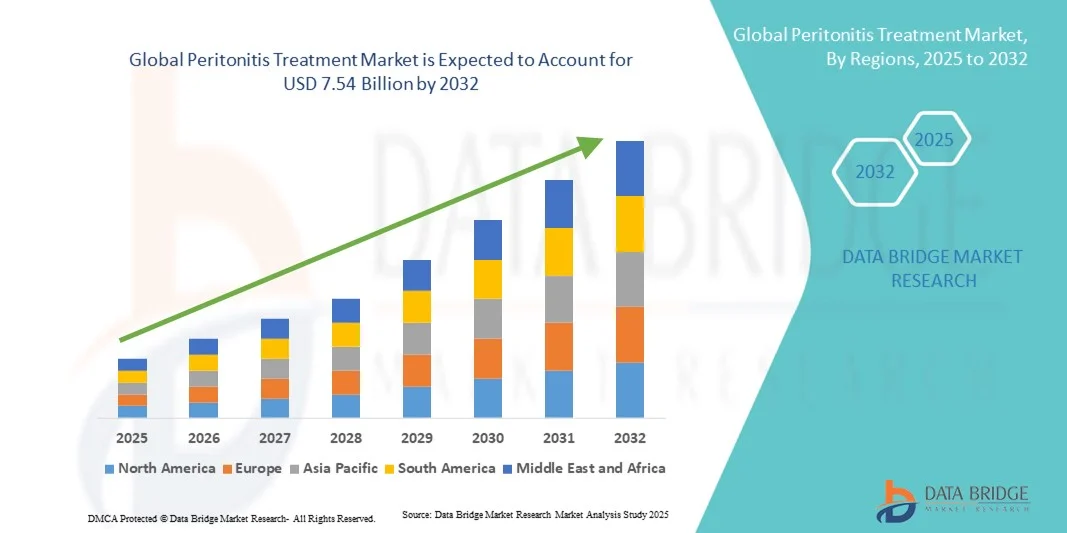
Peritonitis Treatment Market Size
- The global peritonitis treatment market size was valued at USD 4.70 billion in 2024 and is expected to reach USD 7.54 billion by 2032, at a CAGR of 6.10% during the forecast period
- The market growth is largely fueled by the increasing prevalence of peritonitis, advancements in antibiotics and treatment options, and growing awareness among healthcare providers and patients, leading to earlier diagnosis and improved patient outcomes
- Furthermore, rising demand for effective and accessible treatment solutions in both hospital and home care settings is establishing modern therapies and interventions as the preferred approach for managing peritonitis. These converging factors are accelerating the uptake of peritonitis treatment solutions, thereby significantly boosting the industry's growth
Peritonitis Treatment Market Analysis
- Peritonitis treatments, encompassing antibiotics, intravenous fluids, pain management, and surgical interventions, are increasingly vital components of modern healthcare systems due to their effectiveness in managing abdominal infections, preventing complications, and improving patient outcomes in both hospital and home care settings
- The escalating demand for peritonitis treatments is primarily fueled by the increasing prevalence of the condition, rising awareness among healthcare providers and patients, and advancements in antibiotic therapies and minimally invasive surgical techniques
- North America dominated the peritonitis treatment market with the largest revenue share of 38.7% in 2024, characterized by well-established healthcare infrastructure, high adoption of advanced treatment protocols, and a strong presence of key pharmaceutical and medical device players, with the U.S. experiencing substantial growth in hospital and outpatient treatments, driven by innovations in targeted antibiotic therapies and rapid diagnostic solutions
- Asia-Pacific is expected to be the fastest growing region in the peritonitis treatment market during the forecast period due to rising healthcare access, increasing incidence of abdominal infections, and growing investments in healthcare infrastructure across emerging economies
- Antibiotics segment dominated the peritonitis treatment market with a market share of 52.5% in 2024, driven by its established efficacy in controlling infections, broad availability, and continuous development of new formulations to address antibiotic-resistant strains
Report Scope and Peritonitis Treatment Market Segmentation
|
Attributes |
Peritonitis Treatment Key Market Insights |
|
Segments Covered |
|
|
Countries Covered |
North America
Europe
Asia-Pacific
Middle East and Africa
South America
|
|
Key Market Players |
|
|
Market Opportunities |
|
|
Value Added Data Infosets |
In addition to the insights on market scenarios such as market value, growth rate, segmentation, geographical coverage, and major players, the market reports curated by the Data Bridge Market Research also include in-depth expert analysis, pricing analysis, brand share analysis, consumer survey, demography analysis, supply chain analysis, value chain analysis, raw material/consumables overview, vendor selection criteria, PESTLE Analysis, Porter Analysis, and regulatory framework. |
Peritonitis Treatment Market Trends
Advancements in Targeted Antibiotic Therapies and Minimally Invasive Procedures
- A significant and accelerating trend in the global peritonitis treatment market is the development of targeted antibiotic therapies and minimally invasive surgical interventions. This integration is significantly enhancing treatment efficacy and reducing patient recovery times
- For instance, the introduction of novel broad-spectrum antibiotics combined with laparoscopic drainage techniques allows for faster resolution of infection with fewer complications. Similarly, catheter-based peritoneal lavage procedures are being refined for more precise infection control
- Targeted therapies enable personalization of treatment based on pathogen identification and antibiotic susceptibility, improving outcomes. For instance, some hospitals utilize rapid microbial testing to tailor antibiotic regimens and minimize unnecessary broad-spectrum use. Furthermore, minimally invasive procedures reduce hospitalization duration, lower complication rates, and allow earlier patient mobility
- The seamless combination of pharmacological and procedural innovations facilitates more comprehensive management of peritonitis, addressing both infection control and supportive care. Through integrated treatment protocols, clinicians can monitor response, adjust therapy, and optimize recovery, creating a unified and patient-centered care experience
- This trend towards more precise, effective, and patient-friendly treatment strategies is fundamentally reshaping expectations for peritonitis management. Consequently, companies and hospitals are adopting rapid diagnostics, AI-based infection prediction tools, and advanced minimally invasive procedures
- The demand for therapies that combine targeted antibiotics and minimally invasive interventions is growing rapidly across hospital and home care settings, as healthcare providers increasingly prioritize efficacy, reduced complications, and faster patient recovery
Peritonitis Treatment Market Dynamics
Driver
Rising Incidence and Growing Awareness Among Healthcare Providers
- The increasing prevalence of peritonitis, especially among patients with cirrhosis, peritoneal dialysis, or abdominal surgeries, is a significant driver for the heightened demand for effective treatments
- For instance, in 2024, leading hospitals in North America reported increased adoption of guideline-based antibiotic protocols and minimally invasive drainage techniques to manage peritonitis cases efficiently. Such initiatives by key healthcare providers are expected to drive market growth in the forecast period
- As healthcare professionals become more aware of the importance of early diagnosis and treatment, peritonitis management protocols are being updated, resulting in improved patient outcomes and reduced mortality rates
- Furthermore, increasing awareness campaigns and continuous medical education programs are making hospitals and clinics prioritize timely interventions, reducing infection-related complications
- The availability of integrated treatment options, combining rapid diagnostics, targeted antibiotics, and surgical interventions, along with growing government and insurance support, are key factors propelling the adoption of advanced peritonitis management strategies in both developed and emerging regions
Restraint/Challenge
Antibiotic Resistance and High Treatment Costs
- The rising prevalence of antibiotic-resistant pathogens poses a significant challenge to effective peritonitis management and broader market adoption. Resistant infections can lead to prolonged hospital stays, higher complication rates, and increased mortality risk
- For instance, reports of multidrug-resistant E. coli and Klebsiella strains in hospital settings have made some clinicians cautious in treatment selection, requiring more complex and costly therapy regimens
- Addressing these challenges through the development of new antibiotics, combination therapies, and strict infection control protocols is crucial for maintaining treatment efficacy. In addition, the high cost of advanced therapies and minimally invasive procedures can limit access for patients in developing regions or for those without comprehensive health insurance coverage
- While generic antibiotics and standardized protocols are available, the need for specialized treatments, hospitalization, and monitoring increases overall healthcare expenditure, creating a barrier for widespread adoption
- Overcoming these challenges through antimicrobial stewardship, development of affordable treatment options, and improved insurance coverage will be vital for sustained market growth
Peritonitis Treatment Market Scope
The market is segmented on the basis of type, treatment type, diagnosis method, drug type, and end user.
- By Type
On the basis of type, the peritonitis treatment market is segmented into primary and secondary peritonitis. The Primary peritonitis segment dominated the market with the largest revenue share in 2024, driven by its high prevalence among patients with liver cirrhosis and those undergoing peritoneal dialysis. Hospitals and specialty clinics prioritize early diagnosis and treatment to reduce mortality rates. Standardized antibiotic regimens and rapid diagnostic tests are commonly applied to manage primary peritonitis. The recurrence risk and requirement for continuous monitoring contribute to consistent demand in developed markets. Advanced treatment guidelines further reinforce the segment’s dominance, as clinicians follow established protocols to improve patient outcomes.
The Secondary peritonitis segment is expected to witness the fastest growth during the forecast period, driven by increasing abdominal surgeries, gastrointestinal perforations, and trauma cases worldwide. The segment benefits from improvements in surgical interventions and post-operative care. Hospitals increasingly adopt minimally invasive techniques for faster recovery. Rising clinician awareness and the availability of advanced diagnostics help in timely management. Growth in emerging markets with expanding healthcare infrastructure supports higher adoption. Continuous innovations in treatment methods also fuel the segment’s rapid expansion.
- By Treatment Type
On the basis of treatment type, the peritonitis treatment market is segmented into antibiotics, intravenous fluids, pain medication, surgery, and others. The Antibiotics segment dominated the market with a share of 52.5% in 2024 due to its essential role as the first line of treatment in peritonitis management. Broad-spectrum antibiotics are widely administered for immediate infection control, and rapid microbial testing helps tailor therapy. Hospitals prioritize antibiotics to reduce complications and mortality. Continuous development of new formulations targeting resistant strains supports the segment’s leadership. The availability, efficacy, and ease of administration ensure antibiotics remain the preferred treatment. Widespread adoption across hospitals and clinics strengthens its dominant position.
The Surgery segment is expected to witness the fastest growth from 2025 to 2032, driven by the rising use of laparoscopic and minimally invasive procedures for secondary peritonitis and complex cases. Surgical interventions reduce recovery time and post-operative complications. Hospitals and specialty clinics are increasingly adopting these techniques for better outcomes. Investments in advanced surgical tools enhance efficiency and patient safety. Awareness campaigns and training for surgeons promote wider adoption. The need for precise, targeted interventions supports rapid market expansion.
- By Diagnosis Method
On the basis of diagnosis method, the peritonitis treatment market is segmented into medical imaging, blood tests, and examination. The Blood Tests segment dominated the market in 2024 due to its critical role in detecting infection markers, white blood cell counts, and pathogens. Rapid blood diagnostics allow timely antibiotic administration and improved patient outcomes. Hospitals monitor treatment response and detect complications early through blood tests. Technological advancements, such as automated analyzers, support accurate and faster results. Widespread adoption across developed markets reinforces dominance. Blood testing forms a cornerstone of peritonitis management protocols.
The Medical Imaging segment is expected to witness the fastest growth during the forecast period, driven by the increasing use of CT scans and ultrasound to identify infection source and severity in secondary peritonitis. Imaging helps guide surgical and minimally invasive interventions. Awareness of non-invasive diagnostics in emerging markets also supports adoption. Hospitals prefer imaging for precise treatment planning and monitoring recovery. Continuous technological innovations improve accuracy and efficiency. Growing investments in imaging infrastructure boost the segment’s expansion potential.
- By Drug Type
On the basis of drug type, the peritonitis treatment market is segmented into antibiotics and analgesics. The Antibiotics segment dominated the market in 2024 with the largest revenue share, owing to their essential role in treating bacterial infections causing peritonitis. Hospitals rely on broad-spectrum and targeted antibiotic therapies for immediate infection control. Rapid susceptibility testing enhances treatment effectiveness. Availability of both generic and branded antibiotics ensures wide access. Development of novel antibiotics targeting resistant strains reinforces market dominance. Adoption across hospitals and specialty clinics maintains consistent demand.
The Analgesics segment is expected to witness the fastest growth during the forecast period, driven by increasing focus on supportive care and patient comfort. Hospitals integrate analgesics into treatment protocols to manage pain effectively. Growing awareness of patient-centric care supports segment growth. Specialty clinics provide multimodal pain management strategies. Expansion of outpatient care settings promotes wider analgesic adoption. Rising healthcare access in emerging regions further boosts the segment’s rapid growth.
- By End User
On the basis of end user, the peritonitis treatment market is segmented into hospitals, specialty clinics, and others. The Hospitals segment dominated the market with the largest revenue share in 2024 due to advanced infrastructure, access to multidisciplinary care teams, and availability of diagnostics and treatment facilities. Hospitals manage the majority of peritonitis cases, including critical and post-surgical patients. Established treatment protocols and insurance coverage reinforce hospital dominance. High patient volumes and continuous monitoring contribute to steady demand. Hospitals lead in adoption of advanced therapies and minimally invasive procedures. Developed regions continue to drive hospital-based market growth.
The Specialty Clinics segment is expected to witness the fastest growth during the forecast period, fueled by increasing outpatient care for early-stage peritonitis, post-dialysis monitoring, and preventive interventions. Clinics provide convenient access to targeted treatments and follow-up care. Growing awareness among patients supports adoption. Expansion of healthcare access in urban and semi-urban areas contributes to growth. Integration of minimally invasive procedures in clinics enhances patient recovery. Specialty clinics’ focus on patient-centered care drives rapid segment expansion.
Peritonitis Treatment Market Regional Analysis
- North America dominated the peritonitis treatment market with the largest revenue share of 38.7% in 2024, characterized by well-established healthcare infrastructure, high adoption of advanced treatment protocols, and a strong presence of key pharmaceutical and medical device player
- Patients and healthcare providers in the region highly value the availability of advanced antibiotics, minimally invasive surgical procedures, and rapid diagnostic tools that improve treatment outcomes and reduce mortality rates
- This widespread adoption is further supported by strong healthcare funding, high per capita healthcare expenditure, and the presence of key pharmaceutical and medical device companies, establishing North America as the leading market for peritonitis treatment in both hospital and specialty clinic settings
U.S. Peritonitis Treatment Market Insight
The U.S. peritonitis treatment market captured the largest revenue share in 2024 within North America, driven by the country’s advanced healthcare infrastructure and widespread adoption of standardized treatment protocols. Patients and healthcare providers prioritize rapid diagnosis, effective antibiotic regimens, and minimally invasive surgical procedures to manage peritonitis efficiently. The growing incidence of hospital-acquired and post-surgical infections further fuels market demand. High healthcare spending, insurance coverage, and strong presence of leading pharmaceutical and medical device companies support market expansion. Moreover, ongoing research and development in targeted antibiotic therapies and novel treatment approaches significantly contribute to market growth. The focus on patient safety, improved outcomes, and reduced mortality continues to strengthen U.S. market dominance.
Europe Peritonitis Treatment Market Insight
The Europe peritonitis treatment market is projected to expand at a substantial CAGR throughout the forecast period, primarily driven by increasing prevalence of abdominal infections and stringent healthcare regulations. Rising urbanization and growing healthcare expenditure are fostering access to advanced treatments. European hospitals emphasize early diagnosis and timely intervention, while clinics adopt minimally invasive surgical techniques. Patients are also increasingly aware of peritonitis risks, supporting proactive treatment uptake. The market sees significant growth across hospitals, specialty clinics, and outpatient care settings. Continuous advancements in antibiotic therapies and supportive care solutions are accelerating market adoption in the region.
U.K. Peritonitis Treatment Market Insight
The U.K. peritonitis treatment market is anticipated to grow at a noteworthy CAGR during the forecast period, driven by heightened awareness of infection prevention and rising demand for advanced treatment options. Hospitals and specialty clinics increasingly adopt rapid diagnostic tools and targeted antibiotic regimens to reduce complications and improve patient outcomes. The country’s strong healthcare infrastructure and government-supported healthcare programs encourage timely treatment interventions. Patient awareness campaigns and preventive strategies further boost demand. Both hospital and outpatient settings are expanding adoption of minimally invasive procedures. Overall, growing focus on patient-centric care and improved survival rates supports market growth in the U.K.
Germany Peritonitis Treatment Market Insight
The Germany peritonitis treatment market is expected to expand at a considerable CAGR during the forecast period, fueled by increasing awareness of abdominal infections and emphasis on early diagnosis. Germany’s well-developed healthcare infrastructure ensures widespread access to advanced antibiotics, diagnostic tools, and minimally invasive surgical procedures. Hospitals prioritize reducing infection-related complications and improving recovery outcomes. Growing patient awareness and adherence to clinical guidelines support higher adoption of treatment protocols. Technological innovations in drug formulations and supportive care solutions further accelerate market growth. The country’s focus on quality healthcare delivery and clinical efficacy reinforces Germany’s market expansion.
Asia-Pacific Peritonitis Treatment Market Insight
The Asia-Pacific peritonitis treatment market is poised to grow at the fastest CAGR during 2025 to 2032, driven by rising incidence of abdominal infections, improving healthcare access, and expanding hospital infrastructure in countries such as China, India, and Japan. Government initiatives promoting healthcare development and early diagnosis are supporting market adoption. The growing number of specialty clinics and outpatient care centers enhances availability of targeted therapies. Increasing patient awareness and demand for effective treatments further fuel market growth. Investments in modern diagnostic tools and minimally invasive surgical solutions accelerate adoption. Emerging healthcare markets across APAC are rapidly expanding treatment accessibility, driving regional growth.
Japan Peritonitis Treatment Market Insight
The Japan peritonitis treatment market is gaining momentum due to the country’s advanced medical infrastructure, aging population, and increasing prevalence of abdominal infections. Hospitals prioritize minimally invasive surgical interventions and rapid diagnostic tools for better patient outcomes. The integration of advanced antibiotic regimens and supportive care enhances treatment efficacy. Growing awareness of early diagnosis and preventive strategies supports market adoption. Both hospital and outpatient care centers are witnessing increased demand for effective therapies. Continuous research and innovation in treatment approaches further drive market expansion in Japan.
India Peritonitis Treatment Market Insight
The India peritonitis treatment market accounted for the largest market revenue share in Asia-Pacific in 2024, attributed to the country’s rising healthcare access, expanding middle class, and increasing prevalence of abdominal infections. Hospitals and specialty clinics are adopting targeted antibiotic therapies and minimally invasive procedures to improve patient outcomes. Government initiatives promoting healthcare infrastructure and awareness campaigns support early diagnosis and treatment. The growing number of outpatient care facilities enhances treatment accessibility. Affordable treatment options and domestic pharmaceutical manufacturers contribute to market expansion. The rising focus on patient safety, reduced mortality, and improved recovery rates continues to propel India’s market growth.
Peritonitis Treatment Market Share
The Peritonitis Treatment industry is primarily led by well-established companies, including:
- Pfizer Inc. (U.S.)
- Merck & Co., Inc. (U.S.)
- Novartis AG (Switzerland)
- F. Hoffmann-La Roche Ltd (Switzerland)
- Astellas Pharma Inc. (Japan)
- GSK plc (U.K.)
- Gilead Sciences, Inc. (U.S.)
- FUJIFILM Toyama Chemical Co., Ltd. (Japan)
- Sanofi (France)
- Viatris Inc. (U.S.)
- Dr. Reddy’s Laboratories Ltd. (India)
- Johnson & Johnson and its affiliates (U.S.)
- Boehringer Ingelheim International GmbH (Germany)
- Lilly USA, LLC. (U.S.)
- Baxter (U.S.)
- Medtronic (Ireland)
- Polymedicure (India)
What are the Recent Developments in Global Peritonitis Treatment Market?
- In September 2025, Pharma Equity Group's subsidiary, Reponex Pharmaceuticals, received regulatory approval to initiate a Phase II clinical trial for RNX-011, a novel triple-action combination therapy targeting secondary peritonitis. The therapy combines fosfomycin, metronidazole, and GM-CSF administered intraperitoneally during surgery. The trial aims to evaluate its efficacy in reducing severe postoperative complications, including abscesses and re-operations
- In March 2025, a study published in Scientific Reports identified elevated effluent lactate levels as an independent predictor of adverse outcomes in peritoneal dialysis-associated peritonitis (PDAP). The research, conducted by Xiao Yu and colleagues, analyzed data from 1,200 PDAP patients and found that higher lactate concentrations were associated with increased risk of treatment failure and mortality
- In February 2025, the U.S. FDA approved Emblaveo, developed by AbbVie and Pfizer, for the treatment of complicated intra-abdominal infections (IAIs) in adults. The drug, used in combination with an antibiotic, addresses infections caused by antibiotic-resistant bacteria. The approval was based on a late-stage study involving 422 patients, achieving complete resolution of clinical symptoms
- In January 2024, Stanford Health Care released updated guidelines for the diagnosis and management of peritonitis in peritoneal dialysis patients. These guidelines adapt international recommendations to the specific needs of SHC patients, emphasizing timely diagnosis and appropriate antibiotic therapy
- In April 2022, the International Society for Peritoneal Dialysis (ISPD) released updated guidelines on peritonitis management. The guidelines revised definitions for refractory and relapsing peritonitis, peritonitis-associated catheter removal, and peritonitis-associated hospitalization, aiming to standardize treatment protocols and improve patient outcomes

- Interactive Data Analysis Dashboard
- Company Analysis Dashboard for high growth potential opportunities
- Research Analyst Access for customization & queries
- Competitor Analysis with Interactive dashboard
- Latest News, Updates & Trend analysis
- Harness the Power of Benchmark Analysis for Comprehensive Competitor Tracking
Data collection and base year analysis are done using data collection modules with large sample sizes. The stage includes obtaining market information or related data through various sources and strategies. It includes examining and planning all the data acquired from the past in advance. It likewise envelops the examination of information inconsistencies seen across different information sources. The market data is analysed and estimated using market statistical and coherent models. Also, market share analysis and key trend analysis are the major success factors in the market report. To know more, please request an analyst call or drop down your inquiry.
The key research methodology used by DBMR research team is data triangulation which involves data mining, analysis of the impact of data variables on the market and primary (industry expert) validation. Data models include Vendor Positioning Grid, Market Time Line Analysis, Market Overview and Guide, Company Positioning Grid, Patent Analysis, Pricing Analysis, Company Market Share Analysis, Standards of Measurement, Global versus Regional and Vendor Share Analysis. To know more about the research methodology, drop in an inquiry to speak to our industry experts.
Data Bridge Market Research is a leader in advanced formative research. We take pride in servicing our existing and new customers with data and analysis that match and suits their goal. The report can be customized to include price trend analysis of target brands understanding the market for additional countries (ask for the list of countries), clinical trial results data, literature review, refurbished market and product base analysis. Market analysis of target competitors can be analyzed from technology-based analysis to market portfolio strategies. We can add as many competitors that you require data about in the format and data style you are looking for. Our team of analysts can also provide you data in crude raw excel files pivot tables (Fact book) or can assist you in creating presentations from the data sets available in the report.












