


What is the Permanent Magnet Stepper Motors Market Size and Growth Rate?
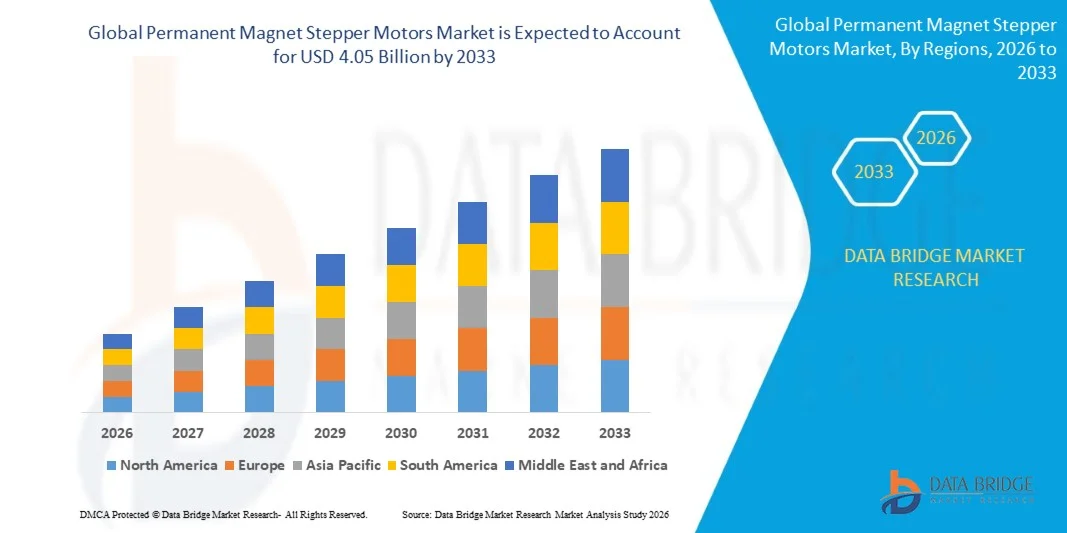
- As per Data Bridge Market Research analysis, the permanent magnet stepper motors market was valued at USD 2.83 billion in 2025 and is projected to reach USD 4.05 billion by 2033, growing at a CAGR of 4.60% from 2026 to 2033.
- The market is experiencing consistent growth driven by increasing demand for automation in industries, rising adoption of robotics and smart manufacturing technologies, and growing need for precise control in motion applications. Permanent magnet stepper motors are widely used in industrial automation, robotics, medical devices, and consumer electronics, providing precise and reliable motion control.
- The increasing automation in manufacturing processes, increased use of robotics across various sectors, and advancements in electric vehicles and renewable energy systems are supporting market expansion. In addition, the growing adoption of precision motion control systems, increasing industrialization, and investments in electronics manufacturing are contributing to demand for permanent magnet stepper motors.
Market Size & Forecast
- Global Market Value (2025): USD 2.83 Billion
- Expected Market Value (2033): USD 4.05 Billion
- Forecast CAGR (2026–2033): 4.60%
What are the Major Takeaways of the Permanent Magnet Stepper Motors Market?
- North America dominated the permanent magnet stepper motors market with the largest revenue share of 35.6% in 2025, supported by advanced industrial applications, high adoption of automation technologies, and a strong presence of key market players.
- Asia-Pacific is expected to be the fastest-growing region at a CAGR of 6.7% from 2026 to 2033, fueled by rapid industrialization, increased adoption of automation, and growing demand for robotics.
- The 2-phase hybrid steeper motors segment led the market with a 51.8% share in 2025, driven by their widespread use in industrial applications, office equipment such as printers, copiers, and scanners, and medical equipment such as surgical hand tools and medical pumps.
- 4-phase hybrid steeper motors are the fastest-growing type, projected to register a CAGR of 5.6%, reflecting the surge in demand for precision motion-control systems, robotics, and automated manufacturing equipment.
- The high-density polyethylene (HDPE) segment dominated the material type category with a 55.6% revenue share in 2025, led by its high impact resistance, chemical resistance, durability, and suitability for demanding industrial environments.
- Four-way entry accounted for 60.6% of the market share in 2025, preferred by the greater accessibility from multiple directions and improved handling flexibility
- The two-way entry segment is the fastest-growing design type category, with a CAGR of 4.5%, driven by applications where simple construction, lower material requirements, and cost efficiency are priorities.
Report Scope and Permanent Magnet Stepper Motors Market Segmentation
|
Attributes |
Permanent Magnet Stepper Motors Key Market Insights |
|
Segments Covered |
|
|
Countries Covered |
North America
Europe
Asia-Pacific
Middle East and Africa
South America
|
|
Key Market Players |
|
|
Market Opportunities |
|
|
Value Added Data Infosets |
In addition to the insights on market scenarios such as market value, growth rate, segmentation, geographical coverage, and major players, the market reports curated by the Data Bridge Market Research also include in-depth expert analysis, geographically represented company-wise production and capacity, network layouts of distributors and partners, detailed and updated price trend analysis and deficit analysis of supply chain and demand. |
What is the Key Trend in the Permanent Magnet Stepper Motors Market?
- Permanent magnet stepper motors are increasingly being integrated with advanced motion-control systems and microstepping technologies to improve positioning accuracy, smoothness, and efficiency across industrial automation, robotics, and embedded applications.
- For instance, in January 2021, researchers published an article in Applied Sciences proposing a current-error-based iterative learning controller with a nonlinear controller for permanent-magnet stepper motors; simulations showed reduced position-tracking error, supporting the trend toward sophisticated closed-loop and digital motor-control systems.
- The increasing integration of digital motor-control systems enables permanent magnet stepper motors to deliver more accurate and controllable motion in automation equipment, robotics, medical devices, and other precision applications.
- Industrial automation and robotics applications are increasingly adopting permanent magnet stepper motors because they provide precise positioning, repeatable motion, and controlled low-speed operation required in automated equipment.
- For instance, in January 2023, a study published in Processes demonstrating a PWM-driven permanent-magnet stepping motor for an instrument panel, highlighting the continued development of micro-stepping and digitally controlled permanent-magnet stepper motors for precise, low-vibration motion applications
- As manufacturers increasingly prioritize high-precision motion, thermal efficiency, controllability, and lower-maintenance motion systems, the integration of permanent magnet stepper motors with sophisticated control technologies is expected to remain a key market trend through the forecast period.
What are the Key Drivers of the Permanent Magnet Stepper Motors Market?
- The rapid expansion of industrial automation and robotics is increasing demand for permanent magnet stepper motors that provide precise positioning, repeatable motion, and reliable control in automated manufacturing equipment.
- For instance, in June 2024, a research article published in Heliyon reported that industrial applications account for 37% of the forecasted 2028 permanent-magnet and hybrid stepper motor market, while robotics represents 26.3%, highlighting the strong demand generated by industrial automation and robotics.
- Automotive, consumer electronics, medical devices, and industrial equipment manufacturers are increasingly incorporating precision motion-control systems into products and production processes, expanding the application base for permanent magnet stepper motors.
- The growing requirement for compact, energy-efficient, high-precision motion solutions is further supporting adoption in robotics, manufacturing equipment, medical devices, consumer electronics, and automotive applications.
- For instance, in May 2023, a research article in SN Applied Sciences developed and simulated a permanent-magnet synchronous motor for lightweight industrial robots, highlighting the importance of motor selection for robotic-system performance and efficiency.
- With industries increasingly relying on automation, robotics, digital motor control, and precision positioning, permanent magnet stepper motors are expected to remain an important motion-control technology across manufacturing and embedded applications.
Which Factors are Challenging the Growth of the Permanent Magnet Stepper Motors Market?
- Permanent magnet stepper motors face performance limitations at higher operating speeds, where torque decreases because the current may not reach its full value before the drive switches to the next phase.
- For instance, in November 2022, a research article published in IEEE Access found that mid-frequency instability generally limits the application of step motors with constant-voltage drives to a speed range well below the theoretical limit imposed by inductance, back electromotive force, and friction torque, highlighting the high-speed operating limitations of stepper motors.
- These speed-related torque limitations can restrict the use of conventional stepper motors in applications requiring high-speed operation, particularly when compared with alternative motor technologies capable of maintaining stronger torque at elevated speeds.
- Permanent magnet stepper motors can also experience large rotor inertia and relatively large step angles, while their permanent-magnet strength can decline, creating design constraints for applications requiring high dynamic performance.
- For instance, in November 2024, a research article in IET Electric Power Applications reported that manufacturing tolerances can significantly increase torque ripple in permanent-magnet motors; the study found that optimized designs reduced maximum torque ripple by 33% and average torque ripple by 16% under simulated manufacturing-tolerance distributions, demonstrating the design and manufacturing challenges affecting motor performance.
- These limitations in high-speed torque, rotor dynamics, and operating range can restrict adoption in demanding motion-control applications, requiring manufacturers to improve motor design and control strategies to maintain performance across wider operating conditions.
How is the Permanent Magnet Stepper Motors Market Segmented?
The permanent magnet stepper motors market is segmented on the basis of type, material type, design type, and application.
- By Type
On the basis of type, the permanent magnet stepper motors market is segmented into 2-phase hybrid steeper motors, 4-phase hybrid steeper motors, and others. The 2-phase hybrid steeper motors segment dominated the market with a 51.8% share in 2025, owing to their widespread use in industrial applications, office equipment such as printers, copiers, and scanners, and medical equipment such as surgical hand tools and medical pumps. These motors combine permanent-magnet and variable-reluctance operating principles, providing enhanced performance characteristics. Increasing miniaturization of equipment is supporting demand for compact stepper-motor solutions. Growing demand for waterproof stepper motors is also contributing to the segment's market leadership. Their ability to provide precise positioning and repeatable motion makes them suitable for a wide range of equipment and automation applications.
The 4-phase hybrid steeper motors segment is projected to register the fastest growth at an CAGR of 5.6% from 2026 to 2033, supported by increasing demand for precision motion-control systems, robotics, and automated manufacturing equipment. Four-phase configurations can provide controlled and accurate movement in applications requiring reliable positioning. Increasing industrial automation is expanding the requirement for advanced motor configurations. Growing adoption of robotics and automated production systems is creating additional demand for high-precision stepper motors. Advances in digital motor-control technologies are also improving operating efficiency and positioning accuracy
- By Material Type
On the basis of material type, the market is segmented into high-density polyethylene (HDPE) and polypropylene (PP). The high-density polyethylene (HDPE) segment dominated the market with 55.6% share in 2025, based on broader material-market research, owing to its high impact resistance, chemical resistance, durability, and suitability for demanding industrial environments. HDPE is widely used where resistance to moisture and chemicals is required. Its durability supports applications involving repeated handling and mechanical stress. The material also provides a favorable strength-to-weight balance. Increasing demand for durable industrial components supports its broader use.
The polypropylene (PP) segment is projected to register the fastest growth at an CAGR of 5.0% from 2026 to 2033, supported by its lightweight characteristics, fatigue resistance, and suitability for applications involving repeated handling. PP provides good chemical resistance and can be manufactured into durable components. Increasing demand for lightweight and cost-effective materials is supporting its adoption. Its ability to withstand repeated flexing provides advantages in applications requiring mechanical durability. The material is also suitable for applications where reduced weight is important.
- By Design Type
On the basis of design type, the market is segmented into two-way entry and four-way entry. The four-way entry segment dominated the market with 60.6% share in 2025, supported by greater accessibility from multiple directions and improved handling flexibility. Four-way-entry designs allow equipment to approach the product from four sides. This provides greater flexibility during material handling and storage operations. The design is particularly useful in facilities with complex warehouse layouts. Increasing automation in material handling is supporting demand for designs that provide greater accessibility.
The two-way entry segment is expected to witness the fastest growth at an CAGR of 4.5% from 2026 to 2033, supported by applications where simple construction, lower material requirements, and cost efficiency are priorities. Two-way-entry designs provide access from two opposing sides. Their relatively straightforward construction can support economical manufacturing. These designs remain suitable for applications with standardized handling requirements. Demand from cost-sensitive users can support continued adoption. However, their restricted access compared with four-way designs can limit flexibility in automated handling environments.
- By Application
On the basis of application, the permanent magnet stepper motors market is segmented into telecommunication equipment, office equipment, medical equipment, industrial automation, consumer electronics, and others. The industrial automation segment dominated the market with a 43.5% share in 2025, driven by extensive use in CNC machines, robotics, automated assembly lines, and packaging machinery. These motors provide precise positioning and repeatable motion control required to maintain production quality and efficiency. Increasing automation in manufacturing processes is increasing demand for accurate motor-control solutions. Growing adoption of robotics for assembly, material handling, inspection, and other industrial operations is further supporting the segment. Investments in smart manufacturing and automated production lines are strengthening demand. Industrial automation therefore remains the largest application area in the global market.
The medical equipment segment is projected to witness the fastest growth at an CAGR of 6.0% from 2026 to 2033, supported by increasing demand for precise and repeatable motion in medical devices. Permanent magnet stepper motors are used in equipment requiring controlled positioning and movement. Applications include medical pumps, surgical hand tools, and other precision medical equipment. Increasing automation and miniaturization of healthcare equipment are creating additional opportunities. Demand for accurate and reliable motion-control systems is increasing as medical equipment becomes more sophisticated.
Which Region Holds the Largest Share of the Permanent Magnet Stepper Motors Market?
- North America dominated the permanent magnet stepper motors market with the largest revenue share of 35.6% in 2025, supported by advanced industrial applications, high adoption of automation technologies, and a strong presence of key market players.
- The region also benefits from rapid manufacturing automation, robotics adoption, and increasing deployment of advanced production technologies, which support demand for precise and reliable motors. According to the Association for Advancing Automation, North American companies ordered more than 31,000 robots in 2024, reflecting continued investment in automated manufacturing systems. Increasing adoption of robotics in automotive, electronics, food and beverage, and other manufacturing industries is creating opportunities for precision motion-control components
U.S. Permanent Magnet Stepper Motors Market Insight
The U.S. permanent magnet stepper motors market is witnessing strong growth due to increasing adoption of industrial automation, robotics, precision manufacturing, and advanced motion-control technologies. The country’s mature automotive, electronics, medical-equipment, and manufacturing industries provide a broad application base for stepper motors. The International Federation of Robotics reported that U.S. industrial robot installations increased 11% year-on-year to 38,000 units in 2025, demonstrating continued investment in automated production systems. Automotive remained the largest adopting industry, with 13,500 robot installations in 2025, while manufacturing robot density reached 307 robots per 10,000 employees. These developments are supporting demand for precise and reliable motor technologies used in automated machinery, robotics, and production equipment.
Asia-Pacific Permanent Magnet Stepper Motors Market Insight
The Asia-Pacific permanent magnet stepper motors market is expected to witness rapid growth, driven by expanding industrial automation, electronics manufacturing, robotics adoption, and investments in advanced production technologies across China, Japan, India, and other Asian economies. The region represented 74% of global industrial robot deployments in 2024, highlighting its strong manufacturing-automation ecosystem. China alone installed 295,000 industrial robots in 2024, accounting for 54% of global deployments, while India recorded a 7% increase to 9,100 installations. Increasing deployment of robotics and automated manufacturing systems is creating substantial demand for precision motion-control components, including stepper motors. The region's expanding electronics, automotive, semiconductor, and machinery industries are further strengthening the long-term application base for permanent magnet stepper motors.
Japan Permanent Magnet Stepper Motors Market Insight
The Japan permanent magnet stepper motors market is witnessing consistent growth due to the country's highly automated manufacturing environment, advanced robotics industry, and strong automotive and electronics sectors. Japan maintained its position as the second-largest industrial robot market globally, with 44,500 industrial robots installed in 2024 and an operational stock of approximately 450,500 units. Japan is also a major robotics manufacturing hub, with Japanese companies accounting for approximately 38% of global robot production. The country's automotive industry installed approximately 13,000 industrial robots in 2024, representing an 11% increase from the previous year. These high levels of factory automation support demand for compact, accurate, and reliable motion-control motors. Continued investment in robotics, automotive electrification, electronics, and automated production equipment is therefore supporting permanent magnet stepper motor adoption
China Permanent Magnet Stepper Motors Market Insight
The China permanent magnet stepper motors market is growing rapidly, driven by large-scale manufacturing automation, robotics adoption, electronics production, and government-supported industrial modernization. China installed a record 295,000 industrial robots in 2024, representing 54% of global deployments, while its operational industrial-robot stock exceeded 2 million units. The country's industrial robot installations increased 7% year-on-year, demonstrating continued expansion of automated manufacturing. China's manufacturing sector is increasingly adopting robotics across automotive, electronics, machinery, and other production industries, creating demand for precision motion-control technologies. The country has also become a major producer of industrial robots, strengthening its domestic automation ecosystem. These developments, combined with continued modernization of manufacturing facilities, are positioning China as one of the most important growth markets for permanent magnet stepper motors.
U.K. Permanent Magnet Stepper Motors Market Insight
The U.K. permanent magnet stepper motors market is experiencing steady growth, supported by increasing adoption of industrial automation, robotics, advanced manufacturing, and precision equipment. The country has an established engineering and manufacturing base spanning automotive, aerospace, electronics, healthcare, and industrial machinery applications. According to the International Federation of Robotics, the U.K. had approximately 2,500 industrial robot installations in 2024, demonstrating continued utilization of robotic automation across manufacturing. Although installations declined from the previous year, automation remains an important technology for improving production flexibility and efficiency. Increasing use of robotics and automated machinery creates opportunities for motion-control components such as stepper motors. Investments in advanced manufacturing and automation technologies are therefore expected to support continued market development.
Germany Permanent Magnet Stepper Motors Market Insight
The Germany permanent magnet stepper motors market is expanding steadily due to the country's strong automotive manufacturing base, highly automated factories, and advanced industrial-robotics ecosystem. Germany had 278,881 operational industrial robots in 2024, making it the largest robotics market in Europe, while its robot density reached 449 robots per 10,000 manufacturing employees, the highest level in Europe. Germany also accounted for approximately 5% of global industrial robot installations in 2024, demonstrating its importance in advanced manufacturing automation. The automotive industry remains the leading customer sector for industrial robots, while electrical and electronics manufacturing represents another major application area. Increasing investment in electric and hybrid vehicle production is creating new requirements for automated production processes and equipment. This strong automation environment continues to support demand for precision motion-control technologies, including permanent magnet stepper motors
Which are the Top Companies in Permanent Magnet Stepper Motors Market?
The permanent magnet stepper motors industry is primarily led by well-established companies, including:
- MinebeaMitsumi Inc. (Japan)
- ORIENTAL MOTOR CO., LTD. (Japan)
- SANYO DENKI CO., LTD. (Japan)
- Shinano Kenshi Co., Ltd. (Japan)
- TAMAGAWA SEIKI CO., LTD. (Japan)
- Shanghai MOONS' Electric Co., Ltd (China)
- Leadshine Technology Co., Ltd. (China)
- Nanotec Electronic GmbH & Co. KG (Germany)
- Dr. Fritz Faulhaber GmbH & Co. KG (Germany)
- Phytron GmbH (Germany)
- ElectroCraft, Inc. (U.S.)
- Applied Motion Products, Inc. (U.S.)
- Lin Engineering, Inc. (U.S.)
- Anaheim Automation, Inc. (U.S.)
- Parker-Hannifin Corporation (U.S.)
- JVL Industri Elektronik A/S (Denmark)
- Mclennan Servo Supplies Ltd. (U.K.)
- Motion Control Products Limited (U.K.)
- MABUCHI MOTOR CO., LTD. (Japan)
What are Latest Developments in Permanent Magnet Stepper Motors Market?
- In November 2025, Oriental Motor expanded its PKP Series with a new 0.51-inch (13 mm) stepper motor lineup, introducing the smallest stepper motors in its PKP Series. The new motors have a frame size of 13 mm and a mass of approximately 21–33 g, supporting applications where equipment downsizing and weight reduction are important. The launch strengthens Oriental Motor’s compact stepper-motor portfolio and demonstrates continued development toward smaller precision motion-control solutions.
- In September 2025, Oriental Motor announced the launch of its new αSTEP AZ Series DC Input Hollow Shaft Type motors, designed to simplify air suction and rotation mechanisms for electronic components and similar applications. The new motors feature a hollow shaft that enables direct air-pipe connection, reducing the need for additional components and simplifying equipment design. The products are available in 20 mm and 28 mm frame sizes and weigh as little as 70 g, supporting faster takt times when mounted on robotic end effectors.
- In August 2025, Sona SPEED Motors announced that its simplex permanent magnet stepper motors powered the NASA–ISRO NISAR mission launched on the GSLV-F16. The motors were developed in India and incorporated into the rocket hardware to precisely control the fuel-mixture ratio in the cryogenic engine actuator assembly. Their ability to provide accurate position control under launch stresses demonstrates the application of permanent magnet stepper motors in high-reliability aerospace systems.
- n April 2025, Oriental Motor introduced a renewed 2-Phase Stepper Motor PKP Series with a 13-mm frame size, designed for further downsizing and weight reduction of equipment. The motor has a mounting frame size of only 13 mm and a mass of 21 g, making it suitable for compact applications including robot-arm end effectors. The development reflects continued advances toward smaller and lighter stepper-motor solutions for precision automation
- In August 2023, Oriental Motor released new 2-phase and 5-phase PKP Series stepper motors equipped with magnetic encoders. The encoder-type motors incorporate a 1,000 P/R encoder, enabling high-precision position detection and accurate homing operations. The development combines the positioning characteristics of stepper motors with feedback-based position detection, supporting applications requiring improved positioning reliability.
- In July 2023, SonaSPEED and Vee Technologies reported that their simplex permanent magnet stepper motor had been selected for ISRO's Chandrayaan-3 launch vehicle. The motor was incorporated into the actuator assembly of the Launch Vehicle Mark-III and controlled the liquid-fuel and oxidizer mixture ratio of the rocket engine. The development demonstrated the capability of permanent magnet stepper motors to operate in demanding aerospace applications requiring accurate and dependable actuation. Chandrayaan-3 subsequently achieved a successful soft landing near the Moon's south pole in August 2023.

- Interactive Data Analysis Dashboard
- Company Analysis Dashboard for high growth potential opportunities
- Research Analyst Access for customization & queries
- Competitor Analysis with Interactive dashboard
- Latest News, Updates & Trend analysis
- Harness the Power of Benchmark Analysis for Comprehensive Competitor Tracking
Global Permanent Magnet Stepper Motors Market, Supply Chain Analysis and Ecosystem Framework
To support market growth and help clients navigate the impact of geopolitical shifts, DBMR has integrated in-depth supply chain analysis into its Global Permanent Magnet Stepper Motors Market research reports. This addition empowers clients to respond effectively to global changes affecting their industries. The supply chain analysis section includes detailed insights such as Global Permanent Magnet Stepper Motors Market consumption and production by country, price trend analysis, the impact of tariffs and geopolitical developments, and import and export trends by country and HSN code. It also highlights major suppliers with data on production capacity and company profiles, as well as key importers and exporters. In addition to research, DBMR offers specialized supply chain consulting services backed by over a decade of experience, providing solutions like supplier discovery, supplier risk assessment, price trend analysis, impact evaluation of inflation and trade route changes, and comprehensive market trend analysis.
Data collection and base year analysis are done using data collection modules with large sample sizes. The stage includes obtaining market information or related data through various sources and strategies. It includes examining and planning all the data acquired from the past in advance. It likewise envelops the examination of information inconsistencies seen across different information sources. The market data is analysed and estimated using market statistical and coherent models. Also, market share analysis and key trend analysis are the major success factors in the market report. To know more, please request an analyst call or drop down your inquiry.
The key research methodology used by DBMR research team is data triangulation which involves data mining, analysis of the impact of data variables on the market and primary (industry expert) validation. Data models include Vendor Positioning Grid, Market Time Line Analysis, Market Overview and Guide, Company Positioning Grid, Patent Analysis, Pricing Analysis, Company Market Share Analysis, Standards of Measurement, Global versus Regional and Vendor Share Analysis. To know more about the research methodology, drop in an inquiry to speak to our industry experts.
Data Bridge Market Research is a leader in advanced formative research. We take pride in servicing our existing and new customers with data and analysis that match and suits their goal. The report can be customized to include price trend analysis of target brands understanding the market for additional countries (ask for the list of countries), clinical trial results data, literature review, refurbished market and product base analysis. Market analysis of target competitors can be analyzed from technology-based analysis to market portfolio strategies. We can add as many competitors that you require data about in the format and data style you are looking for. Our team of analysts can also provide you data in crude raw excel files pivot tables (Fact book) or can assist you in creating presentations from the data sets available in the report.













