


What is the Personal Protective Equipment Market Size and Overview?
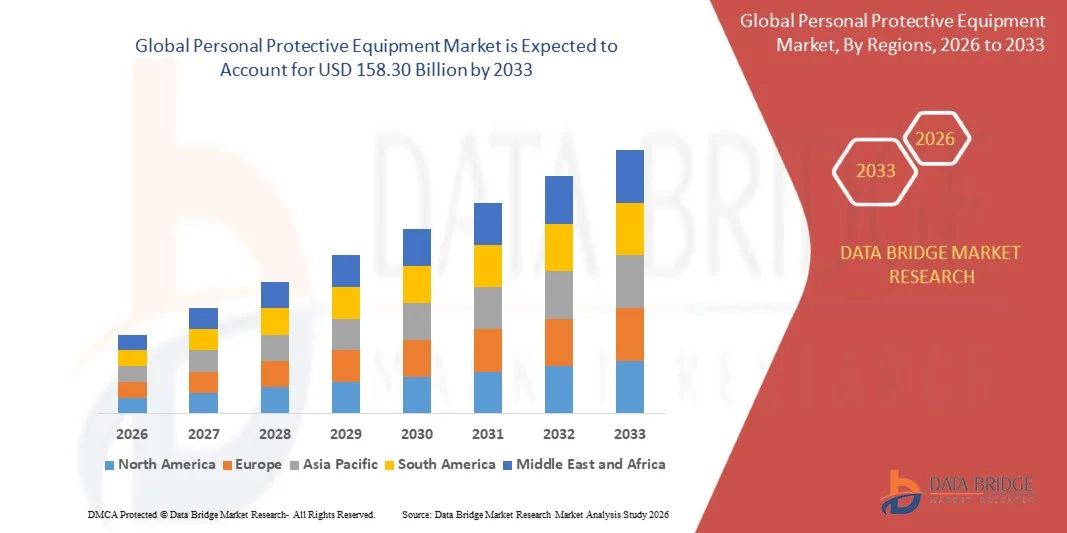
As per Data Bridge Market Research Analysis the global personal protective equipment market was valued at USD 90.77 Billion in 2025 and is projected to reach USD 158.30 Billion by 2033, growing at a CAGR of 7.20% from 2026 to 2033. The market is experiencing consistent growth driven by increasing workplace safety regulations, rising industrialization, and growing awareness regarding occupational health hazards across multiple industries. Expanding demand from construction, manufacturing, healthcare, oil & gas, and mining sectors is further supporting market expansion globally. Continuous advancements in smart PPE technologies, ergonomic safety equipment, and high-performance protective materials are also strengthening market growth across developed and emerging economies.
Market Size & Forecast
- Global Market Value (2025): USD 90.77 Billion
- Expected Market Value (2033): USD 158.30 Billion
- Forecast CAGR (2026–2033): 7.20%
The increasing global focus on worker safety and regulatory compliance, combined with stringent occupational health standards, is compelling industries to adopt advanced protective equipment across industrial operations. PPE solutions are increasingly being integrated with smart monitoring technologies and improved comfort-focused designs to enhance worker productivity and safety performance. Rising investments in infrastructure development, industrial automation, and hazardous worksite management are further accelerating adoption of protective equipment across high-risk working environments.
What are the Major Takeaways of Personal Protective Equipment Market?
- Asia-Pacific dominated the global personal protective equipment market with the largest revenue share of 39.5% in 2025, supported by rapid industrialization, large-scale construction activity, and expanding manufacturing output across major economies
- The protective clothing segment led the market with a 22.7% share in 2025, driven by extensive use in high-risk industrial environments requiring full-body safety coverage against chemical, thermal, and mechanical hazards
- North America is expected to be the fastest-growing region at a CAGR of 8.2% from 2026 to 2033, fueled by increasing industrial safety compliance, strong manufacturing activity, and rising demand from construction and energy sectors
- Pharmaceuticals are the fastest-growing end-use type, projected to register a CAGR of 10.5% from 2026 to 2033, supported by rising demand for contamination-free production environments and strict regulatory compliance in drug manufacturing and laboratory operations
- The manufacturing segment dominated the end-use category with a 18.5% revenue share in 2025, led by large-scale workforce deployment and continuous exposure to machinery-related risks across industrial operations
- The respiratory protection equipment segment is the fastest-growing product type category, with a CAGR of 7.9% from 2026 to 2033, driven by rising exposure to airborne hazards such as dust, fumes, and toxic gases in industrial and healthcare environments
Report Scope and Global Personal Protective Equipment Market Segmentation
|
Attributes |
Personal Protective Equipment Key Market Insights |
|
Segments Covered |
|
|
Countries Covered |
North America
Europe
Asia-Pacific
Middle East and Africa
South America
|
|
Key Market Players |
|
|
Market Opportunities |
|
|
Value Added Data Infosets |
In addition to the insights on market scenarios such as market value, growth rate, segmentation, geographical coverage, and major players, the market reports curated by the Data Bridge Market Research also include in-depth expert analysis, geographically represented company-wise production and capacity, network layouts of distributors and partners, detailed and updated price trend analysis and deficit analysis of supply chain and demand. |
What is the Key Trend in the Global Personal Protective Equipment Market?
Trend: Rising Adoption of Smart PPE
Industries are increasingly adopting smart Personal Protective Equipment integrated with sensors, communication systems, and real-time monitoring technologies to improve worker safety and operational efficiency. Smart helmets, connected respiratory devices, and wearable safety systems are gaining strong demand across construction, mining, oil & gas, and manufacturing sectors where workplace hazards remain high. Advancements in IoT-enabled safety monitoring and predictive risk management are further accelerating adoption of intelligent PPE solutions across industrial facilities.
Companies such as Honeywell International and 3M are expanding smart PPE product portfolios with connected safety platforms and sensor-enabled protective equipment designed to improve real-time worker monitoring and hazard detection.
Global Personal Protective Equipment Market Dynamics
Key Market Driver: Increasing Workplace Safety Regulations
The growing implementation of stringent occupational safety regulations across industrial sectors is significantly driving demand for Personal Protective Equipment worldwide. Governments and workplace safety organizations are enforcing stricter compliance standards to reduce workplace injuries, chemical exposure risks, and industrial accidents across construction, manufacturing, chemicals, and mining industries. Increasing corporate focus on employee safety and operational risk reduction is further strengthening adoption of advanced protective equipment across hazardous work environments.
Organizations such as Occupational Safety and Health Administration and the European Agency for Safety and Health at Work continue to strengthen workplace safety guidelines, compelling employers to increase investments in certified protective equipment and industrial safety programs.
Key Restraint/Challenge: Raw Material Cost Fluctuations
A major challenge in the Personal Protective Equipment market is the fluctuation in prices of raw materials such as nitrile rubber, polypropylene, specialty plastics, and industrial fabrics used in PPE manufacturing. Volatility in petroleum-based raw materials and supply chain disruptions significantly impact production costs and pricing stability for gloves, protective clothing, respirators, and helmets. Global logistics disruptions and rising transportation costs are further increasing procurement challenges for PPE manufacturers and distributors.
Companies such as Ansell and Lakeland Industries, Inc. have highlighted raw material inflation and supply chain pressures as key operational challenges affecting profitability and production planning in recent years.
Key Market Opportunity: Expansion of Sustainable and Eco-Friendly PPE Solutions
The increasing focus on sustainability and environmental responsibility is creating significant growth opportunities for eco-friendly Personal Protective Equipment solutions. Manufacturers are increasingly developing recyclable, biodegradable, and reusable PPE products to reduce industrial waste and improve sustainability compliance across workplaces. Rising corporate ESG commitments and stricter environmental regulations are accelerating demand for sustainable safety products across healthcare, manufacturing, and construction industries.
Companies such as DuPont de Nemours, Inc. and Uvex Safety Group are investing in sustainable protective materials and environmentally responsible PPE manufacturing processes to strengthen their position in the evolving global safety equipment market.
How is the Global Personal Protective Equipment Market Segmented?
The personal protective equipment market is segmented on the basis of product type and end-use.
- By Product Type
On the basis of product type, the global Personal Protective Equipment market is segmented into hands & arm protection equipment, protective clothing, foot & leg protection equipment, respiratory protection equipment, eye & face protection equipment, head protection equipment, other personal protective equipment, and hearing protection. The Protective Clothing segment dominated the market with the largest share of 22.7% in 2025, driven by extensive use in high-risk industrial environments requiring full-body safety coverage against chemical, thermal, and mechanical hazards. Strong adoption across manufacturing, construction, and oil & gas industries supports consistent demand for durable protective apparel. Strict occupational safety regulations across global markets further reinforce its leading position. Continuous material innovation in lightweight and high-performance fabrics also enhances compliance and usage across sectors.
The Respiratory Protection Equipment segment is projected to register the fastest growth at a CAGR of 7.9% from 2026 to 2033, driven by rising exposure to airborne hazards such as dust, fumes, and toxic gases in industrial and healthcare environments. Increasing enforcement of occupational health standards is accelerating adoption of advanced respirators and filtration-based systems. Growth in mining, chemicals, and manufacturing sectors further strengthens demand for respiratory safety solutions. Technological advancements in reusable respirators and high-efficiency particulate filters are improving user comfort and protection levels. Expanding industrialization and stricter air-quality compliance norms are expected to sustain strong growth momentum.
- By End-Use
On the basis of end-use, the global Personal Protective Equipment market is segmented into construction, manufacturing, chemicals, oil and gas, food, pharmaceuticals, transportation, mining, firefighting, and others. The Manufacturing segment dominated the market with the largest share of 18.5% in 2025, driven by large-scale workforce deployment and continuous exposure to machinery-related risks across industrial operations. High compliance with workplace safety standards in automotive, electronics, and heavy engineering industries supports sustained PPE usage. Strong regulatory enforcement of occupational safety norms further boosts adoption across production facilities. Increasing automation and industrial expansion continue to reinforce demand for comprehensive protective gear in manufacturing environments.
The Pharmaceuticals segment is projected to register the fastest growth at a CAGR of 10.5% from 2026 to 2033, driven by rising demand for contamination-free production environments and strict regulatory compliance in drug manufacturing and laboratory operations. Expanding biotechnology and vaccine production facilities are increasing the need for advanced protective equipment. Growing emphasis on sterile processing and controlled environments is further strengthening PPE adoption. Rising global pharmaceutical supply chain expansion increases exposure to biological and chemical hazards for workers. Continuous tightening of health and safety regulations is expected to sustain strong growth momentum in this segment.
Which Region Holds the Largest Share of the Global Personal Protective Equipment Market?
Asia-Pacific dominated the personal protective equipment market and accounted for the largest revenue share of 39.5% in 2025, supported by rapid industrialization, large-scale construction activity, and expanding manufacturing output across major economies. Strong presence of labor-intensive industries such as construction, automotive, electronics, and chemicals is driving consistent demand for safety gear. Increasing enforcement of occupational health and safety regulations across developing economies is further strengthening personal protective equipment adoption. In addition, growing infrastructure investments and rising awareness of workplace safety standards are accelerating regional market expansion. Continuous expansion of industrial workforce and outsourcing-based manufacturing ecosystems further reinforces Asia-Pacific’s leading position.
China Personal Protective Equipment Market Insight
China held the largest share in the Asia-Pacific personal protective equipment market in 2025, driven by its massive manufacturing base, large construction sector, and strong industrial output across heavy industries. The country has extensive use of personal protective equipment in electronics, automotive, steel, and chemical manufacturing facilities where worker safety compliance is strictly enforced. Rapid urbanization and ongoing infrastructure megaprojects are further boosting demand for protective equipment. In addition, strong domestic production capacity of personal protective equipment products ensures cost-effective supply across industrial sectors. Expanding export capabilities also strengthen China’s dominant position in the regional personal protective equipment market.
India Personal Protective Equipment Market Insight
India is witnessing the fastest growth in the Asia-Pacific region with a CAGR of 11.4% from 2026 to 2033, driven by rapid industrial expansion, infrastructure development, and rising construction activity. Increasing adoption of workplace safety regulations across manufacturing, mining, and oil & gas sectors is significantly supporting personal protective equipment demand. Growth in organized manufacturing under industrial development initiatives is further strengthening market penetration. Rising awareness regarding occupational health hazards and increasing use of standardized safety gear in SMEs are accelerating adoption. In addition, expansion of domestic personal protective equipment manufacturing capacity is improving affordability and availability across the country.
Europe Personal Protective Equipment Market Insight
The Europe Personal Protective Equipment market is expanding steadily, supported by strict occupational safety regulations, strong industrial automation, and high compliance standards across industries. Growing demand from manufacturing, construction, chemicals, and energy sectors is reinforcing personal protective equipment adoption across the region. Increasing focus on worker safety and sustainability-driven industrial practices is further boosting the use of advanced protective equipment. In addition, rising adoption of high-performance and ergonomic personal protective equipment solutions is supporting market growth. Strong regulatory enforcement under EU workplace safety frameworks continues to sustain long-term demand.
Germany Personal Protective Equipment Market Insight
Germany accounted for the largest share in the Europe personal protective equipment market in 2025, driven by its strong industrial base in automotive, engineering, chemicals, and manufacturing sectors. High emphasis on occupational safety compliance and advanced workplace safety systems supports widespread personal protective equipment adoption. The country’s strong automation and industrial production infrastructure further increases the need for specialized protective equipment. In addition, continuous innovation in high-quality safety gear manufacturing strengthens domestic supply capabilities. Strong export orientation of German safety equipment manufacturers further reinforces its leading market position.
U.K. Personal Protective Equipment Market Insight
The U.K. market is supported by growing demand across construction, healthcare, manufacturing, and energy sectors, driven by strict workplace safety regulations. Increasing focus on worker protection standards and compliance with health and safety frameworks is accelerating personal protective equipment adoption. Rising infrastructure development and refurbishment projects are further boosting demand for protective equipment. In addition, growing awareness of occupational hazards in small and medium enterprises is strengthening market penetration. Expansion of distribution channels and online procurement platforms is further supporting steady market growth.
North America Personal Protective Equipment Market Insight
North America is projected to grow at the fastest CAGR of 8.2% from 2026 to 2033, driven by increasing industrial safety compliance, strong manufacturing activity, and rising demand from construction and energy sectors. Growing emphasis on worker safety standards enforced by regulatory bodies is significantly boosting personal protective equipment adoption across industries. Technological advancements in smart personal protective equipment and high-performance materials are further accelerating market expansion. In addition, increasing investments in infrastructure modernization and oil & gas operations are strengthening regional demand. Rising focus on workplace risk mitigation and productivity enhancement is further supporting long-term growth.
U.S. Personal Protective Equipment Market Insight
The U.S. accounted for the largest share in the North America personal protective equipment market in 2025, supported by strong demand from construction, manufacturing, oil & gas, and healthcare sectors. High regulatory enforcement of occupational safety standards drives consistent personal protective equipment usage across industrial operations. The country’s advanced industrial base and large workforce exposure to hazardous environments further strengthen demand. In addition, growing adoption of smart and high-performance protective equipment is enhancing workplace safety efficiency. Strong presence of leading personal protective equipment manufacturers and distribution networks reinforces the U.S. leadership position in the regional market.
Which are the Top Companies in Global Personal Protective Equipment Market?
The personal protective equipment industry is primarily led by well-established companies, including:
- Honeywell International (U.S.)
- Lakeland Industries, Inc. (U.S.)
- DuPont de Nemours, Inc. (U.S.)
- 3M (U.S.)
- Alpha Pro Tech Limited (Canada/U.S.)
- Ansell (Australia)
- Avon Rubber P.L.C (Avon Technologies PLC) (U.K.)
- JAL Group Italia SRL (Italy)
- COFRA SRL (Italy)
- Uvex Safety Group (Germany)
- Rock Fall Limited (U.K.)
- BartelsRieger Atemschutztechnik GmbH & Co. KG (Germany)
- Mine Safety Appliances (MSA) Company (U.S.)
- Lindstrom Group (Finland)
- Mallcom Ltd. (India)
- Radians, Inc. (U.S.)
- Gateway Safety, Inc. (U.S.)
What are Latest Developments in Global Personal Protective Equipment Market?
- In May 2025, PIP Global Safety completed the acquisition of Honeywell’s PPE division, including major brands such as UVEX and North, significantly strengthening its global footprint and product portfolio. This acquisition enhances PIP’s competitive positioning in the global Personal Protective Equipment market by expanding its access to high-value industrial safety segments and established distribution networks. It also enables broader product integration across head-to-toe safety solutions, improving its ability to serve large-scale industrial clients. The move is expected to intensify market consolidation and increase competitive pressure on other global PPE manufacturers
- In April 2025, Honeywell confirmed the mid-year completion timeline for the USD 1.325 billion divestment of its PPE segment to Protective Industrial Products, signaling a strategic shift in capital allocation toward aviation, automation, and energy transition businesses. This divestment reshapes the PPE competitive landscape by transferring a major product portfolio to a focused safety equipment provider, strengthening PIP’s market scale and operational reach. The transaction is expected to accelerate portfolio specialization among major players in the PPE industry. In addition, it highlights a broader trend of large conglomerates exiting non-core safety divisions to focus on high-growth industrial technologies
- In March 2025, Techtronic Industries introduced the MILWAUKEE BOLT Safety Helmet with integrated chip-ready accessory mounts, enhancing modularity and compatibility with safety accessories. This product innovation strengthens the company’s position in the premium PPE segment by addressing growing demand for customizable and ergonomically advanced head protection solutions. It also reflects increasing market emphasis on smart, adaptable safety gear designed to improve worker efficiency and comfort. The launch is expected to drive competitive innovation in integrated PPE systems across industrial and construction applications
- In February 2025, the American Society of Safety Professionals introduced updated gender-specific fit guidelines aimed at addressing safety performance gaps in PPE design. These guidelines are influencing manufacturers to develop more inclusive product lines that improve fit, comfort, and protection for a more diverse workforce. The development is expected to accelerate innovation in ergonomically adaptive PPE solutions, particularly as women now represent a larger share of industrial labor forces. It also strengthens regulatory and design frameworks that enhance overall workplace safety standards across industries
- In March 2024, FallTech launched the FT-Lineman Pro Body Belt, a redesigned utility safety belt focused on improved ergonomics, versatility, and long-term support for industrial workers. This product expansion enhances FallTech’s presence in the fall protection and utility safety equipment segment of the PPE market. It responds to rising demand for comfort-oriented protective gear that reduces fatigue and improves worker productivity in high-risk environments. The launch is expected to strengthen the company’s positioning in utility and infrastructure safety applications

- Interactive Data Analysis Dashboard
- Company Analysis Dashboard for high growth potential opportunities
- Research Analyst Access for customization & queries
- Competitor Analysis with Interactive dashboard
- Latest News, Updates & Trend analysis
- Harness the Power of Benchmark Analysis for Comprehensive Competitor Tracking
Global Personal Protective Equipment Market, Supply Chain Analysis and Ecosystem Framework
To support market growth and help clients navigate the impact of geopolitical shifts, DBMR has integrated in-depth supply chain analysis into its Global Personal Protective Equipment Market research reports. This addition empowers clients to respond effectively to global changes affecting their industries. The supply chain analysis section includes detailed insights such as Global Personal Protective Equipment Market consumption and production by country, price trend analysis, the impact of tariffs and geopolitical developments, and import and export trends by country and HSN code. It also highlights major suppliers with data on production capacity and company profiles, as well as key importers and exporters. In addition to research, DBMR offers specialized supply chain consulting services backed by over a decade of experience, providing solutions like supplier discovery, supplier risk assessment, price trend analysis, impact evaluation of inflation and trade route changes, and comprehensive market trend analysis.
Data collection and base year analysis are done using data collection modules with large sample sizes. The stage includes obtaining market information or related data through various sources and strategies. It includes examining and planning all the data acquired from the past in advance. It likewise envelops the examination of information inconsistencies seen across different information sources. The market data is analysed and estimated using market statistical and coherent models. Also, market share analysis and key trend analysis are the major success factors in the market report. To know more, please request an analyst call or drop down your inquiry.
The key research methodology used by DBMR research team is data triangulation which involves data mining, analysis of the impact of data variables on the market and primary (industry expert) validation. Data models include Vendor Positioning Grid, Market Time Line Analysis, Market Overview and Guide, Company Positioning Grid, Patent Analysis, Pricing Analysis, Company Market Share Analysis, Standards of Measurement, Global versus Regional and Vendor Share Analysis. To know more about the research methodology, drop in an inquiry to speak to our industry experts.
Data Bridge Market Research is a leader in advanced formative research. We take pride in servicing our existing and new customers with data and analysis that match and suits their goal. The report can be customized to include price trend analysis of target brands understanding the market for additional countries (ask for the list of countries), clinical trial results data, literature review, refurbished market and product base analysis. Market analysis of target competitors can be analyzed from technology-based analysis to market portfolio strategies. We can add as many competitors that you require data about in the format and data style you are looking for. Our team of analysts can also provide you data in crude raw excel files pivot tables (Fact book) or can assist you in creating presentations from the data sets available in the report.













