


What is the Personal Transporter Size and Growth Rate?
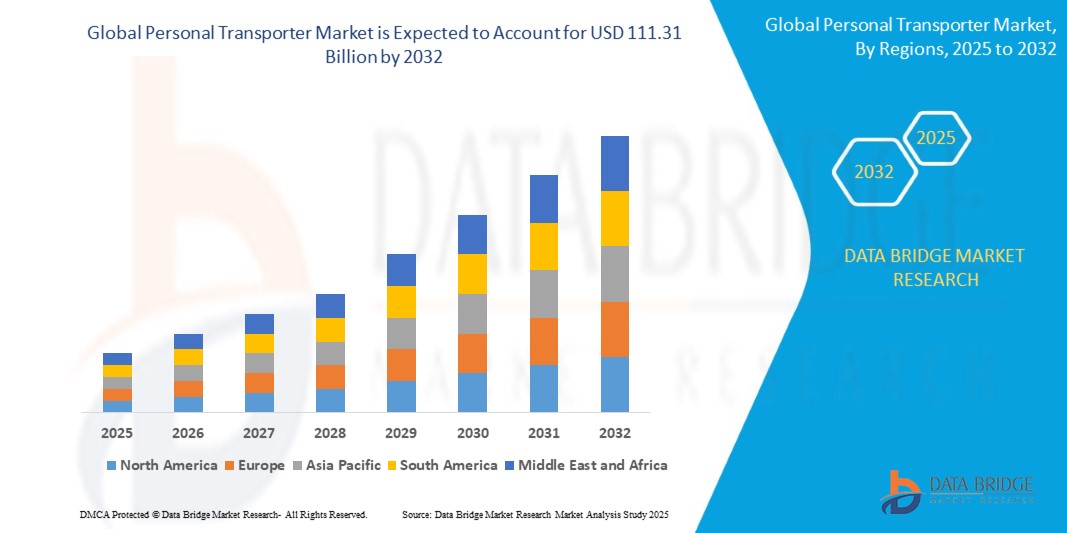
- As per Data Bridge Market Research Analysis the global personal transporter market size was valued at USD 57.96 billion in 2024 and is expected to reach USD 111.31 billion by 2032, at a CAGR of 8.50% during the forecast period
- The market growth is largely fuelled by the increasing demand for eco-friendly transportation alternatives, rising urban congestion, and growing consumer inclination towards compact and efficient mobility solutions
- The proliferation of electric scooters, hoverboards, and self-balancing vehicles, especially among millennials and commuters in densely populated cities, is also driving the expansion of the personal transporter market
Market Size & Forecast
- Global Market Value (2024): USD 57.96 billion
- Expected Market Value (2032): USD 111.31 billion
- Forecast CAGR (2024–2032): 8.50%
What are the Major Takeaways of Personal Transporter?
- Rapid urbanization, coupled with concerns over air pollution and traffic congestion, is propelling the adoption of personal transporters for last-mile connectivity
- Advancements in battery technologies, lightweight materials, and smart features such as GPS integration and smartphone connectivity are contributing to the market’s innovation and user appeal
- Asia-Pacific dominated the personal transporter market with the largest revenue share of 41.32% in 2024, driven by rapid urbanization, increasing middle-class income levels, and rising adoption of electric micromobility solutions across countries such as China, Japan, and India
- North America region is expected to witness the highest growth rate in the global personal transporter market, driven by increasing consumer inclination toward smart mobility solutions, growing awareness about environmental concerns, and the presence of leading companies actively developing lightweight and high-performance personal transport devices
- The e-bike segment dominated the market with the largest revenue share of 41.6% in 2024, driven by rising urban commuting needs and growing awareness regarding eco-friendly transport. E-bikes offer longer travel ranges, better speed control, and the familiarity of conventional cycling with electric assistance, making them a preferred choice for both recreational and daily use. Demand is further amplified by government subsidies and infrastructure development promoting electric mobility
Report Scope and Personal Transporter Market Segmentation
|
Attributes |
Personal Transporter Key Market Insights |
|
Segments Covered |
|
|
Countries Covered |
North America
Europe
Asia-Pacific
Middle East and Africa
South America
|
|
Key Market Players |
|
|
Market Opportunities |
|
|
Value Added Data Infosets |
|
What is the Key Trend in the Personal Transporter?
“Integration of Smart Features and Connectivity in Personal Transporters”
- Personal transporters are increasingly equipped with smart features such as Bluetooth connectivity, GPS tracking, and mobile app integration. These capabilities allow users to monitor battery levels, track usage, and even remotely lock or unlock devices. The result is enhanced convenience, security, and user engagement
- Real-time diagnostics and performance data through connected platforms are enabling predictive maintenance and better fleet management. This is especially useful for rental operators who rely on efficient operations and minimal downtime. Smart technologies are thus helping improve asset utilization and service reliability
- Features such as geofencing, route optimization, and ride history analysis are being adopted to personalize user experiences. These technologies also support safer riding practices by setting usage boundaries and monitoring speed. This blend of technology and mobility is attracting tech-savvy urban commuters
- For instance, Segway-Ninebot has introduced electric scooters with mobile app control, anti-theft systems, and over-the-air updates. These innovations reflect the growing demand for intelligent, responsive, and connected transport solutions. Such advancements are shaping the future direction of the market
- The integration of connectivity and smart technologies is redefining the personal transporter landscape. These innovations not only improve functionality but also align with consumer expectations for digital convenience. As adoption grows, smart mobility will become a central pillar of this market
Personal Transporter Market Dynamics
Driver
“Rising Demand for Eco-Friendly and Compact Urban Mobility Solutions”
- Urban congestion and pollution are pressing issues, driving interest in sustainable personal transport solutions. Personal transporters such as electric scooters and hoverboards offer zero-emission mobility for short distances. Their compact size and environmental benefits make them ideal for city travel
- Rising fuel costs and increasing preference for cost-effective commuting options are encouraging individuals to switch to electric transporters. These vehicles offer reduced operational costs, minimal maintenance, and easy handling. This appeals especially to students, young professionals, and city dwellers
- Government support for green mobility, including subsidies and incentives for electric vehicle adoption, is accelerating market growth. Infrastructure enhancements such as dedicated lanes and charging points further support this transition. These measures are laying a strong foundation for mass adoption
- For instance, cities such as Berlin and San Francisco have embraced e-scooter-sharing programs to reduce traffic and lower emissions. These initiatives provide convenient and eco-friendly travel options to urban populations. The popularity of these programs illustrates the growing acceptance of personal transporters
- In conclusion, rising urbanization, environmental concerns, and financial incentives are key drivers for the personal transporter market. These vehicles provide a sustainable solution for short-distance travel in cities worldwide. As technology evolves and policies align, adoption is set to accelerate further
Restraint/Challenge
“Safety Concerns and Regulatory Limitations Hampering Market Expansion”
- Personal transporters face scrutiny over safety due to a growing number of injuries and accidents. Many users ride without helmets or proper training, increasing the risk of harm. This has led to skepticism and hesitation among potential users and municipalities alike
- Regulatory inconsistencies across countries restrict where and how personal transporters can be used. In some regions, they are banned on sidewalks or public roads, limiting their practicality. These fragmented laws challenge global adoption and hinder cross-border growth of rental services
- Insurance and liability issues pose another barrier, especially in cases involving accidents or equipment failure. Lack of clear legal protections deters both individuals and fleet operators. These gaps in regulation create uncertainty and slow down investment in the segment
- For instance, in 2023, Paris voted to ban shared electric scooters due to safety concerns and improper usage by riders. This decision significantly impacted operator revenues and triggered tighter control across European cities. Such regulatory actions highlight the fragility of the market
- In conclusion, while personal transporters offer convenience and sustainability, safety and legal hurdles remain major obstacles. Addressing these issues through standardization, infrastructure support, and rider education is essential. Without these improvements, mass adoption may remain constrained in several regions
How is the Personal Transporter Segmented?
The market is segmented on the basis of vehicle type, product, weight capacity, travel range, and application.
• By Vehicle Type
On the basis of vehicle type, the personal transporter market is segmented into e-bike, e-scooter, e-hoverboard, e-skateboard, and others. The e-bike segment dominated the market with the largest revenue share of 41.6% in 2024, driven by rising urban commuting needs and growing awareness regarding eco-friendly transport. E-bikes offer longer travel ranges, better speed control, and the familiarity of conventional cycling with electric assistance, making them a preferred choice for both recreational and daily use. Demand is further amplified by government subsidies and infrastructure development promoting electric mobility.
The e-scooter segment is expected to witness the fastest growth rate from 2025 to 2032, fuelled by the surge in shared micro-mobility services across urban centers. E-scooters are compact, user-friendly, and ideal for last-mile connectivity, gaining traction among younger demographics and corporate commuters. Their integration into ride-sharing platforms and advancements in battery technologies are accelerating adoption rates globally.
• By Product
On the basis of product, the personal transporter market is segmented into retro, standing or self-balancing, and folding. The standing or self-balancing segment held the largest market share in 2024, driven by its compact design, ease of navigation, and growing popularity among city commuters. These models, which include hoverboards and certain smart scooters, are favored for their portability and minimal storage space requirements.
The folding segment is expected to witness the fastest growth rate from 2025 to 2032, propelled by its appeal to frequent travelers and those with limited storage options. Folding personal transporters are gaining attention due to their lightweight design and convenience, especially in regions with robust public transportation systems. As urban congestion rises, consumers seek flexible, stowable mobility solutions for multi-modal commuting.
• By Weight Capacity
On the basis of weight capacity, the personal transporter market is segmented into up to 10 kg, 10 kg–20 kg, and more than 20 kg. The 10 kg–20 kg segment dominated the market with the highest revenue share in 2024, attributed to its optimal balance between performance and portability. This weight range supports sufficient battery size and motor power while still being manageable for carrying and storage.
The more than 20 kg segment is expected to witness the fastest growth rate from 2025 to 2032, driven by increasing demand for high-performance models capable of supporting larger riders and longer distances. These transporters often include enhanced features such as dual motors, extended battery life, and advanced suspension systems, making them ideal for serious commuters and off-road enthusiasts.
• By Travel Range
On the basis of travel range, the market is segmented into up to 20 km, 20 km–35 km, and more than 35 km. The 20 km–35 km segment held the dominant share in 2024, offering the ideal middle ground for daily urban commutes without frequent recharging. These models are well-suited for typical city travel distances and offer reliable performance for routine usage.
The more than 35 km segment is expected to witness the fastest growth rate from 2025 to 2032, driven by demand from long-distance commuters and delivery services. As battery technology improves, these high-range transporters are becoming more accessible, delivering powerful performance and extended use per charge for commercial and personal applications.
• By Application
On the basis of application, the personal transporter market is segmented into on-road and off-road. The on-road segment accounted for the largest revenue share in 2024, supported by rising urbanization, expanding micromobility infrastructure, and consumer preference for convenient travel solutions in city environments. These transporters offer smooth rides on paved roads and are increasingly integrated into urban mobility strategies.
The off-road segment is expected to witness the fastest growth rate from 2025 to 2032, owing to the growing appeal of adventure travel and recreational usage. Off-road models feature rugged tires, reinforced frames, and powerful motors, appealing to thrill-seekers and users in rural or uneven terrains. Increased interest in outdoor exploration is driving demand for these specialized personal mobility solutions.
Which Region Holds the Largest Share of the How is Personal Transporter Segmented?
- Asia-Pacific dominated the personal transporter market with the largest revenue share of 41.32% in 2024, driven by rapid urbanization, increasing middle-class income levels, and rising adoption of electric micromobility solutions across countries such as China, Japan, and India
- The region’s strong manufacturing base, combined with government initiatives supporting electric mobility and sustainable transport, is accelerating the availability and affordability of personal transporters
- In addition, the widespread usage of e-scooters and e-bikes for daily commutes, coupled with expanding urban delivery services and a tech-savvy younger population, is contributing significantly to the market's expansion across both metropolitan and smaller cities
China Personal Transporter Market Insight
The China personal transporter market captured the largest revenue share in Asia-Pacific in 2024, supported by the country’s robust production capabilities, rapid technological advancements, and strong domestic demand for cost-effective urban mobility solutions. Government incentives promoting electric vehicles and smart city development, along with the rise of app-based micromobility services, are propelling demand. Furthermore, China's dense urban environments and growing logistics sector are creating favorable conditions for personal transporters used in both personal and commercial settings.
Japan Personal Transporter Market Insight
The Japan personal transporter market is expected to witness the fastest growth rate from 2025 to 2032, due to the nation's advanced infrastructure, aging population, and demand for convenient and compact mobility devices. Consumers are increasingly adopting electric scooters and bikes that integrate seamlessly with other smart systems. The country’s emphasis on safety, innovation, and energy efficiency is further strengthening market demand, with growing adoption across business districts, tourist zones, and residential communities.
North America Personal Transporter Market Insight
The North America personal transporter market is expected to witness the fastest growth rate from 2025 to 2032, supported by strong consumer interest in eco-friendly commuting, rising urban population, and the popularity of personal micromobility for last-mile connectivity. Growing demand for e-scooters, hoverboards, and e-bikes is prominent among working professionals and college students, especially in cities with well-developed bike lanes. Moreover, government support for sustainable transportation and the presence of leading mobility brands are further enhancing adoption across the U.S. and Canada.
U.S. Personal Transporter Market Insight
The U.S. personal transporter market accounted for the highest revenue share within North America in 2024, driven by increased preference for compact, electric-powered mobility devices suitable for urban travel and short commutes. The integration of personal transporters into public transportation systems, growth of shared mobility services, and rising consumer awareness regarding environmental sustainability are contributing to market expansion. Regulatory developments and infrastructure improvements continue to support the adoption of lightweight, foldable, and app-connected transport solutions.
Europe Personal Transporter Market Insight
The Europe personal transporter market is expected to witness the fastest growth rate from 2025 to 2032, attributed to increasing investments in urban mobility, the push for reduced carbon emissions, and the integration of personal transporters into multimodal transit systems. The demand for e-scooters, e-bikes, and similar devices is growing rapidly across cities due to their convenience, efficiency, and alignment with climate goals. Countries such as Germany, France, and the Netherlands are witnessing a rise in both personal ownership and shared-use micromobility services.
Germany Personal Transporter Market Insight
The Germany personal transporter market is expected to witness the fastest growth rate from 2025 to 2032, fueled by strong government support for e-mobility, the development of smart city initiatives, and rising environmental consciousness among consumers. The country’s cycling culture, coupled with investments in infrastructure and urban transport modernization, is driving the adoption of personal transporters for both leisure and commuting. Manufacturers are focusing on producing innovative, sustainable, and safety-enhanced devices to meet consumer expectations.
U.K. Personal Transporter Market Insight
The U.K. personal transporter market is expected to witness the fastest growth rate from 2025 to 2032, supported by ongoing trials for e-scooters, rising fuel costs, and increased preference for agile, low-emission personal mobility solutions. Consumers are turning toward transporters for convenience and to avoid urban congestion. The government’s focus on sustainability and expanding urban mobility infrastructure is creating favorable conditions for wider adoption, particularly among commuters, delivery personnel, and urban travelers.
Which are the Top Companies in Personal Transporter?
The Personal Transporter industry is primarily led by well-established companies, including:
- Hangzhou Chic Intelligent Technology Co., Ltd. (China)
- Airwheel Holding Limited (China)
- T3 Holdings, Inc. (U.S.)
- Onewheel (U.S.)
- BOXX Corp. (U.S.)
- Razor USA LLC (U.S.)
- INMOTION TECHNOLOGIES CO., LTD. (China)
- SEGWAY INC. (U.S.)
- Honda Motor Company, Ltd. (Japan)
- Inventist Inc. (U.S.)
- Jiangsu Xinri E-Vehicle Co., Ltd. (China)
- Terra Motors Corporation (Japan)
- Gogoro Inc. (Taiwan)
- BMW AG (Germany)
What are Latest Developments in Personal Transporter?
- In November 2023, Canadian electric mobility company Envo Drive Systems introduced the Utility Personal Transporter (UPT), which is currently in its functional prototype stage. The UPT is a four-wheel-drive electric platform designed to be highly adaptable, serving various purposes, akin to a more compact version of the REE "skateboard chassis" system. Envo presented the UPT to the media last Friday during an event that also highlighted the launch of their new Veemo velomobile. The UPT, however, bears a stronger resemblance to one of Envo's more established products, the e-ATV

- Interactive Data Analysis Dashboard
- Company Analysis Dashboard for high growth potential opportunities
- Research Analyst Access for customization & queries
- Competitor Analysis with Interactive dashboard
- Latest News, Updates & Trend analysis
- Harness the Power of Benchmark Analysis for Comprehensive Competitor Tracking
Global Personal Transporter Market, Supply Chain Analysis and Ecosystem Framework
To support market growth and help clients navigate the impact of geopolitical shifts, DBMR has integrated in-depth supply chain analysis into its Global Personal Transporter Market research reports. This addition empowers clients to respond effectively to global changes affecting their industries. The supply chain analysis section includes detailed insights such as Global Personal Transporter Market consumption and production by country, price trend analysis, the impact of tariffs and geopolitical developments, and import and export trends by country and HSN code. It also highlights major suppliers with data on production capacity and company profiles, as well as key importers and exporters. In addition to research, DBMR offers specialized supply chain consulting services backed by over a decade of experience, providing solutions like supplier discovery, supplier risk assessment, price trend analysis, impact evaluation of inflation and trade route changes, and comprehensive market trend analysis.
Data collection and base year analysis are done using data collection modules with large sample sizes. The stage includes obtaining market information or related data through various sources and strategies. It includes examining and planning all the data acquired from the past in advance. It likewise envelops the examination of information inconsistencies seen across different information sources. The market data is analysed and estimated using market statistical and coherent models. Also, market share analysis and key trend analysis are the major success factors in the market report. To know more, please request an analyst call or drop down your inquiry.
The key research methodology used by DBMR research team is data triangulation which involves data mining, analysis of the impact of data variables on the market and primary (industry expert) validation. Data models include Vendor Positioning Grid, Market Time Line Analysis, Market Overview and Guide, Company Positioning Grid, Patent Analysis, Pricing Analysis, Company Market Share Analysis, Standards of Measurement, Global versus Regional and Vendor Share Analysis. To know more about the research methodology, drop in an inquiry to speak to our industry experts.
Data Bridge Market Research is a leader in advanced formative research. We take pride in servicing our existing and new customers with data and analysis that match and suits their goal. The report can be customized to include price trend analysis of target brands understanding the market for additional countries (ask for the list of countries), clinical trial results data, literature review, refurbished market and product base analysis. Market analysis of target competitors can be analyzed from technology-based analysis to market portfolio strategies. We can add as many competitors that you require data about in the format and data style you are looking for. Our team of analysts can also provide you data in crude raw excel files pivot tables (Fact book) or can assist you in creating presentations from the data sets available in the report.













