


Personalized Cancer Vaccine Manufacturing Market Overview
As per Data Bridge Market Research analysis The Personalized Cancer Vaccine Manufacturing Market was valued at USD 1.18 billion in 2025 and is projected to reach USD 4.25 billion by 2033, growing at a CAGR of 17.40% from 2026 to 2033. The market is experiencing robust growth driven by increasing investments in precision oncology, rising adoption of personalized immunotherapies, and continuous advancements in genomic sequencing, neoantigen identification, and mRNA manufacturing technologies.
The growing global burden of cancer, coupled with the shift toward individualized treatment approaches and the expanding pipeline of personalized cancer vaccines, is encouraging biotechnology companies, pharmaceutical manufacturers, and contract development and manufacturing organizations (CDMOs) to enhance specialized production capabilities. Advanced manufacturing platforms, AI-driven antigen selection technologies, and scalable GMP-compliant production processes are increasingly being adopted to support the development of patient-specific vaccines, enabling faster turnaround times, improved therapeutic efficacy, and broader clinical application across multiple cancer indications.
Key Market Trends & Insights
- North America dominated the Personalized Cancer Vaccine Manufacturing Market with the largest revenue share of 39.82% in 2025, supported by a strong biotechnology ecosystem, significant oncology R&D investments, and the presence of leading vaccine developers and manufacturing facilities.
- The GMP Manufacturing segment led the market with a 38.64% share in 2025, driven by the critical requirement for compliant production of personalized cancer vaccines under stringent regulatory standards
- Asia-Pacific is expected to be the fastest-growing region at a CAGR of 12.1% from 2026 to 2033, fueled by expanding biopharmaceutical infrastructure, growing cancer prevalence, and rising investments in precision medicine across China, Japan, South Korea, and India
- Process Development are the fastest-growing manufacturing service type, projected to register a CAGR of 12.8%, reflecting the surge in complexity of personalized cancer vaccine pipelines.
- The mRNA-Based Personalized Cancer Vaccines segment dominated the vaccine platform category with a 44.36% revenue share in 2025, led by the rapid technological advancements and strong clinical development activity.
- Melanoma accounted for 29.74% of the market, preferred by its strong history as a primary target for cancer immunotherapy research.
- The Lung Cancer segment is the fastest-growing cancer type category, with a CAGR of 12.4%, driven by rising global incidence of lung cancer and increasing demand for innovative treatment approaches
Market Size & Forecast
- Global Market Value (2025): USD 1.18 Billion
- Expected Market Value (2033): USD 4.25 Billion
- Forecast CAGR (2026–2033): 17.40%
- Leading Region in 2025: North America
- Fastest Growing Region: Asia Pacific
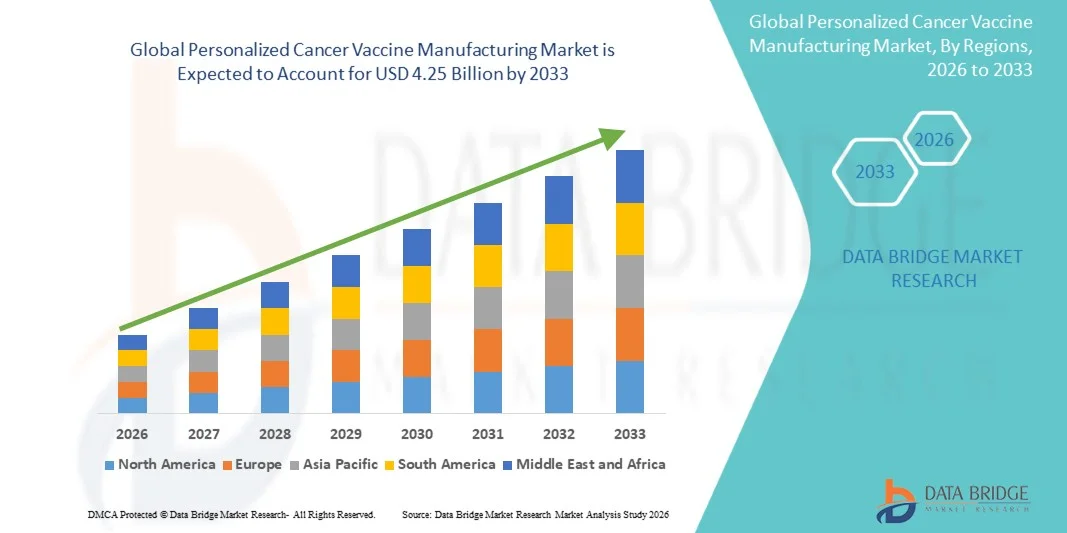
Report Scope and Personalized Cancer Vaccine Manufacturing Market Segmentation
|
Attributes |
Personalized Cancer Vaccine Manufacturing Key Market Insights |
|
Segments Covered |
|
|
Countries Covered |
North America · U.S. · Canada · Mexico Europe · Germany · France · U.K. · Netherlands · Switzerland · Belgium · Russia · Italy · Spain · Turkey · Rest of Europe Asia-Pacific · China · Japan · India · South Korea · Singapore · Malaysia · Australia · Thailand · Indonesia · Philippines · Rest of Asia-Pacific Middle East and Africa · Saudi Arabia · U.A.E. · South Africa · Egypt · Israel · Rest of Middle East and Africa South America · Brazil · Argentina · Rest of South America |
|
Key Market Players |
· Moderna, Inc. (U.S.) · BioNTech SE (Germany) · Merck & Co., Inc. (U.S.) · Genentech, Inc. (U.S.) · Gritstone bio, Inc. (U.S.) · Transgene SA (France) · CureVac SE (Germany) · Nouscom AG (Switzerland) · Geneos Therapeutics, Inc. (U.S.) · Evaxion Biotech A/S (Denmark) · Immunomic Therapeutics, Inc. (U.S.) · OSE Immunotherapeutics (France) · ISA Pharmaceuticals B.V. (Netherlands) · eTheRNA immunotherapies NV (Belgium) · Stemirna Therapeutics Co., Ltd. (China) · TriLink BioTechnologies, LLC (U.S.) · Lonza Group AG (Switzerland) · AGC Biologics (U.S.) · Cytiva (U.S.) · Recipharm AB (Sweden) |
|
Market Opportunities |
· Expansion of AI-driven neoantigen discovery platforms · Growing outsourcing demand for specialized CDMO manufacturing services · Development of scalable decentralized manufacturing models |
|
Value Added Data Infosets |
In addition to the insights on market scenarios such as market value, growth rate, segmentation, geographical coverage, and major players, the market reports curated by the Data Bridge Market Research also include in-depth expert analysis, patient epidemiology, pipeline analysis, pricing analysis, and regulatory framework. |
Personalized Cancer Vaccine Manufacturing Market Trends
Trend: Expansion of mRNA-Based Personalized Cancer Vaccine Manufacturing
Biopharmaceutical companies are increasingly investing in mRNA-based personalized cancer vaccine manufacturing to accelerate the development of patient-specific immunotherapies, improve production flexibility, and shorten treatment timelines. The integration of advanced genomic sequencing, bioinformatics platforms, and automated manufacturing systems enables rapid identification of tumor-specific neoantigens and efficient vaccine production. Research institutions and biotechnology firms are similarly expanding manufacturing capacity to support growing clinical pipelines, while AI-powered antigen selection technologies enhance precision and scalability across diverse cancer indications.
For instance, in June 2024, Moderna and Merck & Co., Inc. continued advancing individualized neoantigen therapy programs supported by scalable mRNA manufacturing capabilities, highlighting the industry's transition toward personalized vaccine production..
Personalized Cancer Vaccine Manufacturing Market Dynamics
Key Market Driver: Rising Adoption of Precision Oncology and Personalized Immunotherapy
The rapid expansion of precision oncology and personalized immunotherapy has created substantial demand for specialized manufacturing capabilities that can produce individualized cancer vaccines based on each patient's unique tumor profile. Biotechnology companies, pharmaceutical manufacturers, and research organizations are deploying advanced manufacturing platforms as a core component of their therapeutic development strategy, reducing production timelines, improving treatment specificity, and enhancing clinical outcomes through highly targeted immune responses.
For instance, in May 2024, BioNTech SE reported continued progress across multiple individualized cancer vaccine programs utilizing patient-specific neoantigen identification and mRNA manufacturing technologies, demonstrating the growing demand for precision-driven production infrastructure
Key Restraint/Challenge: Complex and Cost-Intensive Individualized Manufacturing Processes
A significant restraint in the Personalized Cancer Vaccine Manufacturing Market is the complexity and high cost associated with producing individualized therapies for each patient. Modern manufacturing workflows integrate genomic sequencing, neoantigen discovery, bioinformatics analysis, GMP production, and extensive quality testing, requiring substantial investment in specialized infrastructure, skilled personnel, and regulatory compliance. The overall manufacturing burden extends to logistics coordination, cold-chain management, and rapid turnaround requirements, making commercialization challenging for smaller biotechnology firms and resource-constrained healthcare systems.
For instance, in January 2024, several clinical-stage developers expanding personalized cancer vaccine programs reported increased investments in sequencing, analytical testing, and GMP manufacturing infrastructure, reflecting the broader challenge of maintaining cost-efficient individualized production at scale.
Key Market Opportunity: Expansion of Specialized CDMO and Decentralized Manufacturing Networks
The expansion of specialized contract development and manufacturing organizations and decentralized production networks presents a significant market opportunity. Dedicated manufacturing providers can offer flexible capacity, advanced process expertise, and regulatory support while enabling biotechnology companies to accelerate commercialization without major infrastructure investments. The development of modular manufacturing facilities and regional production hubs is further improving accessibility to personalized cancer vaccines, opening growth opportunities across emerging healthcare markets in Asia-Pacific, Latin America, and the Middle East.
For instance, in 2024, Lonza Group AG continued strengthening advanced biologics and cell-and-gene therapy manufacturing capabilities, supporting the broader industry trend toward outsourced and scalable personalized medicine production.
Personalized Cancer Vaccine Manufacturing Market Scope
The personalized cancer vaccine manufacturing market is segmented on the basis of manufacturing service type, vaccine platform, cancer type, and end user.
- By Manufacturing Service Type
On the basis of manufacturing service type, the Personalized Cancer Vaccine Manufacturing Market is segmented into process development, GMP manufacturing, fill-finish services, analytical testing & quality control, packaging & labeling, and regulatory support services. The GMP Manufacturing segment dominated the market with an estimated 38.64% share in 2025, owing to the critical requirement for compliant production of personalized cancer vaccines under stringent regulatory standards. As individualized vaccines move through clinical and commercial stages, manufacturers increasingly rely on GMP-certified facilities to ensure product quality, safety, and consistency. The segment benefits from rising investments in specialized cleanroom infrastructure and advanced manufacturing technologies. Growing numbers of clinical trials are also increasing demand for scalable GMP production capabilities. Regulatory agencies worldwide continue to emphasize manufacturing quality, further supporting segment growth. Its central role in vaccine production makes it the largest revenue-generating service category in the market.
The Process Development segment is projected to register the fastest growth at a CAGR of 12.8% from 2026 to 2033, driven by the increasing complexity of personalized cancer vaccine pipelines. Developers are focusing on optimizing manufacturing workflows to reduce production timelines and improve scalability. Advanced bioinformatics, neoantigen identification platforms, and automation technologies are creating strong demand for process optimization services. The need to accelerate clinical development while maintaining product quality is further fueling adoption. Growing investments in mRNA and neoantigen-based vaccines are expanding process development requirements. As manufacturers seek cost-efficient and reproducible production methods, demand for specialized process development expertise is expected to rise significantly.
- By Vaccine Platform
On the basis of vaccine platform, the Personalized Cancer Vaccine Manufacturing Market is segmented into mRNA-based personalized cancer vaccines, neoantigen peptide vaccines, dendritic cell vaccines, DNA-based vaccines, viral vector-based vaccines, and tumor cell-based vaccines. The mRNA-Based Personalized Cancer Vaccines segment dominated the market with an estimated 44.36% share in 2025, driven by rapid technological advancements and strong clinical development activity. The success of mRNA platforms has accelerated their application in oncology, enabling faster vaccine design and manufacturing compared to traditional approaches. These vaccines offer high flexibility for targeting patient-specific neoantigens and can be produced using scalable manufacturing processes. Significant investments from pharmaceutical and biotechnology companies are further strengthening the segment. Growing collaborations between vaccine developers and manufacturing organizations are expanding production capacity. The platform’s ability to support personalized treatment strategies continues to drive its market leadership.
The Neoantigen Peptide Vaccines segment is expected to witness the fastest growth at a CAGR of 11.8% from 2026 to 2033, fueled by advancements in tumor sequencing and antigen prediction technologies. These vaccines are specifically designed to target unique tumor mutations, making them highly attractive for personalized oncology applications. Improvements in bioinformatics tools are enhancing the accuracy of neoantigen selection and vaccine development. Rising clinical research activities are increasing confidence in their therapeutic potential. Pharmaceutical companies are investing heavily in peptide-based immunotherapy programs to expand treatment options. As precision medicine adoption grows globally, demand for neoantigen peptide vaccine manufacturing is expected to increase rapidly.
- By Cancer Type
On the basis of cancer type, the Personalized Cancer Vaccine Manufacturing Market is segmented into melanoma, lung cancer, breast cancer, colorectal cancer, prostate cancer, ovarian cancer, pancreatic cancer, and other cancers. The Melanoma segment dominated the market with an estimated 29.74% share in 2025, owing to its strong history as a primary target for cancer immunotherapy research. Melanoma exhibits a high mutational burden, making it particularly suitable for neoantigen-based vaccine development. Numerous clinical studies and personalized vaccine programs have focused on melanoma, generating substantial manufacturing demand. The availability of clinical data supporting immunotherapy effectiveness further strengthens segment growth. Pharmaceutical and biotechnology companies continue to prioritize melanoma-focused vaccine pipelines. Its established position within personalized oncology research contributes significantly to market dominance.
The Lung Cancer segment is projected to register the fastest growth at a CAGR of 12.4% from 2026 to 2033, driven by the rising global incidence of lung cancer and increasing demand for innovative treatment approaches. Advances in genomic profiling are enabling the identification of patient-specific tumor mutations suitable for vaccine targeting. Growing clinical trial activity involving personalized cancer vaccines for non-small cell lung cancer is supporting market expansion. Significant unmet medical needs and high mortality rates are encouraging investment in novel immunotherapies. Manufacturers are increasingly developing customized vaccine solutions for lung cancer patients. Expanding precision oncology programs are expected to accelerate growth throughout the forecast period.
- By End User
On the basis of end user, the Personalized Cancer Vaccine Manufacturing Market is segmented into pharmaceutical companies, biotechnology companies, contract development and manufacturing organizations, academic & research institutes, and cancer centers & hospitals. The Biotechnology Companies segment dominated the market with an estimated 43.27% share in 2025, driven by their strong focus on innovation and personalized immunotherapy development. Many leading personalized cancer vaccine candidates originate from biotechnology firms specializing in precision medicine and genomic technologies. These companies actively invest in research, clinical trials, and manufacturing partnerships to advance product pipelines. Their ability to rapidly adopt emerging technologies supports continued market leadership. Strategic collaborations with pharmaceutical companies and CDMOs further enhance development capabilities. The expanding number of biotech-led vaccine programs continues to strengthen the segment’s revenue contribution.
The Contract Development and Manufacturing Organizations (CDMOs) segment is expected to witness the fastest growth at a CAGR of 13.1% from 2026 to 2033, fueled by increasing outsourcing of complex manufacturing activities. Many biotechnology firms lack the infrastructure required for personalized vaccine production and therefore rely on specialized CDMOs. These organizations provide expertise in process development, GMP manufacturing, quality testing, and regulatory compliance. Growing demand for flexible and scalable manufacturing solutions is accelerating outsourcing trends. CDMOs are investing heavily in advanced biologics and personalized medicine production facilities to meet industry requirements. Their ability to reduce capital expenditure and accelerate commercialization timelines positions them as the fastest-growing end-user segment.
Personalized Cancer Vaccine Manufacturing Market Regional Analysis
North America dominated the Personalized Cancer Vaccine Manufacturing Market with the largest revenue share of 39.82% in 2025, supported by a strong biotechnology ecosystem, significant oncology R&D investments, and the presence of leading vaccine developers and manufacturing facilities. The region also benefits from advanced genomic sequencing capabilities, strong clinical trial activity, and high adoption of precision medicine technologies across healthcare systems. Growing collaboration between biotechnology companies, pharmaceutical manufacturers, and research institutions continues to accelerate innovation and production capacity expansion. Increasing focus on individualized cancer therapies and next-generation immunotherapy development continues to strengthen North America’s leadership position in the global market.
U.S. Personalized Cancer Vaccine Manufacturing Market Insight
The U.S. personalized cancer vaccine manufacturing market is witnessing strong growth due to rising investments in precision oncology programs, cancer immunotherapy research, and advanced biomanufacturing technologies. The country’s mature biotechnology ecosystem, along with increasing adoption of genomic sequencing, AI-driven neoantigen identification, and mRNA manufacturing platforms, is driving demand across clinical and commercial applications. In addition, growing emphasis on personalized treatment approaches and expanding oncology clinical trial activity is accelerating manufacturing capacity expansion across biotechnology companies and specialized production facilities.
Europe Personalized Cancer Vaccine Manufacturing Market Insight
The Europe personalized cancer vaccine manufacturing market remains a major contributor to global revenue, driven by strong government support, scientific innovation, and high demand for advanced cancer treatment solutions. The widespread development of personalized immunotherapies across biotechnology firms, pharmaceutical companies, and research institutions is supporting market expansion throughout the region. Increasing investments in genomic medicine technologies, coupled with favorable research initiatives and a highly skilled life sciences workforce, continue to enhance the adoption of personalized cancer vaccine manufacturing across Europe.
U.K. Personalized Cancer Vaccine Manufacturing Market Insight
The U.K. personalized cancer vaccine manufacturing market is experiencing steady growth, supported by rising adoption of precision medicine technologies, cancer research initiatives, and advanced vaccine development programs. Increasing investments in specialized manufacturing infrastructure and growing demand for patient-specific immunotherapy solutions are contributing to market growth. Furthermore, integration of artificial intelligence, genomic analytics, and next-generation sequencing technologies is improving manufacturing efficiency and therapeutic precision, positioning the U.K. as a key innovation hub in the personalized cancer vaccine manufacturing industry.
Germany Personalized Cancer Vaccine Manufacturing Market Insight
The Germany personalized cancer vaccine manufacturing market is expanding steadily due to the country’s strong biopharmaceutical industry, advanced research capabilities, and increasing adoption of innovative oncology technologies. Biotechnology companies, pharmaceutical manufacturers, and research institutes are increasingly utilizing personalized vaccine platforms for cancer treatment development and clinical evaluation activities. Continuous advancements in mRNA technologies, genomic sequencing, and bioinformatics solutions, along with strong government support for healthcare innovation, are further driving market growth in Germany.
Asia-Pacific Personalized Cancer Vaccine Manufacturing Market Insight
The Asia-Pacific personalized cancer vaccine manufacturing market is expected to witness rapid growth, driven by increasing cancer incidence, expanding biotechnology investments, and rising healthcare infrastructure development across countries such as China, India, and Japan. Growing awareness regarding precision oncology, rising adoption of advanced genomic technologies, and increasing demand for innovative cancer therapies are supporting regional market expansion. In addition, the growing presence of biotechnology research centers and biopharmaceutical manufacturing facilities is accelerating personalized cancer vaccine development across commercial and academic sectors.
Japan Personalized Cancer Vaccine Manufacturing Market Insight
The Japan personalized cancer vaccine manufacturing market is witnessing consistent growth due to rising investments in cancer immunotherapy research, biotechnology innovation, and precision medicine initiatives. Pharmaceutical manufacturers, biotechnology companies, and research institutions are increasingly adopting personalized vaccine technologies for therapeutic development, clinical studies, and translational research purposes. Moreover, increasing integration of genomic sequencing technologies and the country’s focus on advanced healthcare solutions are further contributing to market growth.
China Personalized Cancer Vaccine Manufacturing Market Insight
The China personalized cancer vaccine manufacturing market is growing rapidly, driven by increasing healthcare expenditure, expanding biotechnology infrastructure, and rising government focus on cancer treatment innovation and precision medicine. Growing adoption of AI-enabled genomic analysis platforms and advanced vaccine manufacturing technologies across biotechnology and pharmaceutical sectors is significantly boosting market demand. In addition, rising investments in oncology research, increasing awareness regarding personalized therapies, and rapid technological advancements are positioning China as one of the fastest-growing markets for personalized cancer vaccine manufacturing globally.
Personalized Cancer Vaccine Manufacturing Market Share
The personalized cancer vaccine manufacturing industry is primarily led by well-established companies, including:
- Moderna, Inc. (U.S.)
- BioNTech SE (Germany)
- Merck & Co., Inc. (U.S.)
- Genentech, Inc. (U.S.)
- Gritstone bio, Inc. (U.S.)
- Transgene SA (France)
- CureVac SE (Germany)
- Nouscom AG (Switzerland)
- Geneos Therapeutics, Inc. (U.S.)
- Evaxion Biotech A/S (Denmark)
- Immunomic Therapeutics, Inc. (U.S.)
- OSE Immunotherapeutics (France)
- ISA Pharmaceuticals B.V. (Netherlands)
- eTheRNA immunotherapies NV (Belgium)
- Stemirna Therapeutics Co., Ltd. (China)
- TriLink BioTechnologies, LLC (U.S.)
- Lonza Group AG (Switzerland)
- AGC Biologics (U.S.)
- Cytiva (U.S.)
- Recipharm AB (Sweden)
Latest Developments in Personalized Cancer Vaccine Manufacturing Market
- In April 2025, Moderna, Inc. and Merck & Co., Inc. announced multiple presentations at the AACR Annual Meeting highlighting progress of their individualized neoantigen therapy (V940/mRNA-4157) programs, including Phase III development in non-small cell lung cancer and new immune response analyses. The update reinforced continued investment in personalized cancer vaccine development and scalable mRNA manufacturing capabilities
- In April 2024, BioNTech SE announced three-year Phase I follow-up data showing durable immune responses and delayed tumor recurrence for its individualized mRNA cancer vaccine candidate autogene cevumeran (BNT122) in resected pancreatic cancer. The company also confirmed that the randomized Phase II trial was actively enrolling patients, supporting continued expansion of personalized cancer vaccine manufacturing
- In April 2023, Transgene and NEC Corporation presented new Phase I data at the AACR Annual Meeting demonstrating strong and specific immune responses for the individualized neoantigen cancer vaccine TG4050. The results supported advancement toward Phase II studies and highlighted the growing role of AI-assisted personalized vaccine development and manufacturing
- In February 2023, Personalis, Inc. and Moderna, Inc. signed a new agreement to continue using the NeXT Platform for genomic sequencing in clinical studies evaluating the investigational personalized cancer vaccine mRNA-4157/V940, enabling identification of patient-specific neoantigens for individualized vaccine manufacturing
- In November 2022, BioNTech SE announced the acquisition of a GMP-certified manufacturing facility in Singapore to establish its first Asia-Pacific mRNA manufacturing site. The facility was designed to support clinical and commercial production of mRNA therapeutics, including future personalized oncology vaccine candidates, strengthening the company's global manufacturing network

- Interactive Data Analysis Dashboard
- Company Analysis Dashboard for high growth potential opportunities
- Research Analyst Access for customization & queries
- Competitor Analysis with Interactive dashboard
- Latest News, Updates & Trend analysis
- Harness the Power of Benchmark Analysis for Comprehensive Competitor Tracking
Data collection and base year analysis are done using data collection modules with large sample sizes. The stage includes obtaining market information or related data through various sources and strategies. It includes examining and planning all the data acquired from the past in advance. It likewise envelops the examination of information inconsistencies seen across different information sources. The market data is analysed and estimated using market statistical and coherent models. Also, market share analysis and key trend analysis are the major success factors in the market report. To know more, please request an analyst call or drop down your inquiry.
The key research methodology used by DBMR research team is data triangulation which involves data mining, analysis of the impact of data variables on the market and primary (industry expert) validation. Data models include Vendor Positioning Grid, Market Time Line Analysis, Market Overview and Guide, Company Positioning Grid, Patent Analysis, Pricing Analysis, Company Market Share Analysis, Standards of Measurement, Global versus Regional and Vendor Share Analysis. To know more about the research methodology, drop in an inquiry to speak to our industry experts.
Data Bridge Market Research is a leader in advanced formative research. We take pride in servicing our existing and new customers with data and analysis that match and suits their goal. The report can be customized to include price trend analysis of target brands understanding the market for additional countries (ask for the list of countries), clinical trial results data, literature review, refurbished market and product base analysis. Market analysis of target competitors can be analyzed from technology-based analysis to market portfolio strategies. We can add as many competitors that you require data about in the format and data style you are looking for. Our team of analysts can also provide you data in crude raw excel files pivot tables (Fact book) or can assist you in creating presentations from the data sets available in the report.












