


What is the Global Personalized Women Nutrition Market Size and Growth Rate?
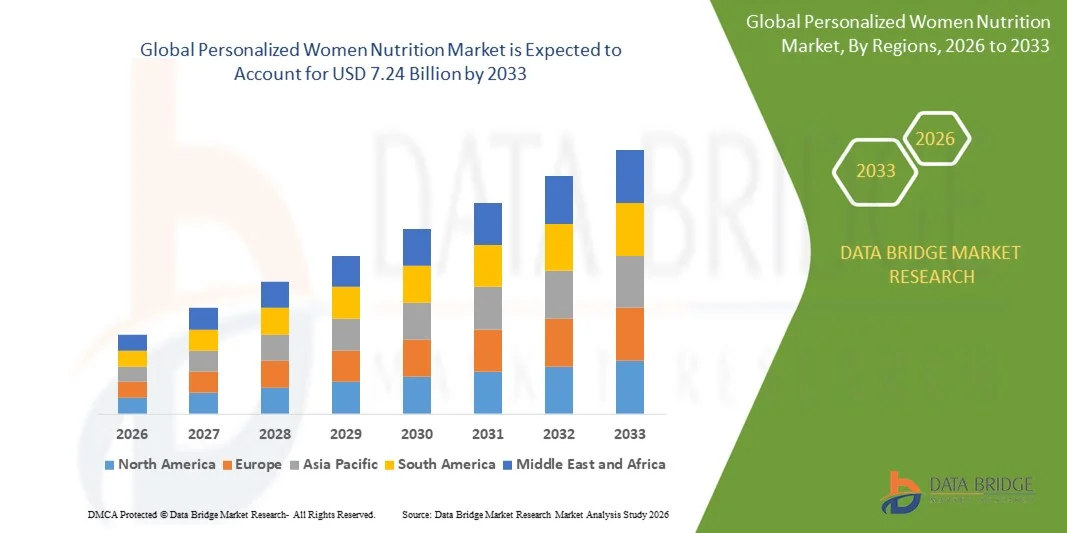
- The Global Personalized Women Nutrition Market was valued at USD 3.47 billion in 2025 and is projected to reach USD 7.24 billion by 2033, expanding at a CAGR of 9.60% during the forecast period.
- Market growth is primarily driven by increasing consumer focus on women-specific health needs, alongside advancements in digital health platforms and nutrigenomics that enable more precise, data-backed nutrition solutions.
- Additionally, rising demand for tailored, convenient, and science-based nutrition products is positioning personalized women nutrition as a preferred wellness approach, with these aligned forces rapidly accelerating product adoption and strengthening overall industry expansion.
What are the Major Takeaways of Global Personalized Women Nutrition Market?
- Personalized women nutrition solutions—designed to deliver tailored dietary, supplement, and wellness recommendations based on biomarkers, hormonal profiles, lifestyle data, and genetic insights—are becoming essential components of modern health management due to their precision, convenience, and strong alignment with women’s evolving wellness needs.
- The rising demand for personalized women nutrition is primarily driven by increasing awareness of women-specific health challenges, growing interest in preventive healthcare, and the expanding availability of digital health platforms that enable individualized nutrition plans.
- North America dominated the Global Personalized Women Nutrition Market with the largest revenue share of 32.2% in 2025, supported by advanced healthcare infrastructure, high consumer spending on wellness, and strong market penetration from major personalized nutrition brands, with the U.S. witnessing accelerated adoption fueled by innovations in at-home testing, AI-powered nutrition apps, and personalized supplement programs.
- Asia-Pacific is expected to be the fastest-growing region in the Global Personalized Women Nutrition Market during the forecast period due to increasing urbanization, rising disposable incomes, and growing consumer inclination toward customized wellness and nutrition solutions.
- The Active Measurement segment dominated the market with the largest revenue share of 58.4% in 2025, driven by rising adoption of biomarker-based and genetic testing tools that provide precise and dynamic nutritional insights for women.
Report Scope and Global Personalized Women Nutrition Market Segmentation
|
Attributes |
Personalized Women Nutrition Key Market Insights |
|
Segments Covered |
|
|
Countries Covered |
North America
Europe
Asia-Pacific
Middle East and Africa
South America
|
|
Key Market Players |
• Persona Nutrition (U.S.) |
|
Market Opportunities |
|
|
Value Added Data Infosets |
In addition to the insights on market scenarios such as market value, growth rate, segmentation, geographical coverage, and major players, the market reports curated by the Data Bridge Market Research also include in-depth expert analysis, pricing analysis, brand share analysis, consumer survey, demography analysis, supply chain analysis, value chain analysis, raw material/consumables overview, vendor selection criteria, PESTLE Analysis, Porter Analysis, and regulatory framework. |
What is the Key Trend in the Global Personalized Women Nutrition Market?
Enhanced Personalization Through AI and Digital Integration
- A significant and accelerating trend in the Global Personalized Women Nutrition Market is the deepening integration of artificial intelligence (AI) with digital health platforms, wearable devices, and mobile wellness ecosystems. This convergence enables more precise, adaptive, and convenient nutrition guidance tailored to women’s unique hormonal, metabolic, and lifestyle needs.
- For Instance, leading platforms now integrate seamlessly with health-tracking apps such as Apple Health, Google Fit, and Fitbit, allowing real-time syncing of data related to menstrual cycles, sleep, stress levels, and physical activity. This continuous data flow strengthens personalization and improves the accuracy of nutritional recommendations.
- AI-powered algorithms in personalized women nutrition solutions can learn from user biomarkers and habits to suggest optimized diet plans, detect nutrient deficiencies, and deliver dynamic adjustments. Some advanced systems also provide intelligent alerts for irregular health patterns, while digital coaching tools offer hands-free support through automated voice-enabled reminders and guidance.
- The seamless integration of nutrition platforms with broader digital wellness ecosystems allows women to manage diet, supplements, fitness, sleep, and hormonal health through a single interface—creating a unified, automated, and highly intuitive wellness experience.
- This shift toward smarter, more connected, and more intuitive nutrition systems is redefining consumer expectations for personalized wellness. As a result, companies are developing AI-enhanced nutrition programs that offer adaptive diet recommendations, predictive health insights, and compatibility with digital assistants for effortless daily management.
- The demand for personalized women nutrition solutions that incorporate advanced AI, continuous biometric monitoring, and cross-platform digital integration is rising rapidly, as consumers increasingly prioritize convenience, holistic wellness insights, and highly individualized health management.
Global Personalized Women Nutrition Market Dynamics
Driver
Growing Need Driven by Increasing Women’s Health Awareness and Digital Wellness Adoption
- The rising awareness of women-specific health concerns—such as hormonal imbalance, reproductive health, nutrient deficiencies, and metabolic disorders—alongside the rapid adoption of digital wellness ecosystems is significantly accelerating the demand for personalized women nutrition solutions.
- For instance, in 2025, several leading digital health companies expanded their women-focused platforms by integrating advanced biomarker testing and hormonal health analytics, enabling more precise, personalized nutrition programs tailored to women’s changing physiological needs. Such innovations from key players are expected to drive market growth throughout the forecast period.
- As women increasingly recognize the importance of proactive and customized health management, personalized nutrition solutions offering targeted supplement plans, cycle-based dietary support, and real-time health monitoring are becoming compelling alternatives to generic nutrition approaches.
- Furthermore, the growing popularity of wearable devices, health-tracking apps, and digital coaching programs is making personalized nutrition a seamless component of the broader wellness ecosystem, allowing women to synchronize nutrition plans with activity data, hormonal cycles, sleep patterns, and stress levels.
- The convenience of app-based guidance, subscription-based supplement delivery, and remote consultation with nutrition experts is propelling market adoption across diverse age groups. Additionally, the rise of at-home testing kits and AI-driven recommendations is further enhancing accessibility and user engagement in both developed and emerging markets.
Restraint/Challenge
Concerns Regarding Data Privacy and High Personalized Program Costs
- Concerns surrounding data privacy and the security of sensitive health information pose a significant challenge to broader adoption of personalized women nutrition solutions. As these platforms rely on biomarker analysis, genetic data, and lifestyle tracking, consumers may worry about misuse or unauthorized access to their personal health data.
- For instance, growing reports of vulnerabilities in digital health and consumer wellness apps have made some users hesitant to adopt platforms requiring biometric or genetic data submission.
- Addressing these concerns through robust data encryption, transparent privacy policies, secure data storage, and strict regulatory compliance is crucial for building and maintaining user trust. Leading players emphasize secure data practices and consent-based data sharing to reassure consumers.
- Additionally, the relatively high cost of comprehensive personalized nutrition programs—especially those involving DNA testing, continuous biomarker monitoring, or premium subscription plans—can be a barrier for price-sensitive consumers, particularly in developing markets. While more affordable app-based solutions are emerging, programs offering advanced personalization often remain costly.
- Although prices are gradually decreasing as technology matures, the perception of personalized nutrition as a premium service may limit mass adoption among consumers who do not immediately recognize the value of highly tailored wellness guidance.
- Overcoming these challenges through enhanced data security, consumer education on data safety, wider availability of cost-effective programs, and flexible subscription options will be essential for sustaining the market’s long-term growth.
How is the Global Personalized Women Nutrition Market Segmented?
The personalized women nutrition market is segmented on the basis of product type, recommendation, application and end use.
- By Product Type
On the basis of product type, the Global Personalized Women Nutrition Market is segmented into Active Measurement and Standard Measurement solutions. The Active Measurement segment dominated the market with the largest revenue share of 58.4% in 2025, driven by rising adoption of biomarker-based and genetic testing tools that provide precise and dynamic nutritional insights for women. Active Measurement platforms—using DNA analysis, hormone panels, microbiome testing, and real-time metabolic tracking—offer individualized recommendations and continual updates, making them highly appealing for women seeking advanced and targeted wellness support.
The Standard Measurement segment is expected to witness the fastest CAGR from 2026 to 2033, supported by the affordability of questionnaire-based assessments and the widespread adoption of basic nutritional profiling. As more women enter personalized nutrition through cost-effective, simplified solutions, this segment will experience accelerated growth, particularly in emerging markets and among first-time users of personalized wellness programs.
- By Recommendation:
On the basis of recommendation type, the Global Personalized Women Nutrition Market is segmented into Fixed Recommendation, Repeat Recommendation, and Continuous Recommendation models. The Continuous Recommendation segment dominated the market with a revenue share of 46.7% in 2025, supported by the rapid rise of AI-powered platforms capable of adjusting nutritional guidance in real time based on biomarker updates, menstrual cycle tracking, lifestyle changes, and wearable-device data. These systems offer dynamic and highly personalized plans that evolve with the user, driving strong adoption among women seeking proactive and adaptive wellness management.
The Repeat Recommendation segment is expected to record the fastest CAGR from 2026 to 2033, driven by growing demand for periodic plan updates delivered monthly or quarterly. This model provides a balance between personalization and affordability, allowing users to update their nutrition plans without fully committing to continuous monitoring systems, making it especially popular among mid-tier consumers.
- By Application
On the basis of application, the Global Personalized Women Nutrition Market is segmented into Standard Supplements and Disease-Based nutrition programs. The Standard Supplements segment dominated the market with the largest revenue share of 62.9% in 2025, driven by strong consumer demand for personalized vitamins, minerals, and hormonal-support formulations tailored to address daily wellness, energy, stress, skin health, and reproductive needs. The wide availability of subscription-based supplement packs and the convenience of digital ordering further reinforce this segment’s leadership.
The Disease-Based segment is projected to witness the fastest CAGR from 2026 to 2033, fueled by the rising prevalence of conditions such as PCOS, thyroid disorders, iron deficiency, menopause-related symptoms, and metabolic syndrome among women. Increasing awareness of personalized therapeutic nutrition as a complementary approach to clinical treatment is prompting healthcare providers and consumers to adopt disease-targeted nutrition programs.
- By End Use
On the basis of end use, the Global Personalized Women Nutrition Market is divided into Direct-To-Consumer (D2C), Wellness and Fitness Centers, Hospitals and Clinics, and Institutions. The Direct-To-Consumer segment dominated the market with the largest revenue share of 54.3% in 2025, driven by the rapid expansion of subscription-based nutrition services, at-home testing kits, and app-driven personalized plans. Women increasingly prefer convenient, digital-first solutions that allow them to access customized nutrition without clinical visits.
The Hospitals and Clinics segment is expected to record the fastest CAGR from 2026 to 2033, as healthcare providers adopt precision nutrition to enhance diagnosis, treatment support, and long-term disease management. Personalized nutrition is becoming integrated into women’s healthcare pathways—especially in fertility, hormonal health, and chronic disease management—driving rapid acceleration in clinical settings.
Which Region Holds the Largest Share of the Global Personalized Women Nutrition Market?
- North America dominated the Global Personalized Women Nutrition Market with the largest revenue share of 32.2% in 2025, driven by growing awareness of women-specific health needs, rising interest in preventive care, and the rapid adoption of digital health and personalized wellness platforms.
- Consumers in the region highly value the convenience, science-backed insights, and tailored nutrition plans enabled by biomarker testing, genetic assessments, and AI-driven recommendation engines. The strong integration of personalized nutrition apps with wearables and menstrual health trackers further enhances user engagement and adoption.
- This widespread uptake is additionally supported by high disposable incomes, strong digital health infrastructure, and increasing preference for individualized wellness solutions, positioning personalized women nutrition as a preferred choice for both everyday health optimization and targeted women’s health management.
U.S. Personalized Women Nutrition Market Insight
The U.S. personalized women nutrition market captured the largest revenue share of 81% in 2025 within North America, driven by the rapid adoption of digital health technologies, at-home testing kits, and subscription-based wellness models. Women in the U.S. are increasingly prioritizing hormone health, metabolic wellness, fertility support, and preventive care, fueling demand for personalized nutrition programs. The strong presence of tech-enabled nutrition brands, combined with widespread use of wearables and health apps, further accelerates market growth. Moreover, high consumer awareness, advanced healthcare infrastructure, and strong integration with AI-driven nutrition platforms significantly contribute to the U.S. market’s dominance.
Europe Personalized Women Nutrition Market Insight
The Europe personalized women nutrition market is projected to expand at a substantial CAGR throughout the forecast period, driven by stringent health standards, rising focus on preventive wellness, and increasing adoption of evidence-based nutrition solutions. Growing awareness of conditions such as PCOS, menopause-related health issues, and micronutrient deficiencies is spurring demand for personalized supplementation and diagnostics. The region is witnessing significant growth across residential consumers, wellness centers, and clinical environments, with customized nutrition being incorporated into both routine wellness plans and specialized therapeutic programs. Europe’s strong regulatory ecosystem and commitment to health innovation further support market expansion.
U.K. Personalized Women Nutrition Market Insight
The U.K. personalized women nutrition market is anticipated to grow at a noteworthy CAGR, supported by rising health consciousness, digital adoption, and growing demand for personalized wellness solutions. Increasing concerns about hormonal imbalances, fertility challenges, and chronic lifestyle-related conditions are encouraging women to opt for individualized supplement programs and nutrition guidance. The U.K.'s strong e-commerce infrastructure, combined with increasing adoption of DNA-based testing, subscription supplement services, and AI-powered nutrition apps, is expected to further stimulate market growth across both consumer and clinical segments.
Germany Personalized Women Nutrition Market Insight
The Germany personalized women nutrition market is expected to expand at a considerable CAGR, driven by strong consumer emphasis on scientific accuracy, clean-label supplements, and data-backed wellness solutions. German consumers prioritize precision and transparency, fueling demand for biomarker-based testing, genetic assessments, and personalized supplement regimens. The country’s advanced healthcare infrastructure, along with its culture of innovation and sustainability, promotes widespread adoption in both residential and clinical settings. Integration of personalized nutrition platforms with digital health records and wellness applications continues to strengthen market penetration.
Asia-Pacific Personalized Women Nutrition Market Insight
The Asia-Pacific personalized women nutrition market is poised to grow at the fastest CAGR of 24% during 2026–2033, driven by rapid urbanization, rising disposable incomes, and increasing awareness of women’s health across countries such as China, Japan, India, and South Korea. Government initiatives promoting digital healthcare and preventive wellness further boost adoption. APAC’s expanding role as a manufacturing hub for supplements and diagnostic tools enhances affordability, making personalized nutrition accessible to a broader population. Growing interest in fertility health, hormonal balance, and beauty-from-within supplements is accelerating regional momentum.
Japan Personalized Women Nutrition Market Insight
The Japan personalized women nutrition market is gaining strong traction due to the nation’s tech-driven culture, aging female population, and growing demand for convenience-focused wellness solutions. Japanese consumers emphasize preventive health and longevity, fueling demand for personalized supplements, functional foods, and biomarker-driven nutrition plans. Integration of personalized nutrition platforms with IoT health devices, sleep trackers, and stress monitors is supporting market growth. Additionally, the increasing adoption of easy-to-use, targeted nutrition solutions for women across different age groups enhances overall market expansion.
China Personalized Women Nutrition Market Insight
The China personalized women nutrition market accounted for the largest revenue share in Asia-Pacific in 2025, supported by the rise of the middle class, rapid digitalization, and strong demand for health optimization among women. China is one of the largest markets for smart wellness devices, at-home test kits, and personalized supplements. Government-led health initiatives and the booming online retail sector further promote adoption. The availability of affordable, locally manufactured testing solutions and tailored supplement programs, along with widespread use of mobile health platforms, continues to propel market growth across urban and semi-urban regions.
Global Personalized Women Nutrition Market Share
The Personalized Women Nutrition industry is primarily led by well-established companies, including:
• Persona Nutrition (U.S.)
• Care/of (U.S.)
• Nutrilite – Amway (U.S.)
• HUM Nutrition (U.S.)
• Viome Life Sciences (U.S.)
• Nestlé Health Science (Switzerland)
• Bayer AG (Germany)
• GNC Holdings (U.S.)
• Elo Health (U.S.)
• Lifenome (U.S.)
• Baze Labs (Germany)
• ZOE (U.K.)
• Wellory (U.S.)
• Herbalife Nutrition (U.S.)
• Nutrigenomix (Canada)
• BetterYou (U.K.)
• JSHealth Vitamins (Australia)
• Rootine (U.S.)
• GENEXUS (Chile)
• CareMax (U.S.)
What are the Recent Developments in Global Personalized Women Nutrition Market?
- In April 2024, Persona Nutrition, a leading U.S.-based personalized supplement company, launched a new women-focused wellness program targeting South Africa. The initiative aims to provide biomarker-driven nutrition plans tailored to women’s unique health needs, including hormonal balance, fertility support, and metabolic wellness. By leveraging advanced digital health platforms and global expertise in nutrigenomics, Persona Nutrition is addressing regional health challenges while strengthening its presence in the rapidly growing Global Personalized Women Nutrition Market.
- In March 2024, Care/of, a U.S.-based personalized vitamin and supplement company, introduced its CycleSync Program, specifically designed for women managing menstrual and reproductive health. The AI-driven platform delivers dynamically adjusted supplement and nutrition recommendations, highlighting Care/of’s commitment to precision wellness and proactive health management for women across different life stages.
- In March 2024, Nestlé Health Science successfully rolled out the Shanghai Women’s Wellness Initiative, integrating personalized nutrition programs into clinical and wellness centers across urban China. This initiative utilizes biomarker testing and digital health platforms to optimize supplement recommendations and lifestyle guidance, emphasizing the growing role of technology in women-focused nutrition solutions.
- In February 2024, HUM Nutrition, a leading provider of science-backed supplements, announced a strategic partnership with major telehealth platforms in North America to deliver personalized nutrition guidance for women remotely. This collaboration enhances accessibility, convenience, and adherence, underscoring HUM Nutrition’s commitment to innovation and holistic wellness management.
- In January 2024, Viome Life Sciences, a company specializing in microbiome and metabolic testing, launched its AI-Powered Women’s Health Program at CES 2024. The program leverages AI-driven insights to offer personalized supplement and dietary recommendations based on gut microbiome, hormonal cycles, and metabolic profiles, demonstrating Viome’s dedication to integrating advanced technology into tailored nutrition solutions for women.

- Interactive Data Analysis Dashboard
- Company Analysis Dashboard for high growth potential opportunities
- Research Analyst Access for customization & queries
- Competitor Analysis with Interactive dashboard
- Latest News, Updates & Trend analysis
- Harness the Power of Benchmark Analysis for Comprehensive Competitor Tracking
Global Personalized Women Nutrition Market, Supply Chain Analysis and Ecosystem Framework
To support market growth and help clients navigate the impact of geopolitical shifts, DBMR has integrated in-depth supply chain analysis into its Global Personalized Women Nutrition Market research reports. This addition empowers clients to respond effectively to global changes affecting their industries. The supply chain analysis section includes detailed insights such as Global Personalized Women Nutrition Market consumption and production by country, price trend analysis, the impact of tariffs and geopolitical developments, and import and export trends by country and HSN code. It also highlights major suppliers with data on production capacity and company profiles, as well as key importers and exporters. In addition to research, DBMR offers specialized supply chain consulting services backed by over a decade of experience, providing solutions like supplier discovery, supplier risk assessment, price trend analysis, impact evaluation of inflation and trade route changes, and comprehensive market trend analysis.
Data collection and base year analysis are done using data collection modules with large sample sizes. The stage includes obtaining market information or related data through various sources and strategies. It includes examining and planning all the data acquired from the past in advance. It likewise envelops the examination of information inconsistencies seen across different information sources. The market data is analysed and estimated using market statistical and coherent models. Also, market share analysis and key trend analysis are the major success factors in the market report. To know more, please request an analyst call or drop down your inquiry.
The key research methodology used by DBMR research team is data triangulation which involves data mining, analysis of the impact of data variables on the market and primary (industry expert) validation. Data models include Vendor Positioning Grid, Market Time Line Analysis, Market Overview and Guide, Company Positioning Grid, Patent Analysis, Pricing Analysis, Company Market Share Analysis, Standards of Measurement, Global versus Regional and Vendor Share Analysis. To know more about the research methodology, drop in an inquiry to speak to our industry experts.
Data Bridge Market Research is a leader in advanced formative research. We take pride in servicing our existing and new customers with data and analysis that match and suits their goal. The report can be customized to include price trend analysis of target brands understanding the market for additional countries (ask for the list of countries), clinical trial results data, literature review, refurbished market and product base analysis. Market analysis of target competitors can be analyzed from technology-based analysis to market portfolio strategies. We can add as many competitors that you require data about in the format and data style you are looking for. Our team of analysts can also provide you data in crude raw excel files pivot tables (Fact book) or can assist you in creating presentations from the data sets available in the report.













