


Pesticide Residue Testing Market Overview
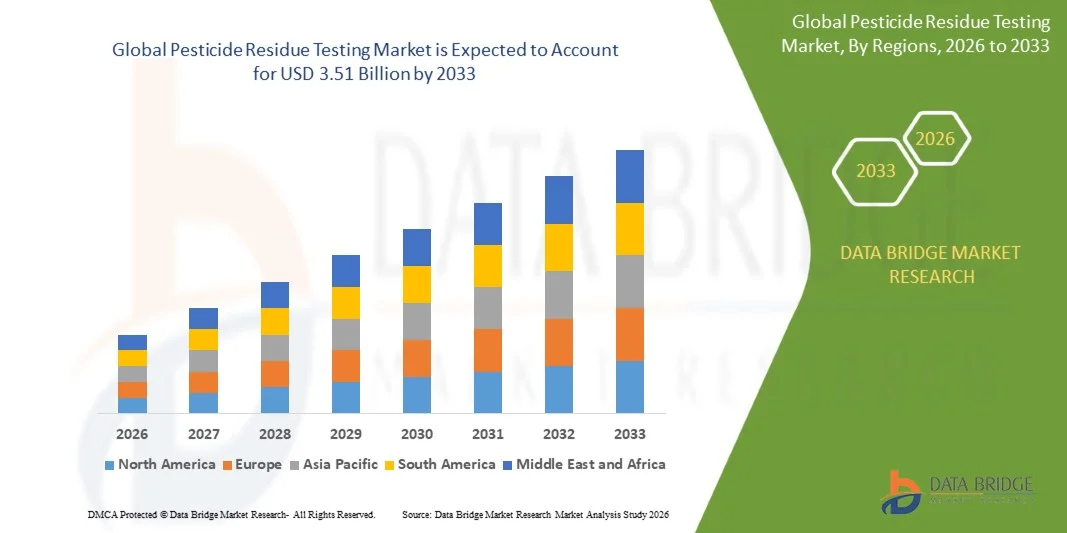
As per Data Bridge Market Research analysis, the pesticide residue testing market was valued at USD 1.94 billion in 2025 and is projected to reach USD 3.51 billion by 2033, growing at a CAGR of 7.70% from 2026 to 2033. The market is experiencing consistent growth driven by stricter global maximum residue limits, rapid advancements in testing technologies, rising consumer demand for verified food purity, and increasing regulatory focus on food safety compliance.
The increasing implementation of stringent food safety regulations, expansion of international food trade, and growing concerns regarding pesticide contamination in agricultural products are compelling food producers, regulatory authorities, and testing laboratories to adopt advanced residue detection solutions. Technologies such as LC-MS/MS, HPLC-based testing, mass spectrometry, and biosensor platforms are enhancing testing accuracy, reducing analysis time, and supporting real-time monitoring across food supply chains. The rising frequency of food recalls and the need to comply with evolving maximum residue limits are further accelerating the adoption of pesticide residue testing solutions across agricultural crops, food and beverage products, and animal feed applications
Market Size & Forecast
- Global Market Value (2025): USD 1.94 Billion
- Expected Market Value (2033): USD 3.51 Billion
- Forecast CAGR (2026–2033): 7.70%
- Leading Region in 2025: Europe
- Fastest Growing Region: Asia-Pacific
Key Market Trends & Insights
- Europe dominated the pesticide residue testing market with the largest revenue share of 34.52% in 2025, supported by stringent food safety regulations, established testing infrastructure, and strong enforcement of maximum residue limits for agricultural and food products
- The herbicides segment led the market with a 40.5% share in 2025, driven by the extensive use of herbicides in agricultural production for weed control and crop yield improvement
- Asia-Pacific is expected to be the fastest-growing region at a CAGR of 4.98%, fueled by increasing agricultural production, expanding food exports, rising awareness regarding food safety, and growing adoption of advanced residue testing technologies in emerging economies
- Fungicides are the fastest-growing type, projected to register a CAGR of 5.8%, reflecting the surge in fungal disease pressure in crops and rising usage of fungicide-based crop protection products
- The LC-MS/MS segment dominated the technology category with a 35.02% revenue share in 2025, led by high sensitivity, accuracy, and ability to detect multiple pesticide residues at trace levels
- Fruits & vegetables accounted for 35.0% of the market, preferred by the extensive pesticide usage in crop cultivation and higher consumer exposure risk
- The organonitrogens & carbamates segment is the fastest-growing class category, with a CAGR of 5.5%, driven by increasing application of these pesticides in crop protection and rising demand for residue monitoring
Report Scope and Pesticide Residue Testing Market Segmentation
|
Attributes |
Pesticide Residue Testing Key Market Insights |
|
Segments Covered |
|
|
Countries Covered |
North America
Europe
Asia-Pacific
Middle East and Africa
South America
|
|
Key Market Players |
|
|
Market Opportunities |
|
|
Value Added Data Infosets |
In addition to the insights on market scenarios such as market value, growth rate, segmentation, geographical coverage, and major players, the market reports curated by the Data Bridge Market Research also include in-depth expert analysis, pricing analysis, brand share analysis, consumer survey, demography analysis, supply chain analysis, value chain analysis, raw material/consumables overview, vendor selection criteria, PESTLE Analysis, Porter Analysis, and regulatory framework. |
Pesticide Residue Testing Market Trends
Increasing Adoption of Advanced Multi-Residue Detection Technologies
Food testing laboratories and regulatory agencies are increasingly adopting advanced analytical techniques such as liquid chromatography–mass spectrometry (LC-MS/MS) and gas chromatography–mass spectrometry (GC-MS/MS) to improve pesticide residue detection accuracy, sensitivity, and efficiency across complex food matrices. These technologies enable simultaneous identification of multiple pesticide compounds at trace levels, supporting compliance with stringent maximum residue limits established by food safety authorities. The rising demand for rapid, reliable, and high-throughput testing solutions among food producers, exporters, and testing laboratories is accelerating the transition from conventional testing methods toward advanced analytical platforms. For instance, in May 2026, the European Food Safety Authority (EFSA) coordinates pesticide residue monitoring programs across European countries, where official laboratories analyze food samples for pesticide residues and ensure compliance with legally established maximum residue limits, supporting advanced food safety testing practices
The increasing focus on accurate, multi-residue detection and regulatory compliance is expected to accelerate the adoption of advanced analytical technologies, strengthening growth opportunities for pesticide residue testing solutions.
Pesticide Residue Testing Market Dynamics
Key Market Driver: Growing Regulatory Focus on Food Safety and Maximum Residue Limits
The increasing implementation of stringent food safety regulations and maximum residue limits (MRLs) for pesticides is creating substantial demand for residue testing solutions across agricultural and food supply chains. Governments, regulatory bodies, and food manufacturers are strengthening monitoring programs to prevent pesticide contamination, ensure consumer safety, and maintain compliance in domestic and international food trade. Testing laboratories are expanding their capabilities to support mandatory screening of fruits, vegetables, cereals, and processed food products, driving consistent adoption of chromatography and mass spectrometry-based testing methods. For instance, in August 2024, the U.S. Environmental Protection Agency (EPA) continued implementing pesticide tolerance regulations that establish the maximum residue levels permitted for pesticides in food commodities, while the U.S. Food and Drug Administration (FDA) conducted pesticide residue monitoring programs to analyze food samples and verify compliance with established safety limits. These regulatory activities support continued demand for pesticide residue testing technologies across the U.S. food supply chain.
The growing emphasis on food safety regulations and international compliance standards will continue to drive demand for pesticide residue testing across global food supply chains.
Key Restraint/Challenge: High Cost and Technical Complexity of Advanced Testing Equipment
A significant restraint in the pesticide residue testing market is the high investment required for advanced analytical instruments and laboratory infrastructure. Modern residue testing systems such as LC-MS/MS and GC-MS/MS require substantial capital expenditure, skilled technical personnel, regular calibration, and maintenance support, creating adoption challenges for small laboratories and testing facilities in developing regions. The complexity of sample preparation procedures and the need for trained professionals further increase operational costs, limiting widespread adoption of sophisticated testing technologies among cost-sensitive end users. For instance, in October 2023, the Food and Agriculture Organization (FAO) highlighted the importance of strengthening food safety laboratory systems through adequate analytical capacity, appropriate equipment, quality management practices, and skilled personnel to improve the detection and monitoring of food contaminants, including pesticide residues. These capacity-building initiatives support the expansion of residue testing capabilities, particularly in developing regions.
The high cost and operational complexity of advanced testing systems remain key barriers, particularly for smaller laboratories, limiting adoption in cost-sensitive markets
Key Market Opportunity: Integration of Rapid Testing Solutions and Digital Food Safety Monitoring Platforms
The integration of rapid testing technologies, automated analytical systems, and digital monitoring platforms presents a significant market opportunity for pesticide residue testing providers. Advanced solutions including portable detection devices, biosensor-based testing methods, and automated laboratory workflows can reduce testing time, improve accessibility, and support real-time monitoring across agricultural and food supply chains. Increasing demand for traceable food production systems and transparent quality control processes is creating opportunities for technology providers to expand residue testing applications beyond traditional laboratories into farms, processing facilities, and emerging markets. For instance, in March 2023, researchers developed a portable acetylcholinesterase-based electrochemical sensor for rapid field detection of organophosphorus pesticides. The sensor integrated a screen-printed carbon electrode with graphene and gold nanoparticles to improve detection performance, enabling rapid on-site pesticide residue screening and supporting the development of decentralized food safety monitoring solutions.
The development of portable biosensor-based pesticide detection technologies highlights the growing opportunity for rapid, decentralized, and cost-effective residue testing solutions. Such innovations can improve accessibility of pesticide monitoring, reduce dependence on centralized laboratories, and support wider adoption of advanced food safety testing across agricultural and food supply chains.
Pesticide Residue Testing Market Scope
The pesticide residue testing market is segmented on the basis of type, technology, food tested, and class.
- By Type
On the basis of type, the pesticide residue testing market is segmented into herbicides, insecticides, fungicides, and others. The herbicides segment dominated the market with an estimated share of 40.5% in 2025, owing to the extensive use of herbicides in agricultural production for weed control and crop yield improvement. Herbicides represent one of the most widely monitored pesticide categories due to their extensive application across cereals, grains, fruits, and vegetables. Increasing regulatory scrutiny regarding herbicide residues is strengthening demand for advanced testing solutions. Food safety authorities are implementing strict maximum residue limits to ensure consumer protection and facilitate international food trade. Analytical technologies such as LC-MS/MS and GC-MS are increasingly used for accurate herbicide residue identification. Growing adoption of residue monitoring programs across agricultural supply chains continues to support segment dominance.
The fungicides segment is projected to register the fastest growth at a CAGR of 5.8% during the forecast period, driven by increasing fungal disease pressure in crops and rising usage of fungicide-based crop protection products. The expansion of fruit and vegetable production is increasing the requirement for fungicide residue testing. Regulatory authorities are strengthening monitoring programs due to concerns regarding chemical accumulation in food products. Export-oriented agriculture is also increasing testing requirements for compliance with international standards. Advances in analytical testing methods are improving detection capabilities for fungicide residues. Increasing focus on sustainable agriculture and safe pesticide usage is expected to create additional growth opportunities.
- By Technology
On the basis of technology, the pesticide residue testing market is segmented into LC-MS/GC-MS, high performance liquid chromatography (HPLC), gas chromatography, and others. The LC-MS/MS segment dominated the market with a 35.02% revenue share in 2025, supported by its high sensitivity, accuracy, and ability to detect multiple pesticide residues at trace levels. LC-MS/MS technology is widely adopted by regulatory laboratories and food testing facilities due to its reliability in complex sample analysis. Increasing food safety regulations and expanding residue monitoring programs are driving adoption of advanced mass spectrometry technologies. The technology enables faster multi-residue analysis compared with conventional methods. Growing demand for accurate pesticide detection across global food supply chains is further strengthening its market position. Continuous improvements in analytical performance are expected to maintain LC-MS/MS dominance.
The NGS/biosensor-based technologies segment is expected to witness the fastest growth with a CAGR of 5.12% during forecast period, driven by increasing demand for rapid, portable, and decentralized testing solutions. These technologies enable faster screening and improved accessibility for pesticide residue monitoring. Growing interest in real-time food safety monitoring is encouraging innovation in biosensor platforms. Portable detection devices are gaining attention for agricultural and field-level applications. Reduced testing time and operational efficiency are supporting adoption. Increasing digitalization of food safety systems is expected to accelerate growth of emerging testing technologies.
- By Food Tested
On the basis of food tested, the pesticide residue testing market is segmented into meat & poultry, dairy products, processed food, fruits & vegetables, cereals, grains & pulses, and others. The fruits & vegetables segment dominated the market with an estimated share of 35.0% in 2025, due to extensive pesticide usage in crop cultivation and higher consumer exposure risk. Fresh produce is among the most frequently tested food categories because pesticide residues can remain on edible surfaces. Regulatory agencies conduct regular monitoring programs for fruits and vegetables to ensure compliance with maximum residue limits. Increasing consumption of fresh produce globally is supporting demand for residue testing. International trade of fruits and vegetables also requires strict testing protocols. Growing consumer preference for safe and chemical-controlled food products continues to drive segment growth.
The processed food segment is expected to witness the fastest growth at a CAGR of 5.6% during the forecast period, supported by increasing consumption of packaged food products and expansion of global food processing industries. Food manufacturers are implementing stronger quality control systems to ensure compliance with residue regulations. Growing demand for transparency and traceability in food production is increasing testing requirements. International food supply chains require consistent monitoring of processed food ingredients. Advanced testing methods are enabling efficient residue detection in complex food matrices. Rising consumer awareness regarding food safety is expected to accelerate adoption.
- By Class
On the basis of class, the pesticide residue testing market is segmented into organochlorines, organophosphates, organonitrogens & carbamates, and others. The organophosphates segment dominated the market with an estimated share of 35.40% in 2025, driven by extensive agricultural usage and strict regulatory monitoring requirements. Organophosphates are widely used for insect control across multiple crops, increasing the need for residue detection. Concerns regarding human exposure and environmental impact have resulted in stricter monitoring standards. Food safety laboratories frequently test for organophosphate residues due to their widespread application. Advanced chromatographic techniques are commonly used for accurate detection. Increasing regulatory compliance requirements continue to support demand for organophosphate residue testing.
The organonitrogens & carbamates segment is expected to witness the fastest growth at a CAGR of 5.5% during the forecast period, driven by increasing application of these pesticides in crop protection and rising demand for residue monitoring. These pesticide classes are used extensively due to their effectiveness against agricultural pests. Increasing food safety regulations are encouraging testing laboratories to expand detection capabilities. Growth in agricultural production across emerging economies is supporting adoption. Advanced analytical technologies are improving identification accuracy for these compounds. Rising focus on safe pesticide management practices is expected to create growth opportunities.
Pesticide Residue Testing Market Regional Analysis
Europe dominated the pesticide residue testing market with the largest revenue share of 34.52% in 2025, supported by stringent food safety regulations, established testing infrastructure, and strong enforcement of maximum residue limits for agricultural and food products. The region benefits from well-established food control systems, increasing adoption of advanced analytical technologies such as LC-MS/MS and GC-MS, and extensive pesticide monitoring programs implemented by regulatory authorities. Growing international food trade, rising consumer demand for safe food products, and continuous improvements in residue detection methods are accelerating market development. Increasing focus on food quality assurance, regulatory compliance, and reduction of pesticide contamination risks continues to strengthen Europe’s leadership position in the global pesticide residue testing market.
U.S. Pesticide Residue Testing Market Insight
The U.S. pesticide residue testing market is witnessing strong growth due to stringent food safety regulations, increasing demand for contaminant-free food products, and rising adoption of advanced analytical testing technologies. The country’s established food safety infrastructure, along with increasing implementation of pesticide monitoring programs by regulatory agencies, is driving demand across food manufacturers, testing laboratories, and agricultural supply chains. In addition, growing focus on compliance with maximum residue limits and international food trade requirements is accelerating residue testing adoption across the U.S. food industry. The U.S. Food and Drug Administration (FDA) conducts a pesticide residue monitoring program that selectively tests a broad range of domestic and imported food commodities for pesticide residues, supporting regulatory compliance and increasing demand for advanced residue testing solutions across the U.S. food supply chain
Europe Pesticide Residue Testing Market Insight
The Europe pesticide residue testing market remains the largest contributor to global revenue, supported by stringent regulatory frameworks, advanced laboratory infrastructure, and comprehensive food safety monitoring systems. The widespread implementation of maximum residue limits, coordinated monitoring programs, and advanced analytical methods such as LC-MS/MS and GC-MS is supporting market expansion across the region. Increasing emphasis on food quality assurance, sustainable agriculture practices, and consumer protection continues to strengthen the adoption of pesticide residue testing throughout Europe. The European Food Safety Authority (EFSA) publishes annual reports on pesticide residues in food based on coordinated monitoring programs conducted by EU Member States, Norway, and Iceland, where food samples are analyzed to assess compliance with maximum residue levels and strengthen pesticide residue surveillance across Europe
U.K. Pesticide Residue Testing Market Insight
The U.K. pesticide residue testing market is experiencing steady growth, supported by strict food safety standards, increasing monitoring of agricultural products, and rising demand for reliable testing services. Increasing regulatory requirements after Brexit, along with continued focus on maintaining food quality and consumer safety, are contributing to market development. Furthermore, adoption of advanced analytical methods and routine surveillance programs is improving testing efficiency and supporting compliance across food producers and importers. The U.K. Expert Committee on Pesticide Residues in Food (PRiF) conducts monitoring programs that analyze food samples for pesticide residues and publishes quarterly and annual reports to assess compliance with maximum residue levels, supporting food safety surveillance across the U.K. food supply chain.
Germany Pesticide Residue Testing Market Insight
The Germany pesticide residue testing market is expanding steadily due to the country’s strong food safety regulations, advanced laboratory capabilities, and increasing demand for high-quality agricultural products. Food testing laboratories and regulatory organizations are increasingly utilizing advanced analytical techniques for pesticide detection and compliance monitoring. Continuous investments in food quality control systems, combined with Germany’s position as a major European food market, are supporting residue testing adoption. The German Federal Office of Consumer Protection and Food Safety (BVL) coordinates national food monitoring programs, including pesticide residue investigations, supporting the expansion of testing activities.
Asia-Pacific Pesticide Residue Testing Market Insight
The Asia-Pacific pesticide residue testing market is expected to witness rapid growth, driven by increasing agricultural production, expanding food exports, rising food safety awareness, and growing adoption of advanced testing technologies across countries such as China, India, and Japan. Growing regulatory initiatives, increasing international trade of agricultural commodities, and investments in food quality infrastructure are supporting regional market expansion. In addition, rising concerns regarding pesticide contamination and the need to comply with global food safety standards are accelerating residue testing adoption across commercial and regulatory laboratories. The Food Safety and Standards Authority of India (FSSAI) publishes pesticide residue monitoring information and supports analytical testing capacity through food laboratory programs, strengthening pesticide residue surveillance and compliance across India’s food supply chain.
Japan Pesticide Residue Testing Market Insight
The Japan pesticide residue testing market is witnessing consistent growth due to strict food safety regulations, advanced analytical capabilities, and increasing demand for quality-controlled food products. Food manufacturers, regulatory laboratories, and agricultural organizations are adopting advanced testing methods to ensure compliance with Japan’s positive list system for pesticide residues. Moreover, the country’s focus on food safety, traceability, and precision agriculture practices is supporting market development. Japan’s Ministry of Health, Labour and Welfare (MHLW) implements the Positive List System for Agricultural Chemical Residues in Foods, requiring monitoring of pesticide residue levels in food products.
China Pesticide Residue Testing Market Insight
The China pesticide residue testing market is growing rapidly, driven by increasing agricultural output, expanding food processing industries, and rising government focus on food safety management. Growing adoption of advanced analytical testing systems, increasing food export requirements, and stricter pesticide residue standards are significantly boosting market demand. In addition, rising investments in food safety infrastructure and agricultural quality control programs are positioning China as one of the fastest-growing markets for pesticide residue testing globally. China’s National Health Commission (NHC), together with relevant authorities, issues the National Food Safety Standard for Maximum Residue Limits of Pesticides in Food, establishing allowable pesticide residue levels and supporting increased monitoring and testing requirements across agricultural and food industries.
Pesticide Residue Testing Market Share
The pesticide residue testing industry is primarily led by well-established companies, including:
- SGS Société Générale de Surveillance SA (Switzerland)
- Eurofins Scientific SE (Luxembourg)
- Intertek (U.K.)
- Bureau Veritas (France)
- ALS (Australia)
- TÜV SÜD (Germany)
- TÜV NORD GROUP (Germany)
- Mérieux NutriSciences (U.S.)
- AsureQuality (New Zealand)
- Microbac Laboratories, Inc. (U.S.)
- SCS Global Services (U.S.)
- LGC Limited (U.K.)
- Tentamus (Germany)
- Romer Labs Division Holding. (Austria)
- Neogen Corporation (U.S.)
- EMSL Analytical, Inc. (U.S.)
- Charm Sciences, Inc. (U.S.)
- Fera Science Limited (U.K.)
- Symbio Laboratories Pty Ltd (Australia)
- Centre Testing International Co., Ltd. (China
Latest Developments in Pesticide Residue Testing Market
- In December 2025, the U.S. Food and Drug Administration (FDA) released its FY 2023 Pesticide Residue Monitoring Program report, providing analytical results from testing human and animal food samples for pesticide residues. The report covered testing of 781 pesticides and selected industrial compounds, while the launch of the FDA Pesticide Report Data Dashboard improved access to residue monitoring data and strengthened transparency in food safety testing programs
- In October 2024, Bhabha Atomic Research Centre (BARC) developed a biosensor-based pesticide detection kit for identifying organophosphate and organocarbamate pesticide residues in food commodities. The portable BioKit enables rapid visual detection of pesticide contamination and supports the adoption of decentralized residue testing solutions for farmers, traders, and food industries
- In April 2024, the Food Safety and Standards Authority of India (FSSAI) launched a food safety awareness campaign focusing on pesticide residue detection and contamination control in food products. The initiative emphasized the importance of raw material testing, pesticide residue monitoring, and improved food safety practices across markets and food supply chains in India
- In February 2022, Zhejiang University researchers developed a novel online sensor technology for trace pesticide detection using an integrated APCI and MPT ionization technique. The research demonstrated a rapid analytical approach for detecting pesticide residues at trace levels, highlighting the potential of advanced sensor-based technologies to improve real-time pesticide monitoring and support future portable residue testing applications
- In October 2021, Eurofins Analytical Services India launched a Mobile Residue Monitoring Laboratory to provide faster pesticide residue and toxin testing services near farms and procurement markets. The mobile laboratory initiative was designed to support farmers and exporters by enabling quicker testing decisions and improving access to residue analysis services for agricultural commodities

- Interactive Data Analysis Dashboard
- Company Analysis Dashboard for high growth potential opportunities
- Research Analyst Access for customization & queries
- Competitor Analysis with Interactive dashboard
- Latest News, Updates & Trend analysis
- Harness the Power of Benchmark Analysis for Comprehensive Competitor Tracking
Global Pesticide Residue Testing Market, Supply Chain Analysis and Ecosystem Framework
To support market growth and help clients navigate the impact of geopolitical shifts, DBMR has integrated in-depth supply chain analysis into its Global Pesticide Residue Testing Market research reports. This addition empowers clients to respond effectively to global changes affecting their industries. The supply chain analysis section includes detailed insights such as Global Pesticide Residue Testing Market consumption and production by country, price trend analysis, the impact of tariffs and geopolitical developments, and import and export trends by country and HSN code. It also highlights major suppliers with data on production capacity and company profiles, as well as key importers and exporters. In addition to research, DBMR offers specialized supply chain consulting services backed by over a decade of experience, providing solutions like supplier discovery, supplier risk assessment, price trend analysis, impact evaluation of inflation and trade route changes, and comprehensive market trend analysis.
Data collection and base year analysis are done using data collection modules with large sample sizes. The stage includes obtaining market information or related data through various sources and strategies. It includes examining and planning all the data acquired from the past in advance. It likewise envelops the examination of information inconsistencies seen across different information sources. The market data is analysed and estimated using market statistical and coherent models. Also, market share analysis and key trend analysis are the major success factors in the market report. To know more, please request an analyst call or drop down your inquiry.
The key research methodology used by DBMR research team is data triangulation which involves data mining, analysis of the impact of data variables on the market and primary (industry expert) validation. Data models include Vendor Positioning Grid, Market Time Line Analysis, Market Overview and Guide, Company Positioning Grid, Patent Analysis, Pricing Analysis, Company Market Share Analysis, Standards of Measurement, Global versus Regional and Vendor Share Analysis. To know more about the research methodology, drop in an inquiry to speak to our industry experts.
Data Bridge Market Research is a leader in advanced formative research. We take pride in servicing our existing and new customers with data and analysis that match and suits their goal. The report can be customized to include price trend analysis of target brands understanding the market for additional countries (ask for the list of countries), clinical trial results data, literature review, refurbished market and product base analysis. Market analysis of target competitors can be analyzed from technology-based analysis to market portfolio strategies. We can add as many competitors that you require data about in the format and data style you are looking for. Our team of analysts can also provide you data in crude raw excel files pivot tables (Fact book) or can assist you in creating presentations from the data sets available in the report.













