What is the Pet Food Additives Market Size and Growth Rate?
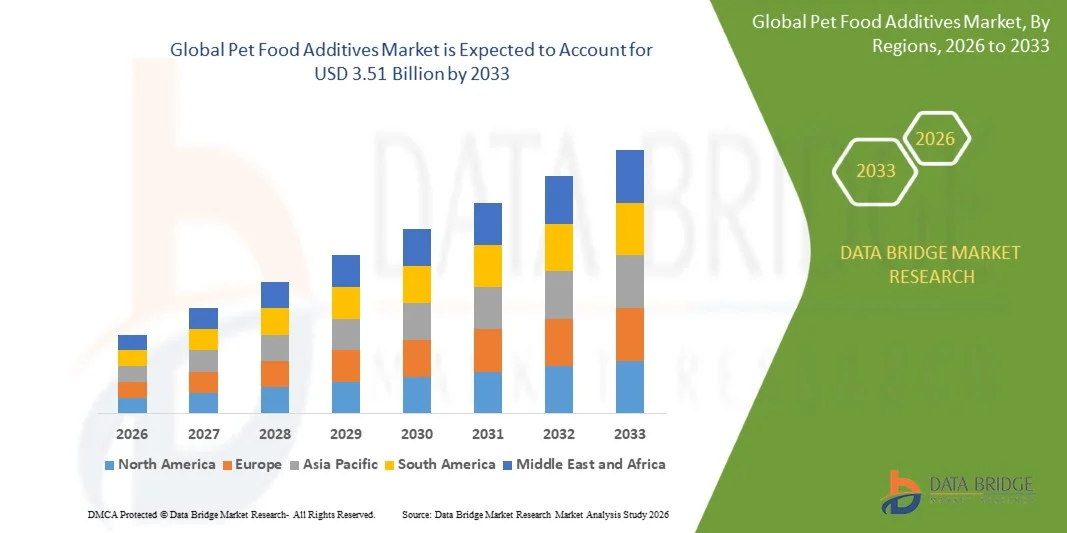
- As per Data Bridge Market Research analysis, the pet food additives market was valued at USD 2.00 billion in 2025 and is projected to reach USD 3.51 billion by 2033, growing at a CAGR of 7.3% from 2026 to 2033.
- The market is experiencing consistent growth driven by rising pet humanization, increasing demand for premium and functional pet food, and growing consumer focus on pet health and wellness. Demand for vitamins, minerals, probiotics and prebiotics, antioxidants, and other functional additives is increasing as pet owners increasingly seek products supporting digestive health, immune support, joint and mobility, and skin and coat health
- The increasing emphasis on pet health and nutrition, combined with growing demand for palatable, nutritionally complete, and functional pet foods, is compelling pet food manufacturers to adopt specialized additives. Probiotics and prebiotics, enzymes, antioxidants, vitamins, and palatability enhancers are increasingly incorporated into pet food formulations to support digestive health, immune function, nutrient utilization, product stability, and food acceptance
Market Size & Forecast
- Global Market Value (2025): USD 2.00 Billion
- Expected Market Value (2033): USD 3.51 Billion
- Forecast CAGR (2026–2033): 7.3%
- Leading Region in 2025: North America
- Fastest Growing Region: Asia Pacific
What are the Major Takeaways of the Pet Food Additives Market?
- North America dominated the pet food additives market with the largest revenue share of 35.7 in 2025, supported by high pet ownership rates, a mature premium segment, and clear regulatory guidance for novel ingredients.
- Asia-Pacific is expected to be the fastest-growing region at a CAGR of 9.5% from 2026 to 2033, fueled by rising household incomes, urbanization, and regulatory harmonization that eases market entry for new additives.
- The mold inhibitors segment led the market with a 30% share in 2025, driven by the critical role of mold inhibitors in preventing spoilage, along with rising awareness of food safety and storage stability
- Antimicrobials are the fastest-growing additive type, projected to register a CAGR of 8.9%, reflecting the surge in emphasis on microbial control and pet food safety.
- The preservation segment dominated the functionality category with a 40% revenue share in 2025, led by the essential role of additives in maintaining pet food stability, quality, and shelf life.
- Dogs accounted for 46% of the market share in 2025, preferred by the large global dog population and high spending on canine nutrition and health.
- The pets drink segment is the fastest-growing software category, with a CAGR of 9.10%, driven by increasing diversification of pet nutrition products and growing interest in functional liquid formulations.
Report Scope and Pet Food Additives Market Segmentation
|
Attributes |
Pet Food Additives Key Market Insights |
|
Segments Covered |
|
|
Countries Covered |
North America
Europe
Asia-Pacific
Middle East and Africa
South America
|
|
Key Market Players |
|
|
Market Opportunities |
|
|
Value Added Data Infosets |
In addition to the insights on market scenarios such as market value, growth rate, segmentation, geographical coverage, and major players, the market reports curated by the Data Bridge Market Research also include import export analysis, production capacity overview, production consumption analysis, price trend analysis, climate change scenario, supply chain analysis, value chain analysis, raw material/consumables overview, vendor selection criteria, PESTLE Analysis, Porter Analysis, and regulatory framework. |
What is the Key Trend in the Pet Food Additives Market?
- Functional and health-focused additives are increasingly incorporated into pet food formulations to support digestive health, immune response, nutrient absorption, and overall well-being, reflecting growing interest in functional nutrition among companion-animal owners.
- For instance, in September 2025, a study published in Foods analyzed probiotic-enriched pet food research from 2014–2024 and identified increasing incorporation of probiotics into pet food to support digestive health, immune response, and overall well-being; the review also highlighted microencapsulation, coating matrices, and post-processing supplementation as emerging delivery technologies.
- Probiotic delivery technologies are advancing through microencapsulation, coating matrices, and post-processing supplementation, helping preserve probiotic viability during processing and improving incorporation into both dry and wet pet food matrices.
- Palatability-focused additives are also gaining importance as manufacturers seek to improve voluntary intake, food acceptance, nutrient utilization, and therapeutic efficacy across dry and wet pet food formulations.
- For instance, in August 2025, a study published in Foods identified more than 15 palatant-technology innovations, including microencapsulation, Maillard-reaction enhancement, multilayer coating systems, life-stage-specific palatant modulation, and dual-phase release architectures, demonstrating the industry's shift toward advanced functional and palatability-focused additives.
- As manufacturers continue prioritizing functional nutrition and palatability, advanced probiotics, encapsulation technologies, natural palatants, and targeted additive formulations are expected to strengthen innovation across the global pet food additives market
What are the Key Drivers of the Pet Food Additives Market?
- The growing emphasis on digestive health, immune function, nutrient utilization, and overall pet wellness is increasing demand for functional additives that provide targeted nutritional and physiological benefits in companion-animal diets.
- For instance, in March 2026, a study published in Animals found that plant-derived functional ingredients, including polyphenols, plant extracts, microalgae, and omega-3 sources, can provide antioxidant, anti-inflammatory, immunomodulatory, microbiome-regulating, and metabolic benefits in dogs and cats, supporting increasing demand for health-focused functional additives.
- Pet food manufacturers are increasingly exploring specialized additive technologies, including microencapsulation, coating matrices, post-processing supplementation, and strain-specific formulations, to maintain stability and functionality during food processing.
- For instance, in December 2024, an research article published in Veterinary Sciences analyzed 27 peer-reviewed studies on vitamins, minerals, and phytonutrients in canine nutrition and found evidence of potential immune-modulating and inflammation-reducing effects, reinforcing the development of pet foods containing targeted functional ingredients for immune health.
- With functional nutrition increasingly supported by scientific research and additive technologies becoming more sophisticated, demand for probiotics, prebiotics, antioxidants, enzymes, vitamins, minerals, and palatability enhancers will continue supporting market expansion.
Which Factors are Challenging the Growth of the Pet Food Additives Market?
- Regulatory requirements for pet food additives create challenges because ingredients must satisfy established safety and utility requirements, while manufacturers must demonstrate appropriate use, labeling, and regulatory compliance across different markets.
- For instance, in October 2024, the U.S. Food and Drug Administration (FDA) finalized Guidance for Industry #293 after the FDA–AAFCO Memorandum of Understanding expired on October 1, 2024, creating a regulatory transition for animal food ingredients and requiring manufacturers to navigate FDA requirements for approved food additives, GRAS substances, and AAFCO-defined ingredients.
- Consumer concerns regarding synthetic additives and preservatives can restrain market growth, as research indicates that many pet owners perceive additives as unnecessary or unhealthy and associate synthetic preservatives with a lack of naturalness in pet food.
- These requirements can increase development complexity for innovative additives, particularly where ingredients require safety substantiation, approved uses, specific labeling provisions, or regulatory review before commercialization in individual markets.
- For instance, in January 2025, the FDA finalized Guidance for Industry #294 establishing the Animal Food Ingredient Consultation (AFIC) process, following its evaluation of the Food Additive Petition and GRAS Notification programs, adding a new consultation pathway for firms developing animal food ingredients and requiring safety review considerations for new ingredients.
- The regulatory complexity surrounding approved food additives, GRAS substances, AAFCO-defined ingredients, and state-specific labeling requirements can therefore slow commercialization and increase compliance requirements for manufacturers developing novel pet food additive formulations.
How is the Pet Food Additives Market Segmented?
The pet food additives market is segmented on the basis of type, additive, functionality, pet type, and application.
- By Type
On the basis of type, the pet food additives market is segmented into vitamins, minerals, amino acids, enzymes, and others. The vitamins segment dominated the market with a 28% share in 2025, owing to their essential role in complete and balanced pet food formulations. Vitamins are widely incorporated to support normal physiological functions and maintain nutritional adequacy in companion animals. Their established use across commercial pet food formulations provides a broad application base for manufacturers. Increasing awareness regarding pet health and nutritional requirements is further supporting demand for vitamin-enriched products. Manufacturers also use vitamin premixes to maintain nutritional consistency during pet food production. Their widespread application and established nutritional importance continue to support the dominance of this segment.
The probiotics and prebiotics segment is projected to register the fastest growth at a CAGR of 10.9% from 2026 to 2033, driven by increasing demand for digestive-health and functional pet nutrition products. These ingredients are increasingly incorporated into pet food formulations to support gut microbiota and digestive health. Growing consumer interest in preventive pet healthcare is encouraging manufacturers to develop microbiome-focused products. Advances in encapsulation and delivery technologies are helping improve the stability of probiotics during pet food processing. Research-backed health benefits are further supporting adoption of these functional additives. The increasing focus on functional nutrition is expected to accelerate demand for probiotic and prebiotic additives.
- By Additive
On the basis of additive, the market is segmented into mold inhibitors, antimicrobials, pellet binders, grain conditioners, toxin binders, acidifiers, colorants, and others. The mold inhibitors segment is considered the dominant additive category, accounting for 30% of the additive segment in 2025. Mold inhibitors help control mold growth and maintain pet food quality during storage and distribution. Their application is particularly important in dry pet food, where products may remain in storage for extended periods. Increasing emphasis on pet food safety and shelf-life stability is supporting demand for preservation-oriented additives. Manufacturers use mold inhibitors to reduce deterioration and maintain product quality. Their established functionality and broad application across commercial pet food products support their leading position.
The antimicrobials segment is expected to witness the fastest growth at a CAGR of 8.9% from 2026 to 2033, driven by increasing emphasis on microbial control and pet food safety. Antimicrobial additives help control microorganisms and maintain product quality during storage. Their importance is particularly high in formulations where moisture and processing conditions can increase microbial risks. Rising consumer awareness regarding the safety and quality of pet food is encouraging manufacturers to strengthen preservation systems. Increasing research into natural antimicrobial ingredients is also creating opportunities for alternative preservation solutions. Growing demand for safe, stable, and longer-lasting pet food products is expected to support continued adoption of antimicrobial additives.
- By Functionality
On the basis of functionality, the market is segmented into preservation, processing, and nutrition. The preservation segment dominated the market with an estimated share of 40% in 2025, owing to the essential role of additives in maintaining pet food stability, quality, and shelf life. Preservation additives help protect products from microbial deterioration and spoilage during manufacturing and storage. Mold inhibitors, antimicrobials, and related ingredients are widely incorporated into commercial pet food formulations. The increasing consumption of packaged pet food is creating sustained demand for ingredients that maintain product quality throughout distribution. Longer storage requirements further increase the importance of effective preservation systems. The need to maintain safe and stable pet food products continues to make preservation a major functionality segment.
The nutrition segment is expected to register the fastest growth at a CAGR of 8.10% from 2026 to 2033, driven by increasing consumer focus on pet health, nutritional adequacy, and functional benefits. Nutritional additives such as vitamins, minerals, amino acids, and enzymes help improve the nutritional profile of pet food. Growing pet humanization is encouraging owners to seek products containing specialized nutritional and health-supporting ingredients. Manufacturers are responding by developing formulations targeting immunity, digestion, mobility, skin and coat health, and overall wellness. Research into functional ingredients is also supporting the development of more targeted nutritional products. The increasing shift from basic feeding toward health-oriented pet nutrition is expected to accelerate growth in this segment.
- By Pet Type
On the basis of pet type, the market is segmented into fish, dogs, cats, and others. The dogs segment dominated the market with a 46% share in 2025, driven by the large global dog population and high spending on canine nutrition and health. Dogs consume a broad range of commercial pet food products containing nutritional, functional, preservation, and palatability additives. Increasing premiumization of dog food is encouraging manufacturers to incorporate specialized ingredients into formulations. Growing awareness of canine digestive, immune, joint, and nutritional health is also supporting demand for functional additives. Manufacturers are increasingly developing products tailored to different dog life stages and health requirements. The combination of a large consumer base and increasing expenditure on canine wellness continues to support the dominance of dogs.
The cats segment is projected to register the fastest growth at a CAGR of 9.4% from 2026 to 2033, driven by increasing cat ownership and growing demand for species-specific nutrition. Cats have distinct nutritional requirements that encourage manufacturers to develop specialized formulations and additive blends. Increasing urbanization is also supporting cat ownership, particularly among consumers seeking companion animals suited to smaller living spaces. Premium cat food products are increasingly incorporating functional ingredients addressing digestion, immunity, and overall wellness. Growing consumer willingness to spend on specialized feline nutrition is creating additional opportunities for additive manufacturers. Expansion of the cat food market in emerging economies is expected to further accelerate demand for cat-specific additives.
- By Application
On the basis of application, the market is segmented into pets canned, pets dairy products, pets drink, and others. The pets canned segment dominated the market with an estimated share of 35.40%, supported by the extensive use of additives in wet pet food formulations. Canned pet food requires additives to support preservation, processing, nutritional stability, texture, and palatability. Its higher moisture content increases the importance of effective preservation and microbial-control systems. Premium wet pet food products are also creating demand for functional and nutritional additives. Manufacturers use specialized additive combinations to maintain quality throughout processing and shelf life. The continued consumption of commercially prepared canned pet food therefore provides a substantial application base for pet food additives.
The pets drink segment is expected to witness the fastest growth at a CAGR of 9.10% from 2026 to 2033, driven by increasing diversification of pet nutrition products and growing interest in functional liquid formulations. Pet drinks provide an alternative delivery format for nutritional and functional ingredients. Additives can be incorporated to improve palatability, nutritional value, stability, and product characteristics. Increasing focus on hydration and preventive pet wellness is encouraging innovation in liquid pet products. Premiumization is also creating opportunities for specialized beverages containing functional ingredients. As manufacturers expand beyond conventional dry and wet food categories, increasing product availability is expected to support growth in pet drink applications.
Which Region Holds the Largest Share of the Pet Food Additives Market?
- North America dominated the pet food additives market with the largest revenue share of 35.7 in 2025, supported by high pet ownership rates, a mature premium segment, and clear regulatory guidance for novel ingredients.
- The region also benefits from increasing pet humanization, premiumization, demand for clean-label and functional nutrition, and strong regulatory frameworks supporting ingredient development and commercialization. U.S. consumers increasingly prioritize nutritional quality, ingredient transparency, digestive health, joint health, and other wellness benefits, encouraging manufacturers to incorporate functional additives into pet food formulations. North America's established FDA and AAFCO regulatory environment further supports innovation in specialized ingredients
U.S. Pet Food Additives Market Insight
The U.S. pet food additives market is witnessing strong growth due to high pet ownership, a mature premium pet-food segment, and increasing demand for functional and health-focused nutrition. The country’s established pet-food industry is supporting demand for vitamins, minerals, probiotics, enzymes, antioxidants, and palatability enhancers. In addition, the U.S. regulatory framework provides defined pathways for food additives, GRAS substances, and AAFCO-defined ingredients, supporting the development of new additive formulations. Growing consumer interest in digestive health, immune support, and other functional benefits is further increasing demand for specialized additives. The FDA finalized Guidance #294 establishing the Animal Food Ingredient Consultation process for substances used in animal food, including pet food, supporting a more structured pathway for ingredient development.
Asia-Pacific Pet Food Additives Market Insight
The Asia-Pacific pet food additives market is expected to witness rapid growth, driven by rising household incomes, urbanization, increasing pet ownership, and regulatory harmonization across major markets. Growing demand for premium pet nutrition is increasing opportunities for vitamins, probiotics and prebiotics, minerals, amino acids, and other functional additives. China, India, Japan, and Southeast Asian markets are contributing to the expansion of commercially manufactured pet food. Increasing consumer awareness of pet health is also encouraging the adoption of specialized nutritional formulations. Japan’s Ministry of Agriculture, Forestry and Fisheries maintains dedicated evaluation criteria and safety frameworks for feed additives used in pet foods, demonstrating the region’s established regulatory infrastructure for additive safety
Japan Pet Food Additives Market Insight
The Japan pet food additives market is witnessing consistent growth due to established pet-food safety regulations, demand for nutritional quality, and increasing development of specialized pet nutrition products. Manufacturers are increasingly focusing on vitamins, minerals, enzymes, probiotics, and other additives that support nutritional adequacy and product functionality. Japan’s mature regulatory environment provides specific requirements for evaluating the safety and use of feed additives in pet food. The country’s aging companion-animal population is also encouraging greater attention toward nutritional products supporting healthy aging and overall wellness. In addition, demand for premium and specialized pet foods is creating opportunities for functional additive formulations. In March 2026, Japan’s MAFF updated its feed-additive information and identified vitamins, minerals, enzymes, antioxidants, and live microorganisms among the purposes and categories covered by its feed-additive framework.
China Pet Food Additives Market Insight
The China pet food additives market is growing rapidly, driven by rising household incomes, urbanization, increasing companion-animal ownership, and expanding demand for premium pet food. Growing consumer attention toward pet health and nutrition is encouraging manufacturers to incorporate functional additives into commercial formulations. Demand is expanding for vitamins, minerals, probiotics, enzymes, palatability enhancers, and other ingredients that provide nutritional and functional benefits. The development of the domestic pet-food industry is also increasing opportunities for local additive suppliers and specialized formulations. Regulatory developments and greater standardization of pet-food ingredients are supporting the commercialization of new products. China implemented its revised national standard for pet food, GB/T 31216-2014, strengthening requirements related to pet-food ingredients and nutritional formulation and supporting greater standardization of the domestic pet-food industry.
U.K. Pet Food Additives Market Insight
The U.K. pet food additives market is experiencing steady growth, supported by established pet-food manufacturing, strong consumer interest in pet health, and increasing demand for premium and functional nutrition. Manufacturers are increasingly incorporating additives that support digestive health, immunity, nutritional adequacy, palatability, and overall pet wellness. Growing demand for natural and sustainable ingredients is also encouraging innovation in functional additive formulations. The country's mature pet-food market provides an established distribution and manufacturing base for specialized ingredients. In addition, consumer interest in ingredient transparency and product quality is supporting demand for clearly defined functional additives. FEDIAF's European pet-food framework provides nutritional guidelines for complete and complementary pet food, supporting formulation practices based on established nutritional requirements.
Germany Pet Food Additives Market Insight
The Germany pet food additives market is expanding steadily due to its established pet-food industry, strong focus on product quality, and increasing demand for premium and sustainable pet nutrition. Manufacturers are increasingly using nutritional and functional additives to improve the nutritional profile, palatability, stability, and functional performance of pet food. Consumer interest in sustainability is also creating opportunities for responsibly sourced and environmentally focused additive ingredients. Germany's position within the European pet-food industry provides manufacturers with access to an established market for specialized ingredients and formulations. Growing attention toward digestive health, immunity, and healthy aging is further supporting demand for functional additives. Europe as maintaining stable growth as consumers increasingly pay premiums for sustainability-certified additives, including Marine Stewardship Council-approved krill meal, supporting opportunities for specialized additive suppliers in markets such as Germany
Which are the Top Companies in Pet Food Additives Market?
The pet food additives industry is primarily led by well-established companies, including:
- ADM (U.S.)
- BASF SE (Germany)
- dsm-firmenich AG (Switzerland)
- Evonik Industries AG (Germany)
- Kemin Industries, Inc. (U.S.)
- Symrise AG (Germany)
- Alltech, Inc. (U.S.)
- Balchem Corporation (U.S.)
- Novonesis Group (Denmark)
- Ingredion Incorporated (U.S.)
- Corbion nv (Netherlands)
- Azelis S.A. (Belgium)
- ADISSEO France S.A.S. (France)
- Impextraco NV (Belgium)
- Phibro Animal Health Corporation (U.S.)
- Lesaffre (France)
- Roquette Frères (France)
- Lallemand Inc. (Canada)
- Angel Yeast Co., Ltd. (China)
- Nutreco N.V. (Netherlands)
What are Latest Developments in Pet Food Additives Market?
- In November 2025, Probi expanded its probiotic portfolio into the pet health segment by launching Pet Health by Probi, introducing scientifically backed probiotic solutions for dogs and cats. The initial portfolio includes Lactiplantibacillus plantarum 6595 for digestive health and Streptococcus salivarius strains BLIS K12 and BLIS M18 for oral health. The development demonstrates increasing commercialization of targeted probiotic additives designed for specific pet-health applications.
- In June 2025, APC introduced BioThrive Microbiome Balance in Europe, a shelf-stable ingredient combining prebiotic plasma-based functional proteins with a specialized probiotic for dry kibble, treats, and pet-food supplements. The formulation was designed to provide microbiome support while offering heat resistance during coating processing, extended shelf life, and enhanced palatability. The launch highlights innovation in stable probiotic and prebiotic delivery for pet-food applications.
- In May 2025, Royal Canin U.S. launched a new supplements and probiotics line designed to help pet owners individualize the health of cats and dogs. The portfolio includes clinically proven probiotic products intended to support digestive health, immune health, beneficial gut bacteria, and stool quality. The launch reflects the increasing incorporation of science-backed functional ingredients into pet nutrition products.
- In September 2023, Symrise inaugurated a new pet-food palatant production facility in Chapecó, Brazil, to manufacture liquid and powder palatants for cat and dog food. The more than 10,000-square-meter facility uses advanced technologies and full automation and was described by Symrise as its largest pet-food ingredient site worldwide. The investment strengthens production capacity for palatability solutions and expands the company's footprint in the Latin American pet-food market.
- In March 2021, Chr. Hansen launched three science-based probiotic technologies for the U.S. pet-food and pet-supplement industry, targeting specific life stages of dogs and cats. PET-PROSTART was developed for growing puppies and kittens and their mothers, PET-PROESSENTIALS for adult pets, and PET-PROVITAL for senior dogs and cats above seven years. The development introduced life-stage-specific probiotic solutions supporting normal health and well-being and demonstrated the industry's shift toward targeted functional additives.

- Interactive Data Analysis Dashboard
- Company Analysis Dashboard for high growth potential opportunities
- Research Analyst Access for customization & queries
- Competitor Analysis with Interactive dashboard
- Latest News, Updates & Trend analysis
- Harness the Power of Benchmark Analysis for Comprehensive Competitor Tracking
Data collection and base year analysis are done using data collection modules with large sample sizes. The stage includes obtaining market information or related data through various sources and strategies. It includes examining and planning all the data acquired from the past in advance. It likewise envelops the examination of information inconsistencies seen across different information sources. The market data is analysed and estimated using market statistical and coherent models. Also, market share analysis and key trend analysis are the major success factors in the market report. To know more, please request an analyst call or drop down your inquiry.
The key research methodology used by DBMR research team is data triangulation which involves data mining, analysis of the impact of data variables on the market and primary (industry expert) validation. Data models include Vendor Positioning Grid, Market Time Line Analysis, Market Overview and Guide, Company Positioning Grid, Patent Analysis, Pricing Analysis, Company Market Share Analysis, Standards of Measurement, Global versus Regional and Vendor Share Analysis. To know more about the research methodology, drop in an inquiry to speak to our industry experts.
Data Bridge Market Research is a leader in advanced formative research. We take pride in servicing our existing and new customers with data and analysis that match and suits their goal. The report can be customized to include price trend analysis of target brands understanding the market for additional countries (ask for the list of countries), clinical trial results data, literature review, refurbished market and product base analysis. Market analysis of target competitors can be analyzed from technology-based analysis to market portfolio strategies. We can add as many competitors that you require data about in the format and data style you are looking for. Our team of analysts can also provide you data in crude raw excel files pivot tables (Fact book) or can assist you in creating presentations from the data sets available in the report.