What is the Pet Food Extrusion Market Size and Growth Rate?
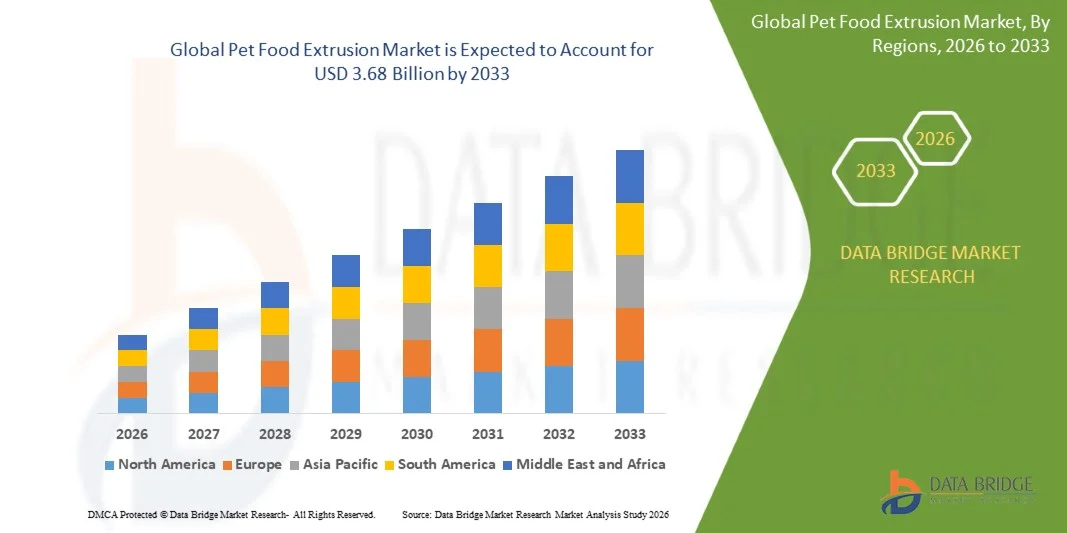
- As per Data Bridge Market Research analysis, the pet food extrusion market was valued at USD 2.14 billion in 2025 and is projected to reach USD 3.68 billion by 2033, growing at a CAGR of 7.02% from 2026 to 2033.
- The market is expanding steadily as pet food manufacturers scale premium, functional, and high-meat-inclusion product lines, and as extrusion technology increasingly underpins dry kibble, semi-moist food, and treat production worldwide.
- Rising global pet ownership, growing humanization of pet diets, and the shift toward alternative-protein and sustainable raw materials are compelling manufacturers to invest in twin-screw and high-moisture extrusion (HME) systems capable of processing a wider range of ingredients while maintaining product consistency and food-safety compliance.
Market Size & Forecast
- Global Market Value (2025): USD 2.14 Billion
- Expected Market Value (2033): USD 3.68 Billion
- Forecast CAGR (2026–2033): 7.02%
- Leading Region in 2025: North America
- Fastest Growing Region: Asia-Pacific
What are the Major Takeaways of the Pet Food Extrusion Market?
- North America dominated the global pet food extrusion market with the largest revenue share of 36.80% in 2025, supported by the concentration of leading extrusion OEMs, established pet food manufacturing infrastructure, and high per-capita pet ownership.
- Asia-Pacific is expected to be the fastest-growing region at a CAGR of 9.8% from 2026 to 2033, fueled by rising pet adoption, expanding disposable incomes, and growing domestic pet food production capacity in China, India, and Japan.
- The twin-screw extruders segment led the market with a 64.20% share in 2025, driven by its flexibility in processing high-meat, grain-free, and alternative-protein formulations.
- Co-rotating twin-screw extruders are the fastest-growing extruder type, projected to register a CAGR of 8.6%, reflecting rising adoption of high-moisture extrusion for plant-based and wet pet food.
- The dry pet food (kibble) segment dominated the product type category with a 69.40% revenue share in 2025, led by its cost efficiency and long shelf life.
- Fully automatic systems accounted for 52.30% of the market share in 2025, preferred by manufacturers seeking consistent product quality and integration with plant-wide digital quality-control systems.
- The plant & vegetable protein-based raw material segment is the fastest-growing category, with a CAGR of 9.3%, driven by manufacturers diversifying away from volatile meat-based input costs.
Report Scope and Pet Food Extrusion Market Segmentation
|
Attributes |
Pet Food Extrusion Key Market Insights |
|
Segments Covered |
|
|
Countries Covered |
North America
Europe
Asia-Pacific
Middle East and Africa
South America
|
|
Key Market Players |
|
|
Market Opportunities |
|
|
Value Added Data Infosets |
In addition to the insights on market scenarios such as market value, growth rate, segmentation, geographical coverage, and major players, the market reports curated by the Data Bridge Market Research also include in-depth expert analysis, geographically represented company-wise production and capacity, network layouts of distributors and partners, detailed and updated price trend analysis and deficit analysis of supply chain and demand. |
What is the Key Trend in the Pet Food Extrusion Market?
- Pet food producers are increasingly adopting high-moisture extrusion (HME) to create wet and semi-moist formulations with meat-like textures, expanding formulation flexibility beyond traditional dry kibble.
- For instance, in April 2025, Bühler Group presented new high-moisture extrusion methods at Petfood Forum 2025 in Kansas City, demonstrating techniques to create tailored wet pet food textures for both dogs and cats using aeration technology alongside HME.
- Equipment makers are also engineering platforms specifically for high fresh-meat-inclusion recipes, which require gentler thermal cooking and specialized post-extrusion handling to preserve fragile, moisture-rich kibble.
- For instance, in 2024, Wenger Manufacturing introduced its PetFLEX thermal twin-screw extrusion platform, designed to expand production of high fresh-meat-inclusion kibble and treats for manufacturers targeting growth markets such as Latin America.
- As pet food formulations continue to diversify across premium, functional, and alternative-protein categories, extrusion technology is expected to remain the central enabling process for new product development across the industry.
What are the Key Drivers of the Pet Food Extrusion Market?
- The growing integration of artificial intelligence and predictive analytics into extrusion process control is helping manufacturers reduce variability, improve yield, and shorten new-recipe development cycles.
- For instance, in May 2025, Wenger Manufacturing and Extru-Tech jointly launched EXPRO AI, an AI-powered extrusion process optimization software built on TwinThread technology that uses real-time and historical process data to predict product quality outcomes and recommend optimal process setpoints.
- Rising global pet ownership and the humanization of pet diets are pushing manufacturers to expand premium, high-protein, and functional product lines, increasing capital investment in flexible, high-capacity twin-screw extrusion systems.
- Growing demand for sustainable and traceable ingredient sourcing is also encouraging processors to adopt extrusion platforms capable of handling a broader range of alternative-protein and plant-based inputs without compromising palatability or texture.
- With pet food manufacturers continuing to prioritize product differentiation and operational efficiency, extrusion equipment will remain indispensable to the industry's ability to scale premium and functional pet nutrition.
Which Factors are Challenging the Growth of the Pet Food Extrusion Market?
- Advanced twin-screw extrusion lines require significant upfront capital investment, encompassing preconditioning, thermal cooking, drying, and coating equipment, alongside process-control and automation systems.
- Tightening food-safety regulations, including HACCP and allergen-control requirements under FDA and EU frameworks, are raising compliance and sanitation costs, favouring processors that can absorb higher capital expenditure over smaller manufacturers.
- Volatility in commodity prices for corn, wheat, and meat-based raw materials continues to compress margin predictability for processors reliant on consistent gelatinization and formulation targets.
- These cost pressures collectively slow adoption among small and medium-sized pet food producers and co-packers, particularly in price-sensitive and emerging markets, limiting the pace of equipment upgrades despite strong underlying demand growth.
How is the Pet Food Extrusion Market Segmented?
The pet food extrusion market is segmented on the basis of extruder type, capacity, product type, animal type, automation level, raw material, end user, and sales channel.
- By Extruder Type
On the basis of extruder type, the global pet food extrusion market is segmented into single-screw extruders, twin-screw extruders, co-rotating twin-screw extruders, and counter-rotating twin-screw extruders. The twin-screw extruders segment dominated the market with a 64.20% share in 2025, owing to superior control over shear, residence time, and moisture input, which allows processors to handle high-meat-inclusion, grain-free, and alternative-protein recipes that single-screw systems cannot reliably process. Their flexibility across dry kibble, semi-moist food, and treat production continues to make twin-screw platforms the preferred choice of large-scale pet food manufacturers and co-packers.
The co-rotating twin-screw extruders segment is projected to register the fastest growth at a CAGR of 8.6% from 2026 to 2033, driven by rising adoption of high-moisture extrusion (HME) for plant-based and alternative-protein formulations, along with growing demand for precise thermal and mechanical energy control in premium wet and semi-moist pet food lines.
- By Capacity
On the basis of capacity, the global pet food extrusion market is segmented into below 500 kg/hr, 500–1,500 kg/hr, and above 1,500 kg/hr. The 500–1,500 kg/hr segment led the market with a 44.70% share in 2025, supported by its widespread use among mid-sized pet food manufacturers and co-packers seeking a balance between production flexibility and throughput efficiency.
The above 1,500 kg/hr segment is expected to witness the fastest CAGR of 8.5% from 2026 to 2033, driven by capacity expansions among large branded pet food manufacturers consolidating production to meet rising global pet ownership and premiumization trends.
- By Product Type
On the basis of product type, the global pet food extrusion market is segmented into dry pet food (kibble), semi-moist pet food, pet treats & chews, and aquafeed & specialty pet food. The dry pet food (kibble) segment dominated the market with a 69.40% share in 2025, owing to its cost efficiency, long shelf life, and continued position as the primary format purchased by pet owners worldwide.
The pet treats & chews segment is anticipated to witness the fastest CAGR of 8.9% from 2026 to 2033, driven by rising demand for functional, high-meat-inclusion, and dental-health treats, supported by extrusion platforms capable of producing multiple treat shapes and textures on a single line.
- By Animal Type
On the basis of animal type, the global pet food extrusion market is segmented into dog food, cat food, and other pets. The dog food segment dominated the market with a 46.50% share in 2025, supported by the larger average serving size of canine diets and decades of formulation and process optimization on high-throughput lines.
The cat food segment is expected to register the fastest CAGR of 8.4% from 2026 to 2033, driven by increasing premiumization and functional nutrition claims in feline diets, along with extrusion process advances tailored to smaller kibble sizes and higher palatability requirements.
- By Automation Level
On the basis of automation level, the global pet food extrusion market is segmented into manual, semi-automatic, and fully automatic systems. The fully automatic segment dominated the market with a 52.30% share in 2025, due to its ability to deliver consistent product quality, reduce labour dependency, and integrate with plant-wide manufacturing execution and quality-control systems.
The semi-automatic segment is projected to witness the fastest CAGR of 7.8% from 2026 to 2033, driven by small and mid-sized manufacturers upgrading legacy lines with partial automation as a cost-effective step toward full digitalization.
- By Raw Material
On the basis of raw material, the global pet food extrusion market is segmented into meat & meat by-products, grain-based, and plant & vegetable protein-based inputs. The meat & meat by-products segment dominated the market with a 41.60% share in 2025, reflecting continued consumer preference for high-protein, meat-forward pet food formulations.
The plant & vegetable protein-based segment is expected to witness the fastest CAGR of 9.3% from 2026 to 2033, driven by manufacturers diversifying raw material sourcing to manage feed-grade meat price volatility and to meet rising demand for sustainable and alternative-protein pet food.
- By End User
On the basis of end user, the global pet food extrusion market is segmented into pet food manufacturers, contract manufacturers & co-packers, and research & academic institutes. The pet food manufacturers segment dominated the market with a 71.80% share in 2025, owing to sustained in-house capacity investments by branded pet food companies expanding premium and functional product lines.
The contract manufacturers & co-packers segment is anticipated to witness the fastest CAGR of 9.1% from 2026 to 2033, driven by emerging pet food brands outsourcing production to specialized co-packers to reduce capital expenditure while scaling new product launches.
- By Sales Channel
On the basis of sales channel, the global pet food extrusion market is segmented into direct sales and distributors & system integrators. The direct sales segment dominated the market with a 63.50% share in 2025, supported by the preference of large manufacturers for direct engineering support, customization, and after-sales service from equipment OEMs.
The distributors & system integrators segment is expected to witness the fastest CAGR of 7.6% from 2026 to 2033, driven by growing demand from small and mid-sized processors in emerging markets that rely on regional partners for financing, installation, and localized technical support.
Which Region Holds the Largest Share of the Pet Food Extrusion Market?
- North America dominated the pet food extrusion market and accounted for the largest revenue share of 36.80% in 2025, supported by the concentration of leading extrusion equipment manufacturers, mature pet food production infrastructure, and high per-capita pet ownership.
- The region also benefits from strong demand for premium and functional pet food, early adoption of AI-enabled process optimization, and continuous investment in high-meat-inclusion and high-moisture extrusion technologies by both branded manufacturers and co-packers.
U.S. Pet Food Extrusion Market Insight
The U.S. pet food extrusion market continues to expand steadily, supported by the presence of leading extrusion equipment manufacturers, high pet ownership rates, and strong consumer demand for premium and functional pet food. Increasing adoption of AI-enabled process optimization, high-moisture extrusion for wet and semi-moist formats, and growing investment in high fresh-meat-inclusion product lines are further reinforcing the country's position as a key innovation hub in the pet food extrusion industry.
Germany Pet Food Extrusion Market Insight
The Germany pet food extrusion market is growing steadily, underpinned by the country's strong food-processing machinery base and presence of established extrusion technology providers. Automotive-grade precision engineering culture has translated into advanced process-control and automation capabilities that German equipment makers are applying to pet food and aquafeed extrusion, supporting continued investment in energy-efficient and digitally integrated extrusion lines.
Asia-Pacific Pet Food Extrusion Market Insight
The Asia-Pacific pet food extrusion market is expected to witness rapid growth, driven by rising pet ownership, expanding domestic pet food manufacturing capacity, and growing investment in modern processing infrastructure across countries such as China, India, and Japan. Increasing consumer demand for premium and internationally branded pet food, along with rising local production to reduce import dependence, is accelerating the adoption of advanced extrusion technologies across the region.
China Pet Food Extrusion Market Insight
The China pet food extrusion market is growing rapidly, supported by rising middle-class pet ownership, expanding domestic pet food brands, and increasing government focus on food-processing modernization. Growing adoption of twin-screw extrusion systems by both multinational and domestic manufacturers, combined with rising investment in premium and functional pet food production, is positioning China as one of the fastest-growing markets for pet food extrusion equipment globally.
India Pet Food Extrusion Market Insight
The India pet food extrusion market is experiencing steady growth, driven by rapidly rising pet ownership, the entry of new domestic and international pet food brands, and growing investment in local manufacturing capacity to reduce reliance on imported pet food. Increasing availability of cost-competitive extrusion equipment from regional manufacturers is further supporting adoption among small and mid-sized pet food processors.
Which are the Top Companies in the Pet Food Extrusion Market?
The pet food extrusion industry is primarily led by well-established companies, including:
- Bühler Group (Switzerland)
- Wenger Manufacturing, Inc. (U.S.)
- Clextral SAS (France)
- Coperion GmbH (Germany)
- ANDRITZ AG (Austria)
- Baker Perkins Ltd. (U.K.)
- Extru-Tech, Inc. (U.S.)
- CPM Europe B.V. (Netherlands)
- Amandus Kahl GmbH & Co. KG (Germany)
- Pavan Group (Italy)
- Brabender GmbH & Co. KG (Germany)
- IDAH Co., Ltd. (Taiwan)
- INSTA-PRO International (U.S.)
- Sairem SAS (France)
- Promill S.r.l. (Italy)
- Rondo Dog S.r.l. (Italy)
- TSUNEISHI Kamtecs Corporation (Japan)
- Diamond America Corporation (U.S.)
- Lima Extrusion (Italy)
- Twin Engineers Pvt. Ltd. (India)
- Smart Process Equipments Pvt. Ltd. (India)
- Ottevanger Milling Engineers B.V. (Netherlands)
What are the Latest Developments in the Pet Food Extrusion Market?
- In May 2025, Wenger Manufacturing, Inc. and Extru-Tech, Inc. jointly launched EXPRO AI, an artificial intelligence-powered extrusion process optimization software developed with TwinThread technology, using predictive modelling to analyze real-time and historical process data and recommend optimal process setpoints for pet food manufacturing lines.
- In April 2025, Bühler Group presented new methods in high-moisture extrusion (HME) for creating innovative, diverse, and nutritious wet pet food at Petfood Forum 2025 in Kansas City, demonstrating how HME combined with aeration technology can expand texture and formulation options for dog and cat wet food.
- In 2024, Wenger Manufacturing introduced its PetFLEX thermal twin-screw extrusion platform, engineered to support high fresh-meat-inclusion kibble, baked treats, and long-goods production, targeting expansion opportunities in growth markets such as Latin America.
- In April 2026, Coperion detailed a reoriented vacuum takeaway system design at Petfood Forum 2026, aimed at reducing recontamination risk and improving product safety and process control on extrusion lines.

- Interactive Data Analysis Dashboard
- Company Analysis Dashboard for high growth potential opportunities
- Research Analyst Access for customization & queries
- Competitor Analysis with Interactive dashboard
- Latest News, Updates & Trend analysis
- Harness the Power of Benchmark Analysis for Comprehensive Competitor Tracking
Data collection and base year analysis are done using data collection modules with large sample sizes. The stage includes obtaining market information or related data through various sources and strategies. It includes examining and planning all the data acquired from the past in advance. It likewise envelops the examination of information inconsistencies seen across different information sources. The market data is analysed and estimated using market statistical and coherent models. Also, market share analysis and key trend analysis are the major success factors in the market report. To know more, please request an analyst call or drop down your inquiry.
The key research methodology used by DBMR research team is data triangulation which involves data mining, analysis of the impact of data variables on the market and primary (industry expert) validation. Data models include Vendor Positioning Grid, Market Time Line Analysis, Market Overview and Guide, Company Positioning Grid, Patent Analysis, Pricing Analysis, Company Market Share Analysis, Standards of Measurement, Global versus Regional and Vendor Share Analysis. To know more about the research methodology, drop in an inquiry to speak to our industry experts.
Data Bridge Market Research is a leader in advanced formative research. We take pride in servicing our existing and new customers with data and analysis that match and suits their goal. The report can be customized to include price trend analysis of target brands understanding the market for additional countries (ask for the list of countries), clinical trial results data, literature review, refurbished market and product base analysis. Market analysis of target competitors can be analyzed from technology-based analysis to market portfolio strategies. We can add as many competitors that you require data about in the format and data style you are looking for. Our team of analysts can also provide you data in crude raw excel files pivot tables (Fact book) or can assist you in creating presentations from the data sets available in the report.