


What is the Petri Dish Fillers Size and Growth Rate?
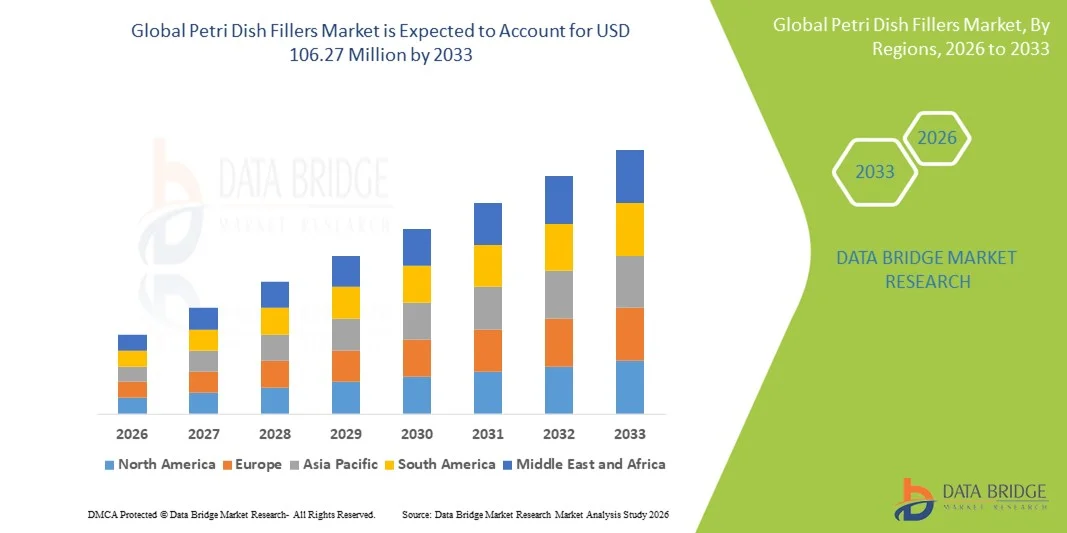
- As per Data Bridge Market Research Analysis the global Petri dish fillers market size was valued at USD 80.08 million in 2025 and is expected to reach USD 106.27 million by 2033, at a CAGR of 3.60% during the forecast period
- The market growth is largely fueled by increasing demand in biotechnology, pharmaceutical, and life-science laboratories, where efficient, automated sample-preparation systems, including Petri dish fillers, are becoming essential
- Furthermore, rising adoption of automation, integration of advanced technologies such as robotic filling systems and IoT-based process optimization, and a push toward high-throughput, contamination-free, and scalable lab workflows are accelerating the uptake of Petri dish filling solutions
Market Size & Forecast
- Global Market Value (2025): USD 80.08 million
- Expected Market Value (2033): USD 106.27 million
- Forecast CAGR (2026–2033): 3.60%
What are the Major Takeaways of Petri Dish Fillers?
- Petri dish fillers, enabling automated filling of culture media into Petri dishes, are increasingly vital components of modern microbiology, chemical, biochemical, pharmaceutical, and nanotechnology laboratories due to their precision, efficiency, and ability to minimize contamination risks
- The escalating demand for Petri dish fillers is primarily fueled by the growing adoption of laboratory automation, the need for high-throughput research, and stringent quality control requirements in both academic and industrial laboratories
- North America dominated the Petri dish fillers market with the largest revenue share of 37.1% in 2025, characterized by advanced laboratory infrastructure, high R&D investments, and a strong presence of key industry players, with the U.S. witnessing substantial growth in automated Petri dish filling systems driven by innovations in speed, accuracy, and integration with laboratory information management systems (LIMS)
- Asia-Pacific is expected to be the fastest growing region in the Petri dish fillers market during the forecast period due to increasing laboratory automation, rising research activities, and growing disposable incomes in emerging economies
- Plastic material segment dominated the Petri dish fillers market with a market share of 52.9% in 2025, driven by its cost-effectiveness, ease of handling, and widespread use across microbiology, pharmaceutical, and nanotechnology applications
Report Scope and Petri Dish Fillers Market Segmentation
|
Attributes |
Petri Dish Fillers Key Market Insights |
|
Segments Covered |
|
|
Countries Covered |
North America
Europe
Asia-Pacific
Middle East and Africa
South America
|
|
Key Market Players |
|
|
Market Opportunities |
|
|
Value Added Data Infosets |
|
What is the Key Trend in the Petri Dish Fillers?
Automation and Integration with Laboratory Information Systems (LIS)
- A significant and accelerating trend in the global Petri dish fillers market is the integration of automated filling systems with Laboratory Information Systems (LIS) and other digital lab management platforms, enhancing precision, tracking, and efficiency of culture media preparation
- For instance, advanced BioFill automated systems allow real-time monitoring of fill volumes and media usage through LIS dashboards, reducing human error and improving workflow efficiency
- Integration with digital lab platforms enables features such as batch tracking, error alerts, and automated documentation, ensuring compliance with laboratory standards and improving reproducibility of experiments
- The seamless combination of automated Petri dish fillers with lab-wide data management solutions allows scientists to optimize operations, track sample usage, and maintain comprehensive audit trails in regulated environments
- This trend towards smart, interconnected, and data-driven laboratory equipment is reshaping expectations for operational efficiency and reproducibility, prompting manufacturers such as Advanced Instruments and Microlab to develop LIS-compatible automated filling systems
- The demand for Petri dish fillers integrated with LIS and automated workflow capabilities is growing rapidly across research, pharmaceutical, and clinical diagnostics labs, as organizations prioritize accuracy, traceability, and efficiency
- Robotics-assisted Petri dish filling is emerging, enabling fully automated lab workflows with minimal human intervention, further reducing contamination risks and operational errors
- Sustainability-focused designs, such as low-waste and recyclable media dispensing systems, are gaining traction as laboratories seek to reduce plastic waste and operational costs
Petri Dish Fillers Market Dynamics
Driver
Rising Demand Due to Laboratory Automation and High-Throughput Research
- The increasing adoption of laboratory automation and high-throughput research systems in pharmaceutical, biotech, and microbiology labs is a key driver for the growing demand for Petri dish fillers
- For instance, in March 2025, Microlab announced the launch of a high-speed automated Petri dish filler capable of handling hundreds of plates per hour, aimed at accelerating microbial research workflows
- Automated fillers provide precise media distribution, minimize contamination risks, and reduce manual labor requirements, making them indispensable for modern laboratories
- Furthermore, the growing emphasis on reproducibility, standardized testing, and operational efficiency is making automated Petri dish fillers integral to lab processes
- The ability to fill large volumes of Petri dishes quickly and accurately, combined with compatibility with different media types, continues to propel market adoption in both research and industrial settings
- The expansion of pharmaceutical and biotech R&D activities globally is increasing demand for automated Petri dish fillers to support faster drug discovery and testing cycles
- Government funding and grants for research laboratories in emerging economies are encouraging the adoption of advanced lab automation systems, further driving market growth
Restraint/Challenge
High Initial Cost and Maintenance Requirements
- The relatively high cost of advanced automated Petri dish filling systems compared to manual filling methods poses a challenge to broader market adoption, especially for smaller laboratories or institutions in developing regions
- For instance, sophisticated fillers with integrated automation and LIS connectivity can cost several times more than traditional manual systems, limiting access for budget-constrained labs
- Maintenance requirements, including periodic calibration, cleaning, and replacement of precision components, further increase the total cost of ownership, discouraging some potential buyers
- While automation offers efficiency gains, smaller labs may perceive the ROI as insufficient, slowing adoption in cost-sensitive segments
- Addressing these challenges through more affordable models, modular systems, and remote maintenance support will be essential for expanding market penetration and sustained growth
- Technical complexity and the need for trained personnel to operate and maintain automated systems can act as a barrier, especially in labs with limited expertise
- Compatibility issues with existing lab infrastructure or legacy systems may hinder adoption, requiring additional investment for integration
How is the Petri Dish Fillers Segmented?
The market is segmented on the basis of end-use area, material, Petri dish capacity, and carousal sizes.
- By End Use Area
On the basis of end-use area, the Petri dish fillers market is segmented into microbiology, chemical, bio-chemical, nanotechnology, pharmaceutical, and others. The microbiology segment dominated the market with the largest revenue share of 38.7% in 2025, driven by the extensive use of Petri dishes for microbial culture, clinical diagnostics, and food safety testing. Laboratories increasingly rely on automated fillers to ensure consistent media volume, reduce contamination risks, and improve throughput for high-volume microbial studies. The segment’s dominance is also supported by regulatory standards and quality control requirements in clinical and industrial microbiology labs, necessitating precise and reproducible filling. In addition, the growing prevalence of infectious disease research and pathogen testing continues to drive strong demand in this segment. Established companies offer specialized fillers optimized for various agar types, further reinforcing the market dominance of microbiology applications.
The pharmaceutical segment is anticipated to witness the fastest growth rate from 2026 to 2033, fueled by increasing R&D activities, drug discovery, and clinical testing that require large-scale preparation of Petri dishes for cell cultures and microbial studies. The rising adoption of high-throughput automated laboratories in pharmaceutical research allows rapid filling of multiple dishes simultaneously, enhancing operational efficiency. Pharmaceutical labs also benefit from integration with Laboratory Information Systems (LIS), ensuring traceability and compliance with stringent regulatory standards. The growing global demand for biologics, vaccines, and sterile products further accelerates market expansion in this segment. Companies are investing in advanced fillers compatible with diverse culture media to meet evolving pharmaceutical research needs.
- By Material
On the basis of material, the Petri dish fillers market is segmented into plastic, glass, and other materials. The plastic segment dominated the market with a share of 52.9% in 2025, driven by its cost-effectiveness, ease of handling, and widespread applicability across research, pharmaceutical, and industrial laboratories. Plastic Petri dishes are preferred for routine microbial work, automated media filling, and disposable applications, minimizing cross-contamination risks. The lightweight nature and compatibility with automated filling systems make plastic dishes ideal for high-throughput environments. Furthermore, plastic Petri dishes support diverse media types and are easily sterilized, aligning with laboratory efficiency goals. The availability of eco-friendly, recyclable plastics also contributes to the segment’s appeal among sustainability-conscious laboratories.
The glass segment is expected to witness the fastest growth during 2026–2033, propelled by the demand for reusable and chemically resistant Petri dishes in specialized research and high-precision applications. Glass dishes offer superior transparency for microscopy and imaging, making them preferred for advanced cell culture and biochemical studies. Their thermal stability allows autoclaving and repeated sterilization, extending lifespan and reducing long-term costs for research labs. Increasing adoption in pharmaceutical and biotech labs requiring high-purity and contaminant-free culture environments is boosting growth in this segment. Companies are innovating with coated and treated glass dishes to improve durability and usability with automated fillers.
- By Petri Dish Capacity
On the basis of capacity, the market is segmented into small, medium, and large-sized Petri dishes. Small size Petri dishes dominated the market with a share of 44.1% in 2025, owing to their compatibility with standard lab equipment, suitability for microbiological and pharmaceutical testing, and convenience in handling multiple samples simultaneously. Small dishes are widely used in routine microbial culture, clinical diagnostics, and educational labs. Their prevalence supports high-throughput automated filling operations, reducing manual errors and operational time. Laboratories also prefer small dishes for standardization across experiments and ease of integration with incubators and imaging systems. The segment benefits from widespread availability and cost-efficiency, reinforcing its market dominance.
Medium size Petri dishes are expected to witness the fastest growth from 2026 to 2033, driven by their application in specialized research, high-density screenings, and pharmaceutical R&D requiring slightly larger sample volumes. Medium dishes are compatible with automated high-capacity fillers and are ideal for experiments that require increased media volume without sacrificing throughput. The growth of biotechnology research, cell culture studies, and combinatorial testing is fueling the demand for medium-sized dishes. Manufacturers are providing customized solutions for medium capacity dishes to enhance lab efficiency and support regulatory compliance.
- By Carousal Sizes
On the basis of carousal sizes, the market is segmented into single, double, and triple carousals. Single carousal fillers dominated the market with a share of 47.5% in 2025, driven by their operational simplicity, faster setup, and suitability for small- to medium-scale laboratory operations. Single carousal systems are cost-effective, easy to maintain, and ideal for laboratories with moderate throughput requirements. Their compact design and compatibility with standard Petri dish sizes make them popular for routine microbial work. The segment benefits from widespread adoption in academic and diagnostic labs due to its reliability and ease of integration with automated workflows.
Triple carousal fillers are anticipated to witness the fastest growth rate during 2026–2033, fueled by their high-throughput capabilities, ability to handle multiple media types simultaneously, and suitability for large-scale pharmaceutical and industrial research labs. Triple carousals reduce manual intervention, enhance operational efficiency, and support continuous filling operations. Increasing demand from biotechnology, pharmaceutical, and food testing labs for rapid, high-volume dish preparation is driving market expansion. Manufacturers are introducing advanced triple carousal systems with automation, LIS integration, and enhanced contamination control features to cater to the growing need for efficiency in modern laboratories.
Which Region Holds the Largest Share of the Petri Dish Fillers?
- North America dominated the Petri dish fillers market with the largest revenue share of 37.1% in 2025, characterized by advanced laboratory infrastructure, high R&D investments, and a strong presence of key industry players
- Laboratories in the region prioritize precision, efficiency, and contamination control, leading to widespread use of automated Petri dish fillers in microbiology, pharmaceutical, and biotechnology research
- The strong presence of key industry players, coupled with stringent regulatory standards and quality control requirements, further supports the adoption of automated filling systems across clinical, research, and industrial labs
U.S. Petri Dish Fillers Market Insight
The U.S. Petri dish fillers market captured the largest revenue share of 82% in 2025 within North America, fueled by the rapid adoption of automated laboratory equipment and the expanding trend of high-throughput research. Laboratories are increasingly prioritizing precision, reproducibility, and contamination-free media preparation, driving the adoption of automated Petri dish fillers. The growing preference for integration with Laboratory Information Systems (LIS) and automated workflow solutions further propels the market. Moreover, the presence of leading research institutions, pharmaceutical companies, and biotech firms continues to support the widespread use of advanced filling systems across clinical, academic, and industrial laboratories.
Europe Petri Dish Fillers Market Insight
The Europe Petri dish fillers market is projected to expand at a substantial CAGR throughout the forecast period, primarily driven by stringent regulatory standards, quality control requirements, and the rising demand for laboratory automation. Increasing urbanization and investment in research infrastructure are fostering the adoption of automated Petri dish fillers. European laboratories are also emphasizing workflow efficiency and reproducibility, with growing use in pharmaceutical, microbiology, and biotechnology applications. The region is witnessing significant growth in both academic and commercial labs, with automated filling systems being incorporated into new laboratory setups and modernization projects.
U.K. Petri Dish Fillers Market Insight
The U.K. Petri dish fillers market is anticipated to grow at a noteworthy CAGR during the forecast period, driven by the increasing trend of laboratory automation and the demand for higher efficiency and precision. Concerns over contamination, accuracy, and compliance with standardized testing are encouraging research and diagnostic labs to adopt automated fillers. The U.K.’s strong research infrastructure, combined with an emphasis on technological innovation, is expected to continue stimulating market growth. In addition, the integration of Petri dish fillers with high-throughput screening and LIS systems enhances productivity and ensures regulatory compliance.
Germany Petri Dish Fillers Market Insight
The Germany Petri dish fillers market is expected to expand at a considerable CAGR during the forecast period, fueled by rising awareness of laboratory automation, quality standards, and sustainable practices. Germany’s well-developed research and pharmaceutical infrastructure, along with a focus on precision and contamination control, promotes the adoption of automated filling systems. Integration with automated laboratory workflows and digital monitoring solutions is becoming increasingly prevalent, supporting productivity and compliance. There is a strong preference for reliable, high-quality solutions in clinical, academic, and industrial labs, aligning with local research and manufacturing standards.
Asia-Pacific Petri Dish Fillers Market Insight
The Asia-Pacific Petri dish fillers market is poised to grow at the fastest CAGR of 23% during the forecast period of 2026 to 2033, driven by increasing urbanization, rising R&D investments, and the expansion of biotechnology and pharmaceutical research in countries such as China, Japan, and India. The region's growing inclination towards laboratory automation, supported by government initiatives promoting scientific research and innovation, is driving the adoption of automated Petri dish fillers. Furthermore, as APAC emerges as a manufacturing hub for laboratory equipment, the affordability and accessibility of advanced filling systems are expanding to a wider base of research and diagnostic laboratories.
Japan Petri Dish Fillers Market Insight
The Japan Petri dish fillers market is gaining momentum due to the country’s high-tech research environment, emphasis on precision, and demand for contamination-free laboratory processes. Japanese laboratories prioritize automation to improve reproducibility and operational efficiency in pharmaceutical, microbiology, and biochemical studies. Integration of Petri dish fillers with high-throughput screening and digital lab management systems is fueling growth. In addition, Japan’s aging research workforce encourages the adoption of user-friendly automated systems that reduce manual labor while ensuring accuracy and safety across laboratory operations.
India Petri Dish Fillers Market Insight
The India Petri dish fillers market accounted for the largest market revenue share in Asia Pacific in 2025, attributed to the country’s expanding pharmaceutical and biotech R&D activities, rapid urbanization, and high rates of laboratory automation adoption. India is emerging as a key hub for research laboratories, and automated Petri dish fillers are becoming increasingly popular in academic, industrial, and clinical settings. Government initiatives promoting scientific research and the push towards modern laboratory infrastructure are key factors propelling market growth. Affordable automated systems, supported by domestic manufacturers, are further driving adoption across the country.
Petri Dish Fillers Market Share
The Petri Dish Fillers industry is primarily led by well-established companies, including:
- INTEGRA Biosciences (Switzerland)
- Biotool Swiss AG (Switzerland)
- IQ Designs, Inc. (U.S.)
- Alliance BioExpertise (France)
- Aarya Invent Solutions (India)
- Aseptic Technology Inc. (U.S.)
- Avantor, Inc. (U.S.)
- BIOMÉRIEUX (France)
- Corning Incorporated (U.S.)
- Spectrum Chemical Mfg. Corp. (U.S.)
- Boekel Scientific (U.S.)
- Beijing HiYi Technology Co., Ltd. (China)
- Hektros (Italy)
- Pagès Group (France)
- PHC Holdings Corporation (Japan)
- DWK Life Sciences GmbH (Germany)
What are the Recent Developments in Global Petri Dish Fillers Market?
- In November 2025, NEST Biotechnology introduced its “Automatic Petri Dish”, specially designed for automated filling featuring a smooth lid‑base design for easy sliding in automated equipment, minimizing manual handling and contamination risk while boosting throughput and efficiency
- In June 2025, AES CHEMUNEX evaluated its APS One Automated Pourer Stacker at a hospital lab in Rennes, France the lab reported that the system could pour 10 litres of culture media and fill a full carousel of plates in about 40 minutes without needing to reload, underscoring its value for high‑throughput microbiology operations
- In January 2025, BBS Automation unveiled its new semi‑automated Petri dish production platform called HEKUdish compact a turnkey solution combining robotic dish handling, transfer station and manual packaging, targeting smaller batch production and medical‑grade Petri dish manufacturing for labs needing flexibility rather than high-volume automation
- In August 2024, AsureQuality a food‑testing and quality control lab deployed a new automated system for plate imaging, sorting, and movement of Petri dishes at its food microbiology laboratory in Auckland. The system combines digital imaging, AI‑based detection and automated dish movement post‑incubation significantly reducing manual work, speeding up sample processing, and improving traceability and data management in microbial testing workflows
- In June 2024, Neogen Corporation launched the Petrifilm® Automated Feeder, aimed at high‑volume food‑safety labs; it can automatically feed and enumerate up to 300 Petri‑film/plate samples in just 33 minutes, dramatically reducing manual processing time and improving lab throughput

- Interactive Data Analysis Dashboard
- Company Analysis Dashboard for high growth potential opportunities
- Research Analyst Access for customization & queries
- Competitor Analysis with Interactive dashboard
- Latest News, Updates & Trend analysis
- Harness the Power of Benchmark Analysis for Comprehensive Competitor Tracking
Data collection and base year analysis are done using data collection modules with large sample sizes. The stage includes obtaining market information or related data through various sources and strategies. It includes examining and planning all the data acquired from the past in advance. It likewise envelops the examination of information inconsistencies seen across different information sources. The market data is analysed and estimated using market statistical and coherent models. Also, market share analysis and key trend analysis are the major success factors in the market report. To know more, please request an analyst call or drop down your inquiry.
The key research methodology used by DBMR research team is data triangulation which involves data mining, analysis of the impact of data variables on the market and primary (industry expert) validation. Data models include Vendor Positioning Grid, Market Time Line Analysis, Market Overview and Guide, Company Positioning Grid, Patent Analysis, Pricing Analysis, Company Market Share Analysis, Standards of Measurement, Global versus Regional and Vendor Share Analysis. To know more about the research methodology, drop in an inquiry to speak to our industry experts.
Data Bridge Market Research is a leader in advanced formative research. We take pride in servicing our existing and new customers with data and analysis that match and suits their goal. The report can be customized to include price trend analysis of target brands understanding the market for additional countries (ask for the list of countries), clinical trial results data, literature review, refurbished market and product base analysis. Market analysis of target competitors can be analyzed from technology-based analysis to market portfolio strategies. We can add as many competitors that you require data about in the format and data style you are looking for. Our team of analysts can also provide you data in crude raw excel files pivot tables (Fact book) or can assist you in creating presentations from the data sets available in the report.













