


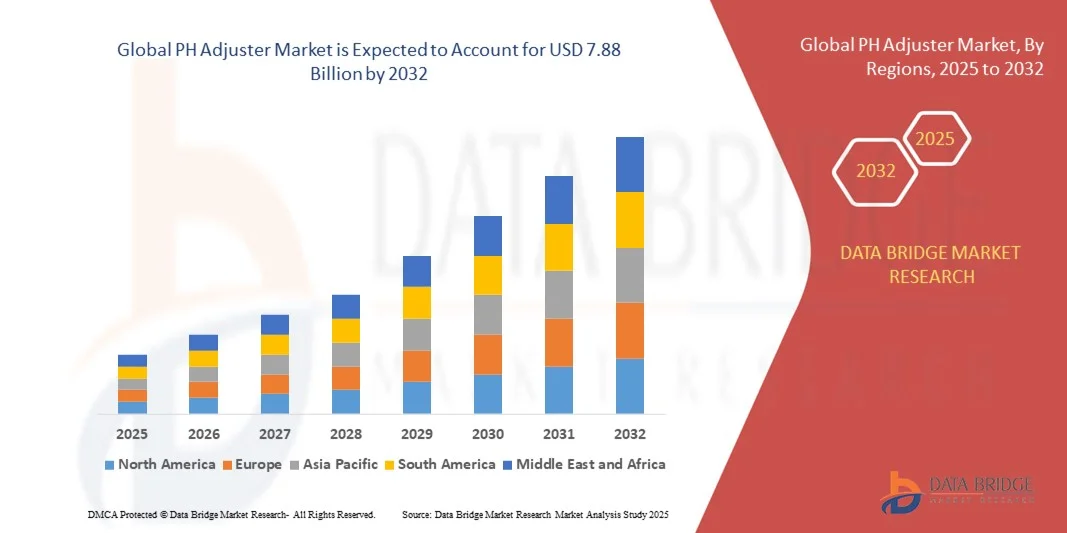
PH Adjuster Market Size
- The global PH adjuster market size was valued at USD 4.01 billion in 2024 and is expected to reach USD 7.88 billion by 2032, at a CAGR of 8.80% during the forecast period
- The market growth is largely fuelled by the rising demand for pH stabilizing solutions across water treatment, agriculture, and industrial manufacturing sectors
- The increasing emphasis on maintaining water quality and soil health, coupled with growing awareness of pH balance in end-use applications, is boosting market expansion
PH Adjuster Market Analysis
- The pH adjuster market is experiencing steady growth due to its vital role in ensuring chemical balance and process optimization across multiple industries
- Growing regulatory focus on environmental protection and wastewater treatment is accelerating the use of pH adjusters in municipal and industrial applications
- North America dominated the pH adjuster market with the largest revenue share of 36.25% in 2024, driven by the widespread application of pH adjusters across industries such as agrochemicals, pharmaceuticals, and personal care
- Asia-Pacific region is expected to witness the highest growth rate in the global PH adjuster market, driven by rapid urbanization, increasing demand for agrochemicals, and growing emphasis on sustainable water and soil treatment practices
- The adjuvants segment held the largest market revenue share in 2024, driven by its extensive use in enhancing the effectiveness of agricultural chemicals and fertilizers. Adjuvants play a critical role in optimizing spray solutions by maintaining proper pH levels, improving chemical stability, and maximizing nutrient absorption in crops. Their increasing adoption in modern farming practices supports higher yield and sustainable agriculture
Report Scope and PH Adjuster Market Segmentation
|
Attributes |
PH Adjuster Key Market Insights |
|
Segments Covered |
|
|
Countries Covered |
North America
Europe
Asia-Pacific
Middle East and Africa
South America
|
|
Key Market Players |
|
|
Market Opportunities |
|
|
Value Added Data Infosets |
In addition to the insights on market scenarios such as market value, growth rate, segmentation, geographical coverage, and major players, the market reports curated by the Data Bridge Market Research also include import export analysis, production capacity overview, production consumption analysis, price trend analysis, climate change scenario, supply chain analysis, value chain analysis, raw material/consumables overview, vendor selection criteria, PESTLE Analysis, Porter Analysis, and regulatory framework. |
PH Adjuster Market Trends
Growing Demand for Sustainable and Bio-Based PH Adjusters
- The increasing environmental awareness and stringent regulatory standards are driving industries toward sustainable and bio-based pH adjusters. Companies are actively developing eco-friendly formulations derived from natural and renewable sources to replace synthetic chemical variants, reducing ecological impact and improving safety standards across applications such as agriculture, cosmetics, and wastewater treatment. The trend is further strengthened by the rising global focus on carbon neutrality and corporate sustainability commitments among major chemical producers
- The demand for green chemistry solutions in end-use industries has led to growing adoption of organic acids and biodegradable compounds. These alternatives not only help manufacturers comply with environmental norms but also appeal to consumers seeking sustainable products. The transition is supported by global initiatives promoting cleaner production practices and reduced chemical waste, particularly in regions implementing circular economy principles to minimize industrial pollution
- Several industrial players are investing in R&D to create bio-based adjusters with better stability and performance consistency across a wide range of pH levels. These innovations are aimed at enhancing product quality while ensuring cost-effectiveness and compliance with environmental mandates. Companies are also focusing on developing scalable production technologies and partnerships with biotech firms to secure consistent raw material supplies for bio-based products
- For instance, in 2023, multiple European chemical manufacturers introduced plant-based citric acid solutions for pH control in personal care and food applications, significantly reducing carbon emissions and hazardous byproducts during production. These solutions demonstrated improved biodegradability and reduced toxicity levels compared to traditional inorganic acids, enhancing consumer safety. Such developments reflect the industry’s ongoing transition toward sustainable chemistry
- While sustainable pH adjusters are gaining traction, scalability and cost parity with traditional chemicals remain challenges. Continuous investment in green technology and supply chain optimization is essential to expand market reach and commercial viability. Industry collaboration, government incentives, and advancements in green chemistry processes are expected to further bridge the cost-performance gap over the next decade
PH Adjuster Market Dynamics
Driver
Expanding Use of PH Adjusters in Water and Wastewater Treatment
- The growing global emphasis on water conservation and pollution control has elevated the demand for pH adjusters in water and wastewater treatment plants. Proper pH balance is essential for effective coagulation, flocculation, and disinfection processes, ensuring treated water meets regulatory safety standards. This has led to increasing use of pH adjusters in municipal and industrial water treatment projects aimed at sustainable resource utilization
- Rapid industrialization and urbanization are contributing to higher wastewater output, compelling governments and industries to adopt advanced treatment systems. PH adjusters are increasingly used to optimize these systems, maintaining equipment longevity and operational efficiency while ensuring compliance with environmental discharge regulations. Their role is especially critical in industries such as food processing, pulp and paper, and textiles, where wastewater characteristics fluctuate significantly
- Public infrastructure initiatives focused on sustainable water management are further accelerating adoption. In emerging economies, the implementation of new municipal and industrial treatment facilities is significantly boosting product demand across both liquid and dry chemical segments. Governments are also emphasizing water recycling programs that depend on precise pH control to maintain process stability and efficiency
- For instance, in 2023, India’s Ministry of Jal Shakti expanded its Smart Water Management program, which incorporated chemical pH balancing solutions in over 50 new treatment facilities to improve water quality outcomes and resource recovery rates. Similar initiatives have been observed in the Middle East and North America, where large-scale industrial wastewater treatment investments are supporting long-term demand growth
- The growing application scope in municipal, industrial, and agricultural water management is expected to strengthen the global market position of pH adjusters over the forecast period. As global water stress intensifies, industries are increasingly investing in automated pH control systems integrated with digital monitoring to optimize chemical dosing and reduce operational costs
Restraint/Challenge
Volatility in Raw Material Prices and Environmental Compliance Costs
- The production of synthetic pH adjusters heavily depends on raw materials such as sulfuric acid, caustic soda, and ammonia, the prices of which are subject to high volatility due to fluctuating energy costs and global supply disruptions. These price fluctuations directly impact manufacturing margins and product affordability. Furthermore, geopolitical tensions and trade barriers can further exacerbate cost instability in chemical supply chains
- Rising regulatory scrutiny concerning chemical discharge and handling safety has increased operational costs for manufacturers. Companies are required to invest in cleaner technologies, waste management systems, and compliance documentation, which can slow market expansion, particularly among small and medium-sized producers. Compliance with stringent environmental frameworks such as REACH and EPA regulations adds to the overall production burden
- Supply chain interruptions, especially during geopolitical or environmental crises, can cause raw material shortages, leading to inconsistent product availability and increased end-user pricing. Such volatility affects the stability of long-term supply agreements in key end-use sectors. To mitigate risks, many manufacturers are now diversifying raw material sourcing and establishing regional production bases to ensure supply security
- For instance, in 2023, the surge in global caustic soda prices, driven by energy constraints in Europe, resulted in cost escalation across several downstream industries, forcing manufacturers to temporarily reduce output or pass increased costs to customers. This scenario emphasized the urgent need for alternative raw material sourcing and energy-efficient manufacturing processes in the pH adjuster sector
- While regulatory reforms and sustainable practices are necessary for environmental protection, balancing compliance costs with profitability remains a major challenge for market players, emphasizing the need for innovation in production efficiency and raw material sourcing strategies. Companies investing in renewable feedstocks and advanced process optimization technologies are expected to gain a competitive edge in addressing these long-term challenges
PH Adjuster Market Scope
The pH adjuster market is segmented into three notable segments based on type, application, and end-use.
- By Type
On the basis of type, the pH adjuster market is segmented into adjuvants, soil treatment, aglime, and gypsum. The adjuvants segment held the largest market revenue share in 2024, driven by its extensive use in enhancing the effectiveness of agricultural chemicals and fertilizers. Adjuvants play a critical role in optimizing spray solutions by maintaining proper pH levels, improving chemical stability, and maximizing nutrient absorption in crops. Their increasing adoption in modern farming practices supports higher yield and sustainable agriculture.
The soil treatment segment is expected to witness the fastest growth rate from 2025 to 2032, driven by the rising focus on soil health restoration and balanced nutrient management. The growing awareness of soil acidification and the need for long-term fertility improvement are boosting demand for pH-adjusting soil treatments across major agricultural regions. These products help in maintaining soil pH, improving microbial activity, and promoting sustainable crop productivity.
- By Application
On the basis of application, the pH adjuster market is segmented into stabilizer, fungicides, pesticides, herbicides, neutralizing agent, and others. The stabilizer segment accounted for the largest market revenue share in 2024 due to its widespread use in food and beverage, cosmetics, and water treatment industries to maintain product consistency and chemical balance. Stabilizing agents are essential for ensuring process efficiency and extending product shelf life in several industrial formulations.
The neutralizing agent segment is projected to grow at the fastest rate during 2025–2032, driven by its increasing application in wastewater treatment, chemical processing, and industrial manufacturing. These agents play a vital role in balancing pH levels, ensuring compliance with environmental discharge standards, and enhancing overall process safety and reliability across diverse industries.
- By End-Use
On the basis of end-use, the pH adjuster market is segmented into textile and leather, agrochemical, pharmaceutical, cosmetics and personal care, and others (surfactants). The agrochemical segment held the largest market share in 2024, supported by the growing use of pH adjusters in fertilizers, pesticides, and soil conditioners to enhance crop performance and nutrient availability. The expansion of precision agriculture and sustainable farming practices further fuels segment growth.
The cosmetics and personal care segment is expected to witness the fastest growth rate from 2025 to 2032, attributed to increasing consumer preference for pH-balanced formulations in skincare, haircare, and hygiene products. Manufacturers are focusing on developing mild, pH-stable formulations to improve product safety, efficacy, and skin compatibility, driving the use of specialized pH adjusters in this sector.
PH Adjuster Market Regional Analysis
- North America dominated the pH adjuster market with the largest revenue share of 36.25% in 2024, driven by the widespread application of pH adjusters across industries such as agrochemicals, pharmaceuticals, and personal care
- The demand in the region is fuelled by advancements in agricultural formulations, water treatment systems, and sustainable production practices emphasizing precise pH control
- The strong presence of key manufacturers, high R&D investments, and the growing focus on crop productivity and environmental safety continue to support market expansion across the region
U.S. PH Adjuster Market Insight
The U.S. pH adjuster market captured the largest revenue share in 2024 within North America, driven by the growing demand for agrochemical and water treatment applications. Rising emphasis on maintaining soil health and sustainable farming practices is significantly boosting the use of pH regulators. The market is further strengthened by increased industrial utilization in personal care formulations and chemical manufacturing, coupled with the adoption of advanced formulation technologies enhancing pH stability and performance.
Europe PH Adjuster Market Insight
The Europe pH adjuster market is expected to witness substantial growth from 2025 to 2032, primarily due to strict environmental regulations and a strong focus on sustainable agricultural practices. The adoption of eco-friendly pH adjusters in industrial and cosmetic applications is increasing, driven by consumer preference for safer and biodegradable chemicals. Moreover, continuous innovation in formulation chemistry and the expansion of agro-based industries are expected to support regional market growth.
U.K. PH Adjuster Market Insight
The U.K. pH adjuster market is expected to witness notable growth from 2025 to 2032, driven by the rising adoption of pH correction agents in agriculture and personal care sectors. Increased awareness regarding soil balance and plant nutrition management supports the growing demand for pH stabilizers in farming applications. Furthermore, the country's focus on sustainability and regulatory compliance is promoting the shift toward environmentally compatible formulations across industrial and consumer products.
Germany PH Adjuster Market Insight
The Germany pH adjuster market is projected to experience strong growth from 2025 to 2032, fuelled by the expansion of the chemical, pharmaceutical, and cosmetics industries. Germany’s emphasis on product innovation, quality assurance, and environmentally conscious manufacturing supports the integration of advanced pH regulation systems. In addition, ongoing technological developments and process optimization in industrial formulations are further propelling market demand.
Asia-Pacific PH Adjuster Market Insight
The Asia-Pacific pH adjuster market is expected to witness the fastest growth rate from 2025 to 2032, driven by rapid industrialization, expanding agricultural output, and rising demand from personal care and pharmaceutical sectors in countries such as China, India, and Japan. Government initiatives promoting sustainable farming and environmental management are further accelerating product utilization. The region’s large-scale manufacturing base and improving infrastructure are fostering significant market growth opportunities.
Japan PH Adjuster Market Insight
The Japan pH adjuster market is anticipated to record steady growth from 2025 to 2032, supported by high demand from cosmetics, pharmaceutical, and agrochemical industries. The country’s focus on high-quality formulations and precise pH management in production processes enhances product adoption. In addition, the growing trend toward sustainable and bio-based ingredients is promoting innovation in pH adjustment solutions.
China PH Adjuster Market Insight
The China pH adjuster market accounted for the largest market revenue share in Asia Pacific in 2024, attributed to the country’s expanding agrochemical production, rapid industrialization, and increasing focus on water treatment. The presence of major local manufacturers and government emphasis on agricultural efficiency and pollution control are major growth drivers. Moreover, the widespread use of pH adjusters in personal care and textile industries continues to strengthen the market outlook in China.
PH Adjuster Market Share
The PH Adjuster industry is primarily led by well-established companies, including:
• Chr. Hansen Holding A/S (Denmark)
• DSM (Netherlands)
• DuPont (U.S.)
• Evonik Industries (Germany)
• Land O'Lakes, Inc. (U.S.)
• Mitsui & Co., Ltd. (Japan)
• Ohly (Denmark)
• Lesaffre (France)
• Alltech (U.S.)
• Novozymes (Denmark)
• Calpis Co., Ltd. (Japan)
• Unique Biotech (India)
• Pure Cultures (U.S.)

- Interactive Data Analysis Dashboard
- Company Analysis Dashboard for high growth potential opportunities
- Research Analyst Access for customization & queries
- Competitor Analysis with Interactive dashboard
- Latest News, Updates & Trend analysis
- Harness the Power of Benchmark Analysis for Comprehensive Competitor Tracking
Global Ph Adjuster Market, Supply Chain Analysis and Ecosystem Framework
To support market growth and help clients navigate the impact of geopolitical shifts, DBMR has integrated in-depth supply chain analysis into its Global Ph Adjuster Market research reports. This addition empowers clients to respond effectively to global changes affecting their industries. The supply chain analysis section includes detailed insights such as Global Ph Adjuster Market consumption and production by country, price trend analysis, the impact of tariffs and geopolitical developments, and import and export trends by country and HSN code. It also highlights major suppliers with data on production capacity and company profiles, as well as key importers and exporters. In addition to research, DBMR offers specialized supply chain consulting services backed by over a decade of experience, providing solutions like supplier discovery, supplier risk assessment, price trend analysis, impact evaluation of inflation and trade route changes, and comprehensive market trend analysis.
Data collection and base year analysis are done using data collection modules with large sample sizes. The stage includes obtaining market information or related data through various sources and strategies. It includes examining and planning all the data acquired from the past in advance. It likewise envelops the examination of information inconsistencies seen across different information sources. The market data is analysed and estimated using market statistical and coherent models. Also, market share analysis and key trend analysis are the major success factors in the market report. To know more, please request an analyst call or drop down your inquiry.
The key research methodology used by DBMR research team is data triangulation which involves data mining, analysis of the impact of data variables on the market and primary (industry expert) validation. Data models include Vendor Positioning Grid, Market Time Line Analysis, Market Overview and Guide, Company Positioning Grid, Patent Analysis, Pricing Analysis, Company Market Share Analysis, Standards of Measurement, Global versus Regional and Vendor Share Analysis. To know more about the research methodology, drop in an inquiry to speak to our industry experts.
Data Bridge Market Research is a leader in advanced formative research. We take pride in servicing our existing and new customers with data and analysis that match and suits their goal. The report can be customized to include price trend analysis of target brands understanding the market for additional countries (ask for the list of countries), clinical trial results data, literature review, refurbished market and product base analysis. Market analysis of target competitors can be analyzed from technology-based analysis to market portfolio strategies. We can add as many competitors that you require data about in the format and data style you are looking for. Our team of analysts can also provide you data in crude raw excel files pivot tables (Fact book) or can assist you in creating presentations from the data sets available in the report.













