


Phage Therapy for Antibiotic Resistance Market Size
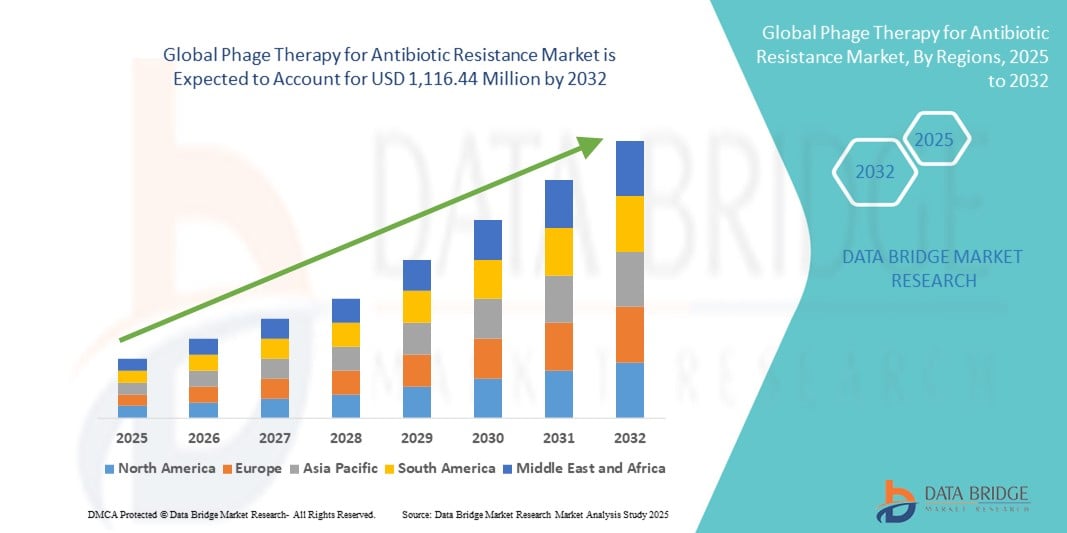
- The global phage therapy for antibiotic resistance market size was valued at USD 313.63 million in 2024 and is expected to reach USD 1,116.44 million by 2032, at a CAGR of 17.20% during the forecast period
- The market growth is largely fueled by the growing adoption and technological progress within bacteriophage-based therapeutics and personalized medicine, leading to increased innovation in both hospital and outpatient settings
- Furthermore, rising global concerns regarding multidrug-resistant (MDR) bacterial infections and the limitations of traditional antibiotics are establishing phage therapy as a modern, targeted treatment solution of choice. These converging factors are accelerating the uptake of Phage Therapy for Antibiotic Resistance solutions, thereby significantly boosting the industry's growth
Phage Therapy for Antibiotic Resistance Market Analysis
- Phage therapy, which utilizes bacteriophages to target and eliminate antibiotic-resistant bacteria, is becoming an increasingly critical tool in combating the global rise in antimicrobial resistance. Its precision targeting, minimal side effects, and ability to bypass traditional antibiotic mechanisms make it a vital component in modern infectious disease treatment strategies
- The escalating demand for alternative therapies to antibiotics is being driven by the growing prevalence of multidrug-resistant (MDR) and extensively drug-resistant (XDR) infections, as well as global healthcare efforts to reduce antibiotic misuse
- North America dominated the global phage therapy for antibiotic resistance market with the largest revenue share of 40.00% in 2024, fueled by robust investments in research, strong biotech infrastructure, and numerous clinical trials supported by the U.S. government and private firms. The U.S., in particular, is leading the way in clinical adoption and regulatory initiatives to fast-track phage-based treatments
- Asia-Pacific is projected to be the fastest-growing region in the phage therapy for antibiotic resistance market during the forecast period of 2025 to 2032. This growth is supported by high infectious disease burden, rising healthcare expenditure, and increased government focus on AMR mitigation programs in countries like India, China, and Japan
- The human health segment dominated the phage therapy for antibiotic resistance market with a market revenue share of 68.2% in 2024, driven by increasing global antibiotic resistance, rising hospital-acquired infections, and regulatory support for phage-based clinical trials
Report Scope and Phage Therapy for Antibiotic Resistance Market Segmentation
|
Attributes |
Phage Therapy for Antibiotic Resistance Key Market Insights |
|
Segments Covered |
|
|
Countries Covered |
North America
Europe
Asia-Pacific
Middle East and Africa
South America
|
|
Key Market Players |
|
|
Market Opportunities |
|
|
Value Added Data Infosets |
In addition to the insights on market scenarios such as market value, growth rate, segmentation, geographical coverage, and major players, the market reports curated by the Data Bridge Market Research also include in-depth expert analysis, pricing analysis, brand share analysis, consumer survey, demography analysis, supply chain analysis, value chain analysis, raw material/consumables overview, vendor selection criteria, PESTLE Analysis, Porter Analysis, and regulatory framework. |
Phage Therapy for Antibiotic Resistance Market Trends
Advancements in Smart Therapeutic Systems for Targeted Bacterial Eradication
- A significant and accelerating trend in the global phage therapy for antibiotic resistance market is the increasing integration of advanced biotechnology and personalized medicine. These innovations are enhancing precision, treatment efficacy, and reducing off-target effects in patients with multidrug-resistant bacterial infections
- For instance, companies such as Adaptive Phage Therapeutics and Pherecydes Pharma are developing phage platforms that use real-time pathogen sequencing to match patients with customized bacteriophage combinations—transforming how clinicians combat superbugs
- Machine learning tools are also being explored to predict phage-host interactions, optimize phage cocktail formulations, and monitor bacterial resistance evolution—offering dynamic treatment plans tailored to each infection's resistance profile
- Recent technological integration also includes smart delivery mechanisms such as encapsulated phages in nanocarriers or hydrogel-based systems, which can release bacteriophages in response to environmental triggers like pH or bacterial enzymes—ensuring localized and effective dosing
- Hospitals and research institutions are now collaborating to create phage biobanks and intelligent databases, enabling rapid matching of bacteriophages to patient-specific infections. This speeds up treatment initiation and improves clinical outcomes, especially in ICU and post-surgical care settings
- The growing demand for personalized, adaptive, and precision-targeted therapies is reshaping expectations within infectious disease management. As antibiotic resistance continues to rise globally, phage therapy—supported by smart diagnostics and delivery—is emerging as a critical tool in the next-generation antimicrobial arsenal
Phage Therapy for Antibiotic Resistance Market Dynamics
Driver
Growing Need Due to Rising Antibiotic Resistance and Limitations of Traditional Therapies
- The increasing global prevalence of antibiotic-resistant bacterial infections, especially in hospital-acquired infections and chronic wounds, is a major driver for the growing demand for phage therapy
- For instance, in April 2024, Adaptive Phage Therapeutics announced progress in its clinical trials for personalized phage therapy targeting multi-drug resistant Pseudomonas aeruginosa, signaling rising industry confidence in phage-based solutions. Such advancements by key players are expected to fuel the Phage Therapy for Antibiotic Resistance market growth during the forecast period
- As healthcare systems grapple with treatment failures from conventional antibiotics, phage therapy offers a precise and targeted approach to combat bacterial infections without disrupting the entire microbiome
- Furthermore, the growing investment from government and private sectors into antimicrobial resistance (AMR) initiatives is accelerating R&D in phage-based therapeutics
- The flexibility of phage therapy in being customized to individual infections, especially through phage libraries and bioengineering, is a significant advantage. This precision is attracting attention across both developed and developing markets, propelling broader adoption
- Also, regulatory bodies such as the FDA and EMA are increasingly supportive of compassionate use and streamlined approval frameworks for phage therapy, which is encouraging startups and research institutions to enter the market
Restraint/Challenge
Limited Clinical Validation and Regulatory Ambiguity
- Despite promising preclinical and early-stage results, large-scale randomized clinical trials for phage therapy remain limited, which challenges broader medical acceptance
- For instance, the variability in phage efficacy due to strain specificity makes it difficult to design standardized treatments, complicating regulatory pathways across regions
- Addressing these issues requires greater collaboration between biotech firms, regulators, and academic institutions to define consistent quality, safety, and efficacy benchmarks
- Moreover, the lack of established commercial manufacturing infrastructure for phages and the high cost of personalized therapies make scalability a concern
- While interest is growing, market adoption is hindered by a lack of awareness among healthcare professionals and skepticism due to the historical use of phages in non-Western markets
- To overcome these challenges, stakeholders must focus on expanding clinical evidence, establishing scalable production technologies, and fostering regulatory clarity to build trust in phage therapy as a mainstream solution
Phage Therapy for Antibiotic Resistance Market Scope
The market is segmented on the basis of therapy type, delivery method, target pathogen, and application.
- By Therapy Type
On the basis of therapy type, the phage therapy for antibiotic resistance market is segmented into lytic phage therapy, lysogenic phage therapy, and others. The lytic phage therapy segment dominated the largest market revenue share of 63.4% in 2024, driven by its rapid bactericidal activity and lower risk of transferring harmful genes compared to lysogenic types. Lytic phages immediately lyse bacterial cells, making them a favorable choice for treating acute infections caused by drug-resistant bacteria.
The lysogenic phage therapy segment is expected to witness the fastest CAGR of 21.1% from 2025 to 2032, owing to growing research interest in its long-term integration capabilities and potential role in gene delivery systems. Innovations in synthetic biology are helping overcome traditional safety concerns, unlocking new opportunities in cancer therapy and microbiome engineering.
- By Delivery Method
On the basis of delivery method, the phage therapy for antibiotic resistance market is segmented into oral, topical, intravenous, and others. The topical segment held the largest market revenue share of 38.7% in 2024, driven by its efficacy in treating localized infections such as chronic wounds, burns, and skin infections. Topical formulations allow for direct application, minimizing systemic side effects and enhancing patient compliance.
The oral segment is anticipated to register the fastest CAGR of 23.3% from 2025 to 2032, as advancements in encapsulation technologies improve phage survival through the gastrointestinal tract. This method is particularly promising for treating gastrointestinal infections and systemic conditions via microbiome modulation.
- By Target Pathogen
On the basis of target pathogen, the phage therapy for antibiotic resistance market is segmented into Escherichia coli, Staphylococcus aureus, Pseudomonas aeruginosa, Klebsiella pneumoniae, and Others. The Escherichia coli segment dominated the largest market share of 29.5% in 2024, due to the high global prevalence of E. coli-related urinary tract infections (UTIs) and bloodstream infections, particularly in healthcare settings.
The Klebsiella pneumoniae segment is projected to witness the highest CAGR of 25.4% from 2025 to 2032, as this pathogen is a leading cause of multidrug-resistant hospital-acquired pneumonia and bloodstream infections. Phage therapies targeting K. pneumoniae are showing promise in early clinical trials, creating significant growth opportunities.
- By Application
On the basis of application, the phage therapy for antibiotic resistance market is segmented into human health, animal health, agriculture, and others. The human health segment accounted for the largest market revenue share of 68.2% in 2024, driven by increasing global antibiotic resistance, rising hospital-acquired infections, and regulatory support for phage-based clinical trials.
The agriculture segment is expected to witness the fastest CAGR of 22.6% from 2025 to 2032, due to growing concerns over antibiotic overuse in farming and the need for natural, residue-free alternatives. Phage applications in crops and livestock are gaining traction, particularly in Europe and North America.
Phage Therapy for Antibiotic Resistance Market Regional Analysis
- North America dominated the phage therapy for antibiotic resistance market with the largest revenue share of 40.00% in 2024, driven by increasing prevalence of antibiotic-resistant infections, strong investment in biopharmaceutical R&D, and early adoption of innovative antimicrobial technologies
- The region benefits from advanced healthcare infrastructure, strong regulatory frameworks (such as FDA's support for compassionate use of phages), and public-private initiatives to combat antimicrobial resistance (AMR), which are boosting phage therapy adoption
- Moreover, growing interest from academic institutions and biotech companies in personalized phage therapies is helping establish North America as the innovation hub for phage-based treatments
U.S. Phage Therapy for Antibiotic Resistance Market Insight
The U.S. phage therapy for antibiotic resistance market captured the largest revenue share of 82.2% in 2024 within North America, supported by expanding AMR surveillance programs, robust clinical trial pipelines, and strategic collaborations between pharma and academia. With leading players like Adaptive Phage Therapeutics and Armata Pharmaceuticals driving innovation, and a growing number of FDA-approved investigational new drug (IND) applications, the U.S. is expected to remain the epicenter of global phage therapy development.
Europe Phage Therapy for Antibiotic Resistance Market Insight
The Europe phage therapy for antibiotic resistance market is projected to expand at a substantial CAGR of 16.2% throughout the forecast period. This growth is attributed to rising antimicrobial resistance, growing acceptance of alternative therapeutics, and EU-level initiatives such as the Joint Action on AMR. Countries like Belgium, Poland, and the Netherlands are increasingly funding phage therapy research and clinical trials, while the region benefits from historical familiarity with phage treatment in Eastern Europe.
U.K. Phage Therapy for Antibiotic Resistance Market Insight
The U.K. phage therapy for antibiotic resistance market is anticipated to grow at a notable CAGR of 17.8%, driven by NHS-backed research programs, collaborations with international phage therapy networks, and increasing demand for precision-based infection control in both community and hospital settings. Ongoing trials in cystic fibrosis and prosthetic joint infections are expected to further accelerate market adoption.
Germany Phage Therapy for Antibiotic Resistance Market Insight
The Germany phage therapy for antibiotic resistance market is expected to expand at a CAGR of 15.4%, supported by rising demand for innovative biologics, strong biotech infrastructure, and high research output from institutions like Helmholtz and Fraunhofer. Germany's emphasis on sustainability and biosafety is encouraging investment in phage manufacturing and regulatory compliance.
Asia-Pacific Phage Therapy for Antibiotic Resistance Market Insight
The Asia-Pacific phage therapy for antibiotic resistance market is poised to grow at the fastest CAGR of 24.0% during the forecast period (2025–2032). This growth is fueled by large patient populations with AMR infections, rising healthcare expenditures, and government-supported biotechnology hubs. Countries like India, China, and South Korea are investing heavily in phage research, with emerging players setting up phage banks and manufacturing facilities.
Japan Phage Therapy for Antibiotic Resistance Market Insight
The Japan phage therapy for antibiotic resistance market is seeing a CAGR of 18.5%, thanks to its aging population and increasing incidence of hospital-acquired infections. Research universities and biotech startups are investing in novel phage screening technologies and delivery mechanisms. Government funding for AMR reduction programs is also aiding market development.
China Phage Therapy for Antibiotic Resistance Market Insight
The China phage therapy for antibiotic resistance market accounted for the largest revenue share in Asia-Pacific in 2024 (39%), driven by the country's push for antibiotic alternatives, support from national health authorities, and the rise of biotech incubators focusing on personalized medicine. With strong local manufacturing capabilities and large-scale clinical demand, China is positioned to be a leading market for phage therapies in the next decade.
Phage Therapy for Antibiotic Resistance Market Share
The phage therapy for antibiotic resistance industry is primarily led by well-established companies, including:
- PhagePro (U.S.)
- Armata Pharmaceuticals, Inc. (U.S.)
- Adaptive Phage Therapeutics, Inc. (U.S.)
- ContraFect Corporation (U.S.)
- Pherecydes Pharma (France)
- Enbiotix, Inc. (U.S.)
- Locus Biosciences, Inc. (U.S.)
- Intralytix, Inc. (U.S.)
- Theriva Biologics, Inc. (U.S.)
- Eligo Bioscience (France)
- Phagelux, Inc. (China)
- Micreos Human Health B.V. (Netherlands)
- TechnoPhage SA (Portugal)
- Biocontrol Ltd. (U.K.)
- Ichnos Sciences (Switzerland)
- Hong Kong Phage Therapy Center (Hong Kong)
- Ampliphi Biosciences Corporation (U.S.)
- Fixed-Phage Limited (U.K.)
- Targen Pharma (Argentina)
- Twist Bioscience (U.S.)
Latest Developments in Global Phage Therapy for Antibiotic Resistance Market
- In August 2024, Locus’s Phase II study published in The Lancet Infectious Diseases assessed its LBP‑EC01 CRISPR-Cas3-enhanced phage cocktail for treating urinary tract infections—a landmark in engineered phage therapeutics
- In June 2025, Delaware-based SNIPR Biome dosed the first patient in its Phase 1b trial of SNIPR001— a CRISPR-Cas-equipped phage therapy for preventing infections in cancer patients post–stem-cell transplant
- In February 2025, UCSF researchers revealed how “jumbo phages” evade bacterial defenses via a protein “shield”—vital understanding for designing more robust phage therapies

- Interactive Data Analysis Dashboard
- Company Analysis Dashboard for high growth potential opportunities
- Research Analyst Access for customization & queries
- Competitor Analysis with Interactive dashboard
- Latest News, Updates & Trend analysis
- Harness the Power of Benchmark Analysis for Comprehensive Competitor Tracking
Data collection and base year analysis are done using data collection modules with large sample sizes. The stage includes obtaining market information or related data through various sources and strategies. It includes examining and planning all the data acquired from the past in advance. It likewise envelops the examination of information inconsistencies seen across different information sources. The market data is analysed and estimated using market statistical and coherent models. Also, market share analysis and key trend analysis are the major success factors in the market report. To know more, please request an analyst call or drop down your inquiry.
The key research methodology used by DBMR research team is data triangulation which involves data mining, analysis of the impact of data variables on the market and primary (industry expert) validation. Data models include Vendor Positioning Grid, Market Time Line Analysis, Market Overview and Guide, Company Positioning Grid, Patent Analysis, Pricing Analysis, Company Market Share Analysis, Standards of Measurement, Global versus Regional and Vendor Share Analysis. To know more about the research methodology, drop in an inquiry to speak to our industry experts.
Data Bridge Market Research is a leader in advanced formative research. We take pride in servicing our existing and new customers with data and analysis that match and suits their goal. The report can be customized to include price trend analysis of target brands understanding the market for additional countries (ask for the list of countries), clinical trial results data, literature review, refurbished market and product base analysis. Market analysis of target competitors can be analyzed from technology-based analysis to market portfolio strategies. We can add as many competitors that you require data about in the format and data style you are looking for. Our team of analysts can also provide you data in crude raw excel files pivot tables (Fact book) or can assist you in creating presentations from the data sets available in the report.













