


What is the Global Pharmaceutical Glyoxal Market Size and Growth Rate?
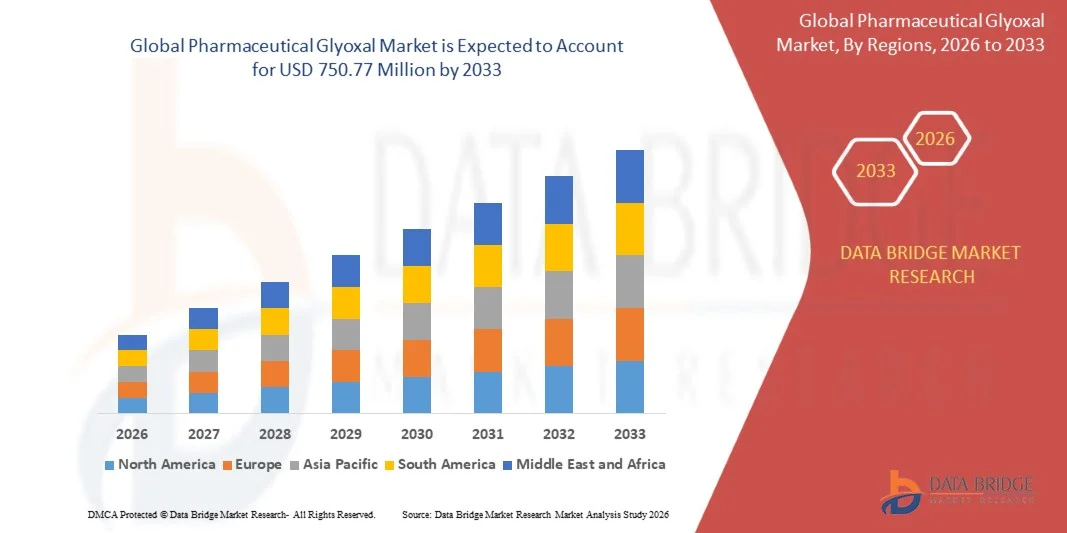
- As per Data Bridge Market Research Analysis the global pharmaceutical glyoxal market size was valued at USD 124.66 million in 2025 and is expected to reach USD 750.77 million by 2033, at a CAGR of 6.01% during the forecast period
- Advancements in chemical processing technologies and formulation efficiency, along with improved purity grades, are supporting broader adoption of glyoxal in high-performance applications such as resins, coatings, textile finishing, and specialty chemicals, thereby enhancing product effectiveness and end-use performance
Market Size & Forecast
- Global Market Value (2025): USD 124.66 million
- Expected Market Value (2033): USD 750.77 million
- Forecast CAGR (2026–2033): 6.01%
What are the Major Takeaways of Pharmaceutical Glyoxal Market?
- Favorable regulatory frameworks promoting low-toxicity and formaldehyde-reduced chemical alternatives, coupled with rising environmental compliance requirements, are encouraging manufacturers to adopt glyoxal-based solutions as safer and more sustainable options
- North America dominated the pharmaceutical glyoxal market with a 41.7% revenue share in 2025, driven by strong pharmaceutical manufacturing infrastructure, advanced chemical processing facilities, and significant investments in specialty chemical production across the U.S. and Canada
- Asia-Pacific is projected to register the fastest CAGR of 10.72% from 2026 to 2033, driven by rapid expansion of pharmaceutical manufacturing, increasing chemical production capacity, and strong demand for pharmaceutical intermediates across China, Japan, India, South Korea, and Southeast Asia
- The 40%–60% purity segment dominated the market with a 46.3% share in 2025, as it represents the most widely used commercial grade in pharmaceutical intermediates, chemical synthesis, and industrial formulations
Report Scope and Pharmaceutical Glyoxal Market Segmentation
|
Attributes |
Pharmaceutical Glyoxal Key Market Insights |
|
Segments Covered |
|
|
Countries Covered |
North America
Europe
Asia-Pacific
Middle East and Africa
South America
|
|
Key Market Players |
|
|
Market Opportunities |
|
|
Value Added Data Infosets |
In addition to the insights on market scenarios such as market value, growth rate, segmentation, geographical coverage, and major players, the market reports curated by the Data Bridge Market Research also include in-depth expert analysis, pricing analysis, brand share analysis, consumer survey, demography analysis, supply chain analysis, value chain analysis, raw material/consumables overview, vendor selection criteria, PESTLE Analysis, Porter Analysis, and regulatory framework. |
What is the Key Trend in the Pharmaceutical Glyoxal Market?
“Increasing Adoption of Glyoxal-Based Crosslinking Agents in Pharmaceutical Formulations”
- The pharmaceutical glyoxals market is witnessing growing adoption of glyoxal-based compounds as effective crosslinking agents used in drug formulation, biomaterial stabilization, and pharmaceutical intermediates
- Manufacturers are focusing on developing high-purity glyoxal solutions that ensure consistent chemical performance, improved stability, and compatibility with pharmaceutical manufacturing standards
- Rising demand for advanced drug delivery systems, polymer-based excipients, and controlled-release formulations is accelerating the use of glyoxal in pharmaceutical processing and material synthesis
- For instance, companies such as BASF, Thermo Fisher Scientific, Merck, and Tokyo Chemical Industry supply pharmaceutical-grade glyoxal derivatives used in research laboratories and pharmaceutical production processes
- Increasing research activities in biomaterials, tissue engineering, and polymer chemistry are further expanding the role of glyoxal as a versatile crosslinking and stabilizing compound
- As pharmaceutical formulations become more advanced and specialized, Pharmaceutical Glyoxals will remain important for chemical synthesis, drug formulation enhancement, and biomaterial development
What are the Key Drivers of Pharmaceutical Glyoxal Market?
- Rising demand for chemical intermediates used in pharmaceutical synthesis, polymer crosslinking, and biomaterial stabilization is driving the adoption of pharmaceutical glyoxals
- For instance, in 2025, leading chemical and life science companies such as BASF, Merck, and Tokyo Chemical Industry expanded their specialty chemical portfolios to support pharmaceutical research and formulation development
- Growing investments in pharmaceutical R&D, biotechnology innovation, and drug development programs across the U.S., Europe, and Asia-Pacific are increasing the consumption of high-purity glyoxal compounds
- Advancements in chemical synthesis techniques, purification technologies, and pharmaceutical manufacturing processes have improved product quality and application versatility
- Rising use of polymer-based drug delivery systems, biomaterials, and medical coatings is creating new demand for glyoxal-based crosslinking agents
- Supported by expanding pharmaceutical production and increasing research activities, the pharmaceutical glyoxals market is expected to witness steady long-term growth
Which Factor is Challenging the Growth of the Pharmaceutical Glyoxal Market?
- Stringent regulatory requirements and safety concerns related to chemical handling, toxicity, and pharmaceutical ingredient approvals can restrict the use of glyoxal in certain formulations
- For instance, during 2024–2025, regulatory agencies across major markets strengthened compliance requirements for pharmaceutical chemical intermediates and excipients used in drug manufacturing
- Fluctuations in raw material prices and supply chain disruptions for specialty chemicals can increase production costs for glyoxal manufacturers
- Limited awareness regarding the specialized pharmaceutical applications of glyoxal in certain developing markets slows broader adoption
- Availability of alternative crosslinking agents and stabilizing chemicals may create competitive pressure within pharmaceutical formulation processes
- To address these challenges, companies are investing in high-purity production methods, regulatory compliance strategies, and advanced chemical research to support the safe and efficient use of Pharmaceutical Glyoxals in pharmaceutical applications
How is the Pharmaceutical Glyoxal Market Segmented?
The market is segmented on the basis of purity, production process, packaging, application, end-use chemicals, and end-use industry.
• By Purity
On the basis of purity, the pharmaceutical glyoxal market is segmented into 90%–99%, 40%–60%, and Others. The 40%–60% purity segment dominated the market with a 46.3% share in 2025, as it represents the most widely used commercial grade in pharmaceutical intermediates, chemical synthesis, and industrial formulations. This concentration offers optimal chemical stability, ease of handling, and cost efficiency, making it suitable for large-scale pharmaceutical and specialty chemical manufacturing. It is commonly used in cross-linking reactions, resin production, and synthesis of pharmaceutical intermediates due to its balanced reactivity and processing efficiency. In addition, manufacturers prefer this purity range for bulk production because it allows efficient transportation and storage while maintaining consistent chemical performance.
The 90%–99% purity segment is expected to grow at the fastest CAGR from 2026 to 2033, driven by increasing demand for high-purity chemicals in pharmaceutical R&D, specialty drug synthesis, and biotechnology applications. Rising regulatory standards and quality control requirements are encouraging pharmaceutical manufacturers to adopt highly refined glyoxal solutions for advanced formulations and laboratory-scale research.
• By Production Process
On the basis of production process, the market is segmented into Catalytic Oxidation of Ethylene Glycol, Oxidation of Acetylene, and Others. The Catalytic Oxidation of Ethylene Glycol segment dominated the market with a 52.4% share in 2025, as it is the most efficient and widely adopted industrial method for producing glyoxal. This process provides higher yields, improved product consistency, and better scalability for large-scale chemical manufacturing. It is extensively used by major chemical producers due to its ability to generate high-quality glyoxal with controlled reaction conditions and lower production costs. Furthermore, the process supports continuous production systems, making it suitable for pharmaceutical-grade glyoxal manufacturing and large industrial supply chains.
The Oxidation of Acetylene segment is expected to grow at the fastest CAGR from 2026 to 2033, driven by advancements in catalytic technologies and increasing demand for alternative production methods that enhance chemical purity and process efficiency. Growing investments in specialty chemical manufacturing and pharmaceutical intermediates are further encouraging adoption of improved oxidation technologies for glyoxal production.
• By Packaging
On the basis of packaging, the pharmaceutical glyoxal market is segmented into Bottles, Drums, Jerrycans, Composite IBC, and Bulk. The Drums segment dominated the market with a 41.6% share in 2025, as drums are widely used for safe storage and transportation of glyoxal solutions across pharmaceutical and chemical manufacturing facilities. These containers provide durability, chemical resistance, and ease of handling during large-volume industrial operations. Drums are commonly used by chemical distributors and pharmaceutical manufacturers because they offer standardized storage capacity and compliance with industrial safety regulations. Their compatibility with automated filling and transport systems also makes them a preferred packaging solution in large-scale supply chains.
The Composite IBC (Intermediate Bulk Container) segment is expected to grow at the fastest CAGR from 2026 to 2033, driven by increasing demand for efficient bulk chemical transportation and storage solutions. Composite IBCs offer higher storage capacity, improved logistics efficiency, and reduced packaging waste, making them increasingly popular among pharmaceutical and specialty chemical manufacturers handling large production volumes.
• By Application
On the basis of application, the market is segmented into Cross-Linking, Chemical Intermediates, and Others. The Chemical Intermediates segment dominated the market with a 44.8% share in 2025, supported by the extensive use of glyoxal as a key intermediate in the synthesis of pharmaceutical compounds, specialty chemicals, and industrial resins. Glyoxal plays an important role in producing heterocyclic compounds, pharmaceutical ingredients, and polymer additives used in various chemical manufacturing processes. Its high reactivity and versatility make it suitable for multiple organic synthesis reactions, including condensation and oxidation processes. Pharmaceutical companies widely utilize glyoxal-based intermediates for developing new drug molecules and chemical formulations.
The Cross-Linking segment is expected to grow at the fastest CAGR from 2026 to 2033, driven by increasing use of glyoxal in polymer crosslinking, biomaterials, and specialty coatings. Growing demand for advanced materials, medical-grade polymers, and high-performance industrial chemicals is further expanding the use of glyoxal as an efficient crosslinking agent in multiple manufacturing applications.
• By End-Use Chemicals
On the basis of end-use chemicals, the pharmaceutical glyoxal market is segmented into 2-Imidazolidinone, 2-Methylimidazole, Allantoin, Dihydroxyethylene Urea (DHEU), Ethylene Glycol Diformate, Glycoluril, Glyoxal Phenol Resin, Glyoxal Sodium Bisulfite, Glyoxal Urea Resin, Glyoxalated Polyacrylamide (GPAM), Glyoxalated Starch, Glyoxal-bis(2-Hydroxyanil), Glyoxylic Acid, Imidazole, Methylol Glyoxal, Quinoxaline, Quinoxaline Derivatives, Tetramethylol Acetylenediurea, and Urea-Glyoxal Concentrate. The Dihydroxyethylene Urea (DHEU) segment dominated the market with a 21.9% share in 2025, as it is widely used in textile finishing agents and specialty chemical formulations derived from glyoxal. The compound offers strong crosslinking performance and chemical stability, making it suitable for multiple industrial and pharmaceutical applications.
The Quinoxaline Derivatives segment is expected to grow at the fastest CAGR from 2026 to 2033, driven by rising demand for heterocyclic compounds in pharmaceutical synthesis and advanced chemical research. Increasing pharmaceutical innovation and drug development programs are accelerating the use of quinoxaline-based compounds derived from glyoxal.
• By End-Use Industry
On the basis of end-use industry, the pharmaceutical glyoxal market is segmented into Textile, Leather, Pharmaceuticals, Water Treatment, Paints and Coatings, Cosmetics and Personal Care, Household Products, Pulp and Paper, Electrical and Electronics, Packaging, Oil and Gas, and Others. The Textile segment dominated the market with a 33.5% share in 2025, driven by the extensive use of glyoxal-based chemicals in textile finishing processes such as wrinkle resistance, fabric strengthening, and crosslinking treatments. Textile manufacturers widely utilize glyoxal derivatives to improve fabric durability, dimensional stability, and chemical resistance. Strong global demand for treated fabrics, technical textiles, and industrial textiles further supports the large-scale consumption of glyoxal in this industry.
The Pharmaceuticals segment is expected to grow at the fastest CAGR from 2026 to 2033, driven by increasing use of glyoxal as a chemical intermediate in drug synthesis and specialty pharmaceutical compounds. Growing pharmaceutical R&D investments, expansion of specialty drug manufacturing, and rising demand for advanced chemical intermediates are accelerating glyoxal adoption across the pharmaceutical sector.
Which Region Holds the Largest Share of the Pharmaceutical Glyoxal Market?
- North America dominated the pharmaceutical glyoxal market with a 41.7% revenue share in 2025, driven by strong pharmaceutical manufacturing infrastructure, advanced chemical processing facilities, and significant investments in specialty chemical production across the U.S. and Canada. High demand for glyoxal as a chemical intermediate in pharmaceutical synthesis, drug formulation, and specialty chemical manufacturing continues to support regional market growth. In addition, rising demand for high-purity chemicals used in pharmaceutical research, biotechnology development, and advanced laboratory applications is further accelerating adoption across the region
- Leading chemical manufacturers in North America are expanding production capacities and investing in advanced oxidation technologies to produce high-quality glyoxal for pharmaceutical and specialty chemical applications. Continuous investments in pharmaceutical R&D, biotechnology innovation, and specialty chemical manufacturing are strengthening the region’s leadership in the global Pharmaceutical Glyoxal market
- Strong regulatory frameworks, advanced chemical research capabilities, and well-established pharmaceutical supply chains further reinforce North America’s dominant position in the Pharmaceutical Glyoxal market. Increasing demand for pharmaceutical intermediates, specialty resins, and chemical formulations continues to drive long-term market expansion across the region
U.S. Pharmaceutical Glyoxal Market Insight
The U.S. is the largest contributor in North America, supported by a well-developed pharmaceutical industry, strong specialty chemical manufacturing capacity, and extensive investments in pharmaceutical research and development. Glyoxal is widely used as an intermediate in drug synthesis, polymer production, and specialty chemical formulations used across pharmaceutical manufacturing processes. Growing demand for advanced pharmaceutical compounds, specialty chemicals, and biomedical materials is increasing the utilization of glyoxal in laboratory and industrial-scale chemical synthesis. In addition, the presence of major pharmaceutical companies, contract manufacturing organizations, and chemical producers further strengthens market demand. Continuous innovation in pharmaceutical technologies and expanding biotechnology research are expected to sustain strong growth for the Pharmaceutical Glyoxal market in the U.S.
Canada Pharmaceutical Glyoxal Market Insight
Canada contributes significantly to regional market growth, supported by expanding pharmaceutical research programs, increasing specialty chemical production, and growing investments in biotechnology and life sciences industries. Pharmaceutical manufacturers and research institutions utilize glyoxal in chemical synthesis, laboratory research, and development of pharmaceutical intermediates. Rising demand for specialty chemicals in biomedical research, cosmetic formulations, and industrial applications further supports the adoption of glyoxal across the country. Government initiatives promoting innovation in healthcare technologies and chemical manufacturing also encourage the growth of pharmaceutical intermediates production. In addition, the presence of advanced research laboratories, universities, and biotechnology firms contributes to increasing glyoxal demand across multiple pharmaceutical and chemical applications.
Asia-Pacific Pharmaceutical Glyoxal Market
Asia-Pacific is projected to register the fastest CAGR of 10.72% from 2026 to 2033, driven by rapid expansion of pharmaceutical manufacturing, increasing chemical production capacity, and strong demand for pharmaceutical intermediates across China, Japan, India, South Korea, and Southeast Asia. The region’s large-scale chemical industry and expanding pharmaceutical production facilities significantly increase the consumption of glyoxal in drug synthesis, textile chemicals, and specialty chemical formulations. In addition, rising demand for healthcare products, cosmetics, and specialty industrial chemicals is further boosting glyoxal consumption across the region. Growing investments in pharmaceutical research, biotechnology development, and chemical manufacturing infrastructure continue to accelerate the demand for glyoxal-based intermediates across Asia-Pacific markets.
China Pharmaceutical Glyoxal Market Insight
China is the largest contributor to the Asia-Pacific market, supported by extensive chemical manufacturing infrastructure and strong pharmaceutical production capabilities. The country has a large number of specialty chemical producers supplying glyoxal to pharmaceutical, textile, and industrial chemical industries. Rising demand for pharmaceutical intermediates, specialty resins, and advanced chemical formulations is accelerating glyoxal consumption across domestic manufacturing facilities. In addition, government initiatives supporting chemical industry modernization and pharmaceutical innovation are encouraging investments in advanced chemical processing technologies. Competitive manufacturing costs and large export capacities further position China as a key global supplier of glyoxal and related chemical intermediates.
Japan Pharmaceutical Glyoxal Market Insight
Japan shows steady market growth, supported by advanced pharmaceutical research, high-quality chemical manufacturing standards, and strong demand for specialty chemicals in pharmaceutical and industrial applications. Japanese companies emphasize precision chemical synthesis and high-purity intermediates, which increases demand for refined glyoxal used in drug manufacturing and laboratory research. The country’s well-developed pharmaceutical sector, combined with strong biotechnology innovation and research activities, further contributes to glyoxal adoption. Increasing focus on advanced medical treatments, specialty pharmaceuticals, and high-performance chemical materials is expected to support stable long-term growth in Japan’s Pharmaceutical Glyoxal market.
India Pharmaceutical Glyoxal Market Insight
India is emerging as a major growth hub in the Asia-Pacific region, driven by rapid expansion of pharmaceutical manufacturing, strong growth of generic drug production, and increasing investments in specialty chemical industries. Glyoxal is widely used as a chemical intermediate in pharmaceutical synthesis, textile chemicals, and industrial chemical applications. Growing demand for pharmaceutical exports, expanding chemical manufacturing clusters, and government initiatives supporting domestic pharmaceutical production are accelerating glyoxal consumption across the country. In addition, increasing investments in pharmaceutical R&D, biotechnology research, and specialty chemical manufacturing facilities are strengthening India’s role in the regional Pharmaceutical Glyoxal market.
South Korea Pharmaceutical Glyoxal Market Insight
South Korea contributes significantly to regional growth, supported by strong pharmaceutical research capabilities, advanced chemical manufacturing infrastructure, and increasing investments in biotechnology industries. Glyoxal is utilized in the production of pharmaceutical intermediates, specialty chemicals, and advanced polymer materials used across multiple industrial applications. Rapid development of high-value pharmaceutical products and specialty chemicals further increases the demand for high-quality glyoxal solutions. In addition, government support for biotechnology innovation, strong export-oriented chemical industries, and advanced manufacturing technologies contribute to sustained growth of the Pharmaceutical Glyoxal market in South Korea.
Which are the Top Companies in Pharmaceutical Glyoxal Market?
The pharmaceutical glyoxal industry is primarily led by well-established companies, including:
- Amzole India Pvt. Ltd (India)
- Asis Scientific Pty Ltd (Australia)
- Ataman Chemicals (India)
- BASF SE (Germany)
- Bidvest Chemical (South Africa)
- Bisley Asia (M) Sdn Bhd (Malaysia)
- Eastman Chemical Company (U.S.)
- Fluorochem Limited (U.K.)
- Fujifilm Wako Pure Chemical Corporation (Japan)
- Glentham Life Sciences Limited (U.K.)
- Haihang Industry (China)
- Hanna Instruments Ltd (U.S.)
- Himedia Laboratories (India)
- Kanto Kagaku (Japan)
- Kemira Oyj (Finland)
- Merck KGaA (Germany)
- Meru Chem Pvt. Ltd (India)
- Muby Chemicals (India)
- Multichem Specialities Private Limited (India)
- Oakwood Products Inc. (U.S.)
- Otto Chemie Pvt. Ltd (India)
What are the Recent Developments in Global Pharmaceutical Glyoxal Market?
- In October 2025, Multichem Specialities Private Limited was recognized among the Top 10 Specialty Chemical Distributors 2025 by Industry Outlook Magazine, highlighting its quality, innovation, and dependable service in the specialty chemicals sector. In July 2025, the company also organized a successful blood donation drive in collaboration with Breach Candy Hospital Trust, engaging employees and community members to support healthcare needs
- In February 2024, Multichem Specialities Private Limited participated in Vitafoods India, strengthening its presence in the nutraceuticals and specialty ingredients segment while engaging with customers and partners to showcase its expanding chemical portfolio
- In October 2024, Otto Chemie Pvt. Ltd. expanded its portfolio of high-purity laboratory chemicals and reagents, enhancing its presence in pharmaceutical, research, and industrial sectors. The company also strengthened its distribution network and supply chain capabilities to meet growing demand across India and international markets
- In July 2024, Otto Chemie Pvt. Ltd. organized a blood donation and health awareness drive in collaboration with local hospitals, reflecting the company’s commitment to community welfare and employee participation in social responsibility initiatives
- In March 2025, Oxford Lab Fine Chem LLP implemented eco-friendly packaging solutions and optimized waste management practices in its production and distribution processes, reinforcing the company’s commitment to sustainable and responsible chemical manufacturing

- Interactive Data Analysis Dashboard
- Company Analysis Dashboard for high growth potential opportunities
- Research Analyst Access for customization & queries
- Competitor Analysis with Interactive dashboard
- Latest News, Updates & Trend analysis
- Harness the Power of Benchmark Analysis for Comprehensive Competitor Tracking
Global Pharmaceutical Glyoxal Market, Supply Chain Analysis and Ecosystem Framework
To support market growth and help clients navigate the impact of geopolitical shifts, DBMR has integrated in-depth supply chain analysis into its Global Pharmaceutical Glyoxal Market research reports. This addition empowers clients to respond effectively to global changes affecting their industries. The supply chain analysis section includes detailed insights such as Global Pharmaceutical Glyoxal Market consumption and production by country, price trend analysis, the impact of tariffs and geopolitical developments, and import and export trends by country and HSN code. It also highlights major suppliers with data on production capacity and company profiles, as well as key importers and exporters. In addition to research, DBMR offers specialized supply chain consulting services backed by over a decade of experience, providing solutions like supplier discovery, supplier risk assessment, price trend analysis, impact evaluation of inflation and trade route changes, and comprehensive market trend analysis.
Data collection and base year analysis are done using data collection modules with large sample sizes. The stage includes obtaining market information or related data through various sources and strategies. It includes examining and planning all the data acquired from the past in advance. It likewise envelops the examination of information inconsistencies seen across different information sources. The market data is analysed and estimated using market statistical and coherent models. Also, market share analysis and key trend analysis are the major success factors in the market report. To know more, please request an analyst call or drop down your inquiry.
The key research methodology used by DBMR research team is data triangulation which involves data mining, analysis of the impact of data variables on the market and primary (industry expert) validation. Data models include Vendor Positioning Grid, Market Time Line Analysis, Market Overview and Guide, Company Positioning Grid, Patent Analysis, Pricing Analysis, Company Market Share Analysis, Standards of Measurement, Global versus Regional and Vendor Share Analysis. To know more about the research methodology, drop in an inquiry to speak to our industry experts.
Data Bridge Market Research is a leader in advanced formative research. We take pride in servicing our existing and new customers with data and analysis that match and suits their goal. The report can be customized to include price trend analysis of target brands understanding the market for additional countries (ask for the list of countries), clinical trial results data, literature review, refurbished market and product base analysis. Market analysis of target competitors can be analyzed from technology-based analysis to market portfolio strategies. We can add as many competitors that you require data about in the format and data style you are looking for. Our team of analysts can also provide you data in crude raw excel files pivot tables (Fact book) or can assist you in creating presentations from the data sets available in the report.













