


What is the Pharmaceutical Vials Market Size and Growth Rate?
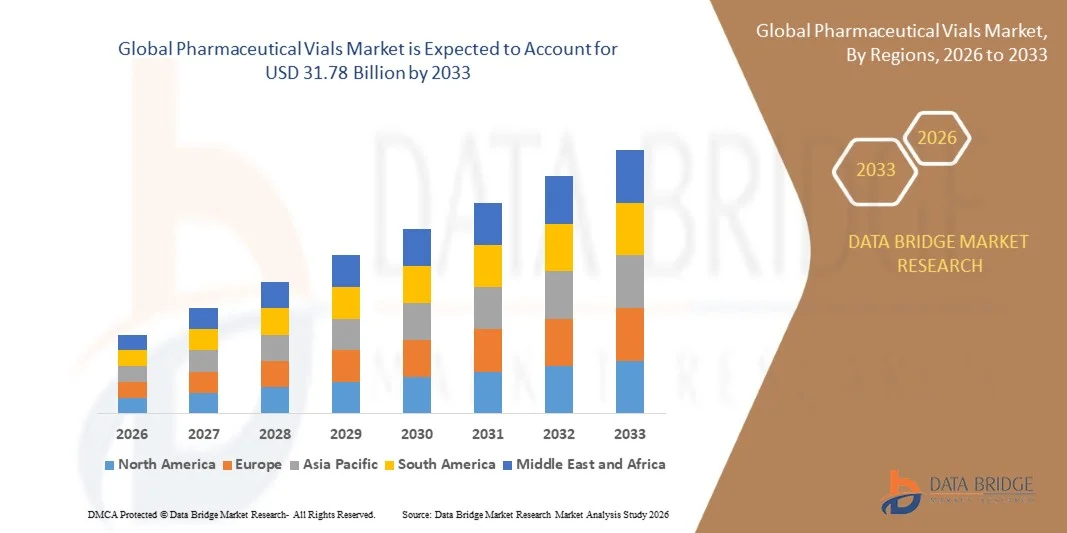
- As per Data Bridge Market Research analysis the pharmaceutical vials market was valued at USD 18.02 billion in 2025 and is projected to reach USD 31.78 billion by 2033, growing at a CAGR of 7.35% from 2026 to 2033.
- The market is experiencing steady growth driven by the expanding production of injectable pharmaceuticals, biologics, and vaccines, increasing demand for sterile drug packaging, and continuous advancements in vial manufacturing materials and filling technologies.
- The rising prevalence of chronic diseases, growing investments in biopharmaceutical manufacturing, and stringent regulatory requirements for drug safety and container integrity are accelerating the adoption of high-quality pharmaceutical vials worldwide. Glass and advanced polymer vials are increasingly being utilized to ensure product stability, contamination prevention, and compatibility with sensitive formulations, supporting the growing demand across pharmaceutical companies, contract manufacturing organizations (CMOs), and healthcare facilities.
Market Size & Forecast
- Market Value (2025): USD 18.02 Billion
- Expected Market Value (2033): USD 31.78 Billion
- Forecast CAGR (2026–2033): 7.35%
- Leading Region in 2025: North America
- Fastest Growing Region: Asia-Pacific
What are the Major Takeaways of the Pharmaceutical Vials Market?
- North America dominated the pharmaceutical vials market with the largest revenue share of in 2025, supported by the strong presence of leading pharmaceutical and biopharmaceutical manufacturers, increasing production of injectable drugs, and well-established healthcare infrastructure.
- Asia-Pacific is expected to be the fastest-growing region, recording a CAGR of from 2026 to 2033. Growth is driven by rapidly expanding pharmaceutical manufacturing, increasing healthcare expenditure, and rising production of generic medicines and vaccines across countries such as China, India, Japan, and South Korea.
- The glass segment held the largest market revenue share of approximately 64.00% in 2025 driven by its superior chemical resistance, excellent barrier properties, and widespread use for injectable drugs, vaccines, and biologics. Borosilicate glass remains the preferred material due to its compatibility with sensitive pharmaceutical formulations and compliance with stringent regulatory standards.
- The plastic segment is expected to witness the fastest growth during the forecast period from 2026 to 2033 driven by increasing adoption of cyclic olefin polymers (COP) and cyclic olefin copolymers (COC), which offer enhanced break resistance, lightweight handling, and compatibility with advanced biologic drug delivery systems.
- The 1 ML segment held the largest market revenue share in 2025 driven by its extensive use for vaccines, injectable antibiotics, biologics, and lyophilized pharmaceuticals.
- The 24-400 MM segment is expected to witness the fastest growth during the forecast period from 2026 to 2033 driven by increasing demand for larger-volume biologics, specialty injectables, and automated aseptic filling operations.
Report Scope and Pharmaceutical Vials Market Segmentation
|
Attributes |
Pharmaceutical Vials Key Market Insights |
|
Segments Covered |
|
|
Countries Covered |
North America
Europe
Asia-Pacific
Middle East and Africa
South America
|
|
Key Market Players |
|
|
Market Opportunities |
|
|
Value Added Data Infosets |
In addition to the insights on market scenarios such as market value, growth rate, segmentation, geographical coverage, and major players, the market reports curated by the Data Bridge Market Research also include import export analysis, production capacity overview, production consumption analysis, price trend analysis, climate change scenario, supply chain analysis, value chain analysis, raw material/consumables overview, vendor selection criteria, PESTLE Analysis, Porter Analysis, and regulatory framework. |
What is the Key Trend in the Pharmaceutical Vials Market?
- Ready-to-use (RTU) pharmaceutical vials are rapidly gaining adoption as pharmaceutical manufacturers seek to improve aseptic filling efficiency, reduce contamination risks, and accelerate the production of injectable drugs, biologics, and vaccines.
- For instance, in September 2024, SCHOTT Pharma, Gerresheimer AG, and Stevanato Group formed the Alliance for RTU to accelerate industry-wide adoption of ready-to-use vials and cartridges, supporting more efficient sterile filling processes and higher product quality.
- Pharmaceutical companies and CDMOs are increasingly shifting toward pre-sterilized vial formats to simplify manufacturing workflows, minimize cleaning and depyrogenation steps, and improve regulatory compliance.
- Manufacturers are also investing in advanced glass technologies and high-performance coatings to enhance vial strength, reduce breakage, and improve filling-line productivity for sensitive biologic formulations.
- For instance, Corning Incorporated continues expanding its Corning RTU Vials portfolio with SG EZ-fill technology, enabling pharmaceutical manufacturers to improve production flexibility while lowering total manufacturing costs.
- As biologics, biosimilars, and other injectable therapies continue to gain market share, the adoption of ready-to-use, high-performance pharmaceutical vials is expected to accelerate, reinforcing their role as a critical component of modern sterile drug manufacturing.
What are the Key Drivers of the Pharmaceutical Vials Market?
- The rapid growth of injectable biologics, biosimilars, vaccines, and specialty pharmaceuticals has significantly increased demand for high-quality pharmaceutical vials that ensure sterility, drug stability, and regulatory compliance.
- For instance, in April 2025, SCHOTT Pharma inaugurated its new pharmaceutical packaging manufacturing facility in Serbia, expanding production capacity for glass ampoules used to store injectable medicines and strengthening the regional pharmaceutical supply chain.
- Pharmaceutical manufacturers are expanding investments in sterile manufacturing infrastructure and advanced primary packaging to support rising global demand for injectable therapies and high-value biologic drugs.
- For instance, May 2025 during Q2 FY2025, SCHOTT Pharma reported strong growth in its drug containment solutions business, driven by increasing demand for ready-to-use products and specialty pharmaceutical vials.
- As pharmaceutical companies continue expanding injectable drug production and biologic manufacturing worldwide, pharmaceutical vials will remain indispensable for ensuring product integrity, patient safety, and efficient sterile drug delivery.
Which Factors are Challenging the Growth of the Pharmaceutical Vials Market?
- Pharmaceutical vial manufacturers face significant capital investment requirements for high-precision glass forming, sterilization, automated inspection systems, and compliance with stringent GMP and regulatory standards.
- These high production and quality assurance costs increase overall packaging expenses, particularly for smaller manufacturers and contract packaging organizations.
- For instance, in September 2025, Corning Incorporated and SGD Pharma inaugurated a USD60 million glass tubing manufacturing facility in India to strengthen the supply of pharmaceutical-grade glass for vial production, highlighting the substantial investments required to expand high-quality vial manufacturing capacity.
- Rising energy prices, raw material costs, and increasingly stringent quality requirements further add to manufacturing complexity and operational expenditure across the pharmaceutical packaging value chain.
- The combination of high capital investment, strict regulatory compliance, and increasing production costs continues to challenge market expansion, particularly for smaller manufacturers and companies operating in price-sensitive markets, despite the growing global demand for sterile injectable packaging.
How is the Pharmaceutical Vials Market Segmented?
The market is segmented on the basis of material, neck type, cap size, market, drug type, capacity, application, distribution channel, and end-user.
- By Material
On the basis of material, the pharmaceutical vials market is segmented into plastic, glass, and others. The glass segment held the largest market revenue share of approximately 64.00% in 2025 driven by its superior chemical resistance, excellent barrier properties, and widespread use for injectable drugs, vaccines, and biologics. Borosilicate glass remains the preferred material due to its compatibility with sensitive pharmaceutical formulations and compliance with stringent regulatory standards.
The plastic segment is expected to witness the fastest growth during the forecast period from 2026 to 2033 driven by increasing adoption of cyclic olefin polymers (COP) and cyclic olefin copolymers (COC), which offer enhanced break resistance, lightweight handling, and compatibility with advanced biologic drug delivery systems.
- By Neck Type
On the basis of neck type, the pharmaceutical vials market is segmented into crimp neck, double chamber, screw neck, flip cap, and others. The crimp neck segment held the largest market revenue share in 2025 driven by its extensive use in sterile injectable packaging, lyophilized drugs, and vaccine storage requiring secure sealing and container integrity.
The double chamber segment is expected to witness the fastest growth during the forecast period from 2026 to 2033 driven by increasing demand for dual-compartment drug delivery systems that preserve sensitive formulations until administration.
- By Cap Size
On the basis of cap size, the pharmaceutical vials market is segmented into 13-425 MM, 15-425 MM, 18-400 MM, 22-350 MM, 24-400 MM, 8-425 MM, 9MM, and others. The 13-425 MM segment held the largest market revenue share in 2025 driven by its widespread use in injectable medicines, vaccines, and laboratory pharmaceutical products.
The 24-400 MM segment is expected to witness the fastest growth during the forecast period from 2026 to 2033 driven by increasing demand for larger-volume biologics, specialty injectables, and automated aseptic filling operations.
- By Market
On the basis of market, the pharmaceutical vials market is segmented into parenteral, gastro, ENT, and others. The parenteral segment held the largest market revenue share in 2025 driven by strong demand for injectable drugs, biologics, biosimilars, and vaccine packaging requiring sterile primary containers.
The ENT segment is expected to witness the fastest growth during the forecast period from 2026 to 2033 driven by increasing adoption of specialty nasal and otic formulations requiring compact sterile vial packaging.
- By Drug Type
On the basis of drug type, the pharmaceutical vials market is segmented into injectable and non-injectable. The injectable segment held the largest market revenue share in 2025 driven by the rapid expansion of biologics, vaccines, oncology therapeutics, and sterile injectable medicines worldwide.
The non-injectable segment is expected to witness the fastest growth during the forecast period from 2026 to 2033 driven by increasing demand for oral liquid formulations, diagnostic reagents, and specialty pharmaceutical products.
- By Capacity
On the basis of capacity, the pharmaceutical vials market is segmented into 1 ML, 2 ML, 3 ML, 4 ML, 8 ML, 10 ML, 20 ML, 30 ML, 50 ML, and others. The 1 ML segment held the largest market revenue share in 2025 driven by its extensive use for vaccines, injectable antibiotics, biologics, and lyophilized pharmaceuticals.
The 50 ML segment is expected to witness the fastest growth during the forecast period from 2026 to 2033 driven by rising demand for larger-dose biologics, infusion therapies, and specialty hospital formulations.
- By Application
On the basis of application, the pharmaceutical vials market is segmented into nasal, oral, and others. The oral segment held the largest market revenue share in 2025 driven by its widespread use for oral liquid formulations, diagnostic solutions, and specialty pharmaceutical preparations.
The nasal segment is expected to witness the fastest growth during the forecast period from 2026 to 2033 driven by increasing adoption of nasal vaccines, biologics, and advanced intranasal drug delivery technologies.
- By Distribution Channel
On the basis of distribution channel, the pharmaceutical vials market is segmented into direct sales, medical stores/pharmacies, e-commerce, and others. The direct sales segment held the largest market revenue share in 2025 driven by long-term procurement agreements between vial manufacturers, pharmaceutical companies, and contract development and manufacturing organizations for bulk sterile packaging supplies.
The e-commerce segment is expected to witness the fastest growth during the forecast period from 2026 to 2033 driven by expanding digital procurement platforms and increasing online sourcing of pharmaceutical packaging products by laboratories, healthcare organizations, and research institutions.
Which Region Holds the Largest Share of the Pharmaceutical Vials Market?
- North America dominated the pharmaceutical vials market with the largest revenue share in 2025, supported by the strong presence of leading pharmaceutical and biopharmaceutical manufacturers, increasing production of injectable drugs, and well-established healthcare infrastructure.
- The region continues to witness rising demand for high-quality glass and polymer vials owing to the growing adoption of biologics, vaccines, and specialty pharmaceuticals. Moreover, stringent regulatory requirements for sterile packaging and continuous investments in pharmaceutical manufacturing facilities are further strengthening the regional market.
U.S. Pharmaceutical Vials Market Insight
The U.S. pharmaceutical vials market captured the largest revenue share in 2025 within North America, fueled by the country's robust pharmaceutical industry, expanding biologics pipeline, and increasing demand for sterile injectable therapies. Pharmaceutical manufacturers are investing significantly in advanced packaging technologies, ready-to-use vial systems, and high-performance drug containment solutions to improve manufacturing efficiency and regulatory compliance. In addition, growing CDMO activities and continuous innovation in biologic drug development continue to drive market expansion.
Europe Pharmaceutical Vials Market Insight
The Europe pharmaceutical vials market is expected to witness the fastest growth rate from 2026 to 2033, primarily driven by increasing investments in biologics manufacturing, rising demand for sustainable pharmaceutical packaging, and expanding vaccine production capacity. The region's stringent pharmaceutical quality regulations and growing adoption of ready-to-use sterile packaging solutions are encouraging manufacturers to invest in advanced vial technologies. Furthermore, the presence of leading pharmaceutical packaging companies continues to support regional market growth.
U.K. Pharmaceutical Vials Market Insight
The U.K. pharmaceutical vials market is expected to witness the fastest growth rate from 2026 to 2033, driven by increasing investments in life sciences, expanding biologics research, and rising demand for sterile injectable drug packaging. The country's growing pharmaceutical manufacturing capabilities, coupled with the expansion of contract development and manufacturing organizations (CDMOs), are accelerating the adoption of advanced pharmaceutical vial solutions. In addition, increasing regulatory emphasis on drug quality and patient safety is supporting market growth.
Germany Pharmaceutical Vials Market Insight
The Germany pharmaceutical vials market is expected to witness the fastest growth rate from 2026 to 2033, fueled by the country's strong pharmaceutical manufacturing base, technological leadership in glass packaging, and continuous innovation in primary drug containment solutions. Germany is home to several leading pharmaceutical packaging manufacturers, driving the adoption of high-quality borosilicate glass and ready-to-use vial technologies. Growing biologics production and investments in sustainable pharmaceutical packaging are further contributing to market expansion.
Asia-Pacific Pharmaceutical Vials Market Insight
The Asia-Pacific pharmaceutical vials market is expected to witness the fastest growth rate from 2026 to 2033, supported by rapidly expanding pharmaceutical manufacturing, increasing healthcare expenditure, and rising production of generic medicines and vaccines across countries such as China, India, Japan, and South Korea. Growing investments by multinational pharmaceutical companies and expanding CDMO operations are accelerating demand for high-quality pharmaceutical packaging solutions. The region is also benefiting from increasing exports of injectable medicines and biologics.
Japan Pharmaceutical Vials Market Insight
The Japan pharmaceutical vials market is expected to witness the fastest growth rate from 2026 to 2033 due to the country's advanced pharmaceutical industry, increasing demand for biologics and specialty medicines, and strong focus on high-quality drug packaging. Japanese manufacturers continue to invest in innovative glass technologies and precision pharmaceutical packaging to meet stringent regulatory standards. Moreover, growing research and development activities in biologics and regenerative medicine are supporting demand for premium pharmaceutical vials.
China Pharmaceutical Vials Market Insight
The China pharmaceutical vials market accounted for the largest market revenue share in Asia-Pacific in 2025, attributed to the country's rapidly expanding pharmaceutical manufacturing sector, increasing vaccine production, and strong government support for domestic biopharmaceutical development. China has emerged as a major global supplier of pharmaceutical packaging materials, while rising investments in injectable drug manufacturing and expanding exports of pharmaceutical products continue to strengthen demand for pharmaceutical vials across the country.
Which are the Top Companies in Pharmaceutical Vials Market?
The pharmaceutical vials industry is primarily led by well-established companies, including:
- SCHOTT AG (Germany)
- Gerresheimer AG (Germany)
- Stevanato Group S.p.A. (Italy)
- SGD Pharma (France)
- Nipro Corporation (Japan)
- Corning Incorporated (U.S.)
- Bormioli Pharma S.p.A. (Italy)
- Piramal Glass Limited (India)
- Şişecam (Turkey)
- West Pharmaceutical Services, Inc. (U.S.)
- Stoelzle Glass Group (Austria)
- DWK Life Sciences GmbH (Germany)
- Adelphi Healthcare Packaging (U.K.)
- Shandong Qidu Pharmaceutical Co., Ltd. (China)
What are Latest Developments in Pharmaceutical Vials Market?
- In September 2025, Gerresheimer AG announced the expansion of its Wertheim, Germany manufacturing site with a new production facility for ready-to-fill (RTF) pharmaceutical vials based on its EZ-fill Smart platform. The project includes an investment of around EUR 30 million and is expected to strengthen production capacity for high-quality sterile vial packaging used in biologics and injectable medicines. The expansion reinforces Gerresheimer's position in advanced pharmaceutical primary packaging by improving supply reliability and supporting growing global demand for ready-to-use vial solutions.
- In September 2025, Corning Incorporated and SGD Pharma inaugurated a new Type I borosilicate glass tubing manufacturing facility near Hyderabad, India, with an investment of approximately USD60 million. The facility is designed to produce up to 13,000 tonnes of pharmaceutical glass tubing annually, sufficient for approximately 2.2 billion pharmaceutical vials per year, while supporting Corning® Velocity® vial technology to improve fill-and-finish productivity. This investment strengthens regional pharmaceutical packaging supply chains and expands the availability of high-performance vial solutions.
- In September 2024, SCHOTT Pharma, Gerresheimer AG, and Stevanato Group S.p.A. announced the formation of the Alliance for RTU, a strategic industry collaboration to accelerate the adoption of ready-to-use (RTU) vials and cartridges across the pharmaceutical industry. The alliance promotes standardized sterile primary packaging solutions that improve manufacturing efficiency, reduce contamination risks, and enhance patient safety for injectable drug production.
- In May 2024, Gerresheimer AG signed an agreement to acquire Bormioli Pharma Group for an enterprise value of approximately EUR 800 million, creating a dedicated moulded glass business unit after integration. The acquisition significantly expands Gerresheimer's pharmaceutical glass packaging portfolio, including pharmaceutical vials, strengthening its capabilities in primary packaging for injectable medicines and biologics.

- Interactive Data Analysis Dashboard
- Company Analysis Dashboard for high growth potential opportunities
- Research Analyst Access for customization & queries
- Competitor Analysis with Interactive dashboard
- Latest News, Updates & Trend analysis
- Harness the Power of Benchmark Analysis for Comprehensive Competitor Tracking
Global Pharmaceutical Vials Market, Supply Chain Analysis and Ecosystem Framework
To support market growth and help clients navigate the impact of geopolitical shifts, DBMR has integrated in-depth supply chain analysis into its Global Pharmaceutical Vials Market research reports. This addition empowers clients to respond effectively to global changes affecting their industries. The supply chain analysis section includes detailed insights such as Global Pharmaceutical Vials Market consumption and production by country, price trend analysis, the impact of tariffs and geopolitical developments, and import and export trends by country and HSN code. It also highlights major suppliers with data on production capacity and company profiles, as well as key importers and exporters. In addition to research, DBMR offers specialized supply chain consulting services backed by over a decade of experience, providing solutions like supplier discovery, supplier risk assessment, price trend analysis, impact evaluation of inflation and trade route changes, and comprehensive market trend analysis.
Data collection and base year analysis are done using data collection modules with large sample sizes. The stage includes obtaining market information or related data through various sources and strategies. It includes examining and planning all the data acquired from the past in advance. It likewise envelops the examination of information inconsistencies seen across different information sources. The market data is analysed and estimated using market statistical and coherent models. Also, market share analysis and key trend analysis are the major success factors in the market report. To know more, please request an analyst call or drop down your inquiry.
The key research methodology used by DBMR research team is data triangulation which involves data mining, analysis of the impact of data variables on the market and primary (industry expert) validation. Data models include Vendor Positioning Grid, Market Time Line Analysis, Market Overview and Guide, Company Positioning Grid, Patent Analysis, Pricing Analysis, Company Market Share Analysis, Standards of Measurement, Global versus Regional and Vendor Share Analysis. To know more about the research methodology, drop in an inquiry to speak to our industry experts.
Data Bridge Market Research is a leader in advanced formative research. We take pride in servicing our existing and new customers with data and analysis that match and suits their goal. The report can be customized to include price trend analysis of target brands understanding the market for additional countries (ask for the list of countries), clinical trial results data, literature review, refurbished market and product base analysis. Market analysis of target competitors can be analyzed from technology-based analysis to market portfolio strategies. We can add as many competitors that you require data about in the format and data style you are looking for. Our team of analysts can also provide you data in crude raw excel files pivot tables (Fact book) or can assist you in creating presentations from the data sets available in the report.













