


What is the Phenobarbital Market Size and Growth Rate?
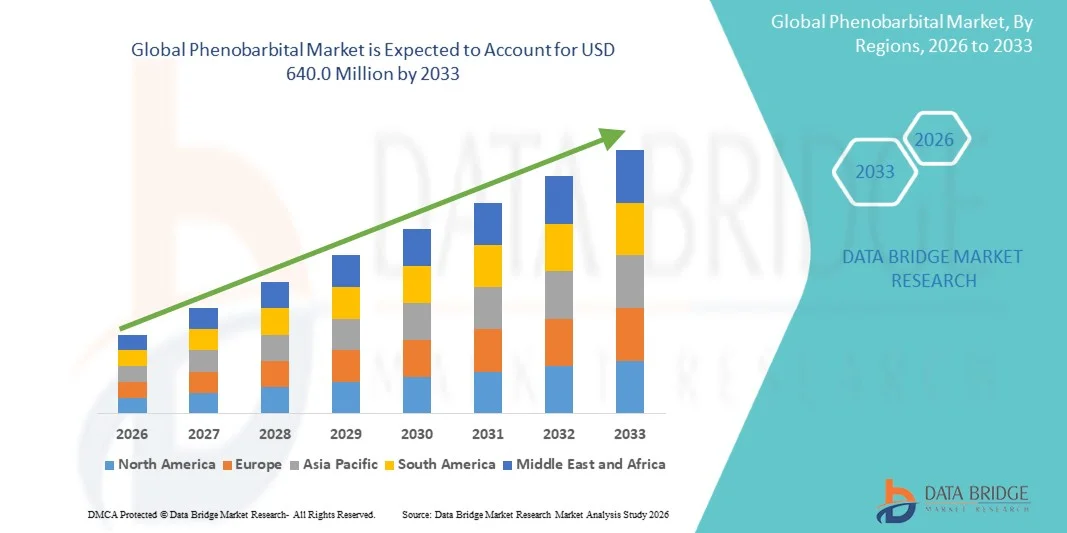
- As per Data Bridge Market Research analysis, the Phenobarbital Market was valued at USD 486.0 million in 2025 and is projected to reach USD 640.0 million by 2033, growing at a CAGR of 3.50% from 2026 to 2033.
- The market is experiencing steady, moderate growth driven by phenobarbital's sustained role as a low-cost, first-line antiseizure medication in both emergency and chronic care settings, alongside its continued inclusion on the WHO Model List of Essential Medicines.
- Persistently high global epilepsy prevalence, particularly across low- and middle-income countries where access to newer, higher-cost antiseizure medications remains limited, continues to sustain demand for phenobarbital. At the same time, gradual utilization declines in higher-income markets, where clinicians increasingly favor newer-generation agents with more favorable safety profiles, are moderating overall growth.
Market Size & Forecast
- Global Market Value (2025): USD 486.0 million
- Expected Market Value (2033): USD 640.0 million
- Forecast CAGR (2026–2033): 3.50%
What are the Major Takeaways of the Phenobarbital Market?
- North America dominated the Phenobarbital Market with the largest revenue share of 34.60% in 2025, supported by established hospital emergency-care infrastructure, standardized neonatal seizure protocols, and consistent generic manufacturing supply.
- Asia-Pacific is expected to be the fastest-growing region at a CAGR of 5.35% from 2026 to 2033, fueled by rising epilepsy diagnosis rates, expanding access to essential low-cost antiseizure medicines, and growing government procurement programs across India and Southeast Asia.
- The tablets segment led the market with a 46.80% share in 2025, driven by its cost-effectiveness and widespread use in long-term chronic epilepsy management.
- The injectable solution segment is the fastest-growing dosage form, projected to register a CAGR of 5.60%, reflecting rising hospital and neonatal intensive care unit demand.
- The epilepsy & seizure disorders segment dominated the application category with a 58.40% revenue share in 2025, supported by phenobarbital's long-standing first-line role in global antiseizure treatment protocols.
- The neonatal seizures segment is the fastest-growing application, with a projected CAGR of 5.90%, driven by continued guideline-recommended use in neonatal intensive care.
- The generic segment accounted for over 91% of the market share in 2025, reflecting phenobarbital's decades-long off-patent status and broad multinational generic manufacturing base.
Report Scope and Phenobarbital Market Segmentation
|
Attributes |
Phenobarbital Key Market Insights |
|
Segments Covered |
|
|
Countries Covered |
North America
Europe
Asia-Pacific
Middle East and Africa
South America
|
|
Key Market Players |
|
|
Market Opportunities |
|
|
Value Added Data Infosets |
In addition to the insights on market scenarios such as market value, growth rate, segmentation, geographical coverage, and major players, the market reports curated by the Data Bridge Market Research also include in-depth expert analysis, patient epidemiology, pipeline analysis, pricing analysis, and regulatory framework. |
What is the Key Trend in the Phenobarbital Market?
- Continued alignment with WHO-recommended essential medicine guidelines is reinforcing phenobarbital's ongoing role as a core, low-cost antiseizure therapy, particularly across low- and middle-income countries.
- For instance, phenobarbital continues to be designated a core antiseizure medication on the WHO Model List of Essential Medicines, with the drug included in the national essential medicines lists of approximately 96% of surveyed countries, reflecting its continued global relevance despite the availability of newer agents.
- Despite its long-standing role, phenobarbital's share of overall antiseizure medication consumption is gradually declining in higher-income markets as clinicians increasingly shift toward newer-generation agents with more favorable safety and tolerability profiles.
- For instance, a longitudinal study of antiseizure medication consumption across 73 countries and regions between 2012 and 2022 found declining use of phenobarbital, phenytoin, and carbamazepine, coinciding with rising adoption of newer agents such as levetiracetam, which has since been added to the WHO Essential Medicines List.
- Generic manufacturers continue to expand injectable phenobarbital production capacity to help stabilize hospital supply amid periodic shortages affecting this critical care formulation.
- For instance, BPI Labs launched an alcohol-free phenobarbital sodium injection formulation in 2022 to help address supply gaps following shortages reported by other manufacturers, including Hikma Pharmaceuticals, within the injectable phenobarbital segment.
As global health systems continue to balance essential-medicine affordability with evolving clinical preferences for newer antiseizure agents, phenobarbital is expected to retain a durable, if moderately growing, role within emergency, neonatal, and cost-constrained epilepsy care settings worldwide.
What are the Key Drivers of the Phenobarbital Market?
- The persistently high global burden of epilepsy, particularly across low- and middle-income countries, continues to sustain demand for affordable, first-line antiseizure medications such as phenobarbital.
- For instance, in 2021, September, the Institute for Health Metrics and Evaluation (IHME) estimated that approximately 51.7 million people worldwide were living with active epilepsy in 2021, with nearly 80% residing in low- and middle-income countries where treatment gaps exceed 75% in the lowest-income settings.
- Continued inclusion of phenobarbital on the WHO Model List of Essential Medicines supports its procurement through public health systems and government tender programs across emerging markets.
- For instance, in July 2023, phenobarbital remained listed among the WHO's core antiseizure medications alongside carbamazepine, phenytoin, and valproic acid, supporting its continued procurement through national essential medicines programs across Africa and South-East Asia. The WHO's 23rd Model List was published on July 26, 2023, and its supporting documentation identifies phenobarbital, phenytoin, carbamazepine, and valproic acid among essential antiseizure medicines.
- The low production cost and long-standing generic manufacturing base make phenobarbital one of the most cost-effective antiseizure therapies available, sustaining its use in cost-constrained healthcare systems.
- For instance, cost analyses have shown that phenobarbital pricing can vary substantially by region, with costs reported to be roughly 2.7 times higher in South-East Asia than in Europe, prompting ongoing efforts to improve regional supply chain efficiency and affordability.
With epilepsy remaining one of the most common serious neurological conditions worldwide and healthcare systems continuing to balance cost and access considerations, phenobarbital is expected to remain a foundational therapy within the broader antiseizure medication landscape.
Which Factors are Challenging the Growth of the Phenobarbital Market?
- Declining clinician preference in higher-income markets, driven by safety and tolerability concerns relative to newer antiseizure medications, is limiting growth in developed regions.
- For instance, the same 73-country utilization study found consumption of older agents such as phenobarbital continuing to decline even as newer agents such as levetiracetam gained WHO Essential Medicines List status, reflecting a broader shift in prescribing patterns across higher-income healthcare systems.
- Regulatory classification as a controlled substance in various jurisdictions adds prescribing, storage, and distribution compliance requirements for manufacturers and healthcare providers.
- For instance, in the U.S., phenobarbital and its sodium salts are classified as Schedule IV controlled substances under the Federal Controlled Substances Act, requiring manufacturers and dispensing pharmacies to comply with additional recordkeeping, storage, and distribution controls.
- Periodic manufacturing disruptions and a limited number of active injectable-formulation producers have contributed to intermittent drug shortages, affecting consistent hospital supply.
- For instance, phenobarbital sodium injection has previously appeared on U.S. pharmacy drug shortage tracking lists, with manufacturers such as Hikma reporting supply constraints that prompted alternate suppliers, including BPI Labs, to expand production of alcohol-free injectable formulations.
- The combination of declining utilization in high-income markets, controlled-substance compliance requirements, and periodic manufacturing disruptions continues to create headwinds for the phenobarbital market, even as its established safety record and low cost sustain demand within essential-medicine and emergency-care settings globally.
How is the Phenobarbital Market Segmented?
The Phenobarbital Market is segmented on the basis of dosage form, application, route of administration, distribution channel, end user, patient demographics, and prescription type.
- By Dosage Form
On the basis of dosage form, the Phenobarbital Market is segmented into tablets, oral solution/elixir, and injectable solution. The tablets segment dominated the market with a 46.80% share in 2025, owing to its cost-effectiveness, ease of long-term administration, and widespread use in chronic epilepsy management across both hospital and homecare settings.
The injectable solution segment is projected to register the fastest growth at a CAGR of 5.60% from 2026 to 2033, driven by rising hospital use in neonatal seizure management and status epilepticus emergency care, where rapid-acting intravenous administration is required.
- By Application
On the basis of application, the Phenobarbital Market is segmented into epilepsy & seizure disorders, neonatal seizures, alcohol & sedative withdrawal syndrome, status epilepticus, and sedation & anesthesia premedication. The epilepsy & seizure disorders segment dominated the market with a 58.40% share in 2025, supported by phenobarbital's decades-long role as a first-line, low-cost antiseizure medication and its continued inclusion on the WHO Model List of Essential Medicines.
The neonatal seizures segment is expected to witness the fastest CAGR of 5.90% from 2026 to 2033, driven by phenobarbital's continued recommendation as a first-line therapy for neonatal seizure management in clinical guidelines across both high-income and resource-limited healthcare settings.
- By Route of Administration
On the basis of route of administration, the Phenobarbital Market is segmented into oral, intravenous, and intramuscular. The oral segment dominated the market with a 61.25% share in 2025, owing to its widespread use in long-term outpatient epilepsy management and its suitability for both pediatric and adult patients.
The intravenous segment is anticipated to witness the fastest CAGR of 5.45% from 2026 to 2033, supported by growing hospital and neonatal intensive care unit demand for rapid-acting seizure control in emergency and critical care settings.
- By Distribution Channel
On the basis of distribution channel, the Phenobarbital Market is segmented into hospital pharmacies, retail pharmacies, and online pharmacies. The hospital pharmacies segment dominated the market with a 42.10% share in 2025, driven by high consumption of injectable phenobarbital in emergency, neonatal, and critical care departments.
The online pharmacies segment is expected to witness the fastest CAGR of 6.20% from 2026 to 2033, supported by expanding digital prescription fulfillment infrastructure and improved access to essential generic medicines in emerging markets.
- By End User
On the basis of end user, the Phenobarbital Market is segmented into hospitals & clinics, homecare settings, and long-term care & specialty epilepsy centers. The hospitals & clinics segment dominated the market with a 48.75% share in 2025, supported by its central role in acute seizure management, neonatal care, and controlled-substance dispensing oversight.
The homecare settings segment is projected to witness the fastest CAGR of 5.15% from 2026 to 2033, driven by growing preference for long-term outpatient epilepsy management outside hospital settings.
- By Patient Demographics
On the basis of patient demographics, the Phenobarbital Market is segmented into pediatric, adult, and geriatric. The adult segment dominated the market with a 44.90% share in 2025, reflecting the broad prevalence of chronic epilepsy management across the general adult population.
The pediatric segment is expected to witness the fastest CAGR of 5.70% from 2026 to 2033, driven by phenobarbital's continued first-line role in neonatal and pediatric seizure management guidelines globally.
- By Prescription Type
On the basis of prescription type, the Phenobarbital Market is segmented into generic and branded. The generic segment dominated the market with a 91.35% share in 2025, reflecting phenobarbital's status as a long off-patent molecule produced by a broad base of multinational generic manufacturers across developed and emerging markets alike.
The branded segment, though comparatively small, is projected to grow at a CAGR of 4.20% from 2026 to 2033, supported by continued demand for specialty pediatric and alcohol-free injectable formulations marketed under established brand names.
Which Region Holds the Largest Share of the Phenobarbital Market?
- North America dominated the Phenobarbital Market and accounted for the largest revenue share of 34.60% in 2025, supported by established hospital emergency-care infrastructure, standardized neonatal seizure management protocols, and a consistent generic manufacturing and distribution base.
- The region also benefits from well-established controlled-substance regulatory frameworks, strong hospital pharmacy penetration, and continued use of injectable phenobarbital in critical care and neonatal intensive care settings. Continued focus on drug shortage mitigation is expected to further reinforce supply stability across the region.
U.S. Phenobarbital Market Insight
The U.S. phenobarbital market remains anchored by its established role in emergency status epilepticus management, neonatal intensive care, and long-standing generic prescribing practices. Regulatory oversight under the Federal Controlled Substances Act shapes distribution and dispensing practices, while periodic manufacturing-driven shortages have prompted expanded production from alternate generic suppliers to help stabilize hospital-level injectable supply.
Germany Phenobarbital Market Insight
The Germany phenobarbital market continues to benefit from a well-established generic pharmaceutical manufacturing base and long-standing clinical familiarity with the molecule, marketed domestically under established brand names. Continued use in neonatal and pediatric seizure management, alongside steady export activity to other European markets, supports stable demand in the country.
Asia-Pacific Phenobarbital Market Insight
The Asia-Pacific phenobarbital market is expected to witness the fastest growth globally, driven by rising epilepsy diagnosis rates, expanding public health procurement programs, and continued reliance on low-cost, off-patent antiseizure medications across large and price-sensitive patient populations in India, China, and Southeast Asia.
India Phenobarbital Market Insight
The India phenobarbital market benefits from a large domestic generic manufacturing base, government essential-medicines procurement programs, and continued use of phenobarbital as a first-line, affordable antiseizure therapy across both public and private healthcare settings. Expanding rural healthcare access and epilepsy screening initiatives continue to support steady demand.
Africa Phenobarbital Market Insight
The Africa phenobarbital market plays a particularly important role given the region's high epilepsy treatment gap and reliance on low-cost essential medicines. Continued inclusion of phenobarbital in national essential medicines lists across Sub-Saharan Africa, combined with international public health procurement support, remains central to improving epilepsy treatment access across the region.
Which are the Top Companies in the Phenobarbital Market?
The global phenobarbital industry is primarily led by well-established generic and specialty pharmaceutical companies, including:
- Hikma Pharmaceuticals PLC (U.K.)
- Sun Pharmaceutical Industries Ltd. (India)
- Teva Pharmaceutical Industries Ltd. (Israel)
- Viatris Inc. (U.S.)
- Fresenius Kabi AG (Germany)
- Sanofi S.A. (France)
- BPI Labs, LLC (U.S.)
- Piramal Critical Care, Inc. (India)
- Aurobindo Pharma Ltd. (India)
- Zydus Lifesciences Ltd. (India)
- Alkem Laboratories Ltd. (India)
- Cipla Ltd. (India)
- Torrent Pharmaceuticals Ltd. (India)
- Amneal Pharmaceuticals, Inc. (U.S.)
- Desitin Arzneimittel GmbH (Germany)
- Alliance Pharma plc (U.K.)
- Rising Pharmaceuticals, Inc. (U.S.)
- Lannett Company, Inc. (U.S.)
- Wockhardt Ltd. (India)
- Micro Labs Ltd. (India)
What are the Latest Developments in the Phenobarbital Market?
- In 2022, December, BPI Labs launched an alcohol-free phenobarbital sodium injection formulation in the U.S. market, aimed at improving patient safety and addressing supply gaps following shortages reported by other manufacturers in the injectable phenobarbital segment.
- In 2024, January, Hikma Pharmaceuticals continued to manufacture and market phenobarbital sodium injection across multiple dosage strengths in the U.S. market, remaining one of the primary suppliers of the injectable formulation to hospitals and critical care settings.
- In 2025, May, the WHO Model List of Essential Medicines continued to retain phenobarbital among its recommended antiseizure medications, reaffirming its role in national essential-medicines programs even as newer agents such as levetiracetam gain broader adoption in higher-income markets.
- In 2024, June, a multi-country longitudinal analysis of antiseizure medication consumption trends highlighted continued reliance on phenobarbital across lower-income regions, even as its relative share of overall antiseizure medication use gradually declines in higher-income markets.
- In 2025, August, generic manufacturers across India, including Sun Pharmaceutical, Cipla, and Torrent Pharmaceuticals, continued to expand production capacity for oral phenobarbital formulations to support both domestic essential-medicines programs and export demand to other price-sensitive markets.

- Interactive Data Analysis Dashboard
- Company Analysis Dashboard for high growth potential opportunities
- Research Analyst Access for customization & queries
- Competitor Analysis with Interactive dashboard
- Latest News, Updates & Trend analysis
- Harness the Power of Benchmark Analysis for Comprehensive Competitor Tracking
Data collection and base year analysis are done using data collection modules with large sample sizes. The stage includes obtaining market information or related data through various sources and strategies. It includes examining and planning all the data acquired from the past in advance. It likewise envelops the examination of information inconsistencies seen across different information sources. The market data is analysed and estimated using market statistical and coherent models. Also, market share analysis and key trend analysis are the major success factors in the market report. To know more, please request an analyst call or drop down your inquiry.
The key research methodology used by DBMR research team is data triangulation which involves data mining, analysis of the impact of data variables on the market and primary (industry expert) validation. Data models include Vendor Positioning Grid, Market Time Line Analysis, Market Overview and Guide, Company Positioning Grid, Patent Analysis, Pricing Analysis, Company Market Share Analysis, Standards of Measurement, Global versus Regional and Vendor Share Analysis. To know more about the research methodology, drop in an inquiry to speak to our industry experts.
Data Bridge Market Research is a leader in advanced formative research. We take pride in servicing our existing and new customers with data and analysis that match and suits their goal. The report can be customized to include price trend analysis of target brands understanding the market for additional countries (ask for the list of countries), clinical trial results data, literature review, refurbished market and product base analysis. Market analysis of target competitors can be analyzed from technology-based analysis to market portfolio strategies. We can add as many competitors that you require data about in the format and data style you are looking for. Our team of analysts can also provide you data in crude raw excel files pivot tables (Fact book) or can assist you in creating presentations from the data sets available in the report.













