


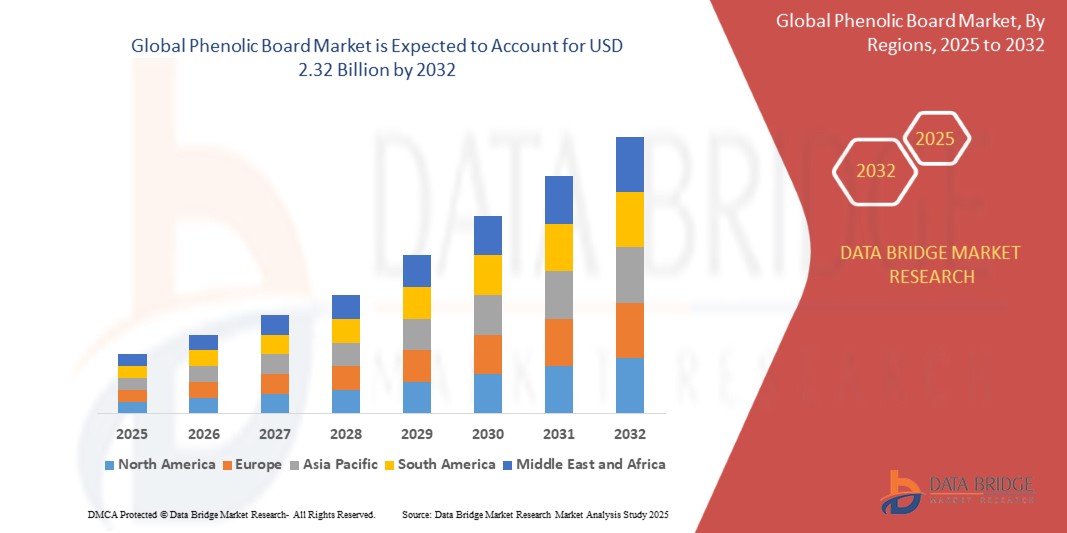
What is the Global Phenolic Board Market Size and Growth Rate?
- The global phenolic board market size was valued at USD 1.92 billion in 2024 and is expected to reach USD 2.32 billion by 2032, at a CAGR of 2.80% during the forecast period
- The phenolic board market is experiencing significant growth, driven by increasing demand for high-performance insulation materials in the construction and industrial sectors. The market is primarily fueled by stringent fire safety regulations, which mandate the use of materials with excellent fire resistance and low smoke emission properties
- Phenolic boards, known for their superior thermal insulation, moisture resistance, and structural strength, are gaining traction as an ideal solution for a variety of applications, including building insulation, HVAC ductwork, and fireproofing
What are the Major Takeaways of Phenolic Board Market?
- The construction industry is experiencing robust growth, driven by rapid urbanization, population growth, and substantial investments. As a result, there is an increasing demand for high-performance insulation materials such as phenolic insulation boards, which offer excellent thermal insulation, moisture resistance, and structural strength
- Phenolic boards are becoming a preferred choice for insulating walls, roofs, and floors in both residential and commercial buildings. In addition, the ongoing development of smart cities and sustainable building projects further amplifies the need for advanced insulation solutions. The growth in the construction sector boosts the demand for phenolic boards and drives market growth
- Asia-Pacific dominated the phenolic board market with the largest revenue share of 41.5% in 2024, driven by rapid urbanization, expanding construction activities, and increasing demand for durable, fire-resistant, and moisture-resistant building materials
- North America is projected to grow at the fastest CAGR of 9.7% from 2025 to 2032, driven by increasing demand for sustainable construction materials, heightened safety regulations, and the widespread adoption of high-performance panels for both interior and exterior applications
- The ≤40 mm segment dominated the phenolic board market with the largest market revenue share of 58.4% in 2024, attributed to its widespread use in interior applications, furniture manufacturing, and decorative wall panel
Report Scope and Phenolic Board Market Segmentation
|
Attributes |
Phenolic Board Key Market Insights |
|
Segments Covered |
|
|
Countries Covered |
North America
Europe
Asia-Pacific
Middle East and Africa
South America
|
|
Key Market Players |
|
|
Market Opportunities |
|
|
Value Added Data Infosets |
In addition to the insights on market scenarios such as market value, growth rate, segmentation, geographical coverage, and major players, the market reports curated by the Data Bridge Market Research also include in-depth expert analysis, pricing analysis, brand share analysis, consumer survey, demography analysis, supply chain analysis, value chain analysis, raw material/consumables overview, vendor selection criteria, PESTLE Analysis, Porter Analysis, and regulatory framework. |
What is the Key Trend in the Phenolic Board Market?
“Sustainability-Driven Demand for Fire-Resistant and Hygienic Phenolic Boards”
- A prominent and rapidly growing trend in the global phenolic board market is the rising demand for sustainable, fire-resistant, and hygienic materials in construction, transportation, and industrial sectors. Phenolic boards are increasingly recognized for their superior durability, moisture resistance, and ability to meet stringent fire safety regulations
- For instance, companies are focusing on developing low-emission, formaldehyde-free phenolic boards to align with global green building certifications and indoor air quality standards, meeting the growing expectations for sustainable construction materials
- Phenolic boards offer enhanced resistance to water, chemicals, and impact, making them ideal for high-traffic environments such as airports, hospitals, schools, and public transport, where durability and hygiene are critical
- In addition, the market is witnessing increased adoption of antimicrobial phenolic boards, especially in healthcare and food processing sectors, to promote hygiene and reduce the risk of contamination
- Key manufacturers such as Kingspan Group and UNILIN are investing in research and product innovation to offer eco-friendly phenolic boards with enhanced fire-retardant, water-resistant, and antibacterial properties, supporting global sustainability and safety goals
- The demand for high-performance, environmentally conscious phenolic boards is reshaping market dynamics, with growth accelerating across both commercial and residential infrastructure projects
What are the Key Drivers of Phenolic Board Market?
- The increasing focus on fire safety regulations, especially in public buildings, transportation, and industrial facilities, is a significant driver of the phenolic board market, given their superior fire-retardant properties compared to conventional materials
- For instance, in March 2024, Stonewood Architectural Panel (U.S.) launched a new line of phenolic boards specifically designed for exterior cladding with improved fire performance and durability, catering to the global demand for safer building materials
- Growing awareness of hygiene and infection control, particularly after the COVID-19 pandemic, has fueled the demand for antimicrobial and easy-to-clean phenolic boards, especially in healthcare, hospitality, and education sectors
- The construction industry's increasing preference for lightweight, durable, and moisture-resistant materials for wall panels, partitions, facades, and furniture applications is further boosting phenolic board adoption
- In addition, the push for green building certifications, such as LEED and BREEAM, and rising demand for low-emission construction materials are encouraging manufacturers to develop phenolic boards that align with sustainable construction standards
Which Factor is challenging the Growth of the Phenolic Board Market?
- The high initial cost of phenolic boards compared to traditional materials such as plywood, MDF, or laminated particle boards poses a key challenge to wider market penetration, especially in cost-sensitive regions and low-budget projects
- For instance, despite their durability and performance advantages, the higher price point of phenolic boards deters small-scale builders and residential users from opting for these solutions in favor of more affordable alternatives
- In addition, limited availability of high-performance phenolic boards in certain developing markets constrains growth, as logistics and production infrastructure are still evolving in these regions
- Stringent manufacturing standards and regulatory approvals, especially for fire-retardant and formaldehyde-free variants, also lead to higher production costs and longer product development cycles
- Overcoming these challenges will require manufacturers to focus on cost optimization, localized production, and awareness campaigns to demonstrate the long-term value proposition and durability benefits of phenolic boards, driving greater adoption across diverse end-use sectors
How is the Phenolic Board Market Segmented?
The market is segmented on the basis of thickness, application, and end use.
- By Thickness
On the basis of thickness, the phenolic board market is segmented into ≤40 mm and >40 mm. The ≤40 mm segment dominated the phenolic board market with the largest market revenue share of 58.4% in 2024, attributed to its widespread use in interior applications, furniture manufacturing, and decorative wall panels. Thinner phenolic boards offer ease of handling, flexibility, and cost-effectiveness, making them a preferred option for lightweight structures and residential installations. In addition, their moisture resistance and durability drive strong demand across kitchen, bathroom, and office settings.
The >40 mm segment is expected to witness the fastest growth rate from 2025 to 2032, driven by increasing demand in heavy-duty applications such as exterior cladding, high-traffic areas, and structural installations. These thicker boards provide enhanced strength, impact resistance, and fire-retardant properties, making them ideal for use in public buildings, transport infrastructure, and industrial environments where robust performance is critical.
- By Application
On the basis of application, the phenolic board market is segmented into Interior, Building and Construction, Insulation Panel, Exterior, Furniture, and Others. The Building and Construction segment dominated the Phenolic Board market with the largest market revenue share of 42.7% in 2024, supported by the material's superior fire resistance, moisture durability, and ease of installation. Growing emphasis on safety regulations and sustainable construction practices is accelerating phenolic board usage in wall cladding, partitions, and facades.
The Insulation Panel segment is projected to grow at the fastest CAGR from 2025 to 2032, fueled by the global push for energy-efficient buildings and thermal management solutions. Phenolic boards' excellent insulating properties and low thermal conductivity make them a preferred material for insulating panels used in both residential and commercial projects, supporting energy savings and carbon footprint reduction.
- By End Use
On the basis of end use, the phenolic board market is segmented into Residential, Commercial, and Industrial. The Commercial segment accounted for the largest market revenue share of 48.9% in 2024, driven by rising demand for high-durability, fire-resistant, and hygienic materials in retail spaces, hospitals, educational institutions, and public transport infrastructure. Phenolic boards' resistance to moisture, chemicals, and impact makes them ideal for high-traffic, commercial environments requiring long-lasting performance.
The Residential segment is expected to witness the fastest growth rate from 2025 to 2032, supported by increasing adoption of modern interior design solutions, rising awareness of moisture-resistant materials, and growing demand for sustainable, easy-to-maintain products in home applications such as kitchens, bathrooms, and furniture.
Which Region Holds the Largest Share of the Phenolic Board Market?
- Asia-Pacific dominated the phenolic board market with the largest revenue share of 41.5% in 2024, driven by rapid urbanization, expanding construction activities, and increasing demand for durable, fire-resistant, and moisture-resistant building materials. The region’s strong manufacturing base and rising investments in infrastructure development, particularly in China, Japan, and Southeast Asia, continue to propel the market
- Consumers across Asia-Pacific highly value the durability, hygienic properties, and fire-retardant capabilities offered by phenolic boards, which are widely utilized in residential, commercial, and public infrastructure projects
- Government regulations promoting the use of sustainable, high-performance materials, combined with increasing disposable incomes and awareness of safety standards, further support the widespread adoption of phenolic boards in the region
China Phenolic Board Market Insight
The China phenolic board market accounted for the largest revenue share in Asia-Pacific in 2024, supported by rapid construction growth, smart city initiatives, and rising demand for sustainable, durable building materials. Strong domestic manufacturing capabilities, affordability, and growing use of phenolic boards in commercial buildings, public transport, and residential projects are driving the market's expansion.
Japan Phenolic Board Market Insight
The Japan phenolic board market is witnessing steady growth, fueled by the country’s emphasis on high-quality, technologically advanced construction materials. With strict safety regulations and a focus on energy-efficient, moisture-resistant, and fire-retardant products, phenolic boards are increasingly integrated into residential and commercial building projects, contributing to improved building performance and longevity.
Which Region is the Fastest Growing Region in the Phenolic Board Market?
North America is projected to grow at the fastest CAGR of 9.7% from 2025 to 2032, driven by increasing demand for sustainable construction materials, heightened safety regulations, and the widespread adoption of high-performance panels for both interior and exterior applications. The region's focus on fire safety, moisture resistance, and durability is accelerating phenolic board usage in residential, commercial, and public sector projects. Technological advancements, growing preference for eco-friendly materials, and the integration of phenolic boards into green building standards such as LEED and WELL certifications are further fueling market growth across North America.
U.S. Phenolic Board Market Insight
U.S. phenolic board market accounted for the largest revenue share within North America in 2024, supported by advanced construction practices, stringent fire safety regulations, and rising demand for low-maintenance, durable materials. Increasing usage of phenolic boards in healthcare, transportation, and public infrastructure, alongside their growing adoption in high-end residential projects, is driving market expansion.
Canada Phenolic Board Market Insight
The Canada phenolic board market is experiencing robust growth, supported by large-scale infrastructure development, heightened safety standards, and growing adoption of moisture-resistant, fire-retardant materials for building applications. Canadian builders are increasingly integrating phenolic boards in both commercial and residential projects to enhance durability, sustainability, and compliance with energy-efficient building codes.
Which are the Top Companies in Phenolic Board Market?
The phenolic board industry is primarily led by well-established companies, including:
- Spigo Group (Spain)
- Guangdong Yuhua Building Materials Co., Ltd. (China)
- Linyi Jiate Import & Export Co., Ltd. (China)
- Phenolam India Pvt. Ltd. (India)
- UNILIN (Belgium)
- Kingspan Group (Ireland)
- SEKISUI CHEMICAL CO., LTD. (Japan)
- Asahi Kasei Corporation (Japan)
- Unitech Enterprise Private Limited (India)
- LINYI CONSMOS WOOD INDUSTRY CO., LTD. (China)
- Changzhou Zhongtian Fireproof Decorative Sheets Co., Ltd. (China)
- Shallin Electronics Co., Ltd. (Taiwan)
- Linyi Yachen Wood Co., Ltd. (China)
- Shandong Green Plastic Co., Ltd. (China)
- Stonewood Architectural Panel (U.S.)
- Shouguang Fuji Wood Industry Co., Ltd. (China)
- Sourci (Australia)
- OKCHEM (China)
- Fiberesin Industries, Inc. (U.S.)
- LG Hausys (South Korea)
What are the Recent Developments in Global Phenolic Board Market?
- In February 2025, Westlake Corporation (NYSE, WLK) revealed that Westlake Epoxy will introduce its new EpoVIVE epoxy product range during the JEC World event, scheduled from March 4 to 6, 2025, in Paris. The EpoVIVE portfolio includes epoxy phenolic resins and curing agents with various sustainable features, aimed at supporting customers' environmental goals and promoting collaboration across the value chain. This launch underscores Westlake’s strategic focus on sustainable innovation and strengthening its presence in the advanced materials sector
- In September 2023, South Korea-based chemical manufacturer Kumho P&B Chemicals launched its advanced phenolic foam (PF) board under the building materials brand Huegreen, in response to increasing demand for high-performance insulation products. The company expects rising adoption of PF boards driven by tightening regulations around quasi-incombustible materials in the construction sector. This development reflects the market’s growing shift towards fire-resistant, eco-friendly insulation solutions

- Interactive Data Analysis Dashboard
- Company Analysis Dashboard for high growth potential opportunities
- Research Analyst Access for customization & queries
- Competitor Analysis with Interactive dashboard
- Latest News, Updates & Trend analysis
- Harness the Power of Benchmark Analysis for Comprehensive Competitor Tracking
Global Phenolic Board Market, Supply Chain Analysis and Ecosystem Framework
To support market growth and help clients navigate the impact of geopolitical shifts, DBMR has integrated in-depth supply chain analysis into its Global Phenolic Board Market research reports. This addition empowers clients to respond effectively to global changes affecting their industries. The supply chain analysis section includes detailed insights such as Global Phenolic Board Market consumption and production by country, price trend analysis, the impact of tariffs and geopolitical developments, and import and export trends by country and HSN code. It also highlights major suppliers with data on production capacity and company profiles, as well as key importers and exporters. In addition to research, DBMR offers specialized supply chain consulting services backed by over a decade of experience, providing solutions like supplier discovery, supplier risk assessment, price trend analysis, impact evaluation of inflation and trade route changes, and comprehensive market trend analysis.
Data collection and base year analysis are done using data collection modules with large sample sizes. The stage includes obtaining market information or related data through various sources and strategies. It includes examining and planning all the data acquired from the past in advance. It likewise envelops the examination of information inconsistencies seen across different information sources. The market data is analysed and estimated using market statistical and coherent models. Also, market share analysis and key trend analysis are the major success factors in the market report. To know more, please request an analyst call or drop down your inquiry.
The key research methodology used by DBMR research team is data triangulation which involves data mining, analysis of the impact of data variables on the market and primary (industry expert) validation. Data models include Vendor Positioning Grid, Market Time Line Analysis, Market Overview and Guide, Company Positioning Grid, Patent Analysis, Pricing Analysis, Company Market Share Analysis, Standards of Measurement, Global versus Regional and Vendor Share Analysis. To know more about the research methodology, drop in an inquiry to speak to our industry experts.
Data Bridge Market Research is a leader in advanced formative research. We take pride in servicing our existing and new customers with data and analysis that match and suits their goal. The report can be customized to include price trend analysis of target brands understanding the market for additional countries (ask for the list of countries), clinical trial results data, literature review, refurbished market and product base analysis. Market analysis of target competitors can be analyzed from technology-based analysis to market portfolio strategies. We can add as many competitors that you require data about in the format and data style you are looking for. Our team of analysts can also provide you data in crude raw excel files pivot tables (Fact book) or can assist you in creating presentations from the data sets available in the report.













