


Phospholipase Enzyme Market Size
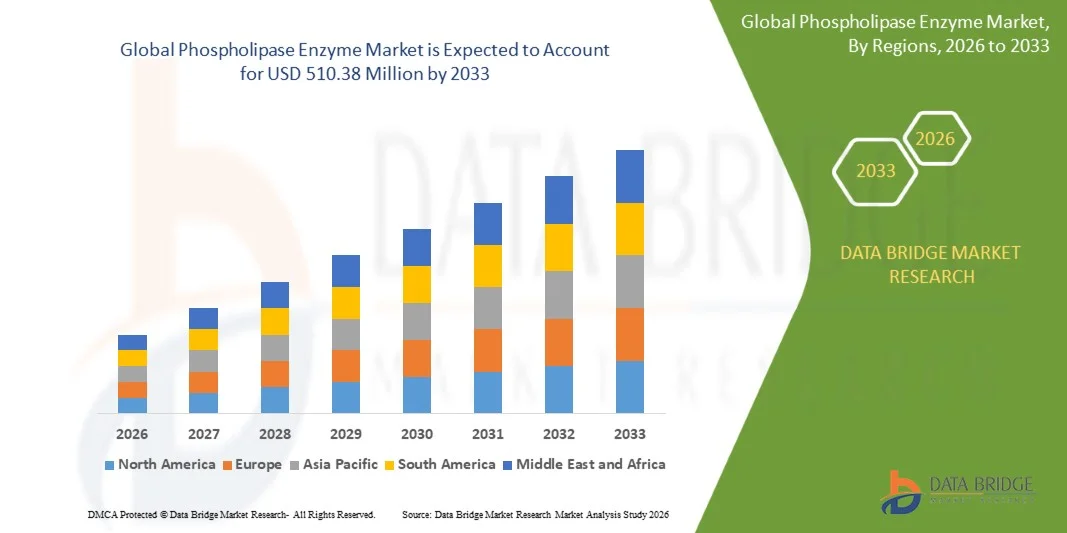
- The global phospholipase enzyme market size was valued at USD 298.16 million in 2025 and is expected to reach USD 510.38 million by 2033, at a CAGR of 6.95% during the forecast period
- The market growth is largely fueled by the increasing demand for efficient and sustainable enzymatic processing in food, oil refining, and biofuel industries, leading to reduced chemical usage and improved production efficiency across industrial operations
- Furthermore, rising demand for high-quality edible oils, clean-label food products, and eco-friendly processing technologies is positioning phospholipase enzymes as essential solutions in modern industrial applications. These converging factors are accelerating the adoption of enzyme-based processing, thereby significantly boosting the industry's growth
Phospholipase Enzyme Market Analysis
- Phospholipase enzymes, which catalyze the hydrolysis of phospholipids, are increasingly vital in industrial processing applications such as oil degumming, food manufacturing, and biofuel production due to their ability to enhance yield, improve product quality, and reduce processing costs
- The escalating demand for phospholipase enzymes is primarily driven by growing industrial focus on process optimization, increasing adoption of biotechnology-based solutions, and rising preference for sustainable and environmentally friendly production methods
- Asia-Pacific dominated the phospholipase enzyme market in 2025, due to strong demand from food processing, oil refining, and biofuel industries
- North America is expected to be the fastest growing region in the phospholipase enzyme market during the forecast period due to rising demand from biofuel production, food processing, and nutraceutical industries
- Phospholipase A2 segment dominated the market with a market share of 39% in 2025, due to its extensive application in oil degumming and food processing industries. It plays a critical role in improving oil yield and quality by effectively hydrolyzing phospholipids, which enhances operational efficiency for manufacturers
Report Scope and Phospholipase Enzyme Market Segmentation
|
Attributes |
Phospholipase Enzyme Key Market Insights |
|
Segments Covered |
|
|
Countries Covered |
North America · U.S. · Canada · Mexico Europe · Germany · France · U.K. · Netherlands · Switzerland · Belgium · Russia · Italy · Spain · Turkey · Rest of Europe Asia-Pacific · China · Japan · India · South Korea · Singapore · Malaysia · Australia · Thailand · Indonesia · Philippines · Rest of Asia-Pacific Middle East and Africa · Saudi Arabia · U.A.E. · South Africa · Egypt · Israel · Rest of Middle East and Africa South America · Brazil · Argentina · Rest of South America |
|
Key Market Players |
· Cargill, Incorporated (U.S.) · ADM (U.S.) · Alltech (U.S.) · Purina Mills (U.S.) · Nutreco (Netherlands) · Ridley Corp (Australia) · Nutriad International NV (Belgium) · Aller Aqua A/S (Denmark) · Biomin (Austria) · INVE Aquaculture, Inc. (Belgium) · Charoen Pokphand Group (Thailand) · Coppens International B.V. (Netherlands) · BioMar A/S (Denmark) · LifeCircle Nutrition AG (Switzerland) · Kent Nutrition Group (U.S.) · Sonac USA LLC (U.S.) · Growel Feeds Pvt Ltd (India) · JAPFA LTD (Singapore) · Marubeni Nisshin Feed Co., Ltd. (Japan) · Nk Ingredients Pte Ltd (Singapore) · Novus International (U.S.) |
|
Market Opportunities |
· Expansion in Biofuel Production Using Enzyme-Based Processing · Rising Use in Nutraceuticals and Functional Foods |
|
Value Added Data Infosets |
In addition to the insights on market scenarios such as market value, growth rate, segmentation, geographical coverage, and major players, the market reports curated by the Data Bridge Market Research also include in-depth expert analysis, pricing analysis, brand share analysis, consumer survey, demography analysis, supply chain analysis, value chain analysis, raw material/consumables overview, vendor selection criteria, PESTLE Analysis, Porter Analysis, and regulatory framework. |
Phospholipase Enzyme Market Trends
“Rising Adoption of Enzyme-Based Green Processing in Industrial Applications”
- A significant trend in the phospholipase enzyme market is the increasing adoption of enzyme-based green processing technologies across food, oil, and biofuel industries, driven by the need to reduce chemical usage and improve process efficiency. This shift is strengthening the role of phospholipase enzymes in sustainable industrial transformation
- For instance, Novonesis and dsm-firmenich supply industrial enzyme solutions, including phospholipase-based formulations, that are widely used in edible oil refining and food processing applications. Such enzyme systems improve yield efficiency and support cleaner production processes with reduced environmental impact
- The integration of phospholipase enzymes in oil degumming and refining processes is growing rapidly as manufacturers focus on improving oil quality, reducing waste, and lowering processing costs. This is positioning enzymatic treatment as a preferred alternative to conventional chemical refining methods
- The food and beverage industry is increasingly incorporating phospholipase enzymes to enhance texture, flavor stability, and product consistency in processed foods. This trend is supporting innovation in clean-label food manufacturing and improving product quality standards
- Biofuel producers are adopting phospholipase enzymes to optimize feedstock processing efficiency and enhance conversion performance in biodiesel production systems. This is contributing to more sustainable energy production practices and improved industrial output efficiency
- The market is witnessing growing utilization of phospholipase enzymes across nutraceutical and specialty applications where high-purity and functional ingredient processing is required. This expanding application base is reinforcing the transition toward bio-based and environmentally responsible industrial solutions
Phospholipase Enzyme Market Dynamics
Driver
“Growing Demand for Efficient Oil Degumming and Food Processing Solutions”
- The growing demand for efficient oil degumming and advanced food processing solutions is a key driver for the phospholipase enzyme market, as industries seek higher yield, improved product quality, and reduced chemical dependency. These enzymes enable more efficient phospholipid removal, enhancing overall processing performance
- For instance, companies such as Cargill and ADM utilize enzymatic processing technologies in edible oil refining operations to improve oil purity and extraction efficiency. The use of phospholipase enzymes in such systems supports large-scale production optimization and reduces refining losses
- The increasing global consumption of edible oils and processed food products is driving the need for more efficient and sustainable refining technologies. Phospholipase enzymes play a critical role in enhancing processing efficiency while maintaining product quality standards
- Food manufacturers are adopting enzyme-based solutions to improve texture, stability, and nutritional value in processed food products. This is increasing the demand for phospholipase enzymes across bakery, dairy, and functional food applications
- The need for cost-effective and high-performance processing solutions continues to reinforce market expansion. The ability of phospholipase enzymes to improve efficiency and reduce operational costs is making them an essential component in modern food and oil processing systems
Restraint/Challenge
“High Production Cost and Limited Enzyme Availability”
- The phospholipase enzyme market faces challenges due to high production costs and limited availability of specialized enzyme formulations, which restrict large-scale adoption across price-sensitive industries. The complex production process and need for controlled fermentation conditions contribute to elevated costs
- For instance, enzyme manufacturers such as Novozymes require advanced biotechnological infrastructure and precision fermentation systems to produce high-purity phospholipase enzymes. These requirements increase operational complexity and limit cost flexibility for large-scale production
- The limited availability of highly specialized enzyme variants suitable for diverse industrial applications creates supply constraints in the market. This affects consistent adoption across regions with varying industrial capabilities
- The production of stable and high-performance phospholipase enzymes requires strict quality control and advanced purification processes, which further increase manufacturing expenses. These factors contribute to higher final product pricing for end users
- The combination of high production costs and limited scalability continues to restrain broader market penetration. These challenges are encouraging manufacturers to invest in process optimization and cost-reduction technologies to improve accessibility and adoption of phospholipase enzymes
Phospholipase Enzyme Market Scope
The market is segmented on the basis of product type, form, source, and application.
- By Product Type
On the basis of product type, the phospholipase enzyme market is segmented into Phospholipase A1, Phospholipase A2, Phospholipase B, Phospholipase C, and Phospholipase D. The Phospholipase A2 segment dominated the market with the largest market revenue share of 39% in 2025, driven by its extensive application in oil degumming and food processing industries. It plays a critical role in improving oil yield and quality by effectively hydrolyzing phospholipids, which enhances operational efficiency for manufacturers. Its widespread industrial adoption, supported by consistent performance and compatibility with large-scale processing systems, continues to strengthen its market position. The growing demand for refined edible oils and clean-label food products further contributes to its dominance.
The Phospholipase A1 segment is anticipated to witness the fastest growth rate from 2026 to 2033, fueled by its increasing utilization in advanced enzymatic degumming processes and bakery applications. It offers enhanced stability and specificity, making it suitable for diverse processing conditions and improving final product consistency. Rising demand for cost-efficient and environmentally sustainable enzyme solutions is encouraging manufacturers to adopt A1 variants. Continuous advancements in enzyme engineering and expanding industrial use cases are accelerating its adoption across multiple sectors.
- By Form
On the basis of form, the phospholipase enzyme market is segmented into liquid and powder. The liquid segment dominated the market with the largest market revenue share in 2025, driven by its ease of application and faster reaction rates in industrial processes. Liquid enzymes allow better dispersion and uniform mixing, which enhances process efficiency and reduces operational time in large-scale manufacturing. Their compatibility with automated systems and reduced preparation requirements further contribute to their widespread adoption. Industries focusing on high-throughput processing prefer liquid forms due to their consistent performance and ease of handling.
The powder segment is anticipated to witness the fastest growth rate from 2026 to 2033, fueled by its longer shelf life and improved storage stability. Powdered enzymes are easier to transport and handle, particularly in regions with limited cold-chain infrastructure, making them highly suitable for global distribution. Their reduced risk of contamination and precise dosage control support their increasing use in specialized applications. Growing demand for flexible and cost-effective enzyme formats is accelerating the adoption of powder-based phospholipase solutions.
- By Source
On the basis of source, the phospholipase enzyme market is segmented into animal, botanical, and microbial. The microbial segment dominated the market with the largest market revenue share in 2025, driven by its high scalability, cost-effectiveness, and consistent enzyme yield. Microbial sources enable controlled fermentation processes, ensuring stable production and reduced dependency on seasonal or biological variations. They are widely preferred due to their adaptability to genetic modification, which enhances enzyme efficiency and specificity. Increasing demand for sustainable and non-animal-derived ingredients is further strengthening the dominance of microbial phospholipases.
The botanical segment is anticipated to witness the fastest growth rate from 2026 to 2033, fueled by rising consumer preference for plant-based and clean-label products. Botanical enzymes are gaining traction in food and nutraceutical applications where natural sourcing is a key requirement. Their alignment with vegan and environmentally conscious trends is encouraging manufacturers to explore plant-derived alternatives. Continuous research into plant enzyme extraction and performance optimization is supporting their expanding market presence.
- By Application
On the basis of application, the phospholipase enzyme market is segmented into food and beverages, bakery, dairy, oil and fat processing, flavour production, biofuel production, nutraceuticals, personal care, and others. The oil and fat processing segment dominated the market with the largest market revenue share in 2025, driven by the extensive use of phospholipases in enzymatic degumming and refining processes. These enzymes improve oil yield, reduce chemical usage, and enhance overall product quality, making them essential in large-scale edible oil production. Increasing global consumption of processed and refined oils is further supporting the segment’s growth. Industrial preference for sustainable and efficient processing methods continues to drive demand in this segment.
The biofuel production segment is anticipated to witness the fastest growth rate from 2026 to 2033, fueled by increasing investments in renewable energy and sustainable fuel alternatives. Phospholipases play a vital role in improving feedstock quality and conversion efficiency in biodiesel production processes. Growing environmental regulations and the push for reduced carbon emissions are encouraging the adoption of enzyme-based biofuel technologies. Advancements in enzyme optimization and expanding biofuel infrastructure are accelerating the growth of this segment.
Phospholipase Enzyme Market Regional Analysis
- Asia-Pacific dominated the phospholipase enzyme market with the largest revenue share in 2025, driven by strong demand from food processing, oil refining, and biofuel industries
- The region benefits from expanding enzyme manufacturing capacity, cost-efficient production base, and increasing adoption of enzymatic processing across industrial applications
- Rapid industrialization, growing edible oil consumption, and rising investments in biotechnology and enzyme innovation are accelerating market expansion
China Phospholipase Enzyme Market Insight
China held the largest share in the Asia-Pacific phospholipase enzyme market in 2025, supported by its strong food processing and oil refining industries. The country has a well-established industrial enzyme production ecosystem that enables large-scale manufacturing and cost efficiency. Increasing demand for high-quality edible oils and processed foods is further reinforcing market growth. In addition, government support for biotechnology development and expanding export capabilities are strengthening China’s leadership in enzyme production.
India Phospholipase Enzyme Market Insight
India is witnessing the fastest growth in the Asia-Pacific region, driven by rising consumption of processed foods and expanding edible oil refining capacity. Government initiatives promoting food processing and biofuel production are significantly boosting enzyme adoption across industries. The growing nutraceutical and pharmaceutical sectors are also contributing to increasing demand for phospholipase enzymes. In addition, rising investments in biotechnology infrastructure and domestic enzyme production are accelerating long-term market expansion.
Europe Phospholipase Enzyme Market Insight
The Europe phospholipase enzyme market is expanding steadily, supported by strong demand from food and beverage processing, bakery, and nutraceutical applications. The region places strong emphasis on sustainable and enzyme-based processing solutions to reduce chemical usage in industrial operations. Strict environmental regulations are encouraging the adoption of bio-based and eco-friendly enzyme technologies. In addition, continuous advancements in enzyme engineering are enhancing efficiency and application scope across industries.
Germany Phospholipase Enzyme Market Insight
Germany accounted for the largest share in the Europe phospholipase enzyme market in 2025, driven by its strong food processing and biotechnology industries. The country has extensive utilization of enzymes in oil refining, bakery, and dairy applications. Advanced research capabilities and industrial innovation support the development of high-performance enzyme solutions. In addition, strong collaboration between research institutions and industrial manufacturers is reinforcing Germany’s leadership in enzyme technology.
U.K. Phospholipase Enzyme Market Insight
The U.K. market is supported by growing demand from food processing, nutraceutical, and personal care sectors. Increasing focus on sustainable and clean-label production methods is driving enzyme adoption across applications. The country’s research-driven environment supports innovation in biotechnology and enzyme development. In addition, expanding investment in life sciences and specialty chemicals is further supporting market growth.
North America Phospholipase Enzyme Market Insight
North America is projected to grow at the fastest CAGR from 2026 to 2033, driven by rising demand from biofuel production, food processing, and nutraceutical industries. Strong adoption of advanced enzyme technologies is supporting efficient and sustainable industrial processes. Continuous innovation in enzyme engineering is expanding application areas across multiple sectors. In addition, increasing investment in biotechnology and renewable energy solutions is accelerating regional market growth.
U.S. Phospholipase Enzyme Market Insight
The U.S. accounted for the largest share in the North America phospholipase enzyme market in 2025, supported by strong demand from food processing, biofuel, and pharmaceutical industries. The country benefits from a highly advanced biotechnology ecosystem and strong presence of leading enzyme manufacturers. Phospholipase enzymes are widely used in oil processing, nutraceuticals, and industrial applications. In addition, continuous research and innovation along with supportive regulatory frameworks are reinforcing the U.S. leadership position in the regional market.
Phospholipase Enzyme Market Share
The phospholipase enzyme industry is primarily led by well-established companies, including:
- Cargill, Incorporated (U.S.)
- ADM (U.S.)
- Alltech (U.S.)
- Purina Mills (U.S.)
- Nutreco (Netherlands)
- Ridley Corp (Australia)
- Nutriad International NV (Belgium)
- Aller Aqua A/S (Denmark)
- Biomin (Austria)
- INVE Aquaculture, Inc. (Belgium)
- Charoen Pokphand Group (Thailand)
- Coppens International B.V. (Netherlands)
- BioMar A/S (Denmark)
- LifeCircle Nutrition AG (Switzerland)
- Kent Nutrition Group (U.S.)
- Sonac USA LLC (U.S.)
- Growel Feeds Pvt Ltd (India)
- JAPFA LTD (Singapore)
- Marubeni Nisshin Feed Co., Ltd. (Japan)
- Nk Ingredients Pte Ltd (Singapore)
- Novus International (U.S.)
Latest Developments in Global Phospholipase Enzyme Market
- In June 2025, dsm-firmenich completed the sale of its stake in the Feed Enzyme Alliance to Novonesis, enabling a sharper strategic focus on its core nutrition, health, and specialty ingredients segments. This move allows dsm-firmenich to reallocate resources toward high-growth and high-margin areas while reducing exposure to joint operational complexities. For the enzyme market, this transition is creating a more streamlined competitive environment where companies operate with clearer strategic direction. It is also enhancing innovation efficiency and accelerating the development of specialized enzyme solutions including phospholipases
- In February 2025, Novonesis acquired dsm-firmenich’s share in the Feed Enzyme Alliance for approximately €1.5 billion, gaining full ownership and control over production, sales, and distribution operations. This acquisition strengthens vertical integration, allowing better coordination across R&D, manufacturing, and commercialization processes. It enhances the company’s ability to scale enzyme solutions globally and respond faster to evolving industry demands. The development is reinforcing market leadership and accelerating innovation in industrial enzymes including phospholipase technologies used in food and biofuel processing
- In January 2024, the merger of Novozymes and Chr. Hansen to form Novonesis created a global biosolutions leader with expanded technological and research capabilities. The combined entity benefits from complementary expertise in enzymes and microbial solutions, enabling the development of more advanced and efficient products. This consolidation is significantly strengthening R&D pipelines and supporting cross-industry innovation. It is driving the expansion of enzyme applications, including phospholipases, across food processing, agriculture, and renewable energy sectors
- In 2024, the dissolution of the Feed Enzyme Alliance between Novonesis and dsm-firmenich marked a strategic shift toward independent operations and competitive positioning. This separation allows both companies to independently pursue tailored growth strategies and prioritize their respective innovation agendas. It is encouraging increased competition, which is likely to accelerate technological advancements and product differentiation. The move is also enabling more focused investments in specialized enzyme categories such as phospholipases, supporting broader market development
- In 2023, Novozymes strengthened its enzyme portfolio through continued investment in advanced lipid-modifying enzyme solutions, including phospholipase-based technologies. These innovations are improving efficiency in oil refining, food processing, and industrial applications by enhancing yield and reducing processing costs. The development supports sustainability goals by minimizing chemical usage and energy consumption in production processes. It is also expanding the adoption of phospholipase enzymes across diverse industries, contributing to overall market growth and technological advancement

- Interactive Data Analysis Dashboard
- Company Analysis Dashboard for high growth potential opportunities
- Research Analyst Access for customization & queries
- Competitor Analysis with Interactive dashboard
- Latest News, Updates & Trend analysis
- Harness the Power of Benchmark Analysis for Comprehensive Competitor Tracking
Global Phospholipase Enzyme Market, Supply Chain Analysis and Ecosystem Framework
To support market growth and help clients navigate the impact of geopolitical shifts, DBMR has integrated in-depth supply chain analysis into its Global Phospholipase Enzyme Market research reports. This addition empowers clients to respond effectively to global changes affecting their industries. The supply chain analysis section includes detailed insights such as Global Phospholipase Enzyme Market consumption and production by country, price trend analysis, the impact of tariffs and geopolitical developments, and import and export trends by country and HSN code. It also highlights major suppliers with data on production capacity and company profiles, as well as key importers and exporters. In addition to research, DBMR offers specialized supply chain consulting services backed by over a decade of experience, providing solutions like supplier discovery, supplier risk assessment, price trend analysis, impact evaluation of inflation and trade route changes, and comprehensive market trend analysis.
Data collection and base year analysis are done using data collection modules with large sample sizes. The stage includes obtaining market information or related data through various sources and strategies. It includes examining and planning all the data acquired from the past in advance. It likewise envelops the examination of information inconsistencies seen across different information sources. The market data is analysed and estimated using market statistical and coherent models. Also, market share analysis and key trend analysis are the major success factors in the market report. To know more, please request an analyst call or drop down your inquiry.
The key research methodology used by DBMR research team is data triangulation which involves data mining, analysis of the impact of data variables on the market and primary (industry expert) validation. Data models include Vendor Positioning Grid, Market Time Line Analysis, Market Overview and Guide, Company Positioning Grid, Patent Analysis, Pricing Analysis, Company Market Share Analysis, Standards of Measurement, Global versus Regional and Vendor Share Analysis. To know more about the research methodology, drop in an inquiry to speak to our industry experts.
Data Bridge Market Research is a leader in advanced formative research. We take pride in servicing our existing and new customers with data and analysis that match and suits their goal. The report can be customized to include price trend analysis of target brands understanding the market for additional countries (ask for the list of countries), clinical trial results data, literature review, refurbished market and product base analysis. Market analysis of target competitors can be analyzed from technology-based analysis to market portfolio strategies. We can add as many competitors that you require data about in the format and data style you are looking for. Our team of analysts can also provide you data in crude raw excel files pivot tables (Fact book) or can assist you in creating presentations from the data sets available in the report.













