


What is the Photo Rejuvenation Devices Market Size and Growth Rate ?
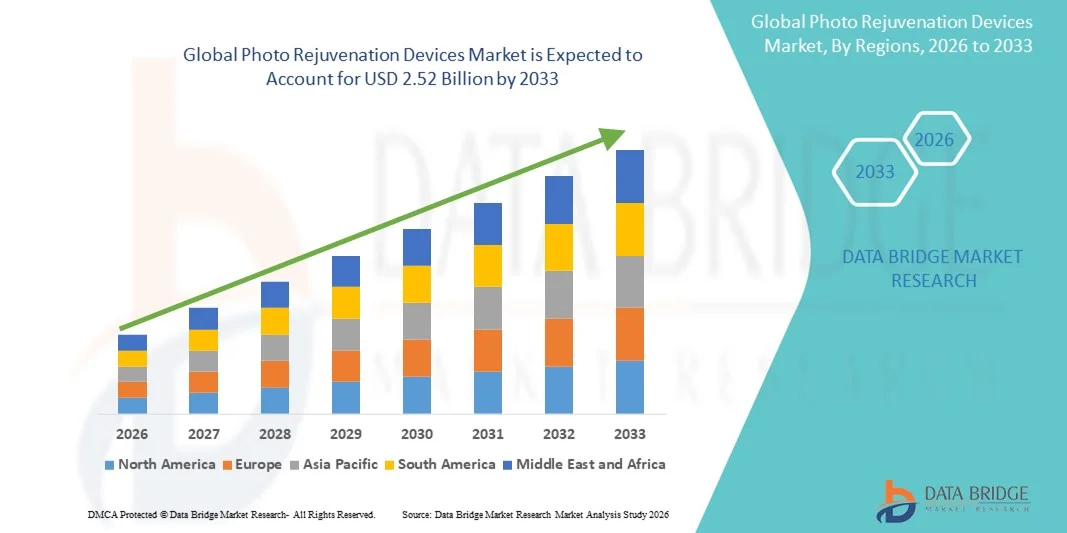
- As per Data Bridge Market Research Analysis the Global photo rejuvenation devices market size was valued at USD 1.50 billion in 2025 and is expected to reach USD 2.52 billion by 2033, at a CAGR of 6.70% during the forecast period
- The market growth is largely fueled by the increasing adoption of non-invasive aesthetic treatments and continuous technological advancements in light-based and energy-based skin rejuvenation systems, leading to greater acceptance of photo rejuvenation procedures across both clinical and home-use settings. The rising focus on improving skin texture, reducing pigmentation, and addressing aging concerns is driving higher utilization of these devices in dermatology clinics, medical spas, and wellness centers
- Furthermore, rising consumer demand for safe, convenient, and cost-effective cosmetic solutions is positioning photo rejuvenation devices as a preferred choice for treating skin-related concerns such as wrinkles, acne scars, sun damage, and redness. These converging factors are accelerating the uptake of Photo Rejuvenation Devices solutions, thereby significantly boosting the industry's growth.
Market Size & Forecast
- Global Market Value (2025): USD 1.50 Billion
- Expected Market Value (2033): USD 2.52 Billion
- Forecast CAGR (2026–2033): 6.70%
What are the Major Takeaways of Photo Rejuvenation Devices Market ?
- Photo rejuvenation devices, utilizing IPL, LED, and laser-based technologies, are increasingly vital tools in modern aesthetic and dermatological practices, as they offer non-invasive solutions for improving skin tone, reducing pigmentation, minimizing wrinkles, and enhancing overall skin appearance. Their ability to deliver effective results with minimal downtime has boosted their adoption across both professional clinics and at-home users
- The escalating demand for photo rejuvenation devices is primarily fueled by rising consumer focus on anti-aging treatments, growing awareness of skin health, and the expanding preference for minimally invasive cosmetic procedures. Increasing availability of portable home-use devices and continuous technological innovations are further accelerating global adoption
- North America dominated the photo rejuvenation devices market with the largest revenue share of approximately 38.5% in 2025, driven by high spending on aesthetic treatments, strong presence of dermatology clinics, rapid adoption of advanced IPL/laser systems, and a growing population seeking non-surgical cosmetic enhancements. The U.S. market remains the primary contributor, supported by rising demand for at-home skincare devices and increasing acceptance of light-based therapies
- Asia-Pacific is expected to be the fastest-growing region in the photo rejuvenation devices market during the forecast period, supported by rising disposable incomes, growing beauty consciousness, rapid expansion of aesthetic clinics, and increasing influence of social media and K-beauty trends. Countries like China, Japan, and South Korea are at the forefront of adoption
- The Brown Spots segment accounted for the largest market revenue share of 53.7% in 2025, driven by the rising prevalence of pigmentation disorders, sun-induced skin damage, and aging-related blemishes.
Report Scope and Photo Rejuvenation Devices Market Segmentation
|
Attributes |
Photo Rejuvenation Devices Key Market Insights |
|
Segments Covered |
|
|
Countries Covered |
North America
Europe
Asia-Pacific
Middle East and Africa
South America
|
|
Key Market Players |
|
|
Market Opportunities |
|
|
Value Added Data Infosets |
In addition to the insights on market scenarios such as market value, growth rate, segmentation, geographical coverage, and major players, the market reports curated by the Data Bridge Market Research also include in-depth expert analysis, patient epidemiology, pipeline analysis, pricing analysis, and regulatory framework. |
What are the Key Trends in Photo Rejuvenation Devices Market ?
Growing Adoption of Intelligent, Multi-Functional Aesthetic Systems
- A significant and accelerating trend in the global photo rejuvenation devices market is the shift toward highly intelligent, multi-functional aesthetic platforms that combine advanced energy-based technologies such as IPL, LED, and laser systems into a single treatment console. This transition is reshaping user expectations by enabling broader clinical capabilities with greater convenience
- For instance, several leading manufacturers now offer IPL-based Photo Rejuvenation Devices that include integrated cooling, customized wavelength settings, and on-device treatment guidance to enhance both clinical efficacy and patient comfort. Similarly, hybrid systems provide clinicians flexibility to address multiple skin concerns in one session
- Advanced software algorithms in photo rejuvenation platforms enable optimized light-emission patterns, learning from user treatment data to deliver more precise and safer energy output. Some systems automatically adjust pulse duration, fluence, and spectral filters based on real-time skin feedback, thereby improving treatment outcomes across different skin types
- The integration of smart interfaces and digital workflow management has streamlined the user experience. Through touchscreen-based controls, practitioners can easily manage treatment parameters, monitor device performance, and access built-in protocols for conditions such as pigmentation, vascular lesions, or skin laxity
- This growing preference for technology that enhances accuracy, consistency, and patient customization is reshaping the aesthetic device landscape. Companies are rapidly introducing upgraded photo rejuvenation platforms with improved ergonomics, refined energy delivery, and broader skin-type compatibility
- The demand for such multi-functional, intelligent, and user-friendly Photo Rejuvenation Devices is rising rapidly across dermatology clinics, medical spas, and home-care users seeking safer and more versatile solutions for skin rejuvenation and cosmetic enhancement
Photo Rejuvenation Devices Market Dynamics
Driver
Growing Demand for Minimally Invasive Aesthetic Treatments and Rising Skin Concerns
- Increasing consumer awareness regarding skin health, combined with the rising demand for minimally invasive aesthetic procedures, is a major driver of the Photo Rejuvenation Devices market. Patients increasingly seek safe, painless, and non-surgical solutions to address pigmentation, wrinkles, acne scars, and sun damage
- For instance, in March 2024, Lumenis launched an upgraded IPL-based photo rejuvenation platform featuring enhanced cooling and broader wavelength options to meet growing clinical demand for multi-condition skin treatments. Such innovations strengthen adoption across dermatology practices
- As global exposure to pollution, UV radiation, and lifestyle stress increases, more individuals experience premature aging and hyperpigmentation. This directly boosts demand for photo rejuvenation procedures due to their proven effectiveness and shorter recovery time
- The shift toward at-home aesthetic devices further contributes to market growth, with compact IPL and LED-based devices gaining popularity among consumers seeking convenient skin-care solutions
- Increasing disposable income, expanding medical tourism, and rising acceptance of cosmetic treatments worldwide also contribute to market expansion. Moreover, dermatologists prefer photo rejuvenation technologies due to their versatility across multiple indications
- Continuous innovation in energy-based devices, including improved safety for darker skin types, supports strong adoption in both developed and emerging markets
Restraint/Challenge
High Device Costs and Concerns Regarding Treatment Safety
- The high cost of professional photo rejuvenation devices remains a significant barrier for small clinics, startups, and home-care users. Premium IPL and laser-based systems require substantial capital investment, making them less accessible in price-sensitive regions
- For instance, reports of occasional adverse events—such as burns, hyperpigmentation, or skin irritation—have caused some consumers to hesitate before undergoing photo rejuvenation treatments, especially when performed by untrained operators
- These concerns emphasize the need for stricter safety guidelines, improved operator training, and advancements in energy control technologies. Manufacturers must adopt robust treatment-preset protocols, high-grade cooling systems, and automated safety checks to build consumer trust
- Another ongoing challenge is the requirement for multiple treatment sessions, which increases overall procedure cost and may limit adoption among budget-conscious users
- In addition, inconsistent regulatory frameworks across countries can slow product approvals, delaying market entry for new technologies
- Addressing these issues through cost-effective device development, improved safety engineering, and wider clinician training programs will be essential for sustaining long-term Photo Rejuvenation Devices market growth
Photo Rejuvenation Devices Market Scope
The market is segmented on the basis of product type, application, end user, and distribution channel.
- By Product Type
On the basis of product type, the Photo Rejuvenation Devices market is segmented into Lasers, Intense Pulsed Light (IPL), and Photodynamic Therapy (PDT). The Lasers segment dominated the largest market revenue share of 48.5% in 2025, driven by its precise energy delivery, versatility across multiple skin conditions, and established clinical efficacy. Laser-based devices are widely adopted in dermatology and cosmetic clinics for treatments such as skin resurfacing, wrinkle reduction, and scar correction. The ability to customize wavelength, pulse duration, and fluence makes lasers suitable for diverse skin types and conditions. Hospitals and specialty clinics prefer laser devices due to high patient satisfaction and predictable results. Rising demand for non-invasive, long-lasting cosmetic outcomes supports their continued dominance. Technological advancements, including fractional, diode, and CO₂ lasers, have enhanced safety and treatment efficiency. Strong adoption is also driven by growing awareness of aesthetic procedures and increasing disposable income in key regions. Continuous research and regulatory approvals further reinforce lasers as the primary choice in photo rejuvenation treatments.
The Intense Pulsed Light (IPL) segment is anticipated to witness the fastest CAGR of 21.3% from 2026 to 2033, fueled by its versatility in addressing multiple skin conditions, ease of use, and lower operational costs compared to traditional laser systems. IPL devices effectively treat pigmentation, vascular lesions, and sun damage in fewer sessions, appealing to both clinics and at-home users. Growth is supported by increasing adoption in dermatology centers, medical spas, and cosmetic clinics. Technological innovations such as multi-wavelength and enhanced cooling systems improve patient comfort and treatment outcomes. The expanding preference for non-invasive procedures among millennials and aging populations further drives adoption. Rising availability of compact IPL devices and enhanced training programs for practitioners accelerates uptake. The growing focus on minimally invasive, multi-functional skin treatments in emerging markets ensures rapid segment growth.
- By Application
On the basis of application, the Photo Rejuvenation Devices market is segmented into Brown Spots and Redness & Excess Blood Vessels. The Brown Spots segment accounted for the largest market revenue share of 53.7% in 2025, driven by the rising prevalence of pigmentation disorders, sun-induced skin damage, and aging-related blemishes. Dermatologists and cosmetic clinics prioritize treatments targeting hyperpigmentation due to high patient demand and visible aesthetic outcomes. Lasers and IPL devices designed for melanin-specific absorption ensure effective treatment of brown spots with minimal downtime. The segment benefits from technological innovations like fractional and Q-switched lasers, enhancing precision and patient satisfaction. Increased awareness of skin health, growing disposable income, and higher willingness to spend on cosmetic procedures contribute to segment leadership. Adoption is further supported by aging populations and rising interest in anti-aging therapies. Clinics and hospitals increasingly offer combined therapies to improve treatment effectiveness. Marketing campaigns emphasizing visible results and safety have strengthened patient trust and clinic adoption.
The Redness & Excess Blood Vessels segment is expected to witness the fastest CAGR of 19.8% from 2026 to 2033, fueled by rising cases of rosacea, vascular lesions, and post-procedure redness. IPL and vascular laser devices are widely used due to their ability to selectively target hemoglobin, reduce redness, and improve skin texture with minimal invasiveness. Increasing patient preference for non-surgical cosmetic treatments and growing awareness of vascular skin conditions support rapid adoption. Advances in pulsed-dye and KTP lasers enhance safety and treatment outcomes, further driving market growth. Clinics and dermatology centers increasingly adopt these devices to expand treatment portfolios. Expansion of aesthetic procedures in emerging regions and rising disposable income accelerate segment uptake. Multi-application devices capable of treating both pigmentation and vascular conditions also enhance the market potential.
- By End User
On the basis of end user, the Photo Rejuvenation Devices market is segmented into Specialty Clinics and Hospitals. The Specialty Clinics segment dominated the largest market revenue share of 57.2% in 2025, driven by high patient preference for outpatient, convenient, and cost-effective aesthetic procedures. Clinics provide flexible scheduling, specialized services, and tailored treatment plans, making them a preferred choice for patients seeking non-invasive skin rejuvenation. Rising number of dermatology and cosmetic clinics globally strengthens the segment’s dominance. These clinics often invest in advanced devices such as lasers and IPL systems to provide multiple treatment options. Patient education programs and marketing strategies promoting skin health treatments further enhance clinic adoption. The segment benefits from innovations that enable faster treatments, shorter recovery periods, and better patient satisfaction. Growing interest in anti-aging and cosmetic enhancement among millennials and aging populations contributes significantly to revenue share. Expansion of aesthetic tourism and affordability of clinic-based procedures further support segment growth.
The Hospitals segment is expected to witness the fastest CAGR of 18.5% from 2026 to 2033, fueled by increasing integration of aesthetic procedures in hospital dermatology and plastic surgery departments. Hospitals provide access to advanced laser platforms and hybrid technologies, allowing comprehensive treatment for multiple skin concerns. Rising collaborations between device manufacturers and hospital networks, along with increasing awareness of minimally invasive cosmetic procedures, drive adoption. Expansion of hospital-based outpatient departments and dermatology centers in emerging markets enhances patient access. The growing need for professional-grade, multi-functional devices in hospitals supports strong segment growth. Hospitals increasingly adopt devices with multiple wavelengths and safety features, meeting diverse patient needs efficiently.
- By Distribution Channel
On the basis of distribution channel, the Photo Rejuvenation Devices market is segmented into Direct and Retail. The Direct segment held the largest market revenue share of 62.1% in 2025, driven by strong manufacturer-clinic and manufacturer-hospital relationships. Direct sales allow device manufacturers to provide personalized demonstrations, training, and after-sales support, which improves adoption rates. Specialty clinics and hospitals prefer direct procurement for bulk orders of high-value laser and IPL systems. Strong brand reputation, reliable service contracts, and technical support further reinforce the dominance of this channel. Direct distribution also facilitates faster product rollout, training, and integration of new technologies. Increasing investment in premium devices by clinics and hospitals contributes to sustained market leadership.
The Retail segment is expected to witness the fastest CAGR of 22.4% from 2026 to 2033, fueled by growing availability of compact and at-home photo rejuvenation devices. E-commerce platforms, medical equipment retailers, and cosmetic device stores provide convenient access to IPL and low-power laser systems for personal use. Rising awareness of home skincare routines, expanding disposable income, and increasing preference for minimally invasive treatments boost retail adoption. The segment benefits from growing online presence, product variety, competitive pricing, and home-use certifications. Rising popularity of self-care, DIY aesthetic treatments, and social media-driven trends accelerate segment growth. Retail channels also offer flexible payment options and promotional schemes, driving rapid market expansion.
Photo Rejuvenation Devices Market Regional Analysis
- North America dominated the photo rejuvenation devices market with the largest revenue share of approximately 38.5% in 2025
- Driven by high spending on aesthetic treatments, strong presence of dermatology clinics, rapid adoption of advanced IPL and laser systems, and a growing population seeking non-surgical cosmetic enhancements
- The widespread availability of professional and at-home photo rejuvenation devices, coupled with increasing consumer awareness of non-invasive skin treatments, is further supporting market growth
U.S. Photo Rejuvenation Devices Market Insight
The U.S. photo rejuvenation devices market accounted for the largest revenue share within North America in 2025, fueled by rising demand for minimally invasive skin treatments, increasing adoption of IPL and laser devices in dermatology clinics, and growing interest in at-home devices. Consumers are increasingly prioritizing anti-aging and skin-improving procedures, while dermatologists and aesthetic clinics focus on expanding services using advanced light-based therapies.
Europe Photo Rejuvenation Devices Market Insight
The Europe photo rejuvenation devices market is projected to expand at a significant CAGR during the forecast period, supported by rising awareness of non-invasive cosmetic treatments and growing adoption of light-based devices across dermatology clinics and aesthetic centers. The region is witnessing growth across both professional and home-use applications, with countries such as Germany, France, and the U.K. leading adoption due to strong healthcare infrastructure and increasing demand for anti-aging and skin treatment solutions.
U.K. Photo Rejuvenation Devices Market Insight
The U.K. photo rejuvenation devices market is expected to grow steadily, driven by increasing consumer preference for non-surgical cosmetic procedures, rising beauty and wellness consciousness, and a strong presence of dermatology and aesthetic clinics. The market is further supported by the availability of advanced IPL and laser devices and the growing popularity of at-home photo rejuvenation solutions.
Germany Photo Rejuvenation Devices Market Insight
Germany’s photo rejuvenation devices market is anticipated to expand at a considerable CAGR during the forecast period, supported by high adoption of advanced laser and IPL technologies in clinical settings, increasing demand for minimally invasive aesthetic treatments, and growing consumer focus on skin care and anti-aging. The presence of technologically advanced medical device manufacturers also promotes market growth.
Asia-Pacific Photo Rejuvenation Devices Market Insight
Asia-Pacific photo rejuvenation devices market is expected to be the fastest-growing region in the Photo Rejuvenation Devices market during the forecast period, supported by rising disposable incomes, increasing beauty consciousness, rapid expansion of dermatology and aesthetic clinics, and growing influence of social media and K-beauty trends. Countries such as China, Japan, and South Korea are at the forefront of adoption, with increasing use of both professional and at-home light-based treatment devices driving market expansion.
Japan Photo Rejuvenation Devices Market Insight
The Japan photo rejuvenation devices market is gaining momentum due to high consumer awareness of cosmetic procedures, advanced dermatology infrastructure, and growing demand for minimally invasive skin treatments. Adoption is further fueled by the increasing availability of IPL and laser-based devices in clinics and at-home devices targeting anti-aging and skin rejuvenation.
China Photo Rejuvenation Devices Market Insight
China photo rejuvenation devices market accounted for the largest revenue share in the Asia-Pacific region in 2025, supported by rapid urbanization, expanding middle-class population, rising beauty consciousness, and strong adoption of aesthetic treatments. The growth of dermatology clinics, availability of advanced IPL and laser devices, and increasing popularity of at-home light-based therapies are major factors driving the market in China.
Photo Rejuvenation Devices Market Share
The Photo Rejuvenation Devices industry is primarily led by well-established companies, including:
- Cynosure, Inc. (U.S.)
- Cutera, Inc. (U.S.)
- Lumenis Ltd. (Israel)
- Alma Lasers (Israel)
- Sciton, Inc. (U.S.)
- Palomar Technologies (U.S.)
- DEKA (Italy)
- Venus Concept Inc. (Canada)
- Quanta System (Italy)
- Hoya ConBio (U.S.)
- Beijing Mychway Technology (China)
- MediTech (South Korea)
- Shenzhen Nufoton (China)
- Cutacare (Germany)
- Syneron Candela (U.S.)
- BTL Industries (Czech Republic)
- Medica Group (U.K.)
Latest Developments in Global Photo Rejuvenation Devices Market
- In June 2023, Candela received U.S. FDA clearance for its Vbeam 595 nm pulsed dye laser system, reinforcing its position with advanced vascular and dermatologic photorejuvenation treatment options beyond traditional IPL and laser platforms
- In August 2024, Candela Corporation, a leading global aesthetic device company, announced that its Matrix™ multi‑application radiofrequency skin platform — featuring the Matrix Pro® RF microneedling applicator — received expanded U.S. FDA 510(k) clearance for the percutaneous treatment of facial wrinkles in patients with Fitzpatrick Skin Types I–IV, underscoring Candela’s continued innovation in advanced skin rejuvenation and wrinkle reduction
- In January 2024, Candela introduced its updated Nordlys IPL and laser device portfolio featuring Selective Waveband Technology (SWT) intense pulsed light (IPL) along with non‑ablative fractional lasers and an Nd:YAG laser, designed to address a broader range of skin concerns including pigmentation, vascular lesions, and wrinkles
- In November 2024, InMode unveiled its new X‑IPL module, expanding its energy‑based device portfolio to include IPL photofacial capabilities — a key addition for non‑invasive skin rejuvenation and pigmentation treatments
- In March 2025, Cynosure announced a strategic partnership with HydraFacial to integrate Cynosure’s IPL photorejuvenation technology into HydraFacial’s treatment platforms, broadening clinical usage of IPL photo rejuvenation technologies in dermatology and med‑spa settings
- In March 2025, Syneron Candela announced a strategic co‑development partnership with Shenzhen Sincoheren S&T Development to create next‑generation energy‑based aesthetic platforms that integrate laser and LED technologies for comprehensive skin rejuvenation treatments
- In October 2025, industry market reports highlighted continued growth in the intense pulsed light (IPL) facial rejuvenation device segment, noting the global IPL device market is projected to grow significantly through 2029 driven by rising demand for non‑invasive aesthetic treatments and expanded clinic adoption worldwide
- In June 2025, industry analysts noted increased consumption and adoption of IPL photorejuvenation devices globally due to their non‑invasive nature and safety profile, underscoring broader trends toward light‑based skin rejuvenation treatments across dermatology clinics

- Interactive Data Analysis Dashboard
- Company Analysis Dashboard for high growth potential opportunities
- Research Analyst Access for customization & queries
- Competitor Analysis with Interactive dashboard
- Latest News, Updates & Trend analysis
- Harness the Power of Benchmark Analysis for Comprehensive Competitor Tracking
Data collection and base year analysis are done using data collection modules with large sample sizes. The stage includes obtaining market information or related data through various sources and strategies. It includes examining and planning all the data acquired from the past in advance. It likewise envelops the examination of information inconsistencies seen across different information sources. The market data is analysed and estimated using market statistical and coherent models. Also, market share analysis and key trend analysis are the major success factors in the market report. To know more, please request an analyst call or drop down your inquiry.
The key research methodology used by DBMR research team is data triangulation which involves data mining, analysis of the impact of data variables on the market and primary (industry expert) validation. Data models include Vendor Positioning Grid, Market Time Line Analysis, Market Overview and Guide, Company Positioning Grid, Patent Analysis, Pricing Analysis, Company Market Share Analysis, Standards of Measurement, Global versus Regional and Vendor Share Analysis. To know more about the research methodology, drop in an inquiry to speak to our industry experts.
Data Bridge Market Research is a leader in advanced formative research. We take pride in servicing our existing and new customers with data and analysis that match and suits their goal. The report can be customized to include price trend analysis of target brands understanding the market for additional countries (ask for the list of countries), clinical trial results data, literature review, refurbished market and product base analysis. Market analysis of target competitors can be analyzed from technology-based analysis to market portfolio strategies. We can add as many competitors that you require data about in the format and data style you are looking for. Our team of analysts can also provide you data in crude raw excel files pivot tables (Fact book) or can assist you in creating presentations from the data sets available in the report.













