


Photomedicine Devices Market Overview
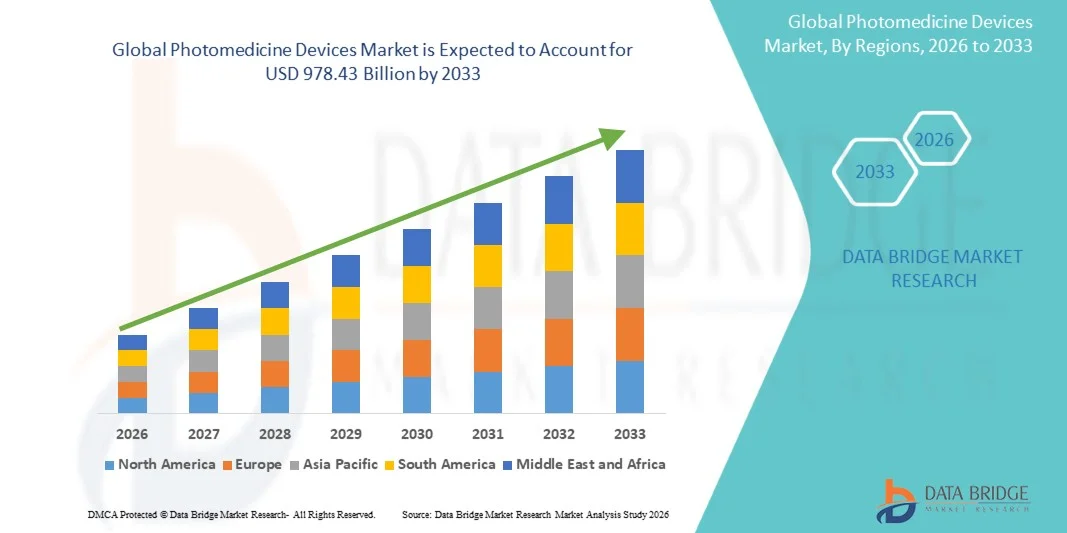
The Photomedicine Devices Market was valued at USD 623.23 billion in 2025 and is projected to reach USD 978.43 billion by 2033, growing at a CAGR of 5.80% from 2026 to 2033. The Photomedicine Devices Market is experiencing consistent growth driven by rising demand for advanced light-based therapeutic and diagnostic solutions, rapid advancements in phototherapy technologies, and expanding applications across dermatology, oncology, ophthalmology, wound care, and aesthetic medicine.
The increasing prevalence of skin disorders, cancer cases, chronic wounds, and eye-related conditions, combined with growing preference for minimally invasive and non-invasive treatment approaches, is encouraging healthcare providers to adopt advanced photomedicine devices. LED-based therapies, laser systems, and other light-based technologies are increasingly replacing conventional treatment methods in several applications, offering targeted, precise, and effective solutions for disease management, cosmetic procedures, and regenerative therapies.
Key Market Trends & Insights
- North America dominated the Photomedicine Devices Market with the largest revenue share of 38.5% in 2025, supported by advanced healthcare infrastructure, high adoption of light-based therapeutic technologies, strong presence of leading medical device manufacturers, and increasing demand for minimally invasive treatment solutions. The region benefits from widespread use of photomedicine devices across dermatology, ophthalmology, oncology, and aesthetic medicine applications, along with significant investments in research and development, clinical innovation, and advanced healthcare technologies.
- The Laser segment dominated the market with a 42.8% share in 2025, due to its extensive application across dermatology, tattoo removal, hair removal, skin resurfacing, and cosmetic procedures.
- Asia-Pacific is expected to be the fastest-growing region in the Photomedicine Devices Market, registering a CAGR of 9.2% from 2026 to 2033, fueled by rising healthcare expenditure, increasing awareness regarding advanced light-based therapies, expanding dermatology and aesthetic medicine markets, and improving access to specialized healthcare services in countries such as China, India, Japan, and South Korea. Growing medical tourism and increasing adoption of minimally invasive treatment procedures are further accelerating regional growth.
- The Light Emitting Diode (LED) Phototherapy segment is projected to be the fastest-growing technology segment with a CAGR of 9.0% from 2026 to 2033, driven by increasing preference for compact, energy-efficient, and patient-friendly phototherapy solutions. Advancements in wavelength-specific LED technology, portable devices, and home-based phototherapy systems are expanding adoption across dermatology and cosmetic treatment applications.
- The Dermatology & Skin Disorders application segment dominated the Photomedicine Devices Market with revenue share in 2025, supported by the rising prevalence of psoriasis, acne, eczema, and other skin-related conditions. Increasing demand for non-invasive aesthetic procedures, growing adoption of laser and light-based treatments, and expanding dermatology clinics are contributing to segment leadership.
Market Size & Forecast
- Global Market Value (2025): USD 623.23 Billion
- Expected Market Value (2033): USD 978.43 Billion
- Forecast CAGR (2026–2033): 5.80%
- Leading Region in 2025: North America
- Fastest Growing Region: Asia-Pacific
Report Scope and Photomedicine Devices Market Segmentation
|
Attributes |
Photomedicine Devices Key Market Insights |
|
Segments Covered |
|
|
Countries Covered |
North America · U.S. · Canada · Mexico Europe · Germany · France · U.K. · Netherlands · Switzerland · Belgium · Russia · Italy · Spain · Turkey · Rest of Europe Asia-Pacific · China · Japan · India · South Korea · Singapore · Malaysia · Australia · Thailand · Indonesia · Philippines · Rest of Asia-Pacific Middle East and Africa · Saudi Arabia · U.A.E. · South Africa · Egypt · Israel · Rest of Middle East and Africa South America · Brazil · Argentina · Rest of South America |
|
Key Market Players |
• Biolase Inc. (U.S.) |
|
Market Opportunities |
· Expansion of AI-Integrated and Personalized Light-Based Therapies · Growing Adoption of Minimally Invasive Aesthetic and Dermatological Procedures · Increasing Applications in Chronic Disease Management and Advanced Healthcare Settings |
|
Value Added Data Infosets |
In addition to the insights on market scenarios such as market value, growth rate, segmentation, geographical coverage, and major players, the market reports curated by the Data Bridge Market Research also include in-depth expert analysis, geographically represented company-wise production and capacity, network layouts of distributors and partners, detailed and updated price trend analysis and deficit analysis of supply chain and demand. |
Photomedicine Devices Market Trends
Trend: Rising Adoption of Advanced Light-Based Therapies and Personalized Photomedicine
Healthcare providers are increasingly adopting advanced Photomedicine Devices to deliver targeted, non-invasive, and personalized treatment solutions across dermatology, ophthalmology, oncology, wound care, and aesthetic medicine applications. The growing preference for minimally invasive procedures, combined with increasing prevalence of skin disorders, cancer-related conditions, and chronic wounds, is accelerating demand for phototherapy, laser therapy, and photodynamic therapy technologies. The integration of LED-based systems, laser technologies, and wavelength-specific light therapies is improving treatment precision and clinical outcomes. For instance, photodynamic therapy (PDT) is gaining adoption in oncology and dermatology due to its ability to selectively target abnormal cells while minimizing damage to surrounding tissues. In addition, advancements in portable and home-use phototherapy devices are expanding access to treatment beyond traditional clinical settings, supporting long-term market growth.
Photomedicine Devices Market Dynamics
Key Market Driver: Increasing Prevalence of Dermatological Disorders and Growing Demand for Minimally Invasive Treatment Solutions
The rising global burden of dermatological conditions such as psoriasis, acne, vitiligo, eczema, and skin cancers is creating significant demand for Photomedicine Devices. Increasing awareness regarding aesthetic treatments, improving access to dermatology services, and growing preference for non-invasive procedures are encouraging healthcare providers to adopt advanced light-based treatment platforms.
According to global healthcare trends, skin diseases affect billions of people worldwide, creating a substantial patient base requiring effective therapeutic solutions. Phototherapy devices, including narrowband UVB systems and LED-based treatment platforms, are increasingly used due to their ability to provide controlled and targeted therapy with reduced systemic side effects compared with traditional treatment approaches. For instance, the increasing adoption of narrowband UVB phototherapy for psoriasis and vitiligo management has supported demand for advanced phototherapy equipment across hospitals and specialty dermatology clinics. In addition, continuous innovation by companies developing laser systems, photodynamic therapy platforms, and smart light-based devices is improving treatment efficiency and expanding clinical applications.
Key Restraint/Challenge: High Cost of Advanced Photomedicine Devices and Limited Access in Emerging Markets
A major challenge in the Photomedicine Devices Market is the high cost associated with advanced laser systems, photodynamic therapy platforms, and specialized light-based treatment equipment. These devices require significant investment in research, engineering, calibration, and clinical validation, increasing overall manufacturing and acquisition costs.
In addition, advanced photomedicine procedures often require trained specialists, dedicated clinical infrastructure, and regular maintenance, which can limit adoption among smaller hospitals, outpatient centers, and healthcare facilities in developing regions. The requirement for periodic servicing, replacement components, and technology upgrades further increases the overall ownership cost. Limited reimbursement coverage for certain aesthetic and dermatological procedures also remains a barrier, particularly in cost-sensitive markets across Asia-Pacific, Latin America, and the Middle East.
Key Market Opportunity: Integration of Artificial Intelligence, Digital Health, and Next-Generation Phototherapy Technologies
The integration of artificial intelligence, digital imaging, and personalized medicine approaches presents a significant growth opportunity for the Photomedicine Devices market. AI-enabled photomedicine platforms are being developed to improve treatment planning, optimize light intensity and wavelength selection, and provide real-time monitoring of patient responses. Advanced imaging technologies combined with phototherapy systems are enabling more accurate diagnosis and personalized treatment strategies. For example, AI-assisted dermatology platforms are increasingly being explored to analyze skin conditions and support clinicians in selecting appropriate treatment protocols. Furthermore, the development of portable, wearable, and home-based phototherapy devices is expanding treatment accessibility and creating new opportunities beyond hospitals and specialty clinics. Growing investments in dermatology innovation, regenerative medicine, and aesthetic healthcare technologies are expected to accelerate adoption of advanced photomedicine solutions globally, particularly across emerging markets including China, India, and Southeast Asia.
Photomedicine Devices Market Scope
The Photomedicine Devices Market is segmented on the basis of application and technology.
- By Application
On the basis of application, the Photomedicine Devices Market is segmented into Dermatology, Tattoo Removal, Hair Removal, Skin Resurfacing, Wound Healing, Pain Management, Oncology, Optical Diagnostics, Dental Procedures, Neonatal Jaundice, and Seasonal Affective Disorder. The Dermatology segment dominated the market with a 34.6% share in 2025, owing to the widespread adoption of light-based therapies for treating skin conditions such as acne, psoriasis, pigmentation disorders, and vascular lesions. Increasing demand for non-invasive aesthetic procedures, rising awareness regarding advanced skincare treatments, and growing utilization of laser and light-based devices in dermatology clinics are driving segment growth. In addition, increasing consumer preference for minimally invasive cosmetic procedures, technological advancements in energy-based treatment platforms, and expansion of aesthetic healthcare centers are further strengthening the dominance of the dermatology segment globally.
The Wound Healing segment is expected to witness the fastest growth at a CAGR of 8.7% from 2026 to 2033, driven by increasing adoption of photobiomodulation therapy and advanced light-based solutions for accelerating tissue repair and reducing inflammation. The rising prevalence of chronic wounds, diabetic ulcers, and surgical wounds is increasing demand for effective non-invasive healing technologies. Furthermore, advancements in LED-based therapies, improved clinical evidence supporting light therapy benefits, and growing adoption in hospitals and specialized wound care centers are expected to accelerate segment expansion.
- By Technology
On the basis of technology, the Photomedicine Devices Market is segmented into Laser, Polychromatic Polarized Light, Full Spectrum Light, Dichroic Lamps, and Light Emitting Diodes (LEDs). The Laser segment dominated the market with a 42.8% share in 2025, due to its extensive application across dermatology, tattoo removal, hair removal, skin resurfacing, and cosmetic procedures. Laser-based photomedicine devices provide high precision, targeted treatment delivery, and improved clinical outcomes, making them widely preferred among dermatologists, aesthetic specialists, and healthcare providers. Increasing demand for advanced cosmetic treatments, growing investments in aesthetic clinics, and continuous innovation in laser technologies, including fractional and wavelength-specific systems, are supporting the leading position of the laser segment.
The Light Emitting Diodes (LEDs) segment is projected to register the fastest growth at a CAGR of 9.2% from 2026 to 2033, supported by increasing adoption of affordable, portable, and non-invasive light therapy solutions. LED-based photomedicine devices are gaining popularity for applications such as wound healing, pain management, anti-aging treatments, and photobiomodulation therapy due to their safety profile and ease of use. In addition, rising adoption of home-based light therapy devices, increasing research into therapeutic applications of LEDs, and growing demand for cost-effective photomedicine solutions are expected to drive rapid segment growth.
Photomedicine Devices Market Regional Analysis
North America dominated the Photomedicine Devices Market and accounted for the largest revenue share of 38.5% in 2025, supported by advanced healthcare infrastructure, high adoption of light-based therapeutic technologies, strong presence of leading medical device manufacturers, and increasing demand for minimally invasive treatment solutions. The region benefits from widespread adoption of phototherapy, laser therapy, and photodynamic therapy across dermatology, ophthalmology, oncology, wound care, and aesthetic medicine applications. Strong investments in clinical research, technological innovation, and advanced healthcare systems are further strengthening market growth. Increasing demand for non-invasive procedures, rising prevalence of dermatological disorders, and growing adoption of AI-enabled diagnostic and treatment platforms continue to support North America’s leadership position in the Photomedicine Devices Market.
U.S. Photomedicine Devices Market Insight
The U.S. Photomedicine Devices market is witnessing strong growth due to increasing demand for advanced light-based treatment technologies, rising prevalence of skin disorders, and growing adoption of minimally invasive medical procedures. The country’s well-established healthcare system, presence of leading medical device companies, and strong focus on research and innovation are driving adoption across hospitals, dermatology clinics, and specialty care centers. Increasing use of phototherapy devices for conditions such as psoriasis, vitiligo, eczema, and neonatal jaundice, along with advancements in LED-based and laser technologies, is supporting market expansion. Additionally, growing investments in personalized medicine, digital healthcare solutions, and aesthetic treatment technologies are accelerating the adoption of next-generation photomedicine platforms in the U.S.
Europe Photomedicine Devices Market Insight
The Europe Photomedicine Devices market remains a major contributor to global revenue, driven by strong healthcare infrastructure, increasing adoption of advanced therapeutic technologies, and growing focus on minimally invasive treatment approaches. The region has witnessed rising use of phototherapy, photodynamic therapy, and laser-based systems across dermatology, oncology, ophthalmology, and cosmetic medicine applications. Government support for healthcare innovation, strong clinical research capabilities, and increasing investments in advanced medical technologies are supporting market expansion. Furthermore, growing awareness regarding non-invasive treatment options and increasing demand for aesthetic procedures are enhancing adoption of Photomedicine Devices across European countries.
U.K. Photomedicine Devices Market Insight
The U.K. Photomedicine Devices market is experiencing steady growth, supported by increasing adoption of advanced phototherapy and laser-based treatment solutions across hospitals, dermatology centers, and aesthetic clinics. Rising prevalence of chronic skin disorders, growing demand for cosmetic procedures, and increasing preference for non-invasive therapies are contributing to market development. The country’s strong healthcare research ecosystem and focus on innovative treatment approaches are supporting the adoption of next-generation photomedicine technologies. Additionally, increasing integration of digital imaging, AI-based skin analysis, and personalized treatment planning is improving clinical outcomes and expanding the application scope of Photomedicine Devices in the U.K.
Germany Photomedicine Devices Market Insight
The Germany Photomedicine Devices market is expanding steadily due to the country’s advanced healthcare infrastructure, strong medical technology industry, and increasing adoption of innovative therapeutic solutions. Hospitals, specialty clinics, and research institutions are increasingly utilizing phototherapy, laser systems, and photodynamic therapy platforms for dermatology, oncology, and wound care applications. Germany’s strong focus on medical innovation, clinical research, and high-quality healthcare services is supporting market growth. Furthermore, increasing investments in advanced laser technologies, LED-based therapies, and personalized healthcare solutions are strengthening Germany’s position as a key market for Photomedicine Devices in Europe.
Asia-Pacific Photomedicine Devices Market Insight
The Asia-Pacific Photomedicine Devices market is expected to witness rapid growth and register the fastest CAGR of 9.2% from 2026 to 2033, driven by rising healthcare expenditure, increasing awareness regarding advanced light-based therapies, expanding dermatology and aesthetic medicine markets, and improving access to specialized healthcare services. Countries such as China, India, Japan, and South Korea are witnessing increasing adoption of phototherapy and laser-based treatment technologies due to growing patient populations and rising demand for minimally invasive procedures. Additionally, expansion of private healthcare facilities, medical tourism, and investments in advanced medical device technologies are accelerating regional market growth.
Japan Photomedicine Devices Market Insight
The Japan Photomedicine Devices market is witnessing consistent growth due to increasing adoption of advanced healthcare technologies, rising demand for minimally invasive treatments, and strong focus on medical innovation. Healthcare providers are increasingly using phototherapy, laser treatment systems, and photodynamic therapy devices across dermatology, ophthalmology, and oncology applications. Japan’s aging population, increasing healthcare expenditure, and advanced research capabilities are supporting demand for innovative therapeutic solutions. Moreover, growing adoption of AI-assisted diagnosis, personalized treatment approaches, and advanced light-based technologies is further contributing to market expansion.
China Photomedicine Devices Market Insight
The China Photomedicine Devices market is growing rapidly, driven by increasing healthcare investments, rising prevalence of dermatological disorders, expanding medical infrastructure, and growing demand for aesthetic and therapeutic procedures. The country is witnessing increased adoption of phototherapy devices, laser systems, and advanced light-based treatment platforms across hospitals, dermatology clinics, and cosmetic centers. Government initiatives to improve healthcare accessibility, rising adoption of minimally invasive procedures, and increasing investments by domestic and international medical device companies are supporting market growth. In addition, China’s expanding medical tourism sector and growing focus on advanced healthcare technologies are positioning the country as one of the fastest-growing markets for Photomedicine Devices globally.
Photomedicine Devices Market Share
The Photomedicine Devices industry is primarily led by well-established companies, including:
- Biolase Inc. (U.S.)
- Lumenis Ltd. (Israel)
- Cynosure LLC (U.S.)
- Candela Corporation (U.S.)
- Lutronic Corporation (South Korea)
- Cutera Inc. (U.S.)
- Solta Medical (U.S.)
- Alma Lasers (Israel)
- Fotona (Slovenia)
- Quanta System S.p.A. (Italy)
- Iridex Corporation (U.S.)
- Philips (Netherlands)
- Stryker Corporation (U.S.)
- Medtronic plc (Ireland)
- Boston Scientific Corporation (U.S.)
- GE HealthCare (U.S.)
- Canon Medical Systems Corporation (Japan)
- Nikon Corporation (Japan)
- Olympus Corporation (Japan)
- Karl Storz SE & Co. KG (Germany)
- Erchonia Corporation (U.S.)
- Thermo Fisher Scientific Inc. (U.S.)
- PhotoMedex Inc. (U.S.)
- Biofrontera AG (Germany)
- Daavlin (U.S.)
- Omnilux (U.S.)
- LightStim (U.S.)
Latest Developments in Photomedicine Devices Market
- In June 2024, Biofrontera Inc., a company specializing in dermatologic photodynamic therapy solutions, announced the commercial launch of its RhodoLED® XL Lamp, an FDA-approved red light LED phototherapy device designed for use with Ameluz® topical gel in the treatment of actinic keratosis. The RhodoLED XL incorporates advanced LED technology to deliver optimized red-light illumination for photodynamic therapy procedures, improving treatment efficiency and supporting dermatology clinics with enhanced phototherapy capabilities. This launch highlights the growing adoption of LED-based photomedicine solutions for targeted dermatological treatments
- In July 2024, Dermalux announced the launch of its Tri-Wave MD MK II LED phototherapy system, designed to provide advanced light-based treatments across aesthetic and medical applications. The device features an upgraded multi-pod LED configuration, enhanced treatment coverage, and improved cooling technology to support safer and more effective phototherapy sessions. This development reflects the increasing demand for next-generation LED photomedicine devices for skin rejuvenation, wound care, and non-invasive therapeutic applications
- In March 2024, BioPhotas Inc. announced the launch of the Celluma CONTOUR, an FDA-cleared LED light therapy device designed for body contouring, skin appearance improvement, and pain management applications. The device integrates multiple LED treatment modes within a single platform, expanding the use of photobiomodulation technology beyond traditional skincare applications. This launch demonstrates the continued expansion of LED-based photomedicine devices into consumer wellness, aesthetic medicine, and pain management markets
- In April 2025, Candela Corporation announced the launch of the Vbeam Pro® laser platform for the treatment of vascular and dermatologic conditions. The advanced pulsed dye laser system combines 595 nm and 1064 nm wavelength technologies to provide enhanced treatment versatility for conditions requiring precision laser therapy. This launch strengthens the role of advanced laser-based photomedicine devices in dermatology and aesthetic medicine by improving treatment accuracy and expanding clinical applications
- In December 2024, Biofrontera Inc. announced that more than 100 RhodoLED® XL systems had been placed in the U.S. market following the commercial launch of the LED-based photodynamic therapy device earlier in 2024. The increasing adoption of the RhodoLED XL highlights growing clinical acceptance of LED-based photomedicine technologies for dermatological treatment pathways and reflects broader market momentum toward non-invasive light-based therapies
- In May 2023, the U.S. Food and Drug Administration (FDA) issued an update regarding the Renuvion/J-Plasma device system from Apyx Medical, providing additional regulatory information related to its use in aesthetic procedures and associated handpieces. The regulatory update highlighted the importance of appropriate indications, clinical use guidelines, and safety considerations for energy-based devices used in skin procedures, influencing the development and adoption of advanced photomedicine and aesthetic technologies

- Interactive Data Analysis Dashboard
- Company Analysis Dashboard for high growth potential opportunities
- Research Analyst Access for customization & queries
- Competitor Analysis with Interactive dashboard
- Latest News, Updates & Trend analysis
- Harness the Power of Benchmark Analysis for Comprehensive Competitor Tracking
Data collection and base year analysis are done using data collection modules with large sample sizes. The stage includes obtaining market information or related data through various sources and strategies. It includes examining and planning all the data acquired from the past in advance. It likewise envelops the examination of information inconsistencies seen across different information sources. The market data is analysed and estimated using market statistical and coherent models. Also, market share analysis and key trend analysis are the major success factors in the market report. To know more, please request an analyst call or drop down your inquiry.
The key research methodology used by DBMR research team is data triangulation which involves data mining, analysis of the impact of data variables on the market and primary (industry expert) validation. Data models include Vendor Positioning Grid, Market Time Line Analysis, Market Overview and Guide, Company Positioning Grid, Patent Analysis, Pricing Analysis, Company Market Share Analysis, Standards of Measurement, Global versus Regional and Vendor Share Analysis. To know more about the research methodology, drop in an inquiry to speak to our industry experts.
Data Bridge Market Research is a leader in advanced formative research. We take pride in servicing our existing and new customers with data and analysis that match and suits their goal. The report can be customized to include price trend analysis of target brands understanding the market for additional countries (ask for the list of countries), clinical trial results data, literature review, refurbished market and product base analysis. Market analysis of target competitors can be analyzed from technology-based analysis to market portfolio strategies. We can add as many competitors that you require data about in the format and data style you are looking for. Our team of analysts can also provide you data in crude raw excel files pivot tables (Fact book) or can assist you in creating presentations from the data sets available in the report.













