


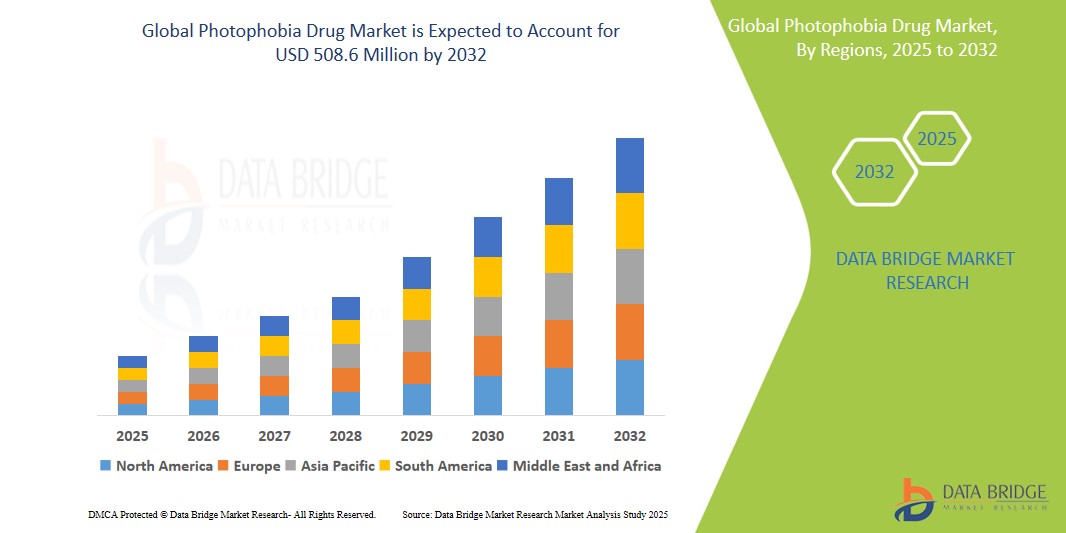
Photophobia Drug Market Size
- The global photophobia drug market size was valued at USD 244.1 million in 2024 and is expected to reach USD 508.6 million by 2032, at a CAGR of 10.4% during the forecast period
- This growth is driven by factors such as the increasing prevalence of neurological and ocular conditions, rising awareness about light sensitivity disorders, and advancements in targeted drug therapies.
Photophobia Drug Market Analysis
- Photophobia drugs are used to treat sensitivity to light, a symptom commonly associated with conditions such as migraine, scleritis, corneal ulcers, conjunctivitis, and dry eyes. These drugs help manage pain, inflammation, and the neurological triggers of photophobia
- The demand for photophobia drugs is propelled by the rising incidence of migraine and ocular infections, greater diagnostic rates, and ongoing research into mechanism-specific treatments, including CGRP antagonists and serotonin receptor agonists
- North America is expected to lead the photophobia drug market due to high prevalence of migraines, well-established healthcare systems, and increased access to specialty medications
- Asia-Pacific is projected to be the fastest-growing region, driven by growing awareness, expansion of healthcare infrastructure, and increasing diagnosis of photophobia-related conditions
- The migraine segment is anticipated to dominate the market with a market share of 47.85% in 2024, as it is one of the most common and debilitating causes of photophobia. The availability of targeted therapies like triptans and CGRP antagonists continues to bolster market growth
Report Scope and Photophobia Drug Market Segmentation
|
Attributes |
Photophobia Drug Key Market Insights |
|
Segments Covered |
|
|
Countries Covered |
North America
Europe
Asia-Pacific
Middle East and Africa
South America
|
|
Key Market Players |
|
|
Market Opportunities |
|
|
Value Added Data Infosets |
In addition to the insights on market scenarios such as market value, growth rate, segmentation, geographical coverage, and major players, the market reports curated by the Data Bridge Market Research also include import export analysis, production capacity overview, production consumption analysis, price trend analysis, climate change scenario, supply chain analysis, value chain analysis, raw material/consumables overview, vendor selection criteria, PESTLE Analysis, Porter Analysis, and regulatory framework. |
Photophobia Drug Market Trends
“Development of Mechanism-Specific Therapies Targeting Light Sensitivity”
- A key trend in the photophobia drug market is the emergence of mechanism-specific therapies that target the neurological and inflammatory pathways responsible for light sensitivity, particularly in migraine-related photophobia
- The growing use of CGRP (Calcitonin Gene-Related Peptide) receptor antagonists, triptans, and novel neuropeptide inhibitors is improving treatment efficacy and patient response rates
- For instance, the introduction of CGRP antagonists such as rimegepant and ubrogepant has shown promise in not only reducing migraine frequency but also significantly alleviating photophobia symptoms in clinical trials
- These targeted therapies are enabling more precise and personalized treatment plans, enhancing patient outcomes and contributing to the expansion of the photophobia drug market
Photophobia Drug Market Dynamics
Driver
“Rising Prevalence of Migraine and Ocular Conditions Fueling Drug Demand”
- The increasing prevalence of migraine, which affects over 1 billion people globally, is a major driver of the photophobia drug market, as photophobia is a hallmark symptom of migraines
- In addition, growing incidences of ocular diseases such as scleritis, dry eyes, and corneal ulcers are also contributing to the need for symptom-specific treatments
- Improved diagnosis, increased healthcare access, and greater awareness about light sensitivity as a treatable condition are encouraging patients to seek medical help
- For instance, According to the Global Burden of Disease Study (2021), migraine ranks as the second leading cause of years lived with disability (YLDs) worldwide, highlighting the urgency for effective treatments targeting associated symptoms like photophobia
- The combined neurological and ophthalmological nature of photophobia continues to drive cross-specialty treatment approaches, fostering pharmaceutical innovation and market growth
Opportunity
“Untapped Potential in Emerging Markets and OTC Product Expansion”
- Emerging economies in Asia-Pacific, Latin America, and Africa present significant opportunities for market expansion due to growing healthcare investments, increased urbanization, and heightened disease awareness
- Many cases of photophobia go undiagnosed or mismanaged in these regions; thus, the introduction of over-the-counter (OTC) symptom relief drugs and digital diagnostic platforms can facilitate early intervention
- For instance, In 2024, a pilot program in India and Indonesia introduced mobile migraine clinics offering photophobia screening and trial access to triptan-based medications, significantly increasing patient engagement and market penetration
- Leveraging telemedicine, AI-powered diagnostic tools, and public-private healthcare collaborations can drive early diagnosis and treatment, especially in rural areas with limited access to specialists
Restraint/Challenge
“Limited Awareness and Misdiagnosis Restricting Market Growth”
- Despite increasing global migraine prevalence, photophobia often remains underdiagnosed or misinterpreted as a secondary symptom rather than a standalone clinical issue, particularly in general practice settings
- Many patients normalize their symptoms or seek non-specialized treatment, leading to delayed intervention and prolonged discomfort
- For instance, A 2023 study by the American Headache Society reported that over 40% of patients with moderate to severe photophobia had never received treatment targeting light sensitivity directly, due to lack of physician training or awareness
- Furthermore, the limited availability of specialists, such as neurologists and ophthalmologists, especially in low-resource regions, contributes to diagnostic gaps and insufficient treatment access
- Addressing these challenges requires greater clinical education, public health campaigns, and investment in interdisciplinary care pathways to ensure patients receive timely and appropriate photophobia treatment
Photophobia Drug Market Scope
The market is segmented on the basis causes type, treatment type, mechanism of action type, route of administration and end user.
|
Segmentation |
Sub-Segmentation |
|
By Causes Type |
|
|
By Treatment Type |
|
|
Mechanism of Action Type |
|
|
By Route of Administration |
|
|
By End- User |
|
In 2025, the migraine segment is projected to dominate the market with the largest share in the causes segment
The migraine segment is expected to dominate the global photophobia drug market with the largest share of 46.28% in 2025 due to the high prevalence of migraines globally and their strong association with photophobia. As one of the most disabling neurological conditions, migraine often presents with light sensitivity, necessitating targeted pharmacological interventions. The rising adoption of CGRP receptor antagonists and triptan-based therapies has significantly improved symptom relief and patient outcomes, further boosting segment growth. Increased awareness, better diagnosis, and expanding treatment options for migraine-related photophobia contribute to the segment's market leadership.
The oral segment is expected to account for the largest share during the forecast period in the route of administration market
In 2025, the oral route of administration segment is expected to dominate the global photophobia drug market with the largest market share of 59.74% due to ease of use, higher patient compliance, and widespread availability of oral medications such as triptans and CGRP antagonists. Oral formulations are often the first line of treatment for migraine-induced photophobia and are preferred for both acute and preventive therapy. The growing availability of innovative oral drug formulations, coupled with increasing prescription rates for migraine management, further supports the dominance of this segment.
Photophobia Drug Market Regional Analysis
“North America Holds the Largest Share in the Photophobia Drug Market”
- North America leads the global photophobia drug market due to the high prevalence of migraine and neurological disorders, advanced pharmaceutical research infrastructure, and strong presence of leading drug manufacturers
- The U.S. holds the largest market share, supported by widespread awareness of photophobia as a clinical symptom, the availability of specialized treatment options, and a high rate of diagnosis for underlying causes such as migraines, scleritis, and dry eyes
- The region benefits from favorable reimbursement policies, increased healthcare expenditure, and rapid adoption of innovative therapies like CGRP receptor antagonists and serotonin agonists
- Additionally, the strong pipeline of migraine and neurological disorder drugs, along with growing patient support programs, is further propelling market growth in North America
“Asia-Pacific is Projected to Register the Highest CAGR in the Photophobia Drug Market”
- The Asia-Pacific region is expected to experience the fastest growth in the photophobia drug market, driven by increasing awareness of eye and neurological health, improving healthcare access, and rising rates of migraine and infectious eye conditions
- Countries like India, China, and Japan are major contributors, where growing urbanization, stressful lifestyles, and rising screen time are contributing to a higher incidence of migraine and light sensitivity
- Japan, with its aging population and strong focus on neurological healthcare, is rapidly expanding its pharmaceutical capabilities to address photophobia and its associated conditions
- India and China are witnessing increased government investments and public health initiatives to enhance access to migraine and eye care treatments, while the expansion of generic drug manufacturing and presence of local pharmaceutical companies support affordability and accessibility of photophobia treatments
Photophobia Drug Market Share
The market competitive landscape provides details by competitor. Details included are company overview, company financials, revenue generated, market potential, investment in research and development, new market initiatives, global presence, production sites and facilities, production capacities, company strengths and weaknesses, product launch, product width and breadth, application dominance. The above data points provided are only related to the companies' focus related to market.
The Major Market Leaders Operating in the Market Are:
- Sun Pharmaceutical Industries Ltd (India)
- Pfizer Inc (U.S.)
- GlaxoSmithKline plc (UK)
- Allergan (U.S.)
- Amgen Inc (U.S.)
- Eli Lilly and Company (U.S.)
- Teva Pharmaceutical Industries Ltd. (Israel)
- Novartis AG (Switzerland)
- Johnson & Johnson Services, Inc. (U.S.)
- Bausch Health (Canada)
- Merck & Co., Inc. (U.S.)
- Alder Biopharmaceuticals Inc (U.S.)
- Zogenix (U.S.)
- RedHill Biopharma (Israel)
- Eisai Co., Ltd (Japan)
- Ionis Pharmaceuticals, Inc (U.S.)
- Biofrontera AG (Germany)
- Biohaven Pharmaceuticals (U.S.)
- Achelios Therapeutics (U.S.)
- Dr. Reddy’s Laboratories Ltd (India)

- Interactive Data Analysis Dashboard
- Company Analysis Dashboard for high growth potential opportunities
- Research Analyst Access for customization & queries
- Competitor Analysis with Interactive dashboard
- Latest News, Updates & Trend analysis
- Harness the Power of Benchmark Analysis for Comprehensive Competitor Tracking
Data collection and base year analysis are done using data collection modules with large sample sizes. The stage includes obtaining market information or related data through various sources and strategies. It includes examining and planning all the data acquired from the past in advance. It likewise envelops the examination of information inconsistencies seen across different information sources. The market data is analysed and estimated using market statistical and coherent models. Also, market share analysis and key trend analysis are the major success factors in the market report. To know more, please request an analyst call or drop down your inquiry.
The key research methodology used by DBMR research team is data triangulation which involves data mining, analysis of the impact of data variables on the market and primary (industry expert) validation. Data models include Vendor Positioning Grid, Market Time Line Analysis, Market Overview and Guide, Company Positioning Grid, Patent Analysis, Pricing Analysis, Company Market Share Analysis, Standards of Measurement, Global versus Regional and Vendor Share Analysis. To know more about the research methodology, drop in an inquiry to speak to our industry experts.
Data Bridge Market Research is a leader in advanced formative research. We take pride in servicing our existing and new customers with data and analysis that match and suits their goal. The report can be customized to include price trend analysis of target brands understanding the market for additional countries (ask for the list of countries), clinical trial results data, literature review, refurbished market and product base analysis. Market analysis of target competitors can be analyzed from technology-based analysis to market portfolio strategies. We can add as many competitors that you require data about in the format and data style you are looking for. Our team of analysts can also provide you data in crude raw excel files pivot tables (Fact book) or can assist you in creating presentations from the data sets available in the report.












